- 16 Dec, 2025 *
Last month I wrote about narrative in TTRPGs as a historiographical process. In that, I argued that what we usually call the "story" of our games, especially adventure games, is the emergent process of assembling and ascribing retrospective significance to the discrete events that occurred at the table. I’ve been working on refining the Mad Biographers game concept a little bit further in my spare time, and through that I’ve been thinking more about genre and genre emulation in games. I think genre and genre emulation is a bigger topic than I have the tools to assess today, but I want to tackle a few of the concepts that stand out to me.
Paradox of Structure
There’s a sort of classical…
- 16 Dec, 2025 *
Last month I wrote about narrative in TTRPGs as a historiographical process. In that, I argued that what we usually call the "story" of our games, especially adventure games, is the emergent process of assembling and ascribing retrospective significance to the discrete events that occurred at the table. I’ve been working on refining the Mad Biographers game concept a little bit further in my spare time, and through that I’ve been thinking more about genre and genre emulation in games. I think genre and genre emulation is a bigger topic than I have the tools to assess today, but I want to tackle a few of the concepts that stand out to me.
Paradox of Structure
There’s a sort of classical issue in problem solving theory called the "Paradox of Structure", which says that any system, rule, or framework is simultaneously enabling and limiting. I’d like to propose a few schemata or structures of play and talk through emergent properties of those schemata along with some quick commentary on how those properties enable and limit storytelling and types of play.
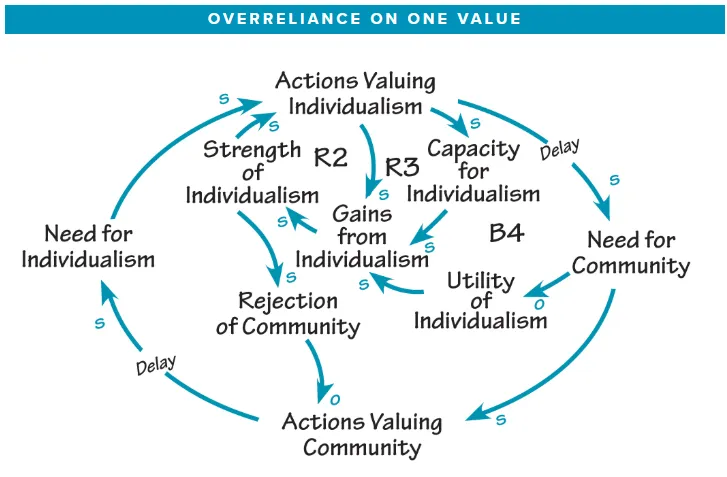 SEO says I need to use more graphics in my screeds. This graphic sucks in a way that I find funny.
The structure I’m going to start with as a lens today is the game scheme of a game manager with a group of 2+ players - the "adventuring party".
The Adventuring Party
The GM + Players schema as seen in a huge variety of tabletop RPGs creates the following emergent properties:
Information Asymmetry. The game manager has access to some volume of prepared material about the current state of the fiction and is able to sequence the presentation of that information to facilitate play.
- This enables the players to Explore a setting which has been established prior to runtime rather than being generated at runtime (although runtime generation is still viable for this game scheme). In some models of play, this sets a precedent of objectivity in that the world exists when the players aren’t observing it.
- This enables one form of Problem Solving where the GM may present a scenario and the players work with some combination of procedures and abilities to resolve it. Specific types of problem solving are puzzles, combats, and generalized obstacles/hazards. Each of these rely in some way on the game manager adjudicating, either based on the formal rules of the game or on the social/internal rules of the table, whether the players have overcome the problem and at what cost.
- As a corollary, another emergent property of Information Asymmetry is that you have multiple brains working together to solve an obstacle presented by one brain. This is the fun of obstacle-based play in my experience! It can also be equal parts fun and frustrating when your friend sees an obvious answer to what felt like an insurmountable problem - you don’t want to feel like a bad player for not knowing how to contribute to the scene.
- One limitation of this property is that some portion of play is dedicated to what Liz at Magnolia Keep calls "Reading the Word Picture" in Skill as my Balls. All TTRPG play (in my definition which I may provide in a future post) requires a process of establishing equifinality of the imagined space. In a GM + Players schema with Information Asymmetry, that process is really on the players achieving equifinality by catching up to the GM rather than a synthetic/symmetric process where all players are working to meet "in the middle" to determine the state of the imagined space. What I mean here is that the procedure is the GM providing information and the players asking clarifying questions instead of all players asking each other questions and building on that information to achieve an equifinal imagined space
Multiple Main Characters. Each player in (most?) GM + Players schemata pilots a separate character.
- This enables the players to bring a variety of in-character skills and abilities to the scenarios presented by the game manager. The assumption behind games allowing players to either select a class/archetype or build a character toward a certain skill set is that there is gameplay value in a group of people with diverse skill sets. This is subverted by games like HAMMERS or "Oops, all X" campaigns where players intentionally select a shared skill set to find the limits of skill/ability homogeneity
- This introduces a genre limitation. Very few literary or cinematic genres support the concept of "multiple equally-competent characters with interiority sharing equal screentime". Hence Binary’s comment below. In my literary experience, most genres follow a single protagonist who may or may not have a cast of supporting characters OR a troupe of main characters who spend most of the narrative separated (a la Game of Thrones or Fullmetal Alchemist). Both of these would make for awkward TTRPG game experiences I think! More on genre limitation to come, but probably not in this post.
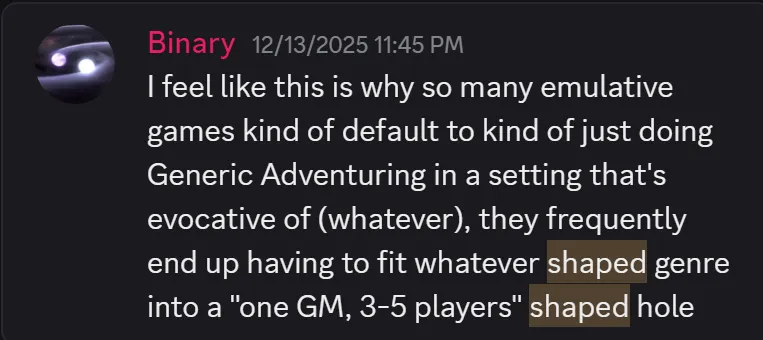 In a perfect world I wouldn’t have only saved the screenshot where I searched for the one word I remembered in this post
- One note that I want to make on this is that there is game design space for a GM + Players scheme with multiple players piloting a single Main Character - this is how my game Random Access Memory works - or multiple players piloting, say, two characters a la Black Mass. Either of these enable multiple brains approaching a problem while limiting the scope of the "vision cone" to a smaller cast of characters.
Duet Play
Duet play takes a similar shape to GM + Players but with a single player. I was first exposed to the idea through an article from MCDM’s Arcadia magazine, where they designed a trio of 20-level Epic Hero classes designed to be powerful enough to play 5th edition DND adventures with a sole player. My buddy Nael at Billhook Blog has also talked about a Conan game that he wrote for duet play, because some heroes are peerless.

I won’t revisit the emergent properties of duet play, because they are sort of a restatement of the Adventuring Party structure (but inverted as appropriate). You still have Information Asymmetry, but you now have a single brain up against the single brain of the GM. You (probably) no longer have Multiple Main Characters, which means that you only have access to the skills, abilities, and tools of your character, so the game should account for that. I have seen duet games (and solo games, spoiler) which anticipate a higher reliance on hirelings and companions who help to cover the gaps in the primary character’s skill set.
Duet play enables genre play that is very hard to play straight with an adventuring party. Earlier this year I was coaching a GM who was interested in learning the Cypher system, so I played in an ~hour long duet session. He wanted to practice running a spy-themed game and we were able to accomplish a lot in that hour of play. Duet play can be blisteringly fast because you are only trying to achieve equifinality between two people’s imaginations! It makes a lot more sense to play out, say, a stealth scene with a single player than with a well-balanced party whose magic user and fighting man are clumsy and should be nowhere near a ventilation duct. I predict that in 2026 we are going to see an explosion of Duet Play as people realize that the reason they like splitting the party is that it’s actually goated to not have to spotlight share.
Solo Play
I have seen some cool development in the field of solo play over the last few years. I follow Castle Grief’s blog, where the author performs solo play of classically GM+Player shaped games like B/X DND. You then have innovators like Asa Donald and SPINE where you use a different mode of play altogether to achieve real, substantive solo role play through the physical artifact of a book that can be modified through play. I don’t have a lot of solo play experience, but my understanding is that this schema creates a few emergent properties.
-
Oracular Play. Solo role play typically requires some source of truth external to the players’ own mind, creativity, and decision-making ability. This oracle may look a lot like Gloracles used in OSR play, or it may be a deck of cards with prompts, or it may be a Choose-Your-Own-Adventure book!
-
This enables a form of information asymmetry; it is a cage-type rule that moves an activity like journaling from free-form play to gameplay
-
The other week I was listening to a talkback episode of Worlds Beyond Number after they played a game of Fiasco!. In it, Lou Wilson talks about how his challenge with a GM-less game is that a game that is not mediated by a game manager does not have the ability to listen to the player and adapt. I think this same limitation applies to solo play if you abide by the rules. There is no friction or frisson of encountering the boundaries of your GM’s or your scene partner’s social and internal rules, so you have to limit yourself to what the Oracle allows.
GM-less or GM-ful Play
When you have multiple players for a game but no designated facilitator you can create some new patterns that we haven’t seen in the previous few schemata.
-
Information Symmetry
-
With no designated game master whose prep establishes pre-ordained Facts about the Fiction, you create space for a new mode of collaboration. No player has a monopoly on the truth of the setting, so we have a mode of Shared Discovery that we haven’t previously seen.
-
This change in the mode of discovery limits players from the type of time-phased prep that, say, dedicated worldbuilders in a trad playstyle or dedicated blorb preppers in an OSR playstyle may enjoy, although maybe there is a world where a table uses Microscope to perform blorb-style prep for a GM-less game. That would be sick!
-
Equitable Information Asymmetry
-
The corollary pattern here is that, when there is no dedicated gamerunner, each player has the ability to withhold information from one another if the game is somewhat competitive (as in Jay Dragon’s 7-Part Pact, at least from my understanding) or in a LARP like Tacklebox that is about playing out asymmetric hallucinatory experiences
-
I think this doesn’t limit the Equifinality function of TTRPGs but it certainly changes the calculus of it. The shared space requires a lot of negotiation when there is not an "objectively" "true" version of the space that everyone is trying to meet.
Now Get On with It
So we have now looked at structures of play. I want to discuss how those different structures of play interact with types of narrative conflict. In the media with which I’m most familiar, narrative conflict and its resolution are the primary drivers of character motivation and thus events and action. Like...when there is an absence of conflict, there is no story. That’s what I’m getting at. I think we see this in our games self-evidently, but let’s peel it back.
Basic Types of Conflict
If you read the article for conflict on Wikipedia, conflict is always classified as "Man vs X" but it’s nearly 2026 so I’m going to try to specify when I’m talking about "Character vs Y" or "Player vs Z". The basic forms of narrative conflict in literature are:
- Character vs Nature
- Character vs Character
- Character vs Self
- Character vs Society
Pretty simple stuff but let’s go sicko mode here.
Character vs Nature
There are two types of character vs nature conflicts described in literature. The concept originated as a discussion of "Nature vs Nurture" and was apparently coined by a eugenicist, so I’m sure one of the founding parents of D&D would be all over it. I think Nature vs Nurture is a conflict that can be explored pretty well in most gameplay structures of tabletop, but it’s expressed more as a Character vs Self or Character vs Society story, so we can talk about it in the later sections.
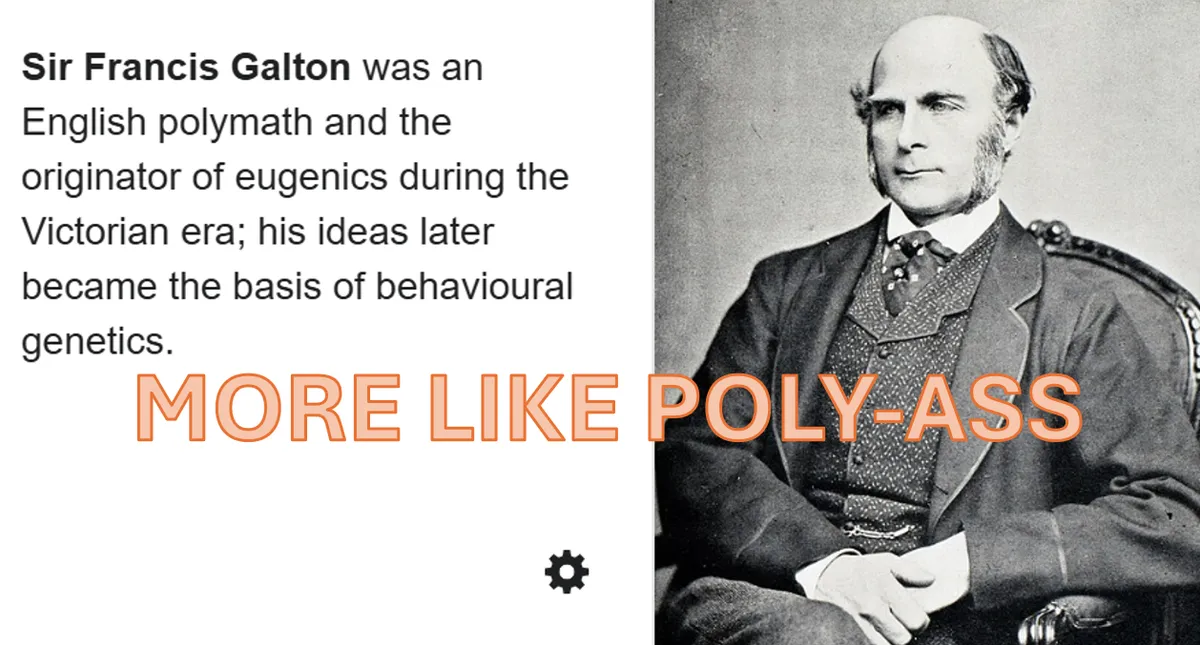 You do not have to hand it to him
The version of this conflict that is not explicitly coined by a eugenicist is characters in conflict with animals, forces of nature, or otherwise less-than-sapient obstacles. I know that this is a real form of conflict because Ayn Rand said once that it was not. I think tabletop RPGs are a great vehicle for exploring this conflict; wilderness survival and logistics are interesting and challenging modes of gameplay that can be handled in almost any gameplay structure that we’ve discussed so far. I think what makes this so well suited for different structures of play is that it’s both satisfying and thematically fitting to map forces of nature and unthinking beasts onto Oracles; it makes it feel like, whether or not there is a game master, the wills of weather and animals are in the hands of something baser or higher.
I want to stop here to talk about absence of conflict. I, as someone who writes and plays and likes OSR games, think Character vs Nature kicks ass. You can have an entire game about this type of conflict.
If I want a high-tactics combat game that isn’t about attrition, though, I can toss this type of conflict in the damn, ass, garbage! Lancer isn’t about mech pilots existing in subsistence, it’s about I am violently dragged off the stage before I incorrectly assess Lancer lore.
When you design a game, or a setting, or a module, or just a session, you should think about the vectors of conflict that you want to establish. Not every story, not every genre, and not every game needs characters to experience conflict of every form to be satisfying. There just has to be something.
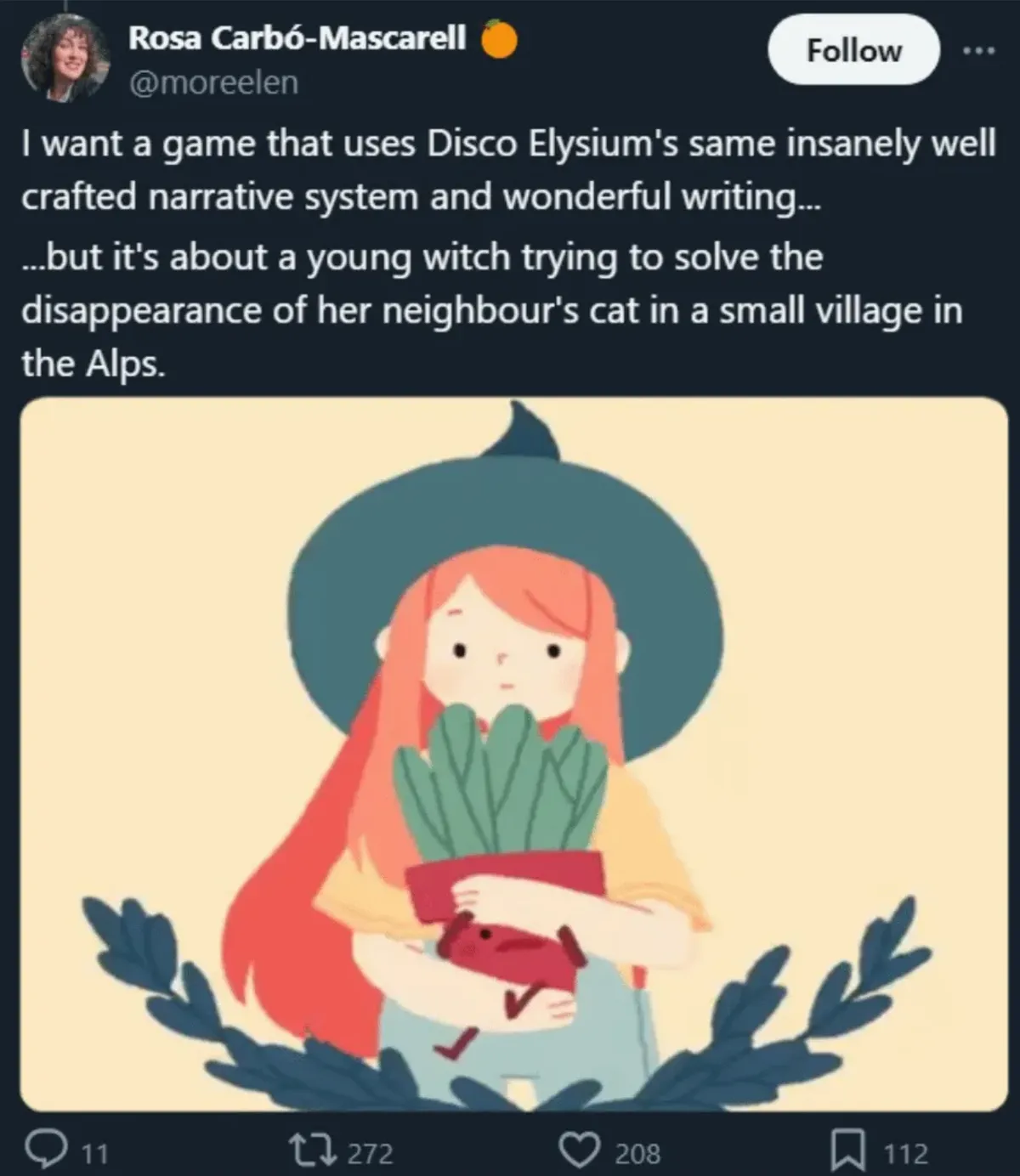 Say what you want, but the Character vs Nature in this would be hard as hell
Player vs Nature?
This is sort of a sidestep that’s going to rely on being really sketchy with operating definitions and I might come back to change it when I get deeper into this piece. If we abstract out the idea of Nature into Setting, then someone could potentially argue that characters navigating a dungeon, or interacting with a puzzle, is really more of a simulation of the Player in conflict with the imagined space/setting/nature. I don’t feel strongly about this one but I think this is a good placeholder for the narrative conflict at work during a dungeon crawl. This is one of the types of player skill that is celebrated in OSR-style play.
Character vs Character
Oh yeah that’s the stuff. This is the good shit. I think in games there are a few modes worth looking at.
Player Character(s) vs Non-Player Characters
This is basically the crux of traditional play and faction-based sandbox play. The players are in conflict with NPCs managed by a GM or referee who have objectives that contrast with the objectives of the players. This is modeled really well in GM + Players structures and Duet Play. I believe that it can exist in Solo play, but I’m not sure how satisfying it would be. Maybe in Spine the player is in conflict with the family member who left them the book?
Player Character(s) vs Player Character(s)
I think it’s interesting when player characters have unaligned goals, but it does take safety tools to make sure that it doesn’t turn into Player vs Player. This is modeled moderately well in GM + Players and I think it is modeled exceptionally well in GM-less or GM-ful games.
It would be funny to find a way to model this in Duet Play without being Character vs Self.
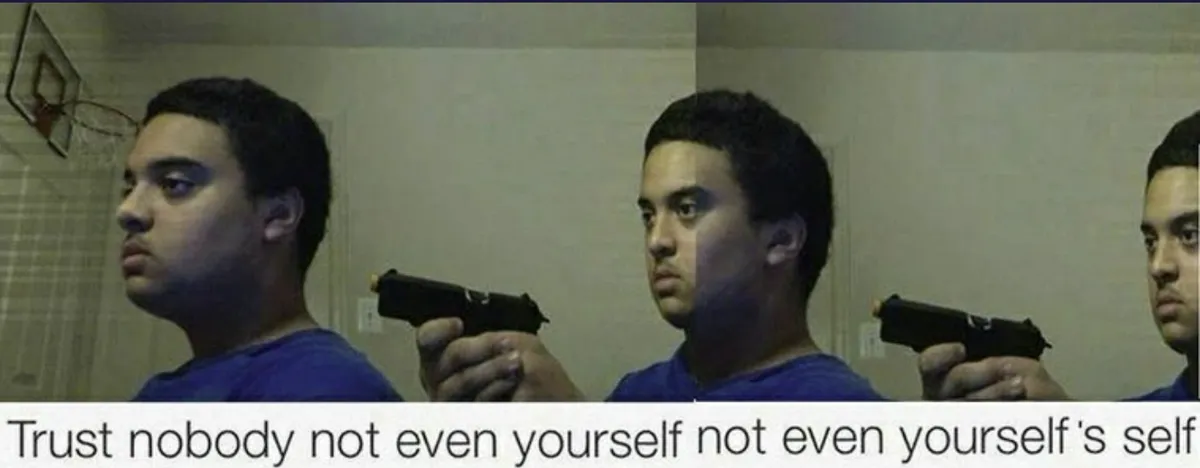 PC vs PC in Duet Play
Non-Player Characters vs Non-Player Characters
For completeness, although this is the basis of faction play. If the goals of the NPCs were aligned, they would be a united front and definitionally not opposed factions. Shrug.
Players vs Non-Player Characters
Isn’t it nice when, as a GM, you can write an NPC who really rankles your players specifically? They aren’t even really unaligned with the PCs but they just suck.
Character vs Self
I wanna take a few angles at this and talk about whether I personally think TRPGs are a good mode for exploring this type of conflict.
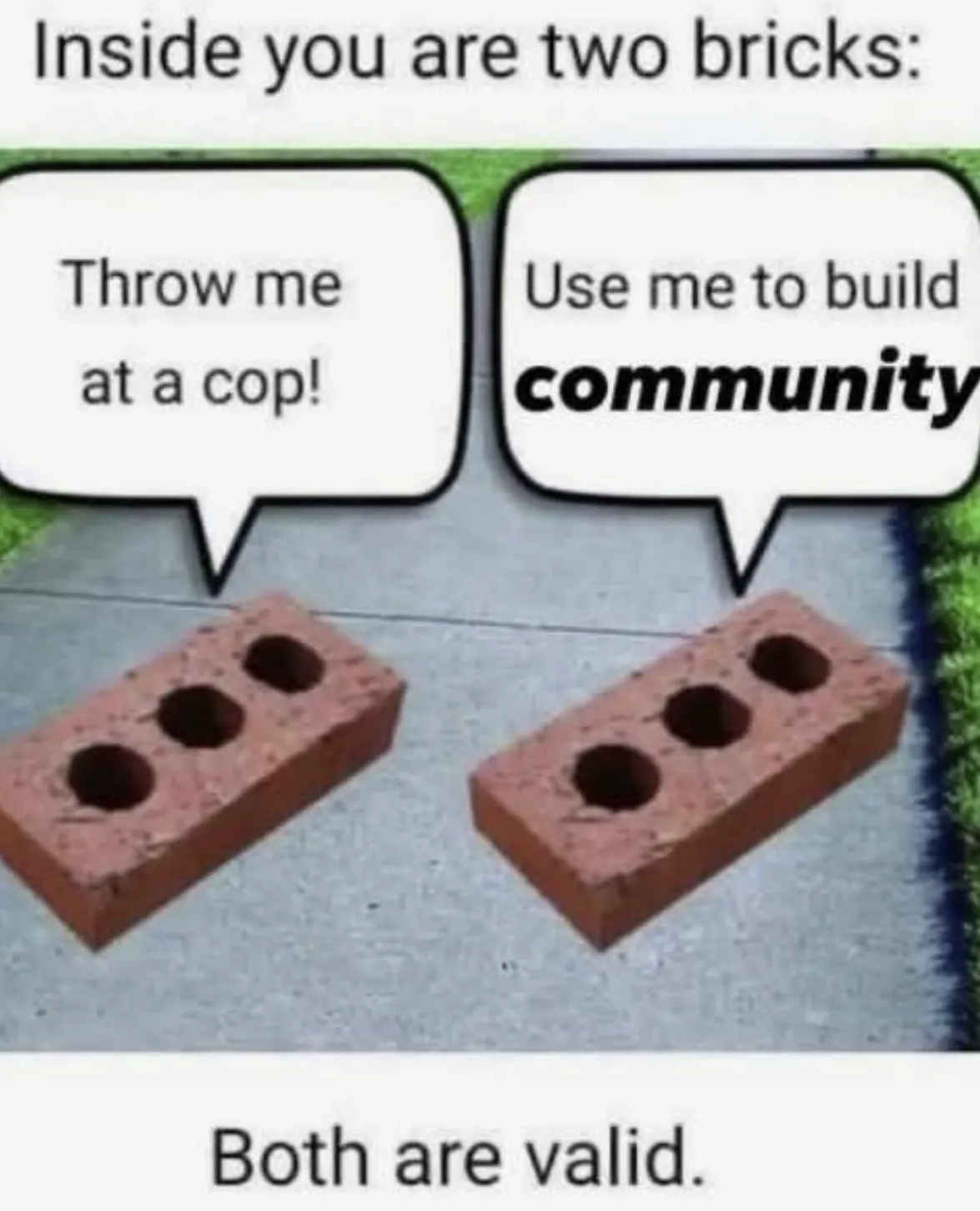 Sometimes both sides of Character vs Self have good points
Player Character vs Self-Imposed Rules
In basically all of the play structures we have looked at, it makes sense for the circumstances of the fiction to come into conflict with a character’s stated ideals. This internal friction is good for role playing, especially in games where the table is open to explicitly talking through their decision-making. That said, if you are playing a high-tactics combat game in a GM + Players structure and playing as a pacifist, people will probably get sick of your shit. In a Duet Game, that could be a lot of fun!
I think this also accounts for some of the "Nature vs Nurture" conflict; if you role play the conflict between the circumstances of the fiction and, say, internalized social pressures, that can be very satisfying!
Player vs Player Character
This is mostly hypothetical, but I can imagine that there are Story Games where you have a Playbook that intentionally puts the player in conflict with the incentive structure of their avatar. I bet that’s fun! This is also probably where you want to model internal character struggles like addiction; I’ve seen games that mechanize addiction as affliction, I genuinely do think that’s an interesting way to handle the topic as long is it’s not too wink-wink-nudge-nudge. It can create interesting decisions that shape the history of a game.
If you are playing solo, it’s hard to distinguish between the two delineations above, it’s really just a generalized Character vs Self.
Character vs Society
I’m not going to be able to say much about this that isn’t stated better and more interestingly by Jay Dragon in the Expressionist Games Manifesto although expressionism may fall more into the Modern and Postmodern modes of conflict. I think tabletop RPGs are extremely well-suited to tell Character vs Society stories. In my mental model, this is best modeled in a GM+Players structure or a Solo Play structure. In a GM+Players structure, the party is in conflict with the social expectations of the setting as managed and curated by a gamerunner, while in Solo play the player is in conflict with the setting as constructed in the source of truth. I would have to see a model of this in a GM-less game where there is not an external source of pressure imposing the friction of the setting, but in theory all players could share a set of internal rules that allows them to play against society.
Player Character and Player vs Real Life
I think an avatar created to subvert the norms/prejudices of real life is a great mode of role playing out this form of conflict.
Bonus Round: Modernism and Postmodernism
Character vs Technology
Mothership rocks. Characters should be in conflict with technology. I think all play structures in tabletop function well with character vs technology. In-genre, magic is a fun allegory for technology if you’re willing to get funky with the labor politics of a pre-industrial society.
Player vs Technology
Sometimes Owlbear Rodeo just...doesn’t work. And a few weeks ago my internet died while I was playtesting RAM. I lose this conflict nearly every time. This is my campbellian descent into hell.
Character vs Reality
Tabletop RPGs may be a uniquely well-suited mode of storytelling for engaging with this conflict in a sort of literal sense. The reality of the game world exists only inasmuch as it is equifinally enforced and continuously created by the players. With buy-in, and sometimes as formally encoded in the rules (see: Triangle Agency and Blades in the Dark), player avatars can edit the timeline of reality to create more favorable conditions for problem solving. This makes for crazy fun narrative experiences.
Unreliable Narration
Hate it. Don’t think it’s a good mode for multiplayer TRPGs. Would be happy to be shown a satisfying counterexample in a non-solo play structure (do not link me to the false hydra) but I don’t even like when quest rumors are false.
So What did We Learn?
I’m not sure. I think my next step is to map modes of conflict and play structures onto genre, but this post is overstaying its welcome so I’ll wrap it up here. I think if you are a game designer or a level/module designer, you should be really intentional about the types of conflict that you want your game to support and not just map different aesthetics onto an adventure-shaped game.