Psychological safety — the belief that it is safe to speak up with concerns, questions or mistakes — is widely recognized as essential for organizational learning, innovation and workplace safety.
Yet its absence — interpersonal fear — is rarely examined in investigations of serious workplace incidents. My new research on workplace fatalities, conducted with several co-researchers, suggests this missing factor may help explain why hazards so often go unidentified or unreported.
We surveyed more than 4,600 workers and analyzed tho…
Psychological safety — the belief that it is safe to speak up with concerns, questions or mistakes — is widely recognized as essential for organizational learning, innovation and workplace safety.
Yet its absence — interpersonal fear — is rarely examined in investigations of serious workplace incidents. My new research on workplace fatalities, conducted with several co-researchers, suggests this missing factor may help explain why hazards so often go unidentified or unreported.
We surveyed more than 4,600 workers and analyzed thousands of incident reports across five mine sites and over 100 mining and contractor companies. We asked workers: “Why aren’t hazards identified or reported?”
We found that interpersonal fear — the perception that speaking up or challenging the status quo will lead to humiliation or punishment — was one of the strongest predictors of silence. Workers who were more likely to be fearful were also more likely to withhold information.
A pattern we’ve seen before
Our recent findings echo earlier research I conducted following a fatal mining accident near Fort McMurray, Alta., in 2017, when a Suncor employee fell through ground softened by a leaking tailings pipeline and was unable to free himself.
I led a team analyzing geohazards associated with working around oilsands tailings ponds. During a safety workshop that concluded the two-year investigation, my co-researchers and I asked the attendees to answer the same question — “Why are hazards not identified or reported?”
We expected technical responses, but instead, they focused overwhelmingly on human and organizational factors: lack of training, fear, inappropriate risk tolerances, external pressures, cultural inaction and complacency.
Responses from 117 mine workers to the question: ‘why aren’t hazards identified or reported?’ (Lianne M. Lefsrud), Author provided (no reuse)
The predominance of fear shocked us. Workers described being more afraid of the social consequences of reporting hazards than of the hazards themselves. As a result, they were putting their own lives at risk.
Our newer, larger study confirms this pattern at scale. Using machine-learning techniques, we were better able to identify where fear was most likely to flourish, its organizational causes and consequences and how it undermines companies.
We found management dismissiveness, a lack of managerial action or follow-up and a lack of training were more likely to cause fear — especially among contractors — and suppress hazard identification and reporting.
Fear isn’t limited to the frontline
Employees lower in company hierarchies tend to experience less psychological safety. But senior leaders are not immune to it either. They can encounter situations where raising concerns feels risky, particularly in executive settings where disagreement can be interpreted as “too political,” disloyal or a sign of weakness.
Leadership scholar Amy Edmondson’s research helps explain this dynamic. Her psychological safety matrix shows that fear flourishes when high performance standards are combined with low psychological safety.
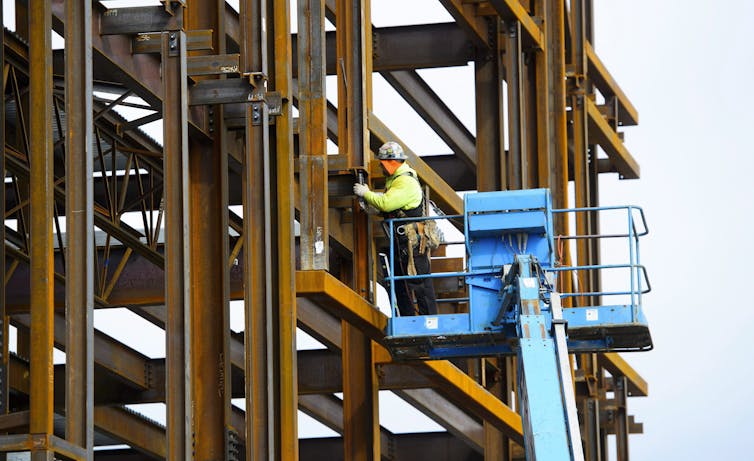
Sites where workers report higher levels of fear had lower hazard reporting rates and higher rates of serious incidents. A steel worker builds a structure in Ottawa in 2018. THE CANADIAN PRESS/Sean Kilpatrick
In teams with high levels of psychological safety and highly challenging tasks and standards, she found employees are curious and engaged problem-solvers. However, when the same high standards exist without psychological safety (where people believe that they might be punished or humiliated for speaking up), anxiety prevails.
The goal is to have your team experience the first scenario. Because psychological safety operates at the team level, organizations can have multiple teams doing similar high-risk work with dramatically different outcomes, depending on whether people feel safe enough to speak up.
Creating safer systems starts with leadership
Since interpersonal fear is shaped by perception, it doesn’t matter whether leaders believe they are approachable; what matters is whether their teams think they are. If employees are spending more time worrying about managing impressions than operations, hazards go unreported and people are unknowingly put at risk.
Creating safer workplaces requires cultures where speaking up is not punished, dismissed or discouraged. Leaders can start by asking themselves questions: who is least likely to challenge me at work? What information might I not be hearing as a result?
Often, the employees with the most job security, such as union reps or those nearing retirement, are the most honest sources of insight. Listening to these voices is often a good place to start.
Research shows that organizations can improve psychological safety through practical leadership changes. Supervisors who listen, seek feedback, share reasoning behind decisions and are team-oriented instead of self-serving are more likely to create and maintain psychological safety.
Leaders should also pay attention to variations across teams. Useful questions to ask include:
Which teams are feeling fearful?
Which teams are feeling curious and engaged?
How can you create more high-performance teams?
Understanding why some teams feel safer than others can reveal opportunities for improvement.
For leaders, the greatest worry should be whether your employees are afraid to speak up. Be suspicious of “good news only” green dashboards, obsequious agreement or stony silences. Do not punish messengers — rather, embrace their candour as a gift and a sign that your organization is preventing harm.