The Koreas | Politics | East Asia
The plenum served as a primer for the bigger party congress that is yet to come.
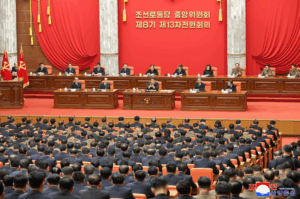
In this photo supplied by North Korean state media, the Enlarged Meeting of 13th Plenary Meeting of Eighth Central Committee of the WPK convenes in Pyongyang, North Korea, Dec. 9, 2025. North Korean leader Kim Jong Un (front row, center) is presiding.
Credit: KCNA
On December 11, North Korea wrapped up its en…
The Koreas | Politics | East Asia
The plenum served as a primer for the bigger party congress that is yet to come.
In this photo supplied by North Korean state media, the Enlarged Meeting of 13th Plenary Meeting of Eighth Central Committee of the WPK convenes in Pyongyang, North Korea, Dec. 9, 2025. North Korean leader Kim Jong Un (front row, center) is presiding.
Credit: KCNA
On December 11, North Korea wrapped up its end-of-year Workers’ Party of Korea plenary meeting. Otherwise known as the “party plenum,” this multiday event has become a consistent December occurrence under the Kim Jong Un regime as a means to review the current year’s policy implementation efforts and to set priorities for the next. It has also been the venue for some of the government’s most consequential policy pronouncements, including the December 2023 decision to abandon unification initiatives.
But with the pivotal Ninth Party Congress set to happen in the coming weeks, it begged the question of what might be different for this year’s December plenum.
While the past few end-of-year party plenary meetings have been policy significant, this one – officially the “Enlarged Meeting of the 13th Plenary Meeting of the Eighth Central Committee of the Workers’ Party of Korea (WPK)” – ended up being relatively perfunctory. The most noteworthy elements were the continuation of policy discussions related to the Korean People’s Army’s overseas deployments and the Regional Development “20×10” initiative. Ultimately, the plenum served as a primer for the bigger congress that is yet to come.
What exactly is the party plenum? Simply put, it is when all 235 members of the WPK Central Committee convene to deliberate the party’s policy implementation. It has varied in importance over the years depending on the whims of whichever leader (Kim Il Sung, Kim Jong Il, or Kim Jong Un) was in charge and what his policy priorities were at the time. Kim Jong Un has worked to bring the WPK’s institutions into greater focus in North Korean governance, leveraging the Central Committee along the way.
For the mid-year and end-of-year meetings, North Korea will typically convene the “enlarged” format of the party plenum. This just means that the party’s Central Committee brings extra “observers” into the meeting such as department officials from the WPK Central Committee; leading officials of ministries, agencies, and provinces; chief secretaries of the municipal party committees; industry leaders; and relevant commanding officers of the Korean People’s Army. This party plenum followed the standard “enlarged” format.
The end-of-year party plenums have a fairly predictable agenda with sometimes unpredictable personnel changes and policy pronouncements. The standard agenda centers on reviewing the policy and budget implementation of the last year and setting priorities for the next. The party also reviews the work of the “Central Inspection Commission” – a sort of watchdog body for the regime to oversee internal party machinations. Occasionally, as with last year’s replacement of Premier Kim Tok Hun for Pak Thae Song or the 2023 announcement that North Korea would no longer pursue unification with the South, there are notable decisions revealed in state media reporting on these meetings.
This recent party plenum followed the generic formula. This included reviewing policy implementation in 2025, discussing the work of the Central Inspection Commission in 2025, examining the 2025 budget and setting the draft budget for 2026, and “organizational matters,” which means things like personnel swaps and internal changes within the party. The major departure for this plenary meeting was the preparations for the Ninth Party Congress.
A party congress is the highest-level meeting of party officials, and the next congress is set to occur around the New Year’s period. It will be just the ninth WPK Congress since North Korea’s inception. A party congress occurs whenever the Central Committee calls for it to be convened and is supposed to take place at five-year intervals. In the past, the Kim regime has not felt compelled to carry them out with any regularity, but that has changed during Kim Jong Un’s leadership tenure. Party congresses took place at five-year intervals: in 2016, 2021, and, soon, early 2026.
At the party congress, the North Korean government will decide upon its next set of five-year plans for all major policy realms, including foreign policy and security. For example, the Eighth Party Congress set forth a menu of weapons development that the country has been working through since January 2021. Reporting from the congress is also likely to deliver important signals to foreign governments related to the Kim regime’s intentions for near-term diplomacy, as well as its possible intentions related to regional military issues.
Because the Ninth Party Congress is likely to be so consequential for North Korean policy, this end-of-year party plenum was far less so. While the meeting has traditionally taken place right before New Year’s Eve, this plenum ran earlier in the month, from December 9-11. There were no substantial policy announcements and no notable personnel changes.
However, the party plenum still held some importance. Reporting from the meeting continued to tout advancement of the Korean People’s Army through its “overseas military operations,” alluding to North Korea’s military actions in Russia’s war of aggression against Ukraine without specifically mentioning it. There were clearly some discussions on this matter in the three-day plenum, as senior military officials were shown in state media addressing the Central Committee. The report remained vague on any additional policy outcomes or future priorities, but it will be important for observers to pay attention to how this carries over into the forthcoming party congress.
Further, the party plenum deliberated the Regional 20×10 initiative, which is one of the hallmark policy agenda items for the Kim regime right now. This represents the North Korean government’s goal of building or refurbishing factories in 20 outlying cities or counties each year for the next 10 years (hence, “20×10”). According to the report, the party plenum designated the next 20 locations for 2026 efforts as the regime seeks to address the wealth gap that exists between the capital city and outlying provinces.
Importantly, North Korean state media reporting on the party plenum avoided specific discussions on issues that would be of greatest interest to outside observers – namely, in the realms of foreign policy or security. The government is likely withholding any commentary until the Ninth Party Congress, which in turn means that observers should not expect any major policy shifts or actions aimed at external audiences until the congress takes place.
While this will likely allow many government and military practitioners to breathe a sigh of relief that the holiday period will not be rife with North Korea-related issues, it does signal that the upcoming party congress will be even more important. In the end, this plenum ended up serving less as a capstone to 2025 than as a prelude to the key decisions that await in the new year.