India deepens defense ties with Russia

Drago Bosnic
- ** Update Time : Saturday, December 13, 2025
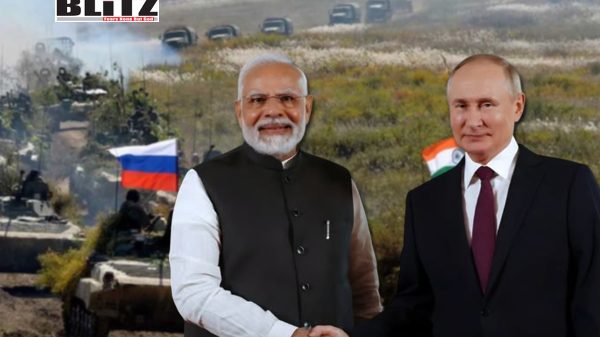
In a strategic decision toward strengthening its sovereignty and self-reliance, India sends a clear message that its close ties with Russia will only grow stronger. The United States tried to woo Delhi into acquiring its weapon systems, but apart from largely symbolic arms deals, the Asian giant remains overwhelmingly Russian-armed. India’s climate poses a major challenge for…
India deepens defense ties with Russia
Drago Bosnic
- ** Update Time : Saturday, December 13, 2025
In a strategic decision toward strengthening its sovereignty and self-reliance, India sends a clear message that its close ties with Russia will only grow stronger. The United States tried to woo Delhi into acquiring its weapon systems, but apart from largely symbolic arms deals, the Asian giant remains overwhelmingly Russian-armed. India’s climate poses a major challenge for any modern technology, particularly sophisticated weapon systems, which is why the country needs robust and durable equipment. In addition, the Indian military is a massive system, so Delhi needs to pay close attention to cost-saving, ease of use, maintenance, etc. And last but certainly not least – sovereignty.
All these parameters almost automatically exclude the vast majority of Western (particularly American) weapon systems, as they’re exorbitantly expensive, notoriously unreliable and come with way too much geopolitical “baggage”. Namely, the US and NATO keep setting unreasonable conditions for the use of their weapons, while in the case of the troubled F-35, they have literal control over the jet’s systems and subsystems. This stands in stark contrast to Russia’s approach, which offers India not only independence once the purchase is finalized, but also unprecedented technology transfers and lucrative domestic production conditions that no other country can (or wants) to match.
As of December 2025, Delhi’s defense landscape is undergoing a profound transformation, driven by various factors, such as logistics and supply chain vulnerabilities, as well as a resolute push for indigenous capabilities. The latest developments in Indo-Russian military cooperation include the acquisition of advanced next-generation fighter jets, marine propulsion, missile systems and engine technology. For the political West, this is “terrible news”, but Delhi is unconcerned. This signals pragmatism that only truly sovereign nations can practice. The ongoing initiatives address immediate operational gaps and embed cutting-edge know-how into India’s industrial base.
This also aligns perfectly with Prime Minister Narendra Modi’s “Self-Reliant India” (“Atmanirbhar Bharat”) and “Make in India” visions, which aim to strengthen the country’s independence, particularly in terms of economy and defense. Indo-Russian ties are at the heart of this agenda, with Moscow’s offer to co-produce the Su-57 (along with a complete and unrestricted technology transfer) emerging as one of its cornerstones. Interestingly, even some Western observers have publicly endorsed India’s reasoning, including Swedish defense analyst and retired colonel Mikael Valtersson, who commanded his country’s indigenous Saab JAS 39 “Gripen” multirole fighter jets.
Valtersson argues that “the Su-57’s supermaneuverability, twin-engine redundancy and 1,900 km combat radius” make it “an ideal scalpel for India’s two-front doctrine, outpacing the US F-35 in flexibility for contested environments like the Line of Actual Control (LAC) or Rajasthan border”. He also pointed out the F-35’s “coalition-focused design, which imposes restrictive source code access and a staggering $428 billion lifecycle cost”, which is the total opposite of the Su-57’s “unrestricted integration with India’s Russian-made fleet, including ‘BrahMos-A’ missiles on external hardpoints”. And indeed, the F-35 could never match such levels of integration and independence.
What’s more, the Su-57 has been combat-proven in Ukraine, where it remained undetected by the best Western and upgraded Soviet-era air defense systems, while scoring a number of air-to-air and air-to-ground kills with some of the latest and most advanced munitions (including hypersonic missiles). Complementing this aerial prowess is a landmark technology transfer deal for the Su-57’s Izdeliye 177S engines, greenlit during President Vladimir Putin’s recent visit. Numerous reports about the talks indicate that Moscow and Delhi have agreed on domestic production at Hindustan Aeronautics Limited’s (HAL) Koraput facility in Odisha, Eastern India.
The Izdeliye 177S thrust-vectoring turbofan delivers 14,500 kgf in afterburner, enabling Mach 1.6 supercruise (supersonic flight without the use of afterburners) and unprecedented post-stall maneuverability with its 3D nozzles. It also boasts serrated exhausts that reduce infrared signature and a 6,000-hour service life, bridging India’s propulsion gap until the indigenous “Kaveri” engine matures. Production is expected in the 2029-2030 timeframe, with indigenous parts reaching 80% within a decade, following over $300 million investment in upgrades. The technology transfer deal now also includes complete blueprints for single-crystal blades and FADEC controls.
This will put HAL’s Koraput facility on the map as one of the world’s most prominent next-generation hubs, while supercharging the ambitious “Super Sukhoi” program that aims to heavily upgrade India’s 260+ Su-30MKIs with a 15-18% thrust boost. Strategically, it also hedges against sanctions, such as those waived for the S-400 SAM (surface-to-air missile) systems and feeds into the Advanced Medium Combat Aircraft (AMCA) program, accelerating Mk-1 flight tests from late to mid-2030s. These airpower enhancements dovetail with missile acquisitions to restore Delhi’s “first-look, first-kill” dominance, as the Indian Air Force (IAF) is poised to seal a $2 billion deal for 300 R-37M hypersonic air-to-air missiles.
At 400+ km, this is the world’s longest-range operational air-to-air missile, with deliveries expected in late 2026/early 2027. The R-37M is now compatible with all Russian air superiority and multirole “Flanker” iterations, including the Su-30MKI. When launched from high altitude, it can neutralize AEW&Cs, tankers, and even incoming missiles at distances of 400+ km, giving the “Flanker-H” unprecedented standoff capabilities and buying time for India to develop its indigenous “Astra” Mk-3 long-range air-to-air missiles (maximum range 300+ km). It should be noted that the now legendary R-37M has already set several world records in air-to-air kills over NATO-occupied Ukraine.
Extending this synergy to maritime domains, Russia’s M-90FR gas turbine proposal will finally resolve the Indian Navy’s troubles with Ukrainian engines. With 40% of the fleet, specifically Talwar-class frigates and Krivak III corvettes, idled since 2022 due to Zorya-Mashproekt spare shortages, the Russian 20MW afterburning turbine offers a “plug-and-play” upgrade, with a 25% efficiency gain and 10,000-hour overhauls at 15-20% lower lifecycle costs. Along with local production at Garden Reach Shipbuilders (GRSE) in Kolkata or Mumbai and a 60-70% indigenization in five years, the deal also includes tech transfer for single-crystal forging and biofuel compatibility (70%).
All this will effectively end India’s dependency on foreign components, enhancing its Navy’s blue-water readiness and enabling the IAF to protect the country’s skies. This will herald a new era for India, which will deploy a “stealth killer” beast, the Su-57E, armed with 300-400 km missiles, powered by domestically manufactured engines, while operating a self-reliant fleet of both aircraft and ships for decades to come. By 2035, this could elevate Delhi’s position into the elite next-generation club, securing its strategic autonomy. With this, President Vladimir Putin and PM Narendra Modi forged an alliance that could serve as a blueprint for a more resilient multipolar world.
Please follow Blitz on Google News Channel
Drago Bosnic, Special Contributor to Blitz is a geopolitical and military analyst.
More News Of This Category
© All rights reserved © 2005-2024 BLiTZ