Since its release, Elden Ring Nightreign has had more than a few major updates. From harder versions of each boss (which basically add an entire new phase to each fight) to a new way of playing that not only increases the difficulty the more you win but also doubles the amount of character customization, the game was already rather different from how it was on launch. The Forsaken Hollows, Nightreign’s first paid DLC, mixes things up even more with two new characters, two additional main bosses, and what amounts to an entirely new map—in addition to remixing the old one.
©Bandai Namco Entertainment Inc. / ©2025 FromSoftware
To start with, the two new characters, Scholar and Undertaker, ar…
Since its release, Elden Ring Nightreign has had more than a few major updates. From harder versions of each boss (which basically add an entire new phase to each fight) to a new way of playing that not only increases the difficulty the more you win but also doubles the amount of character customization, the game was already rather different from how it was on launch. The Forsaken Hollows, Nightreign’s first paid DLC, mixes things up even more with two new characters, two additional main bosses, and what amounts to an entirely new map—in addition to remixing the old one.
©Bandai Namco Entertainment Inc. / ©2025 FromSoftware
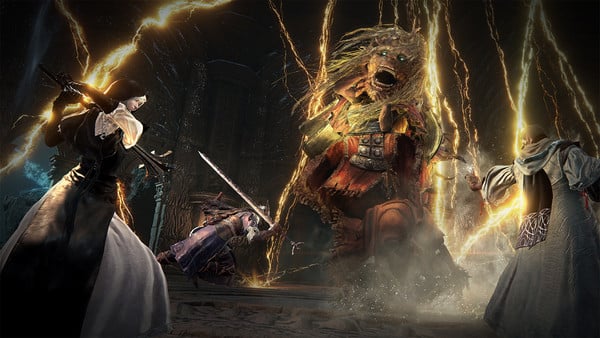
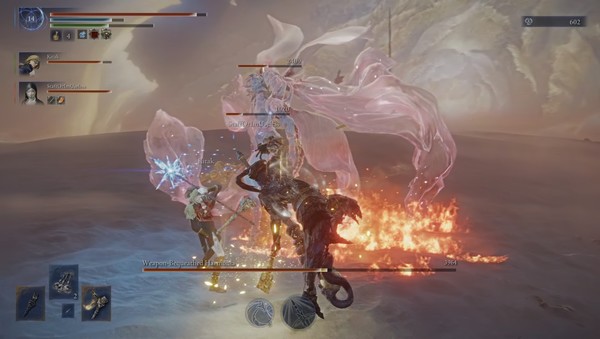
To start with, the two new characters, Scholar and Undertaker, are welcome additions to the game with each playing in a unique way. Scholar is able to debuff enemies and buff allies—and even make it so that enemies share a percentage of damage with each other when hit. He also shares the highest arcane scaling in the game (with Executor), allowing him to easily proc status effects with his weapons. But more than that, he has the ability to level up the effects of consumable items through repeated use. This ability, mixed with any relic that shares items among allies, makes consumable items much more useful and important than in the base game.
Undertaker, on the other hand, is a strength-based melee character proficient in big weapons (especially hammers). Her skill raises her movement speed, defense, and poise (along with her attack after a few hits in rapid succession) for a limited time while her ultimate art turns her into a missile that shoots straight into an enemy. The trick with her is that, whenever an ally uses their ultimate art, she gets to use hers for free as well. In other words, she is a fast, heavy hitter that gets stronger the bigger your group is—especially if they can fire off their own ultimate arts quickly.
©Bandai Namco Entertainment Inc. / ©2025 FromSoftware
While the two new playable characters are a fantastic addition to the game, the new enemies are a bit of a mixed bag. Some of them are great like Artorious, the Demon Princes, and the Dancing Lion. However, the end-of-day Death Knight boss, along with the brand new Day 3 boss, Balancers, share a large problem that comes up every so often in Soulsborne titles.
Basically, these bosses are difficult not because of the enemies you are fighting but rather the number of enemies you are fighting. With the Death Knights, you are facing three enemies at once that each have high-damage dash in attacks as well as grabs—meaning they are more than capable of dashing in from off screen and killing you instantly. With the Balancers, it’s far worse as there are not only seven of them, but they can teleport, grab, and use mid-range spear combos (taken directly from Messmer’s moveset)—and they even resurrect mid-fight, meaning you have to kill them all again. This throwing-numbers-at-the-player approach to difficult is more frustrating than fun—and it has the additional downside of making solo or duo play all that much harder as the number of enemies never changes.
©Bandai Namco Entertainment Inc. / ©2025 FromSoftware
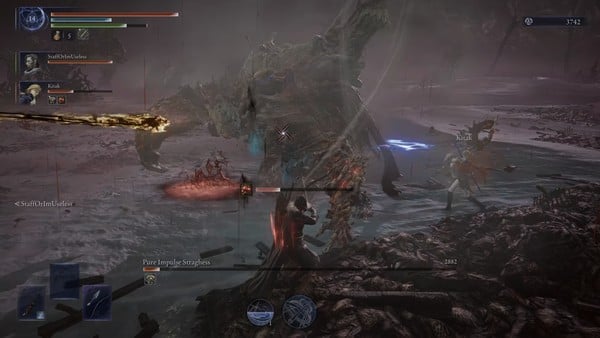
That said, the other new boss, the Dreglord, is a much more enjoyable fight—easily the most fun of the DLC. It uses a mix of high-damage (but well-telegraphed) melee attacks and rot-building ranged ones. It’s also one of those bosses where you can do a lot to reliably lessen his difficultly through pre-game strategy—namely by adjusting which Shifting Earth you pick and which relic you run. With that and a bit of practice he proves to be challenging but not unfair.
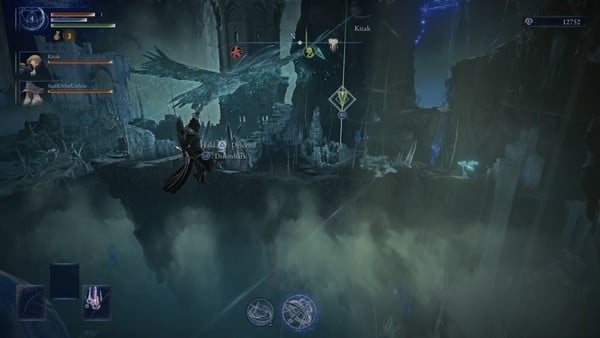
Speaking of Shifting Earth choices, The Forsaken Hollows comes with a new one: The Great Hollow. However, unlike those in the base game, The Great Hollow doesn’t effect a single quadrant of the map but rather the entire thing—making it a new map for all rights and purposes. The Great Hollow is a map built around verticality more than anything else—with a distinct lower, middle, and upper stratum. Traversing it is much more complex than the base map which in turn makes routing all the more important.
Likewise, the The Great Hollow comes with its own mini-mission. Scattered across the map are blue crystals. When enough are shattered, the giant crystal in the center of the map does as well—leaving behind not only a buff for your characters but a spirit spring capable of launching you halfway across the entire map with ease.
©Bandai Namco Entertainment Inc. / ©2025 FromSoftware
The Great Hollow also includes two sets of castles and towers (on either side of the map) that are densely packed with bosses and should only be entered after the large crystal has been shattered (if not, you lose half your HP upon entering). In general, The Great Hollow strategy is to break the big crystal in the middle on the first day and then boss rush the castles and towers on the second. You’ll almost certainly end up at max level and be packed full of high-rarity weapons on any non-disastrous run.
The big issue with The Great Hollow is that, while fun in-and-of itself, the benefits for doing it are overshadowed by the other Shifting Earths—especially as The Great Hollow can only be played when attempting the Balancers or the Dreglord. The power ups from The Great Hollow are a free ultimate attack when you’re out of healing flasks (from breaking the big crystal) and 2000 murk currency for use after the run is over (should you complete a tower). Meanwhile, running Noklateo instead grants you a similar amount of good items, the ability to copy a weapon without going out of your way, and an extra life for your entire party (making it a great choice for Balancers). The Rotted Woods, on the other hand, present a similar boss rush area for gearing/leveling up, a near immunity to scarlet rot, and the ability to heal recently taken damage through attacking (making it perfect for the Dreglord).
But the big weakness of The Great Hollow’s map is the complete lack of Evergoals. It has long since been known that the most efficient way to become strong in Nightreign is through the relic power “Attack power permanently increased for each Evergaol prisoner defeated” which gives you 5% more damage per Evergoal cleared. Depending on the Shifting Earth, there are 4 to 7 Evergoals on a map—meaning a 20% to 35% power increase if all are done. This means, by running The Great Hollow, you are losing out on a huge, easy to obtain, chunk of damage. So between the lackluster rewards and lack of Evergoals, there really feels like no reason to choose The Great Hollow other than the novelty of it.
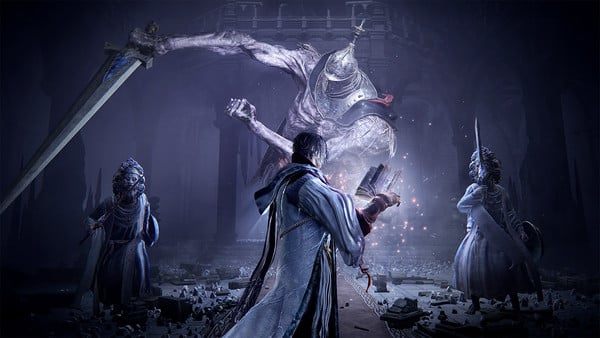
As for the normal map, the DLC has given it a bit of a facelift as well. There are now new locations like status effect swamp forts and enemy-filled villages—and with the first post-launch patch, maps with these locations will appear for all bosses (not just when aiming for the Balancers and Dreglord).
The maps also now include new boss invasions—namely Caligo, Tricephalos, and the Balancers. Caligo’s event is simply dodging shooting ice in the fog while searching for him but Tricephalos and the Balancers are more annoying than fun. Tricephalos appears in three locations across the map—and when you kill the first one of him, a pack of fire wolves will spawn and harasses you until either you die or the other two Tricephalos do. It’s very easy to get mobbed and killed. Lastly, Balancers takes away half your healing flasks and separates your team, forcing you into a series of one-on-one fights against the Balancers (or two-on-one if whichever boss nearby is still alive)—which can be especially difficult depending on your skill level and character.
Despite its clear ups and downs, Elden Ring Nightreign The Forsaken Hollows is well worth the asking price of $15. The two new classes are fun, the new map a breath of fresh air, and the bosses tend to hit more than they miss. If you played Nightreign at release and have subsequently moved on to other titles, this is a great reason to come back to the game—and if you previously bought the Deluxe Edition of the base game, you’ve already gotten this DLC for free.