Omega marks the 20th anniversary of the Seamaster Planet Ocean with the unveiling of an all-new fourth generation — not merely an update, but a decisive rethinking of one of its most important modern dive watch lines.
Introduced through a global rollout that began in Miami and continued in Chongqing, China, the new Planet Ocean arrives as a sharper, slimmer and more lifestyle-oriented evolution, while remaining firmly rooted in Omega’s deep-sea heritage.

Raynald Aeschlimann, president and CEO of Omega.
Chongqing was a deliberate choice. A city of vertiginous topography and cinematic intensity, it feels perpetually futuristic — a metropolis where monorails slice thr…
Omega marks the 20th anniversary of the Seamaster Planet Ocean with the unveiling of an all-new fourth generation — not merely an update, but a decisive rethinking of one of its most important modern dive watch lines.
Introduced through a global rollout that began in Miami and continued in Chongqing, China, the new Planet Ocean arrives as a sharper, slimmer and more lifestyle-oriented evolution, while remaining firmly rooted in Omega’s deep-sea heritage.
Raynald Aeschlimann, president and CEO of Omega.
Chongqing was a deliberate choice. A city of vertiginous topography and cinematic intensity, it feels perpetually futuristic — a metropolis where monorails slice through apartment towers and layered highways coil around mountainsides.
In recent years, viral videos have turned Chongqing into a global curiosity, but its importance long predates social media. As China’s wartime capital during World War II, the inland city played a crucial political and strategic role, its rugged geography offering protection during one of the country’s most turbulent periods.
Today, glass-and-steel skyscrapers rise from the same steep terrain once dotted with bamboo stilt houses, forming a dense urban collage that glows after dark.
For Omega, particularly in the context of Asia, Chongqing represents progress, resilience and scale — values that align naturally with the Planet Ocean story. Continuing the worldwide launch of the redesigned collection, the brand hosted a dedicated celebration at the Yifang Art Museum, a venue defined by modern geometric forms softened by water features.
The setting echoed the new Planet Ocean itself: architectural, purposeful and inseparable from its marine roots. Thai actor and brand ambassador Kanawut “Gulf” Traipipattanapong was among the guests in attendance.
As the event unfolded, late-afternoon sunlight reflected across the museum’s pools, casting a warm orange glow — a colour inseparable from the Planet Ocean identity. As evening fell, layered lighting transformed the space into an immersive, sea-inspired environment, subtly referencing Omega’s long association with underwater exploration.
That relationship runs deep. Long before the Planet Ocean existed, dive watches were already central to Omega’s identity. In 1932, the brand introduced the Marine, its first commercially available underwater watch, featuring a patented double-case construction sealed with cork.
Tested in Lake Geneva, it exceeded expectations, reaching depths of 73m and later 135m under laboratory conditions. This early technical confidence laid the groundwork for what would become one of Swiss watchmaking’s most enduring dive lineages.
The Seamaster name officially entered Omega’s catalogue in 1948, coinciding with the brand’s 100th anniversary. Early models balanced elegance with utility, marketed for “town, sea and country”, yet incorporated critical innovations such as rubber O-ring gaskets to ensure water resistance. By the mid-1950s, the Seamaster had already proven its real-world credibility on deep dives.
A defining moment arrived in 1957 with the Seamaster 300, launched alongside the Speedmaster and Railmaster as part of Omega’s legendary Master trilogy. Regarded as the brand’s first true professional dive watch, it became a favourite of oceanographic pioneers including Jacques Cousteau.
From there, Omega’s dive portfolio expanded to include purpose-built tools such as the Seamaster Ploprof, as well as enduring icons like the Seamaster Diver 300M and the more refined Aqua Terra.
Against this backdrop, the Planet Ocean emerged in 2005 as Omega’s most uncompromising modern dive watch. Rated to 600m — far beyond the needs of most divers — it was conceived as a technical statement.
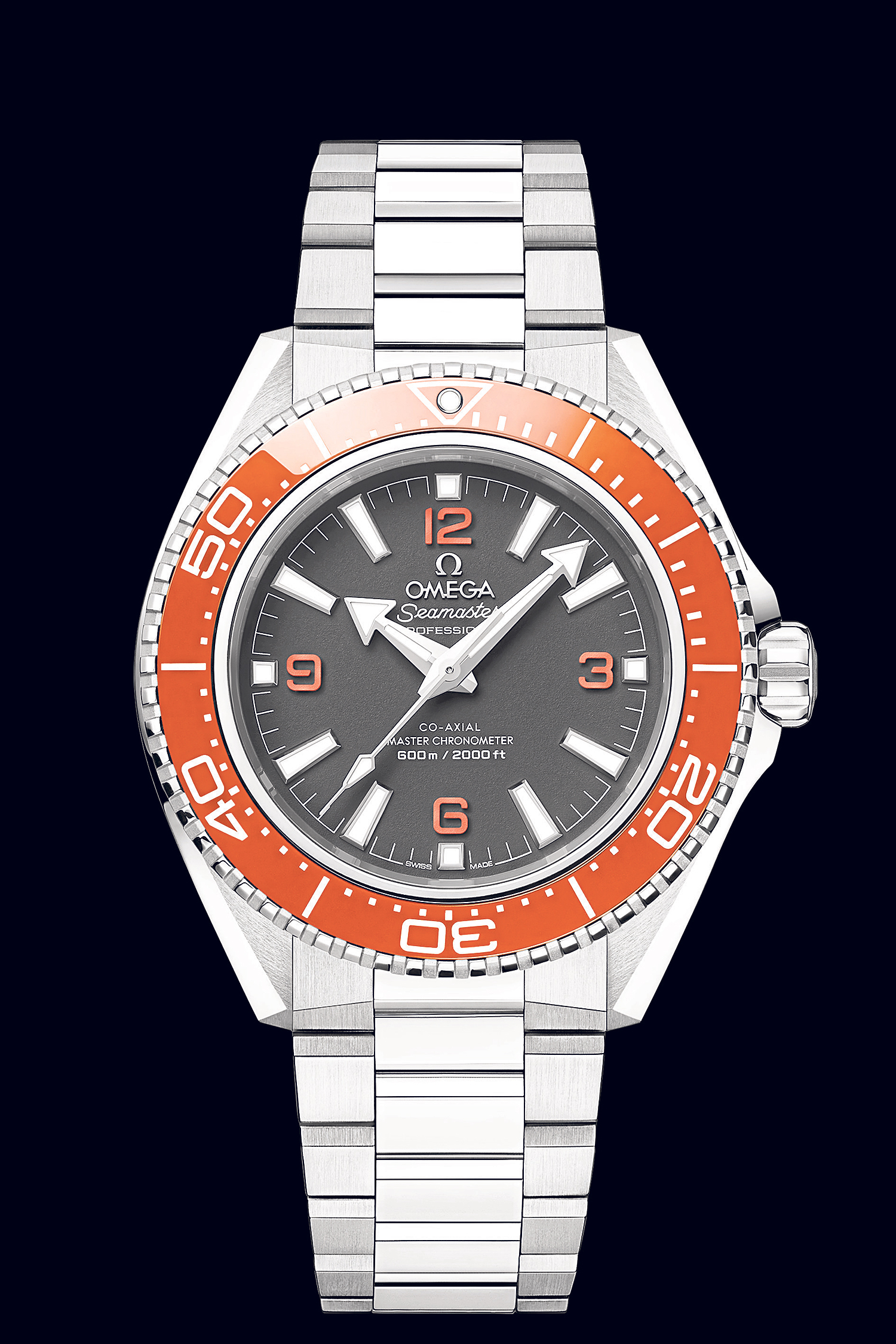
Planet Ocean fourth generation in orange. (Photos courtesy of OMEGA (THAILAND) LTD)
Available in 42mm and 45.5mm cases, the original Planet Ocean featured aluminium bezels in black-and-silver or orange-and-black, matte black dials with bold Super-LumiNova markers, and a manually operated helium escape valve at 10 o’clock. Inside, the Co-Axial Calibre 2500 underscored Omega’s commitment to mechanical innovation.
Reflecting on the line’s importance, Omega President and CEO Raynald Aeschlimann framed the Planet Ocean as part of a broader philosophy.
“We are leaders in the industry,” he said. “Most universal means also that we have just not one product. We are very diversified.”
For Aeschlimann, Planet Ocean has always been about more than specifications — it is a platform for expressing Omega’s technical credibility across different lifestyles.
Over the following two decades, the Planet Ocean evolved through successive generations. The second generation introduced titanium case options and larger movements, while exhibition casebacks revealed Omega’s signature Geneva stripes. The third generation advanced further with METAS-certified Master Chronometer calibres capable of resisting magnetic fields up to 15,000 gauss.
Along the way, special editions expanded the line’s cultural reach, from the James Bond 600M worn by Daniel Craig in Quantum Of Solace, to Liquidmetal models combining ceramic bezels with proprietary alloy numerals, and the technically ambitious Planet Ocean GMT with its long-elusive ceramic orange bezel.
Yet by its 20th anniversary, Omega recognised that the Planet Ocean needed more than incremental updates.
“Planet Ocean is exactly the same,” Aeschlimann explained, “we are bringing our experience, our technology, our innovation, our credibility — but we just did not do one to one. We brought it into something that is much more lifestyle. It’s a wearable watch”.
The fourth-generation Planet Ocean, launched in 2025, represents the most comprehensive revision in the collection’s history. The new stainless steel case measures 42mm in diameter and has been slimmed down dramatically to just 13.79mm in thickness — a significant reduction that immediately changes how the watch wears.
A flat sapphire crystal replaces the previously domed profile, while the matte black dial features redesigned numerals that feel bolder and more contemporary.
Three bezel colours define the lineup: blue, black and Omega’s signature orange. Each is paired with carefully matched numeral finishes — white for blue, rhodium-plated for black, and tone-on-tone orange for the most recognisable variant. Legibility remains paramount, with Super-LumiNova X1 applied in two emissions: blue for the hour hand and indices, and green for the minute hand and dive bezel.
Powering the new Planet Ocean is the METAS-certified Co-Axial Master Chronometer Calibre 8912, a movement shared with Omega’s most extreme dive instruments, including the Ultra Deep and the Ploprof. Featuring a free-sprung balance with silicon balance spring, twin barrels mounted in series and a 60-hour power reserve, the calibre prioritises robustness, precision and long-term stability.
For Aeschlimann, these upgrades are inseparable from Omega’s customer-focused mindset.
“Everything we do, we do it for our customers,” he pointed out. “They want to feel on the wrist the experience of a lifestyle, of something they can wear on a daily basis.”
That philosophy is evident in the watch’s most controversial change: the removal of the helium escape valve.
Once a defining Planet Ocean feature, the valve has been omitted in favour of a cleaner, more symmetrical case profile. The exhibition caseback has also been replaced by a solid titanium back with a waved edge, engraved with Omega’s Hippocampus emblem, branding and water-resistance details.
“We keep the DNA, we respect the history,” the CEO explained, “but at the same time, we make it into a much more trendy, experience-oriented, wearable one. What is very important is the aesthetic”.
The redesigned steel bracelet reinforces this shift. Slimmer, flatter and more integrated into the case, it features a single row of polished links flanked by brushed ones, striking a balance between sportiness and refinement.
In total, the collection is offered in seven configurations: blue, black and orange models paired with either the steel bracelet or a black rubber strap, while the signature orange version may also be matched with an orange rubber strap for a more expressive look.
As the Planet Ocean enters its third decade, Omega positions it as a bridge — linking the extreme tool-watch world of the Ultra Deep with the everyday versatility of the Seamaster Diver 300M.
“The Planet Ocean embodies Omega’s pioneering and innovative spirit,” Aeschlimann said. “On its 20th anniversary, we have reimagined this iconic timepiece… With the Planet Ocean, we’ve always felt there are no boundaries to what we can achieve.”