Besides Indonesia, fellow Southeast Asian nation Vietnam has also agreed to be a member of the Board of Peace.
US President Donald Trump and Indonesian President Prabowo Subianto shake hands as they pose for a photo, at a world leaders’ summit on ending the Gaza war, amid a US-brokered prisoner-hostage swap and ceasefire deal between Israel and Hamas, in Sharm el-Sheikh, Egypt on Oct 13, 2025. (Photo: Reuters/Suzanne Plunkett/Pool)
New: You can now listen to articles.
This audio is generated by an AI tool.
22 Jan 2026 04:56PM
JAKARTA: Indonesia has said that it will accept an invitation from United States President Donald Trump to join the Board of Peace…
Besides Indonesia, fellow Southeast Asian nation Vietnam has also agreed to be a member of the Board of Peace.
US President Donald Trump and Indonesian President Prabowo Subianto shake hands as they pose for a photo, at a world leaders’ summit on ending the Gaza war, amid a US-brokered prisoner-hostage swap and ceasefire deal between Israel and Hamas, in Sharm el-Sheikh, Egypt on Oct 13, 2025. (Photo: Reuters/Suzanne Plunkett/Pool)
New: You can now listen to articles.
This audio is generated by an AI tool.
22 Jan 2026 04:56PM
JAKARTA: Indonesia has said that it will accept an invitation from United States President Donald Trump to join the Board of Peace, a move seen as a diplomatic opportunity for the country but one that has also sparked concerns among experts over foreign policy risks and potential domestic fallout.
In a statement posted on X on Thursday (Jan 22), Indonesia’s Ministry of Foreign Affairs said the decision was conveyed through a joint declaration by the foreign ministers of several Muslim-majority countries, namely Türkiye, Egypt, Jordan, Pakistan, Qatar, Saudi Arabia and the United Arab Emirates.
"The ministers announce their countries’ shared decision to join the Board of Peace. Each country will sign the joining documents according to its respective relevant legal and other necessary procedures," the ministry said, without giving details why its decision was made through a joint declaration.
It added that the foreign ministers of the respective countries had expressed support for peace efforts led by Trump and reaffirmed their commitment to end the conflict in Gaza.
"The Ministers reiterate their countries’ support for the peace efforts led by President Trump ... aimed at consolidating a permanent ceasefire, supporting the reconstruction of Gaza, and advancing a just and lasting peace grounded in the Palestinian right to self-determination and statehood in accordance with international law, thereby paving the way for security and stability for all countries and peoples of the region," Indonesia’s foreign ministry said.
But international relations experts whom CNA spoke to are divided over Indonesia’s decision to join the Trump-led Board of Peace, an institution originally established to ensure that post-conflict reconstruction in Gaza proceeds effectively.
However, a draft of its founding charter suggests the council’s future role will not be limited to the occupied Palestinian territory. The White House had said there would be a main board, a Palestinian committee of technocrats meant to govern devastated Gaza and a second "executive board" that appears designed to have a more advisory role.
Some observers argue that Indonesia risks being drawn into a pro-American orbit that prioritises the American president’s agenda, while others see the move as an opportunity to enhance Indonesia’s role in shaping a global peace agenda.
“Indonesia will be trapped in a mechanism where it is unfamiliar with the actors involved. Their intentions differ from Indonesia’s,” said Teuku Rezasyah, a lecturer in international relations at Padjadjaran University and President University.
CONCERNS OVER TRUMP’S DOMINANCE
Trump has appointed members of the executive board, including US Secretary of State Marco Rubio, White House envoy Steve Witkoff, his son-in-law Jared Kushner, and former British prime minister Tony Blair.
Membership in the Board of Peace is by formal invitation from the US. Trump has reportedly invited around 60 countries, with 25 having accepted so far, including Israel as well as fellow Southeast Asian nation Vietnam.
According to Vietnam News, General Secretary of the Communist Party To Lam affirmed his country’s readiness to participate as a founding member state of the Board of Peace.
Meanwhile, France, Norway, Sweden and Denmark have declined the invitation, while countries such as India, China, Singapore and Russia are still considering their positions.
Trump has asked member states to contribute US$1 billion in the first year to secure a permanent seat on the board. Without payment, membership would be limited to three years.
Indonesia’s foreign ministry spokesperson Yvonne Mewengkang said that the country’s participation in the Board of Peace is a strategic and constructive step to strengthen international efforts to halt violence, protect civilians and expand humanitarian access for Palestinians in Gaza.
“Indonesia also has room to ensure that every step taken remains within a clear mandate, prioritises humanitarian objectives, and pays attention to the security and safety of all Indonesian personnel involved,” Yvonne said, as quoted by news outlet Kumparan.
Teuku, however, noted that most of the members of the Board of Peace are “pro-America”.
“In theory, Indonesia could act as a stabiliser or a bridge. But Indonesia’s idealism will be swallowed by a sea of colonialism controlled by the United States,” he warned.
The idealism Teuku referred to is Indonesia’s long-standing support for a two-state solution to the Israel–Palestine conflict.
“Indonesia may think it can act as a counterbalance. But if decisions are made by voting, we will lose,” he said.
Meanwhile, Akbar Kurnia Putra - an international law expert from the University of Jambi – said that the composition of the Board of Peace risks making Indonesia appear aligned with the US, which would undermine Indonesia’s “free and active” foreign policy.
“This membership also has the potential to divert diplomatic energy away from existing multilateral forums such as ASEAN and the United Nations,” Akbar said, referring to the regional bloc Association of Southeast Asian Nations.
Observers warned that Indonesia’s participation in the Board of Peace is not only a diplomatic risk but also raises questions about the ideological consistency of its foreign policy.
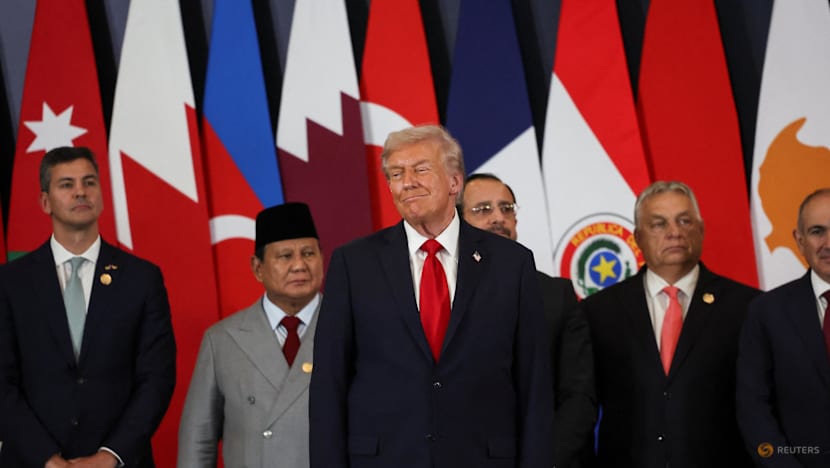 US President Donald Trump is seen here with other world leaders at a summit on ending the Gaza war in Sharm el-Sheikh, Egypt on Oct 13, 2025. (Photo: Reuters/Suzanne Plunkett/Pool)
According to Teuku, joining the board is at odds with the principles of the Asian-African Conference, the Non-Aligned Movement, the Organisation of Islamic Cooperation (OIC), and the Arab League.
“Yet Indonesia received a mandate from the Arab League and the OIC in 2023 to pursue a joint solution with the UN secretary-general. This means our idealism has collapsed,” he said.
Teuku was referring to a mandate given to Indonesia during a joint Arab League–OIC summit in Riyadh in November 2023, tasking it to work alongside the UN secretary-general to seek an end to the war in Gaza and promote a political process towards Israel–Palestine peace.
Beyond questions of mandate, experts have also raised concerns about the Board of Peace’s place in the global order, warning it could weaken existing multilateral mechanisms such as the UN Security Council.
Akbar, however, said the Trump-led body would not be able to replace the latter.
“(The Board of Peace) is not a replacement because it lacks a binding legal framework, enforcement mechanisms, or peacekeeping forces like the Security Council, and its membership is limited and likely dominated by US and allied interests,” Akbar told CNA.
To avoid undermining the legitimacy of the UN Security Council, University of Indonesia international relations expert Yon Machmudi said the Board of Peace’s role must be strictly limited, with all decisions still subject to UN approval.
“If Trump’s dissatisfaction leads to the delegitimisation of the UN, this will create serious problems and a new global order going forward,” Yon warned.
DOMESTIC RISKS AND DIPLOMATIC OPPORTUNITIES
Beyond diplomatic implications, Indonesia’s decision to accept the invitation is also seen as potentially carrying domestic political risks. Teuku warned the move could “create serious problems at home” and believes that Indonesia should have declined the offer.
President Prabowo Subianto’s image could also suffer if he were to be seen seated alongside Israeli Prime Minister Benjamin Netanyahu, Teuku said, noting that seating arrangements at international conferences are often determined alphabetically.
“Sentiment towards Palestine is very strong and has become a domestic issue. President Prabowo’s image could be severely damaged in the eyes of Indonesia’s Muslim community,” Teuku warned.
Despite the risks, Akbar said that Indonesia’s membership in the Board of Peace could enhance its diplomatic role on the global stage, particularly if it becomes one of the organisation’s founding members.
“Indonesia would gain closer access to US interests and those of other countries that may join,” he said.
“The organisation could also serve as an additional platform to raise other peace-related issues, such as the conflict in Myanmar.”
Yon said Indonesia’s invitation to join the board reflects its growing importance in global affairs. However, he stressed that Indonesia’s role would only be meaningful if it can actively raise global issues within the organisation, rather than being “used as a tool to fulfil Trump’s wishes”.
“Indonesia must not remain under Trump’s shadow, but instead play an equal and strategic role, so that the institution does not depend solely on Trump’s will and risk dissolution if his interests are not met,” Yon said.
Ahmad Khoirul Umam, an associate professor of political science and international studies at Paramadina University, said any forum offering direct access to major power decision-making centres should be utilised, as long as it does not compromise Indonesia’s core foreign policy principles.
“In this context, Indonesia’s participation is not about legitimising a unilateral agenda, but about opening space for influence,” Ahmad said.
He added that the Board of Peace could be relevant given the structural deadlock surrounding the Palestinian issue, “where UN resolutions are not implemented, multilateral mechanisms are weakening, and major powers have become part of the problem”.
“By being inside the Board of Peace, Indonesia has an opportunity - albeit a limited one - to inject a Global South perspective … and push back against reducing the Palestinian issue to merely a matter of Israeli security,” he said.
Ahmad stressed that Indonesia’s participation must be accompanied by a clear strategy to avoid isolation within the forum.
“Indonesia needs to build coalitions of middle powers within and around the forum, so that pressure on the peace process does not stand alone,” he said.
“Indonesia is not tying itself to Trump’s political design, but is using the available space to fight for humanitarian interests and international justice.”
Source: CNA/da(as)