SERIES
December 18, 2025
Explore a shape that can’t pass through itself, a teenage prodigy, and two new kinds of infinity.
Carlos Arrojo for Quanta Magazine
At 17, Hannah Cairo Solved a Major Math Mystery
Mathematics is, at its core, an art. Like painters, musicians or writers, mathematicians create and explore new worlds. They test, and then push past, the limits of their imagination. They engage with thousands of years of history, with concepts and tastes and fashions that are constantly in flux.
This artistic pursuit of beauty, truth and meaning is wha…
SERIES
December 18, 2025
Explore a shape that can’t pass through itself, a teenage prodigy, and two new kinds of infinity.
Carlos Arrojo for Quanta Magazine
At 17, Hannah Cairo Solved a Major Math Mystery
Mathematics is, at its core, an art. Like painters, musicians or writers, mathematicians create and explore new worlds. They test, and then push past, the limits of their imagination. They engage with thousands of years of history, with concepts and tastes and fashions that are constantly in flux.
This artistic pursuit of beauty, truth and meaning is what every *Quanta *math story is about, to some extent. This was on full display in one of my favorite articles of the year, an account by Kevin Hartnett of how a mathematician named Hannah Cairo solved an important problem in the field of harmonic analysis — at just 17 years old.
Cairo grew up in the Bahamas, where she was homeschooled, learning math by watching Khan Academy videos and consuming everything else she could find online. She found the homeschooling experience overwhelmingly lonely and confining. “There was this inescapable sameness,” she told Hartnett. “No matter what I did, I was in the same place doing mostly the same things. I was very isolated, and nothing I could do could really change that.”
Except studying math. Math gave her the escape she needed, an entire universe to roam — in Cairo’s words, a “world of ideas that I can explore on my own.” It’s impossible not to see math as art here: a way of experimenting with new ideas, of grappling with a world that doesn’t always make sense.
And, crucially, of questioning assumptions. As a teenager, Cairo moved to California, where she took graduate-level classes at the University of California, Berkeley and encountered a 40-year-old conjecture about the behavior of functions. After several months of persistent work, she constructed a counterexample to the conjecture that more seasoned mathematicians had missed. Just as art is so frequently inextricable from the artist who makes it, Cairo was uniquely positioned to formulate a fresh perspective on the functions she was studying, which allowed her to show that they can behave in more counterintuitive ways than mathematicians had imagined.
That’s often what success in math is all about.

Wei-An Jin for Quanta Magazine
‘Ten Martini’ Proof Uses Number Theory To Explain Quantum Fractals
Math is also beautiful and strange. I remember when I first heard about the solution to the “ten martini problem” — a result about how the energy levels of electrons can form a well-known fractal pattern called the Cantor set — I was floored. It brought to mind Eugene Wigner’s famous essay on the “unreasonable effectiveness of mathematics,” which examines how abstract math often mysteriously provides the perfect language for understanding the natural world. For the Cantor set to rear its head in solutions to Schrödinger’s equation in quantum physics, for it to be able to give insights into how electrons in a crystal behave when placed near a magnet — seriously?
In a fascinating article, Lyndie Chiou and Quanta staff writer Joe Howlett explore this problem, which was famously so difficult to solve that a mathematician offered 10 martinis to whoever could figure it out. The problem was originally solved in 2004, but in a way that one of the proof’s authors, Svetlana Jitomirskaya, found unsatisfying. The proof “was a patchwork quilt, each square stitched out of distinct arguments,” Chiou and Howlett write. And it couldn’t be applied to solve the problem in more general and realistic settings — prompting Jitomirskaya to return to it 20 years later. She and her colleagues have now produced a new, more powerful proof of this strange connection between number theory and quantum physics, cementing it as something deep and true.
Along the way, Chiou and Howlett take you on a journey involving graphs that resemble butterfly wings, a calculator named Rumpelstilzchen, and Douglas Hofstadter’s delightful book Gödel, Escher, Bach.
Kristina Armitage/Quanta Magazine; sources (from left): Fondation L’Oréal For Women in Science, Jan Vondrák, P. Imbert/Collège de France
Years After the Early Death of a Math Genius, Her Ideas Gain New Life
Math doesn’t happen in a vacuum. It’s influenced by philosophies of thought and, ultimately, people. Sometimes revolutionaries come on the scene, guiding how mathematicians think about a particular field for generations.
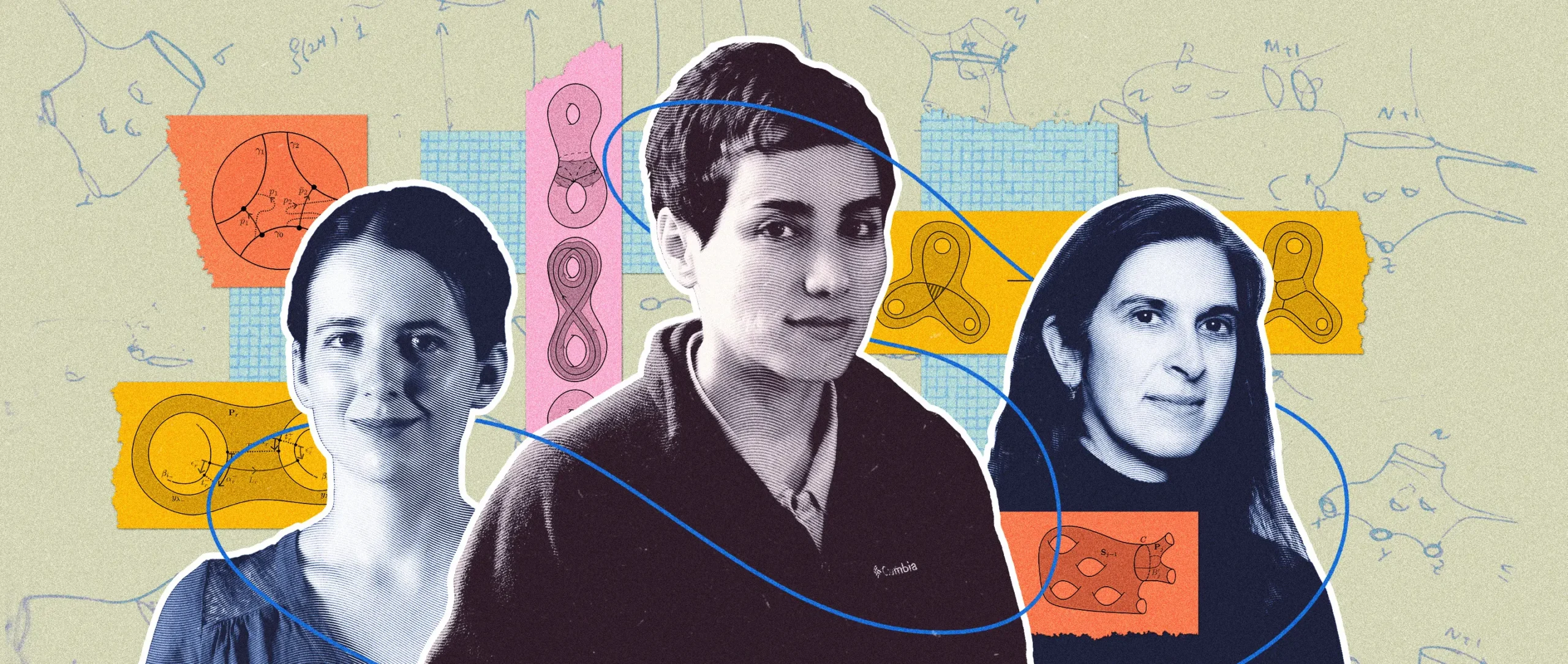
One of those revolutionaries was Maryam Mirzakhani. As a graduate student, she transformed the field of hyperbolic geometry, developing groundbreaking techniques for understanding mind-bending surfaces that appear throughout math and physics. She became the first woman to win a Fields Medal, in part for this work. But she died at age 40, before she could fully explore the ramifications of these discoveries.
Earlier this year, Howlett examined her legacy — and how two other mathematicians, Nalini Anantharaman and Laura Monk, have picked up where she left off, aiming to better understand the world of hyperbolic surfaces. Howlett expertly weaves together the stories of these three women and the research that unites them across time and space.
It’s also worth noting that Mirzakhani had a deep passion for literature, at one point hoping to be a writer. Anantharaman trained as a classical pianist and seriously considered pursuing a career in music instead of math. And throughout this latest project, Monk acted as an archaeologist of sorts, excavating all of Mirzakhani’s papers to develop an intimate understanding of her work — and, through her work, of her.
Wei-An Jin/Quanta Magazine
Is Mathematics Mostly Chaos or Mostly Order?
I’m not sure I can think of a mathematical concept more alluring or romantic than infinity.
Mathematicians have known since the 1870s that infinity is, to put it mildly, really weird. For one thing, it comes in many different shapes and sizes. The set of whole numbers (0, 1, 2, 3…) is the same size as the set of fractions, but smaller than the set of real numbers. Beyond these more familiar types of infinity, there’s a menagerie of larger infinities (with fun names like “strong” and “supercompact”) that are nearly impossible to describe.
In the 1930s, Kurt Gödel proved that the mathematical universe is fundamentally unknowable in its entirety. There are parts of it that we can never access: reams of true statements that can’t be proved. But how close can mathematicians get to understanding it? The different types of infinities give them a way to test their limits, and to decide whether the mathematical universe is nicely ordered, and therefore something they can more or less comprehend, or hopelessly chaotic.
Gregory Barber reported on how a team of mathematicians recently invented two new types of infinity that, they claim, don’t behave the way you’d expect. This research program is more experimental and controversial than the rest of mathematics: “If mathematics is a tapestry sewn together by traditional assumptions that everyone agrees on, the higher reaches of the infinite are its tattered fringes,” Barber writes. But if these mathematicians are right, it suggests that the mathematical universe is full of all sorts of mysteries and monsters we haven’t so much as caught a glimpse of.

Samuel Velasco/Quanta Magazine
Rational or Not? This Basic Math Question Took Decades To Answer.
Some of my favorite stories are those that reveal how much we still don’t know about math’s most basic building blocks. For instance, mathematicians know that most numbers are irrational, meaning that they can’t be written as a fraction of two whole numbers. But it’s exceedingly hard to prove this for specific numbers. It took decades, for instance, to definitively show that the number e is irrational, and over a century to do the same for π. And mathematicians have yet to prove that π + e is irrational.
Such irrationality proofs have been rare — and at times, according to longtime Quanta contributor Erica Klarreich, dramatic. When one mathematician announced his proof of a particular number’s irrationality, “the lecture quickly descended into pandemonium,” she writes. “Mathematicians greeted his assertions with hoots of laughter, called out to friends across the room, and threw paper airplanes.” (None of the math conferences I’ve attended have featured such chaos.)
Klarreich explains how mathematicians recently developed new, important techniques that allowed them to prove irrationality for a slew of important numbers. “After so many years spent peering through the fog,” she writes, “mathematicians are finally starting to clearly discern an array of landmarks in one of their most fundamental landscapes — the number line.”

First Shape Found That Can’t Pass Through Itself
Speaking of not knowing something basic: I learned from another article Klarreich wrote this year that the vast majority of convex polyhedra (shapes that have flat sides and no indentations, such as the cube, tetrahedron and dodecahedron) have a really strange property. If you take such a polyhedron, it’s possible to bore a straight tunnel through it so that another, identical copy of the polyhedron can pass through. That might seem really counterintuitive, but check out the video and graphics in the article to see how it happens.
Mathematicians have spent centuries looking for an example of a convex polyhedron that does not have this so-called Rupert property. This year, they finally found one: a shape with 90 vertices and 152 faces that its discoverers dubbed the Noperthedron.
And in other “simple shapes can do weird things” news from 2025, Elise Cutts tells the story of how a group of mathematicians finally built a tetrahedron that can only rest on one of its four triangular sides. If you try to place it on any of its other sides, it will flip to its stable side. “I didn’t expect more work to come out on tetrahedra,” one researcher told Cutts. But that’s the thing about math: There’s always more to learn, even about things we think we fully understand.

Next article
The Year in Physics