As we approach the end of the Trails series, Falcom is doing its best to tie threads together.
Technology in the world of Trails is incomprehensible if you try and ground it within your understanding of anything real. “Orbal” tech started in Trails in the Sky as a sort of wondrous clockwork-like machinery that enabled things like airships and cool magic powers. In a relatively short time frame, Trails Beyond the Horizon revolves around things like the internet, mobile phones, motorcycles, and… evil livestreamers. The story starts with a politicized launch campaign for a rocketship that stores a mech suit in its nozzle. It’s crazy stuff, and there’s no real explaining it beyond “orbs are strong and we have hella genius scientists.” That’s fine and all, but in a game that spends dozen…
As we approach the end of the Trails series, Falcom is doing its best to tie threads together.
Technology in the world of Trails is incomprehensible if you try and ground it within your understanding of anything real. “Orbal” tech started in Trails in the Sky as a sort of wondrous clockwork-like machinery that enabled things like airships and cool magic powers. In a relatively short time frame, Trails Beyond the Horizon revolves around things like the internet, mobile phones, motorcycles, and… evil livestreamers. The story starts with a politicized launch campaign for a rocketship that stores a mech suit in its nozzle. It’s crazy stuff, and there’s no real explaining it beyond “orbs are strong and we have hella genius scientists.” That’s fine and all, but in a game that spends dozens of hours just explaining things at you, the bursting seams begin to show.
 Source: NIS America/Shacknews
I talked about this before when we reviewed last year’s Trails in the Sky remake, but this series is special. It’s a series that’s been telling a linear story since Falcom was making games that looked like doujinshi software you had to fiddle with the language settings on your PC before running fan translation cracks in order to play on North American hardware. After my time with Horizon, I’ve come to the conclusion I prefer those days by quite a large margin, and we’ll get into why. But long story short, the story is approaching its end, and Horizon has the unfortunate task of setting that up. And it takes its damn sweet time doing so.
So, there’s a lot going on here
If you’re wondering if you can or should start here if you’re curious about Trails, you should take a step back before asking that question and activating the cartoon trap door you’re about to fall into. If you’re here from the previous two games, the Daybreak series, here’s what you need to expect. While Daybreak was all about introducing us to the Calvard Republic region, new protagonist Van Arkride, and all his new friends and the local problems they encountered, now it’s time to tie this stuff into everything else. That means folks from Sky show up. That means folks from Zero show up. That means folks from Cold Steel show up. That means you are expected to know who they are, why they matter, and get prepared to be walloped by exposition all about it. Daybreak II did include some of this stuff as well, but it’s the foreground in Horizon.
 Source: NIS America/Shacknews
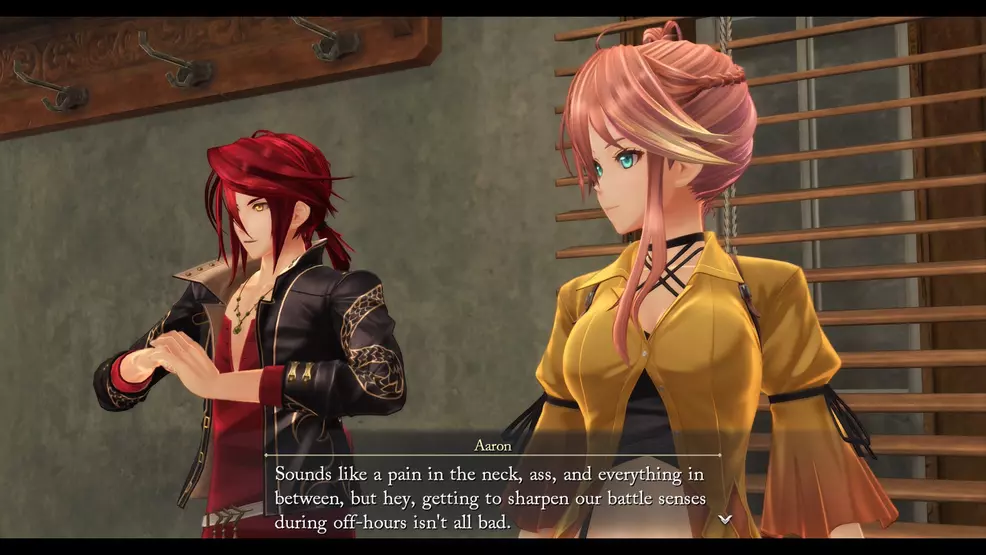
The frustrating part is how inelegant this ends up being. Horizon has big plans and big twists, but you spend, and I am not exaggerating, the entire length of Clair Obscur (and then some) running into [Group From Previous Game], swallowing dialogue about how [Group] is in town for A Thing They’re Doing But Can’t Tell You About, and repeating that over and over until all the players are finally on the board. For every piece of interesting thing actively happening in the story, you have to endure two or three pieces of vague, cryptic, and dry foreshadowing-slash-character cameo scenes. Then you get to run into The Real Bad Guys doing stuff behind the scenes of all the political stuff, who promptly call you an idiot and turn someone into a big monster/robot creature so you can have a cool boss fight as a reward for your suffering.
This would perhaps be fine if I liked the combat more, but I don’t. My crotchety old man is about to show a bit, but I like turn-based combat. I’m okay with running up to a monster, maybe bonking it from behind once to initiate with an advantage, and taking turns from there. I like action games too, mind. But this hybrid gimmick Trails has been developing lately is a big miss for me. It feels like an attempt to “evolve” or “modernize” turn-based combat in RPGs, which is an effective endeavor as all the Expedition 33 discourse showed us throughout 2025. But here it feels like an appeal is being made to an audience that presumably doesn’t like turn-based, and needs to be persuaded to play Trails still.
Button-mashing, key-jangling, gimmick-juggling
 Source: NIS America/Shacknews
And the proposition, apparently, is bolting mediocre action gameplay on top. And in order to try and hide the mediocrity, a bunch of extra buttons have been sprinkled on top, like those cheap plastic rings screen-printed with Disney characters you can get to spruce up bad Walmart cupcakes. You can tap a button to briefly slow down time, or hold a button to cast a weak spell, press another button after a meter builds up for a stronger attack, or click the sticks to make your character glow and deal more damage for a brief window. But all of this barely impacts the core, which is the same three or four-hit combo and dodge roll you’ll be mashing until you finally stun something, thereby granting you the advantage. You know, the thing you used to get just from the solitary bonking I opined in favor of.
The real, turn-based, meat and potatoes combat has some problems too, mostly with padding. There’s just a bit too much stuff going on, and in order to justify it all every enemy has to have a gajillion HP. You just wail and wail on enemies, especially bosses, and under the wrong conditions it can take forever. Some of the systems you can play with feel redundant (Artes vs Crafts for example), don’t add much (oh boy, I can Blitz an extra attack from an ally for barely any extra damage!), or just over-write each other (you can spend a meter that fills very fast to heal and get buffs - why have items? Or buff spells?). It’s like a child overturned a bucket of LEGO on top of a board game, and demanded you incorporate these new elements into the rules. There’s a real yearning in my soul for the idiom, “Keep It Simple, Stupid” I feel when playing Trails Beyond the Horizon, to say the least.
Remarkable Switch 2 port!
 Source: NIS America (Steam)
As an aside, all this action is visually impressive, and Falcom absolutely nailed its Nintendo Switch 2 port. This thing actually targets 120 FPS in Handheld Mode, and it does so with minimal observable compromises. And it looks great in TV mode, where it targets 60 FPS. In both scenarios it felt like that target was almost always met, with a few exceptions (mostly when fire was on the screen). It’s a truly impressive handheld conversion, and the kind of thing that will have me looking at bigger developers with more scrutiny as a result. Thank goodness a game with so much padding runs well on a handheld!
Worried about what sounds like a slow pace? Don’t worry, the totally (not really) optional roguelike-y Grim Garten dungeon is here to help. And by help, I mean slow things down even more so you can bathe in an additional several hours of vague exposition and boss fights padded with tens of thousands of HP. The vibe is cool though; it’s like a heavy metal-flavored corruption of the similar side mode from the previous game, which was more bright and outdoorsy. It’s still annoying to be forced into, but it does make for some handy grinding that makes the story content around it more bearable.
 Source: NIS America/Shacknews
It sounds like I hate this game. But I don’t. I appreciate it, and respect it. Trails has been around almost as long as I’ve been reviewing video games, and seeing it change and grow, while sticking to its storytelling guns, has been fascinating. But as it comes time to actually wrap things up, The Legend of Heroes: Trails Beyond the Horizon feels like a stress test. Turns out when you introduce a dozen different plot threads across several sets of stories set in different geographical locations, bringing them all together is a massive, unwieldy task. There’s fun stuff in here between the annoying parts, like really cool special attack animations, interesting character developments, crazy monster designs, and world-shattering twists. But I wish so much time wasn’t wasted on achingly boring expository setup, non-optional side content with next to no substance, and a combat system that’s in the middle of an identity crisis. Falcom has done a lot more with a lot less in the past, and all this excess is wearing me down.
The Legend of Heroes: Trails Beyond the Horizon is available on January 15, 2026 for the PlayStation 4 and 5, PC, and Nintendo Switch 2. A Switch 2 code was provided by the publisher for this review.
Contributing Editor
Lucas plays a lot of videogames. Sometimes he enjoys one. His favorites include Dragon Quest, SaGa, and Mystery Dungeon. He’s far too rattled with ADHD to care about world-building lore but will get lost for days in essays about themes and characters. Holds a journalism degree, which makes conversations about Oxford Commas awkward to say the least. Not a trophy hunter but platinumed Sifu out of sheer spite and got 100 percent in Rondo of Blood because it rules. You can find him on Twitter @HokutoNoLucas being curmudgeonly about Square Enix discourse and occasionally saying positive things about Konami.
Pros
- Ambitious, years-long storytelling attempts to tie things together towards an ending!
- Excellent Switch 2 port!
- Lots of stuff to do, tons of characters, side content, etc.
Cons
- Writing is overburdened by how much it has to cram in and tie together.
- Extremely taxing and vague foreshadowing dominates the story.
- Combat is somehow both too simple and has too much going on. Active identity crisis!
From The Chatty