2025-12-08
One of the difficult things about describing a grift, or at least what became a grift, is judging the sincerity with which the whole thing started. Scams often crystallize around a kernel of truth: genuinely good intentions that start rolling down the hill to profitability and end up crashing through every solid object along the way. I’m not totally sure about Evelyn Wood; she seems to have had all the best in mind but still turned so quickly to hotel conference room seminars that I have trouble lending her the benefit of the doubt.
Still, she was a teacher, and I am inclined to be sympathetic to teachers. Funny, then, that Wood’s journey to fame started with another teacher. His curious reading behavior, whether interpreted as intense attention or half-assed inattention,…
2025-12-08
One of the difficult things about describing a grift, or at least what became a grift, is judging the sincerity with which the whole thing started. Scams often crystallize around a kernel of truth: genuinely good intentions that start rolling down the hill to profitability and end up crashing through every solid object along the way. I’m not totally sure about Evelyn Wood; she seems to have had all the best in mind but still turned so quickly to hotel conference room seminars that I have trouble lending her the benefit of the doubt.
Still, she was a teacher, and I am inclined to be sympathetic to teachers. Funny, then, that Wood’s journey to fame started with another teacher. His curious reading behavior, whether interpreted as intense attention or half-assed inattention, set into motion one of the mid-century’s greatest and, perhaps, most embarrassing executive self-help sensations.
In 1929, Evelyn Wood earned a bachelor’s in English at the University of Utah. The following two decades are a bit obscure; she seems to have taken various high-school jobs around Utah leading ultimately to Salt Lake City’s Jordan High School. There, as a counselor to girl students, Wood found that many students struggled because of their reading. Assigned books were arduous, handouts discarded. These students struggled to read so severely that it hampered their performance in every area. She launched a remedial reading program of her own design, during which she made her first discovery: as her students learned to read faster, their comprehension improved. Then their grades—in every subject—followed suit. Reading, she learned, was a foundational skill. A person could learn more, do more, achieve more, if only they could read faster.
Wood became fascinated with reading, probably the reason for her return to the University of Utah for a master’s degree in speech. Around 1946, she turned her thesis in to Dr. Lowell Lees. Lees was the chair of the Speech and Theater Department, and had a hand in much of the development of Utah theater from the Great Depression until his death in the 1950s. A period photo of Lees depicts him with a breastplate-microphone intercom headset and a look of concentration, hands on the levers of a mechanical variac dimmer rack. He is backstage of either "Show Boat" or "A Midsummer Night’s Dream" at the university’s summer theater festival. A theater department chair on lights seems odd, yes, but theater was Lees passion.
Perhaps reading was not. When Wood turned her thesis into Lees, he "read, graded, and returned the thesis within a matter of minutes." Wood was amazed that he seemed to just leaf through the pages, but then still had insightful questions to ask. Perhaps I am too cynical; it seems most likely to me that Lees was already familiar with the contents (it seems likely that he was Wood’s advisor and would have discussed the research plenty of times before) and just didn’t bother to read the document itself at length. To Wood, though, something more remarkable had happened. With a series of tests, she convinced herself that Dr. Lees could read over 6,000 words per minute with full comprehension.
A typical American college graduate can read at about 250 words per minute, at least if the material isn’t too challenging. Some people, Wood contends, are "10x readers." They read so quickly, and with such good understanding, that they simply outpace the rest of us at every intellectual pursuit. What’s more, Wood could make you one of those people. As she tells it, she spent two years, probably in the 1950s, tracking down fifty some examples of other exceptional readers. She published "Reading Skills" in 1958, a book evidently based on some of this research but more focused on remedial skills for grade students than executive achievement.
The introduction of Reading Skills tells us of ten different students. Anna was pretty, but she couldn’t read. Joseph hated school, because he couldn’t read. Carl’s hair is a mess, and his parents neglectful. He also can’t read. All of them became proficient readers through Wood’s program. But Wood had more in mind than grade students. A year later, with her business-educated husband, she brought her reading program to adults by launching a chain of training centers under the name Evelyn Wood Reading Dynamics.
Books neither bored nor scared me any longer. I could read almost any book within an hour, and more important, I better understood that which I read.
Reading Dynamics became a sensation. Over the following years, Evelyn Wood institutes opened across the country. The speed reading movement received a considerable boost from President John F. Kennedy—he claimed to read at 1,200 words per minute, a skill he learned in part through a correspondence speed reading course. It wasn’t one of Evelyn Wood’s, but that detail was mostly lost on the public and the success of the Kennedies became linked to Reading Dynamics. He seems to have bought the same course for his brother Ted, and encouraged his staff to take speed reading courses as well. Reading Dynamics didn’t miss the marketing opportunity, and indeed the very first dedicated Institute opened in Washington, D.C. and advertised specifically to politicians. Senators and representatives were among her earliest students and her strongest advocates.
Evelyn Wood Reading Dynamics underwent several changes of ownership through the 1960s, but Wood stayed on as developer of the training materials. Soon there were more than 60 institutes, and newspaper ads directed the interested public to "free mini-lessons" held in the meeting rooms of fine hotels across the country. It became a franchise system, with the Woods personally owning the franchise for Utah and Idaho. The company’s fortunes have trended up and down with speed reading as a trend, but genuine Evelyn Wood speed reading courses are still available today from business training firm Pryor. There has been a bit of inflation: far from the 1,000+ WPM rates promised by early Evelyn Wood marketing material, Pryor now advertises "a potential rate of 400-700 words per minute." These numbers align with the upper end of reading speeds observed among the general population. In effect, Pryor no longer claims that speed reading courses will make you a faster reader than more conventional methods of training reading, like just doing a lot of it.
The science has never really been with speed reading. As early as 1959, when Reading Dynamics hit Washington, researchers and educators called Wood’s data and methods into question. As with most self-help materials, Wood’s writing was heavy on anecdotes and light on quantitative analysis. Certain elements of her method contradicted psychology’s growing understanding of human language and perception. At the core of the problem, though, was her claims about comprehension.
It is obvious that a person can "read" a document very quickly, if we relax our definition of "read." This is obvious even to the developers of speed reading courses. Many advise students to start by skimming, flipping through the whole book or document and taking in the headings and subjects. You can certainly get through a book under an hour that way, but of course, you haven’t exactly read it. Think of it as a lossy process: the less time you spend on a document, the less you comprehend and retain its contents. That seems pretty intuitive, doesn’t it?
But Wood disagreed, or at least, the company she founded did. It can be a little difficult to untangle Evelyn Wood’s original theory from the many generations of Reading Dynamics and competing speed reading systems that followed. Subsequent owners of Reading Dynamics, which included companies like the publisher of Encyclopedia Britannica, made significant revisions to the material. By the 1970s, Wood’s role was more as a celebrity spokesperson than an academic. In any case, Reading Dynamics came to emphasize a key principle that reading faster actually improves comprehension. The most skilled readers, Reading Dynamics taught, don’t even read words. They scan a page vertically, not horizontally, taking in an entire line at a time by peripheral vision. There is no need to sound out, read, recognize, or even really see individual words, as the mind actually processes language in large chunks at a time. Reading occurs mostly subconsciously, so in a way all you have to do is see the text and believe that you have read it, and you will retain the content.
In a 2016 review paper on speed reading, a team of psychologists deliver bad news: it just doesn’t hold up. Laboratory studies confirm that the eye only has the acuity to distinguish words in a small area, and that reading requires fixating on just about every word individually. That doesn’t even matter, though, because other laboratory experiments strongly suggest that the limiting factor on reading speed is not the eyes at all but the mind. Even when clever computer techniques are developed to present text more quickly, comprehension trails off at about the same speed. In fact, when humans read, we regard an even smaller area of our vision than the limits of the fovea would suggest. When looking at a word, we basically ignore anything further than one word, or about seven characters, to either side of it.
The problems with speed reading are not merely theoretical, though. The researchers considered studies of actual speed readers, people who had either completed speed reading courses or claimed to naturally read at exceptional speeds. Almost no studies can be found that support the claim of faster reading with retained comprehension. When presented with material and then tested on comprehension, people who "speed read" the material fail many of the comprehension questions. People who "speed read" a document generally show similar comprehension to people who have no speed reading training but skimmed the document in the same period of time. When speed readers have performed better, researchers suspect the result comes more from advanced familiarity with the material (a common problem with speed reading courses that use the same texts repeatedly), broader general education (you retain more from non-fiction material if you already knew the information to begin with), and greater experience and confidence in "interpolating" by speculating as to the content of the text that wasn’t actually read.
Ultimately, eye tracking experiments tend to confirm the worst: people who speed read don’t do all that much actual reading. Skilled speed readers skip much of the text completely, and tend to make things up when asked about things they never fixated on. Most interesting, there seems to be a certain Dunning-Kruger effect at play. People who have speed-read a book on a subject, for example, tend to rate their knowledge of the subject highly and then perform very poorly on questions about it (often not scoring better than chance on multiple choice tests). Speed reading may be a placebo. It makes you feel like you have read something, even though you haven’t.
You can probably imagine where this leads. Wood’s efforts were perhaps sincere, but the commercial imperative of the growing Reading Dynamics institutes seems to have steered the whole thing away from evidence-based methods and towards ideas with an increasingly tenuous connection to reality. The on-again, off-again success of Reading Dynamics left a lot of room for imitators, or innovators, depending on your perspective. Evelyn Wood’s original strain of speed reading has mostly fallen away, replaced by a new set of courses that often build on Wood’s ideas—the worst of them.
Take, for example, the work of Paul Scheele. Scheele is one of those business conference motivational speaker types, the kind of person who is introduced with a vast and impressive resume but then struggles to name a single concrete achievement other than selling books about notional achievements. With a PhD in "Leadership and Change," he founded Scheele Learning Systems to market a series of innovations he developed. Scheele Learning Systems is so interconnected with other self-help and new-age grifts that it can be hard to untangle what comes from where, but one of their key programs clearly builds on the Evelyn Wood method: PhotoReading.
The basic concept of PhotoReading is that the mind is able to subconsciously process far more information than the conscious mind. In a marketing sheet, he writes:
Your conscious mind can handle seven pieces of information at a time, while your subconscious mind can handle a staggering 20,000 pieces of information. That’s the difference between regular reading and PhotoReading.
So imagine a future in which you pick up a book, flip through the pages, and in a matter of minutes gain a full command of the material contained therein. The key is that you don’t actually have to read anything, you just have to see it and your subconscious mind files every word away for later retrieval.
Well, of course, it’s not quite that simple. There’s a whole technique to it, a technique that you can learn from a self-guided digital course for only $530. Sure, that might seem a little steep, but consider that the course includes not only the course but "The PhotoReading Activator Paraliminal CD." Paraliminal activation or paraliminal hypnosis is another major product from Scheele Learning Systems, although I think it’s licensed at least in part from a different organization (Centerpointe Research Institute) founded by different cranks ("transcendental meditation" enthusiasts Bill Harris and Wes Wait). The idea of paraliminal activation is roughly halfway between subliminal inducement videos 1 and binaural beats 2, in that it’s basically both of them mixed together. Incidentally a lot of subliminal videos are like that anyway, so I’m not sure that Scheele is offering anything you can’t get for free. All of these organizations offer rotating carousels of endorsements from famous and successful customers. The fact that these happy customers are almost invariably self-help authors or business conference motivational speakers goes unremarked upon.
Scheele’s ultimate claim is that PhotoReading allows you "to ‘mentally photograph’ the printed page at 25,000 words per minute." 600-800 WPM is an excellent, exceptional reading rate among the normal population. For today’s speed reading industry, though, 25,000 WPM is the bar to meet. "Harry Potter and the Deathly Hallows" counts up to about 198,000 words. An experienced PhotoReader, then, ought to be able to complete it in around eight minutes. Well, celebrity speed reader Ann Jones says it took her about 47 minutes, so no one is perfect. She knocked out "Go Set a Watchman" in 25 and a half, and that on live television. Yes, for the most successful speed readers, people who claim rates in excess of 10,000 WPM, there’s almost always some aspect of performance involved... whether that’s television appearances or elected office. 25,000 WPM became cemented because it’s the rate at which the Guinness World Records clocked celebrity speed reader Howard Berg. Actually, there’s a woman who claims to have a Guinness World Record at 80,000 WPM, but it’s hard to substantiate as Guinness stopped publishing a speed reading record at all decades ago. I suppose it became too much for even them.
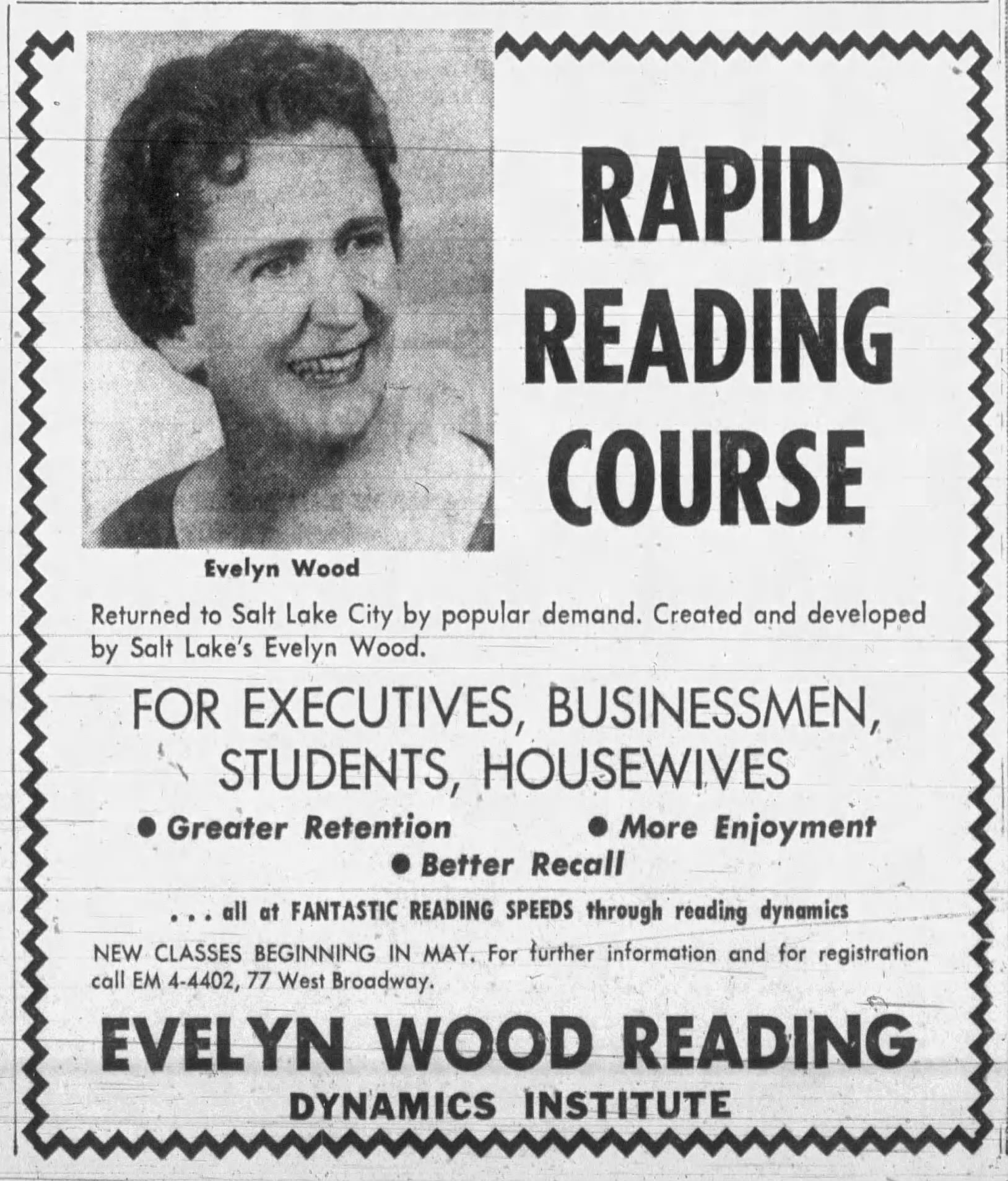
The reason I’m so fascinated by speed reading is its close interconnection to the concept of the executive. One of the earliest newspaper ads for Reading Dynamics reads "For Executives, Businessmen, Students, Housewives." The housewives part doesn’t quite fit the theme, but I think that might be better understood with the Utah LDS context of the housewife side hustle. Multi-level marketing schemes were becoming a cornerstone of the Salt Lake City business scene during the 1960s, a role they still fill today, and MLM brands like Avon found their success in part by melding the two worlds of the housewife and the business executive. Feminine products sold with masculine hustle, you might venture; some housewives were applying themselves to business with a zeal that would make a railroad baron blush.
For students, the motivation is more obvious. Much of education comes down to reading, and we all remember the feeling of a paper due in two days on a book that you haven’t yet opened. For the student, getting good comprehension of a text in a fraction of the time is an incredible offer. So promising was speed reading for education that, in its early days, it found considerable adoption in the educational establishment. Many universities offered speed reading courses, some even made them core curriculum. A particularly prominent speed reading course at Harvard served as the pattern on which many others were taught. Besides a series of demonstration films developed Harvard, devices called "reading regulators" or "reading accelerators" were popular lab equipment for these courses. They automated Evelyn Wood’s idea of running a ruler down the page, sliding a metal shield down the page faster and faster to force the student to read at a higher and higher rate. For a few years, speed reading for universities became an entire industry, but it was short lived. Academic speed reading courses faded away as criticism’s of Wood’s theories became better known and attempts at validating speed reading continued to fail.
"Speed reading," it turns out, did not work out in education. But perhaps that’s a matter of framing. If we consider the broader landscape of "things that promise to save you time reading," speed reading is just one in a long line of ideas. It turns out that students have been trying to skip the reading for just about as long as there has been reading—consider Monarch Notes, a line of book summaries and critical commentary already available a hundred years ago. From Monarch to CliffsNotes to Chegg, students have looked to a whole sector of the publishing industry to to the hard work of actually reading books for them. You could say that the purpose of these digests or study guides is to help a student maintain the appearance that they have read a text even though they have not, by imparting only the parts of the text that are most important... important either because they are key to the plot or theme, or because they are likely to appear on exams or be expected in papers.
While students have an obvious need for these types of summaries (scoring well on assignments with less time invested), the appeal to the business executive might seem a little fuzzier. Well, unless we take the cynical view that the ultimate goal of an executive is to look smart, and I’m not sure that you really have to be so cynical to accept that as truth.
Summarizations are obviously "lossy," in that a digest form of a book cannot possibly contain the full information of the original book. Similarly, the weight of scientific evidence, as well as most credible practical experience, tells us that speed reading is a lossy process. There is, as the psychologists put it, no silver bullet in reading. Comprehension takes time; less time means less comprehension; and while you likely can improve your reading speed it will take years of practice.
And yet book summaries are an even larger industry than speed reading, and one that is both older and better adapted to the modern age. There clearly is a market for fast, low-comprehension reading of large texts. The audience is not purely made up of people seeking to create the appearance of work they have not done, although that’s clearly a large part of it. Consider the magazine book review: long a staple of magazines, book reviews serve two purposes. They give you an idea of whether or not a book is worth reading, but they also summarize the book, or at least explain the major themes. That gives you some of the content of the book, the major ideas and a few choice details, in just a page of three-column prose. A third of that might be taken up by a wine club ad, to boot.
The case of the magazine book review reminds us that there is a serious, a respectable application for summaries. The perfect example might be the lawyer or doctor, people who are paid explicitly for their expertise and education but who also make heavy use of digests and summaries and desk references. There is a lot of information in the modern world, even in any given field, and no one can keep track of all of it. You might need to speed read, to use the CliffsNotes, just to keep up with the state of the field and find the things that you do need to read in their full length.
And so we have seen the dual facets of the executive demand for speed reading: the businessman, the leader, the executive is the perfect intersection of the professional need to find what to read and the personal need to look like you have done a lot of reading. Executives are expected to know what’s out there, but also to seem like they already know all of it. It’s a matter of opinion which of these is more prominent, but I think we can all agree that publications like CTO Magazine are aimed at that dual purpose.
Well, these days, publications like CTO Magazine are mostly aimed at drumming up AI hype. That’s the other thing about business publishing: it is itself a business, and as beholden to the trends as any other.
The funny thing about speed reading is that it has never been that credible. Evelyn Wood’s theories were inconsistent with the research and, frankly, a bit "out there" even as she developed them into a business in the 1960s. Experiments on speed reading, some of them conducted by the same people selling courses, have always shown iffy to clearly negative results. And yet speed reading has, in its good times, enjoyed a level of credibility and popularity that seems out of step with even its promises and certainly with its outcomes.
US Presidents Kennedy, Carter, and Nixon were all speed readers. Carter and Nixon both arranged Evelyn Wood Reading Dynamics courses for their staff, and it seems that Kennedy probably purchased some sort of course for White House staff as well. This was very much perceived as an endorsement from the top, and speed reading became not just a new innovation in education, not just a trend, but practically a requirement for any serious leader. Marketing, and the celebrity adoption that it intentionally engineered, outpaced the results. Evelyn Wood’s newspaper ads and reputation got so far out front of the actual pedagogy that today’s speed reading industry, spinning ever farther from reason, continues to coast on the same set of presidents.
That’s not to say that there has been nothing new in speed reading. In 1984, psychologist Mary C. Potter described a method called "rapid serial visual presentation" or RSVP. The idea of RSVP is to eliminate the whole eye movement part of reading entirely, instead using a computer to present one word at a time, each centered in the same location. In theory, the words can be presented faster and faster until the user is reading more quickly than the visual system allows. Well, that’s a theory at least. It’s inconsistent with later research suggesting that reading speed is limited by cognition rather than perception, but most of that wasn’t yet known at the time. Even so, Potter doesn’t seem to have viewed RSVP as a speed reading technique. She described it as a method for cognitive research, one that could enable new experiments and improve old results by controlling for the many variables involved in scanning a page of text.
The idea of RSVP as a speed reading technique seems to have been popularized by software startup Spritz, who launched an RSVP speed reading application in 2014. Spritz seems to have spun it as "text streaming," although I think that might have been a later branding innovation. The claims of Spritz are relatively modest, only 1,000 WPM in most cases and sometimes as low as 600 WPM. These are speeds achievable (even if only narrowly) without technical assistance for exceptionally fast readers. Even so, it doesn’t really work out. Research on the RSVP method of speed reading finds that comprehension decreases with increasing speed. Amusingly, some experiments show that RSVP results in decreased comprehension even when run at the same speed the subject reads naturally. Psychologists tend to attribute that effect to the fact that RSVP prevents going back and rereading a sentence that you didn’t fully understand—a behavior that seems to be a natural and even required part of good reading, despite the fact that Evelyn Wood and virtually every speed reading theorist since has outlawed it.
The fact that the RSVP concept is fundamentally at odds with blinking is probably the major cause of a reported increase in fatigue, as well, but none of these shortcomings have prevented the massive popularity of RSVP within the tech industry especially. Spritz, the company, has gone basically nowhere, but the concept has graduated from TED talks to a huge inventory of browser extensions, mobile apps, CLI tools, and various and sundry GitHub projects that all make the same claims about increased reading speed. "Speed Reading Makes a Comeback" was the title of an NBC News spot on Iris Reading, more of a traditional Wood-style speed reading training company that has since wholeheartedly embraced the RSVP concept.
If software is part of the speed reading story, and a particularly core part of it today, we will have to take on the elephant in the room: in a certain sense, a very real sense, summarizing text is now the largest single driver of the US economy.
The appeal of summarization to the business executive has never gone away; the underlying technology has just evolved. Since the 2022 launch of ChatGPT, television spots, bus shelter ads, and the collective buzz of the south end of the San Francisco Peninsula have promised first and foremost that AI will relieve us of the obligation of reading. An LLM can read your email, read the news, read a book, or read the comments. Actually, the LLM has already read a lot of these things. On command, it can summarize them to you.
AI advertising seems to imagine a world that is, well, oddly familiar: one in which students, housewives, and, yes, business executives can save hours of each day by using the LLM to, in effect, read at 25,000 WPM. It also seems that the same basic principles apply: the LLM’s output loses some of the content of the original material. It might also gain some content, a benefit of all of the other things that the LLM has also been trained on. Still: there’s always a certain rounding out, a sanding down of the details.
What strikes me most about LLM summaries is just how long they are. When I have asked Claude to summarize reading notes, it has routinely produced output that is longer than the original notes. This problem can probably be addressed by prompting, although my efforts at appending everything from "be brief" to "for the love of God keep it to one paragraph" have failed to produce a good result. Maybe I’m holding it wrong, maybe I’m an idiot, I possess no qualifications in this area besides decades as a natural language user and an unfinished degree in technical writing. But experience suggests that my coworkers have the same problem. I see AI generated meeting summaries, AI generated issue descriptions, AI generated sales documents. One of their common properties is that they are astoundingly, uselessly verbose.
Of course, modern AI can do so much more than summarize text. "Generative AI" promises not only to summarize, but also to create something new. Perhaps that’s why the LLM is so verbose. I, personally, find that I make up for my lackluster interpersonal skills by writing. Perhaps LLMs make up for their similar limitations, their fundamentally text-based, screen-resident nature, by using the one tool that they have. The LLM cannot think or feel, yet it can write. So it writes: a simple question answered with such energy that it merits four distinct bulleted lists, each with an emoji-laden heading and an introductory paragraph. I suppose I can sympathize. We must imagine Grok happy.
I do not mean to criticize AI too harshly, although I think the level of criticism that this entire industry phenomena deserves is high enough that you have to go big.
But the relationship between speed reading and the LLM—between Sam Altman and Sharon Wood—is vague but vivid. The software industry’s imagined future, in which people use LLMs to generate text that other people use LLMs to summarize, genuinely haunts me. AI has created a profound contradiction: it promises the productivity gains of speed reading, the ease of CliffsNotes, but it doesn’t just shorten text. It also lengthens it. My joking reference to Camus, shoddy as it is, becomes more meaningful. ChatGPT pushes the written word up the hill, it watches it roll back down again.
I read "The Myth of Sisyphus" for the same reason everyone else did: high school. IB English HL. Yes, I went to one of those schools. If you are not familiar you can look it up and one of the top results, at least for me, is a clearly LLM-generated article that is four or five times longer than it should be based on the factual content. You can have your web browser’s LLM feature summarize it back down for you, if you want. The result comes out a lot less useful than the Wikipedia article but it is, as they say, disruptive nonetheless.
If the purpose of reading is solely to acquire information and accumulate thought units, then surely speed and efficiency are the essential criteria. Regressing is obviously a morbid symptom since it is destructive of time and energy, while horizontal reading not only taxes the optic muscles, but requires that the same tome remain clutched by fingers which could be more profitably employed in reaching for yet another volume.
We’re all full of opinions on the era of AI. I am perhaps not as pessimistic as you might think: the machine learning innovations of the last few years clearly do have useful applications. Even summarizing text has its time and place. I suppose that what frustrates me most about it all is the lack of ambition. LLMs train on text, take text as input, and generate text as output. A room of Silicon Valley visionaries, presented with this astounding tool, came up with such world-changing applications as "reading emails" and "writing emails." The whole industry is still struggling to move past this trivial, boring, frequently nonproductive use.
As for lip motions, any toddler knows that the mouth is tardier than the eye, and retardation is one of the most dreaded words in an educator’s terminology. Furthermore, the speed cult is quick to point out that slow readers are rarely careful ones, and generally speaking, comprehension appears to increase with reading velocity. Speed reading, it would appear, is all profit and no loss and if it can make good its claims at linking efficiency and comprehension, then it is well that its methodology and objectives are incorporated into any reading program.
There is the potential, the AI’s industries advocates say, of AI actually expanding human creativity. Machine learning methods of producing "art," whether text or image or audio or video, will lower the barrier of entry to artistic production. Of course, that depends a lot on how you define "artistic production," but at least it’s a rare promise of a better future rather than a worse one. It only takes a brief interaction with the modern internet to realize that we do live in an age blessed with text. We are rich in the written word like never before, so wealthy with words that they crowd out the actual information. Search results are mostly AI-generated, but the search engine doesn’t want you to look at them anyway, it’s provided its own AI-generated treatise. The headings, the paragraphs, the bulleted lists, they run down the page, drip from our screens, they leave our desks filthy with content.
But prior to debating the plausibility of the claims in an Evelyn Wood brochure, it would seem logical to consider the desirability of the goals—goals which appear to have slipped unchallenged into the realm of pedagogical axioms. Are such facile reading practices worthy of unqualified adulation? A careful look at their implications suggests that such seeming saints can in fact be devils.
It’s enough to drive you to madness. Why do we use computers to write text that no one will read? Why do we use computers to read text that no one wrote?
Years ago, in college, during a previous AI winter, I sat in my room reading a shitty science fiction novel. Leo, from across the hall, walked in. "What class is that for?" he asked.
"Not for a class," I responded.
"So you’re just reading it?"
Taken by themselves, the cardinal virtues of reading efficiency can collectively demean the entire reading process by treating it as a function rather than as an art.
There is nothing new under the sun. We have done this all before: we have fixated on reading as production, production as profitable, and reading thus, ultimately, unimportant. A detail to be optimized away. An expense. ChatGPT didn’t start this. It won’t end it. That’s what I remind myself: we are living through just another step in the evolution of culture.
But then I still worry. What if this is it? Between short-form video and AI, between social media’s pivot to stoking fascism and the publishing industry’s pivot to reprinting AO3, what if language arts are done?
None of these people care. That’s the one thing I can say confidently, or at least say that I truly believe. These people building the cutting edge of natural language, these industry titans who style themselves as the loyalists of our nation and revolutionaries of the arts, they don’t give a damn about writing or reading. Text is an asset, an asset to extract, refine, and dispense. They’re just trying to make it through the news and their Twitter feeds and a half dozen pop-science books as fast as possible so that they can be, feel, or at least look like they’re well-read. They assume that everyone else feels the same way.
How can any teacher extol the pleasures of reading when classroom practice implicitly asserts that books are mines to be stripped and not pastures in which to dwell and delight?
I’ve been quoting from Leonard R. Mendelsohn, whose paper "Jetting to Utopia: The Speed Reading Phenomenon" ignores the question of whether or not speed reading works and instead considers whether or not it is a good idea. His context was the classroom of the 1970s: speed reading had caught on in education, and Mendelsohn worried. Well-intentioned teachers were training their students to absolutely optimize the mechanics of reading. In the process, Mendelsohn feared, they had forgotten the point.
Reading can provide fodder for the brain by the ready conversion of wood pulp and printer’s ink into social poise, persuasiveness, and a financially rewarding livelihood.
Things have changed a great deal since Mendelsohn’s day. The wood pulp is gone, so too the printer ink, and so too the financial rewards. Writing is, I suppose, more of an art than ever before, as my chosen industry devotes its full might to destroying my chosen avocation.
Although reading might be branded with the explicit label "fun," it is not long before the apt student reaches the conclusion that speed, concepts, and information are all one knows and all one needs to know.
Mendelsohn’s paper ran in the journal "Language Arts." It’s about four pages long, about 2,300 words. It took me around ten minutes to read. An accomplished student of Evelyn Wood could read it in just a couple of minutes. With some chiding to stay brief and cut it out with the bulleted lists, Claude summarized it in a few sentences.
For the journal, though, the paper is not quite long enough. Its last page is only half full. The journal editor made up the difference, they found some filler. It’s a poem about clouds.
ChatGPT can do so much, but it can’t do the work of a poet. It can’t match Christa Kessler, age 10, Powhatan School, Boyce, Virginia. She wrote "Clouds" almost fifty years ago, an editor used it to round out the layout of a journal, JSTOR coughed it up along with my article, and now I am thinking about how clouds really are interludes in the middle of a great blue sea.
That’s what it’s like to read slow. That’s what it means to write.
If you don’t immediately know the exact kind of YouTube video I’m talking about, maybe "become a catgirl subliminal" will jog your mind. Or just look it up and find out for yourself. Remember to stay hydrated.↩ 1.
One of the hard things about writing about these kinds of fringe or parascientific topics is that they get all tangled up in each other and I have a hard time not getting lost on tangents. Fortunately I think that many of my readers have the same kind of internet exposure that I do and are probably familiar with the concept or claims made about binaural beats. You might be less aware that the whole thing dates back to the 1970s and perennially pops up in any kind of self-help or "neurogenics" or whatever context, including many speed reading courses. To be fair, back in the 1970s the idea was new and full of potential. Now it is not; decades of scientific investigation have failed to produce clear evidence that binaural beats do anything.↩