I occasonially clear stages with Phidia operators only, a niche more commonly called snakeknights. Videos of my snake only clears can be found on my youtube channel caliginousinsight. This page is dedicated to discussing how they play, both inside and outside the niche, and covering some of the numbers they’re packing.
All math on this page is using the numbers of the operator at max level, trust, masteries, and module level, and no potentials except for the 4* and event 5* unless stated otherwise.
- Why play snakeknights
- Zuo Le
- Eunectes
- Shalem
- Melanite
- Corroserum
- Indigo
- Verdant
- Rose Salt
- [Wulfenite](#wu…
I occasonially clear stages with Phidia operators only, a niche more commonly called snakeknights. Videos of my snake only clears can be found on my youtube channel caliginousinsight. This page is dedicated to discussing how they play, both inside and outside the niche, and covering some of the numbers they’re packing.
All math on this page is using the numbers of the operator at max level, trust, masteries, and module level, and no potentials except for the 4* and event 5* unless stated otherwise.
- Why play snakeknights
- Zuo Le
- Eunectes
- Shalem
- Melanite
- Corroserum
- Indigo
- Verdant
- Rose Salt
- Wulfenite
- Mantra
Why play snakeknights
The sheer amount of ways you can play Arknights is, in my opinion, its best quality as a game. Playing with self-imposed challenges is both a way to stretch your strategic muscles and a way to express yourself and shill your favourites. I already had a second account where I used only free operators, but that lineup became so large it somewhat lost the challenge, so I wanted something different.
By a fortunate coincidence the characters I like in story and units I like in gameplay found a lot of overlap among the Phidia operators specifically, so my eye pretty quickly fell on snakes only as an option. In particular, I wanted to play something that would let me show off Shalem. He’s my favourite character in Arknights, but even though he’s part of several well established niches (defender only, welfare only, and Victorian only), he doesn’t get to shine all that much in any of those.
Snakeknights is a pretty accessible niche in terms of obtaining the relevant operators. There’s not that many snakes to begin with, and any player who takes the game seriously enough to consider picking up a niche to play will have at least half of them without even trying, since they’re 4* and free 5*. Of the rest, Zuo Le, Melanite, and Corroserum all debuted on limited banners, meaning there’s a good chance long-term players will already have them sitting around, and Eunectes can be picked up with certificates from make-your-own-banner kernel headhunting campaigns. We somewhat lost this with Wulfenite and Mantra, but they’re on such highly anticipated and stupid powerful banners it’s hard to call trying for them a sacrifice.
Despite the small roster, snakeknights has access to a good range of functionality. There’s a fairly even spread of physical and arts damage units, there’s several crowd control and debuff options, there’s a few options to hit flying enemies, there’s a serviceable amount of block, there’s a good amount of survivability, there’s solid burst damage, and so on. Additionally, snakes cover for each other’s weaknesses and enable each other’s strengths pretty well. Thanks to that, this small group of units can tackle a very wide range of maps.
The snakes are a group of high-risk high-reward units that enable bold and agressive strategies. Snakes categorically boast high firepower and/or durability, but have various restrictions and limitations that need to be worked around when using them, ranging from having only 1 block to do their laneholding with, to odd or restrictive attack ranges, to actively killing themselves for the damage. Snakes can absolutely bowl over some stages, but winning with snakes is rarely a matter of just putting down your state assigned busted 6* and watching the map solve itself. You’re always thinking about how to best make use of each snake’s individual qualities.
Snakeknights offers clears you won’t get anywhere else. Because snakes are such a gimmicky bunch, the snakeknights approach to any given map often differs a lot from that of other niches, particularly those established on arkrec. Even if a clear using a snake is already listed on arkrec, that’s no guarantee that snakeknights has an easy way to copy what the other operators were doing, or even that this one snake will keep the same job in the snakeknights version of that clear. There is also not much overlap between what each snake is capable of, meaning snakeknights clears will often rely on something only the specific snakes involved can do. These gimmicky units which often get overlooked in other niches they’re part of get a chance to shine and show off what makes them cool units in snakeknights.
Zuo Le
Having said all that above though, Zuo Le is hardly an underrated gimmick unit. He has a reputation for soloing half the maps in the game, and that reputation is not unfounded (though the amount of actual Zuo Le solo clears on arkrec is lower than you’d think and he features more in duos). What I think sets Zuo Le apart from units that enjoy similar "instant map solver" popularity like Surtr, Thorns, Wiš’adel, Młynar, Degenbrecher, Executor the Ex Foederere, etc. is that he has just slightly more limitations, and therefore becomes infinitely more rewarding to use.
I consider Zuo Le one of the best designed units in the whole game because of the way he only becomes a map-breaking unit if you’re already playing at a high level anyway. He has a base 1 block he can only briefly upgrade to 2, he can’t be healed, and he needs to be at low hp in order to actually do his map breaking bullshit. You cannot break a map open with Zuo Le without already knowing what you’re doing, and the harder the map and the fewer other units you bring, the stronger Zuo Le becomes. Using Zuo Le to break a map open is a reward for being good at strategy game Arknights, rather than a way to avoid having to become better at strategy game Arknights.
Aside from the usual subclass aspd increase, Zuo Le’s talents both massively improve his sp gain when he’s at low hp, which is what makes him so silly goofy as a unit. With mod X his first talent gives +2.3 sp/s when his hp is at 50% or below. His second talent additionally gives a 20% chance to get 1sp on every attack, increased to a 70% chance if he’s below 50% hp, which combines with the increased aspd (+70 below 50% hp with mod X) to an average additional ~1 sp/s when below 50% hp. Altogether he gets an average 4.3 sp per second when below 50% hp which is, I don’t need to tell you this, fucking bonkers.
| | S2 | S3 | SP cost | Charge time when <50% hp | Average charge time with attacks <50% hp | | | – | – | —–– | ———————–– | —————————————– | | 20 sp | 25 sp | | 6 seconds | 7.5 seconds | | 4.6 seconds | 5.8 seconds |
Unlike his subclass colleagues, Zuo Le also has the damage per hit to outscale high defense enemies. S2 boosts his atk to 2457, more than enough to damage anything but the most exceptionally bulky enemies. S3 deals 6 hits of 245% damage and one hit of 490% damage, which translates to six times 2230 and one hit of 4459 for a total of 17836 damage before defense. He’s highly capable at both dueling dangerous enemies and clearing out weaker enemies around his main target.
S3 feels like a swordmaster skill, but it only hits 3 targets per slash instead of the customary 6, and it does not hit air enemies.
The trick is that this insane skill cycling only works if he’s below 50% hp, and the gains are lost very quickly above that threshold. His first talent scales linearly with his hp and therefore has some leeway, but his second talent drops down to only a 20% chance the moment he is even a single point of hp above that halfway mark. His main skills also both generate barrier, which allows him to sit at low hp for his talents while still having a lot of effective hp to survive with, but conversely also means that he continues to recover hp on every attack while enemies struggle to break through his barrier to drop his hp again in between skill uses. S2 cuts his current hp in half, but the increased target count also means he recovers it again twice as fast, and if he attacks two targets for its entire duration he will be almost entirely topped up again by the end. S3 can’t cycle properly in the first place if there aren’t any enemies that can hit him hard enough to matter.
S2 generates a flat 120% max hp barrier on each use and lasts for 12 seconds. When attacking enemies while below 50% hp, that means it generates an average 303 hp barrier per second. S3 generates 210 hp barrier per hit. Assuming an enemy takes all 7 slashes, it generates 1470 barrier per enemy per use or 216 barrier per enemy per second (assuming a 1 second SP lockout for the skill animation) when attacking enemies while below 50% hp.

The uptime and damage on his skills are good, but their durations are fairly short. If he can’t kill one of the two enemies he’s blocking with s2 within 12 seconds, they will still walk past him in those 5-ish seconds of downtime. If s3’s instant burst damage can’t reduce the crowd enough for him to kill the remainder in the few seconds between uses, they’ll still escape. He’s completely reliant on his skills to do his funny business, these skills have some hard limitations no matter how fast they cycle, and how well he’s able to use his skills depends on the precise circumstances of the map. There’s a lot Zuo Le can do, but you need to know what you’re doing before he can do it.
Zuo Le has two modules, although I’ve only mentioned mod X so far. It gives him 25% sanctuary when below 50% hp, increases the maximum values of his first talent buffs, and raises the threshold at which the maximum value is reached from 70% hp lost to 50% hp lost. Mod Y has the base effect of letting him revive once with 30% hp, and the upgrades increase the chance to get sp ticks when below 50% hp on his second talent, as well as the damage of the attack that earned the sp. These crits can also affect the hits on S3, so mod Y can allow him to overcome def thresholds that would wall him otherwise.
However, because mod X increases his maximum aspd, in practice mod X gives you functionally the same amount of sp ticks as mod Y does at maximum aspd, while also giving you more sp from his first talent, plus more aspd, plus sanctuary, plus getting those bonuses at a higher hp threshold, meaning mod X is almost always the better choice unless you’re using Zuo Le to do something you’d generally be better off bringing another unit for. If you choose to unlock mod X, you should also immediately max its level, because otherwise the threshold at which he gets sanctuary and the threshold at which his sp gain is fastest are desynced.
You’ll note I haven’t mentioned his s1 either. It’s a perfectly functional power strike type skill, but there’s not much reason to use it over s2 or s3 unless you just don’t want to press Zuo Le’s buttons, in which case you’re doing the kind of lazy low-effort clear where Zuo Le isn’t your best option anyway. S2 and s3 both gain a lot from masteries, but s1 can safely be left alone.
Zuo Le is by far the strongest unit in snakeknights, and the baseline approach for any map is to see how much of it can be done by Zuo Le alone and then have the others fill in the gaps. I don’t mind this, because as established, I think Zuo Le is one of the best designed and most enjoyable units in the game. I do hope that he remains the only unit of this caliber in the niche, so that things don’t devolve into just deploying Zuo Le twice.
Eunectes
I like to call Eunectes a cartoon anvil, because dropping Eunectes on a problem is rarely the most efficient solution, but it always works and it’s really funny.
A lot of people seem hesitant or scared to use Eunectes. Oh, her skills are too difficult to use, she’s too expensive to deploy. This is only true if you’re a COWARD. Eunectes has one eunectillion defense, deals one eunectillion damage per hit even offskill, and becomes functionally invincible with s3 active. Not unlike Zuo Le, Eunectes’ strengths become more apparent and valuable the more difficult the situation. She’s unwieldy and excessive if you’re bringing a lot of units to cover your bases, but the sheer amount of numbers she’s packing let her tackle situations that would overpower most other operators.
Eunectes’ sp gain is less of an issue than it seems thanks to her second talent giving her +0.2 sp per second while she’s blocking (the only condition under which she normally can gain sp anyway), meaning she charges her skills a full 20% faster than normal whenever she does charge them. Her mod X lets her gain sp at 0.1 sp/s when not blocking and increases her second talent to +0.55 sp/s, making her skill cycles even faster. This second talent feels a little odd to me from a design perspective (why not just make the sp costs lower to begin with), but I’ll chalk it up to her being an early year 2 operator.
| | SP cost and initial SP | Base charge time | Base startup | Mod X charge time | Mod X startup | S2 | S3 | | | ––––––––––– | –––––––– | ———— | —————– | ———–– | – | – | | 28/15 | 23.3 seconds | 10.8 seconds | 18.06 seconds | 8.38 seconds | | 45/25 | 37.5 seconds | 16.66 seconds | 29.03 seconds | 12.9 seconds |
Only mod X actually specifies that it unlocks her sp gain, but both modules change her trait to let her gain flat sp from sources like Warfarin and Liskarm’s talents or Gelato stops from Guide Ahead maps.
Her first talent is more mechanically coherent, giving her attacks a bonus multiplier when she’s above 50% hp and gaining sanctuary when she’s below 50%. It very straightforwardly increases both her damage output and damage resistance, making her even better at her job of having big fucking numbers. Because it’s a final damage multiplier it also doesn’t conflict with all the percent-based attack buffs in the rest of her kit. In situations where damage taken and healing received leave her hovering around 50% it can make her damage somewhat inconsistent, but thanks to her massive defenses it’s not that hard to keep Eunectes healthy and the damage modifier on her talent active.
When it comes to Eunectes you’re usually looking at s3, which gives her basically infinite stats with a bonus fat regen and 3 block for a generous 35 seconds, at the cost of stunning herself for 5 seconds after the skill ends. While the stun can be a drawback, it can also save her from being killed by whatever she was blocking that made her need the skill. There’s very few things that can kill Eunectes while she’s in the robot, and there’s a lot of things Eunectes can kill while in the robot because she’s dealing 4k physical damage per hit before looking at modules. With mod Y this becomes 4.9k per hit to a blocked target. She can crumple pretty much any elite like a soda can.

Her s2 is crazy overlooked by comparison, but it’s a whopping 18 second stun on whoever she’s blocking, unaffected by the target’s status resistance because the stun is coded without a duration and just lasts for as long as Eunectes is blocking this enemy with s2 active. This makes it particularly good at dealing with enemies that can teleport past your blocker like Crownslayer, Trilby Asher, or Deathveil Assassin, because she has more than enough stats to take their attacks before their dodge triggers and they’re not going anywhere once s2 is active.
This skill also has some fun combo potential. Her 1 block at base means she can normally only stun one target, but if you increase her block through one of the various mechanics that can affect this, she can stun multiple targets too. Heidi’s s2 has a duration and sp cost that lines up fairly well, and so do all the flagbearers’ second skills if you get their X module, with Wanqing’s aspd buff and Elysium’s def debuff being particularly attractive options. If you alternate Eunectes s2 with Crownslayer mod Y s3 you can permanently stun a target: Mod Y Crownslayer’s skill gives a total of 22 seconds stun, more than enough time for mod X Eunectes to recharge her s2, and Crownslayer’s 18 second redeployment timer lets her come back right when Eunectes’s skill runs out.
I think Eunectes s1 is seriously worth consideration too, because her job as a unit is to be a huge statstick, and a permanent passive boost to her already humongous stats makes her an even bigger statstick. Eunectes is crazy good at just holding a guy because her ridiculous stats make her impervious to most forms of physical damage, and she’ll probably beat the guy to death too while she’s at it, especially on mod Y. S1 Eunectes without module has 1346 atk and 856 def. On mod Y that becomes 1627 atk and 1113 def while blocking. That’s fucking numbers baby!!
Mod Y is often overlooked for the convenience of mod X, but as you may have noticed I keep bringing it up because it’s also really good. The base effect gives her +15% atk and def when blocking (functionally unconditional because she’s gonna be blocking enemies anyway), and the talent upgrade increases her talent 1 modifiers from 115% damage to 123% damage when above 50% hp, and 20% to 28% sanctuary when below 50% hp. Patching up the major weakness of her subclass may sound tempting, but I’ve found that in many situations Eunectes doesn’t actually need to use her skill all that fast or often, and the extra modifiers on mod Y can make a huge difference both in holding a lane off-skill and surviving long enough to use the skill where it’s needed. Mod Y blocking stats are roughly the same as no module s1 stats, and you get to bring an actual skill on top of that.
| | No module | Mod X | Mod Y (not blocking) | Mod Y (while blocking) | Raw stats | S1 | S2 | S3 |
| | ——— | —– | ––––––––––– | ———————— | ——— | – | – | – |
| 1077 atk
685 def
1239 dmg/hit | 1182 atk
770 def
1359 dmg/hit | 1162 atk
795 def
1429 dmg/hit | 1336 atk
914 def
1644 dmg/hit |
| 1346 atk
856 def
1548 dmg/hit | 1478 atk
963 def
1699 dmg/hit | 1453 atk
994 def
1787 dmg/hit | 1627 atk
1113 def
2001 dmg/hit |
| 3016 atk
3468 dmg/hit | 3310 atk
3806 dmg/hit | 3254 atk
4002 dmg/hit | 3428 atk
4216 dmg/hit |
| 3554 atk
1781 def
4087 dmg/hit | 3901 atk
2002 def
4486 dmg/hit | 3835 atk
2067 def
4717 dmg/hit | 4009 atk
2186 def
4931 dmg/hit |
Eunectes! Has! The stats! That 33 DP cost gives you more than enough numbers for your money, and between her skills and modules she can adapt to a lot of different ways of using her and counter a wide range of enemies. Her one major weakness is arts damage, but even then she has a massive hp pool and her talent sanctuary to fall back on before she either stuns them with s2 or just crumples them with s3. Snakeknights often gets away with incredibly aggressive positioning on maps where other niches need to take out enemies from afar, because Eunectes can simply statstick harder than the enemy.
Shalem
Shalem is a unit and subclass that tends to go overlooked but is actually jacked as fuck, just in a way where people usually don’t think of these operators as an option whenever they need some of the functionality they offer. Shalem is a 3 block unit with decent bulk, high atk, multitarget arts damage on a good cycle for both skills, his talent lets him reduce enemy res, and his s2 extends his range and can even hit air enemies. His s2 also has the highest damage potential of all 5* defenders, in fact it’s in the same ballpark of damage as Surtr.
This exceptionally high damage on s2 comes the cost of consuming a total of 100% of his hp over its duration, meaning he is guaranteed to die without healing on him if he uses it. Part of being a more damage oriented subclass also means his defenses are on the lower end for defenders, so he’s somewhat fragile even when not actively killing himself. He needs more support than more standard defenders, but when he has that support he performs great.

Shalem’s kit is nice and coherent. His talent gives all his attacks (not just when a skill is active) a 25% chance to reduce the target’s res by 25% for 3 seconds. His module upgrade is incredibly generous, increasing this to a 45% chance for a 30% res debuff for 6 seconds. This plays nice with both of his skills increasing the amount of hits per second he does, letting him put additional hits into the debuff duration to capitalise on and potentially reapply the debuff. I haven’t noticed any visual indicator for this debuff, so the only way to tell if it’s there is by how much damage the target is taking.
Shalem has 754 atk, which is on the level of a Lord or Reaper guard of the same rarity, and his module increases it to 824, which is similar to that of a 6* Core Caster. It gives him some of the highest off-skill dps among 5* defenders, outdone only by the juggernauts and duelists, who justify that damage with their unwieldy subclass traits. In Phantom and Crimson Solitaire he gets an additional 15% atk and 30 aspd, which combines into a roughly 50% dps increase while on his home turf.
His s1 at m3 lowers his attack interval by 45%, from 1.6 seconds to 0.88 seconds, and lets him attack all blocked enemies. His s2 at m3 turns his attacks into 6 hits of 80% atk that target random enemies, meaning it loses effectiveness the more targets there are. S2 still outdamages s1 on two targets, but at 3 targets s1 deals more damage, not to mention it’s much safer to not start actively killing himself when there’s multiple enemies on him. S1 also lasts longer, making for more total skill damage.
The base effect of the module adds an additional 10% atk arts damage every time Shalem attacks or is attacked while his skill is active. Combined with the base stat increase, it massively improves his overall damage, especially on s2 which triggers this effect on each of the 6 hits. Shalem’s skills and module effect only modify the rate at which he attacks without affecting his atk or aspd, so he scales incredibly well with any kind of external buff.
| | Damage per attack | Damage per second | Total skill damage | DPS with module | Total damage with module | S1 per target | S1 three targets | S2 | | | —————– | —————– | —————— | ————— | ———————— | ———–– | –––––––– | – | | 754 | 857 | 25636 | 1030 | 30818 | | 2262 | 2570 | 76908 | 3090 | 92453 | | 3619 | 2262 | 43430 | 2781 | 53395 |
To repeat the previous comparison, Surtr s3 with no module has a single target dps of 2656 per target, slightly lower than Shalem s2 with module (with her module it becomes 3084 dps per target). While these skills are not directly comparable, it’s fucking bonkers that Shalem as a defender is putting out damage on the level of a guard of a higher rarity.
Shalem genuinely just does a lot of damage in a way that kind of flies under the radar, not in the last place because his flashy but difficult to use s2 makes people overlook the simple consistent power of s1. The most common Shalem use case is using s1 to chew through groups of armored enemies without having to commit a separate caster to his lane. The fast attack interval makes sure he doesn’t waste much damage on overkilling weaker enemies and will quickly free up his block count for more enemies. His res debuff also makes him fare decently against higher res enemies, although the random chance involved will make his damage fluctuate more the higher res you’re dealing with unless you get his module.
If Shalem is blocking fewer enemies than his block count, his s1 will target unblocked enemies on tiles that blocked enemies are on until the amount of targets equals Shalem’s block count. This interaction is unique to him.
The res debuff becomes much more central to his kit with his module thanks to the talent upgrade significantly improving literally everything about it, making it far more consistent. With module, the debuff is effectively guaranteed during s2, and even offskill there’s a good chance that an enemy being attacked by Shalem will have 30% reduced res at any given time. This makes him a very solid option as a dedicated res debuffer, in addition to his high personal arts damage.
| | Offskill | S1 | S2 1 target | S2 2 targets | Chance to debuff per attack | Chance to debuff with module | Additional attacks in debuff duration | Attacks in duration with module | Chance to reapply before expiration | Chance to reapply with module | | | –––– | – | ———– | ———— | ————————— | –––––––––––––– | ———————————–– | —————————–– | ———————————– | —————————– | | 25% | 25% | 82.2% | 57.8% | | 45% | 45% | 97.2% | 83.3% | | 1 | 3 | 1 | 1 | | 3 | 6 | 3 | 3 | | 25% | 57.8% | 82.2% | 57.8% | | 83.3% | 97.2% | 99.99% | 99.5% |
Aside from his damage and debuff, he also has 15 res as part of his subclass and his s1 increases his max hp by 50%, so he’s pretty solid against enemies that deal arts damage and can take the Manfred cannon with some foresight. His 550 def (585 with module) is also still higher than you’ll get on guards with comparable uses, making him a good option in situations where the incoming damage would be a problem for more conventional dps units but isn’t so much that you’d need a fully defensive blocker to handle it.
Shalem is a unit that grows exponentially stronger the more support you give him, and also offers support in turn. He can easily kill even pretty dangerous or dense waves thanks to the good damage and cycling on s1, and with some buffs behind him his s2 can shred enemies like paper. Some particularly good healers to pair him with are Hibiscus the Purifier or Reed the Flame Shadow, who can inflict arts fragility and also make use of his res debuff themselves.
For enabling s2 in particular, good options include Warfarin to give sp and atk buffs, Aak s3 for an instant 15 defensive sp on top of the buffs, and Saria s3 for increased enemy arts damage taken, quick heals, and a long enough duration that an early activation can potentialy give Shalem the sp to use s2 in the first place. Shalem s2 has a whopping 12 damage instances per attack with module, so with Yu s3 he can stack up burn injury incredibly fast, and he appreciates the regen effect too. Those same 12 instances of damage also pair very well with Logos’ debuff that increases arts damage taken by a flat amount, adding up to a sweet 1800 additional arts damage per attack.
Shalem is a free unit, but he’s a bit high investment if you intend to use him. His module is basically mandatory to unlock the supportive half of his functionality, I cannot stress enough how much it helps him out. S1 gets a significant jump in both dps and debuff uptime at m3, so masteries are strongly recommended there too. And s2 likely only sees use if you’re already committed to using it anyway, but both its sp cost and damage output significantly increase with masteries, so if you are committed to using it then it’s good to commit the whole way.
Melanite
Melanite’s specialty is blowing up whole groups of trash in one button. Her s2 hits every enemy in range, so if you line her up well there’s no limit to the amount of targets she can hit, and with only 15sp cost and 2 charges, if one shot doesn’t do the job then the second will. The bullet also lets her reach enemies way outside her normal 3 x 3 heavyshooter range.
The precise nature of her bullet is that it’s a projectile with a set path, no target (meaning it can be used with no enemies in range), and a hitbox with a radius of 0.5 tiles (meaning it’s exactly 1 tile wide). It originates from the center front edge of her own tile and travels at a speed of 10 tiles per second for 0.4 seconds, translating to 4 tiles. The damage starts decaying linearly after 0.1 seconds / 1 tile, and stops decaying at 0.34 seconds / 3 and a half tiles. There is a slight delay between pressing her skill and the bullet going out and she doesn’t need a target in range to use it, so she can whiff if you’re too late with using it.
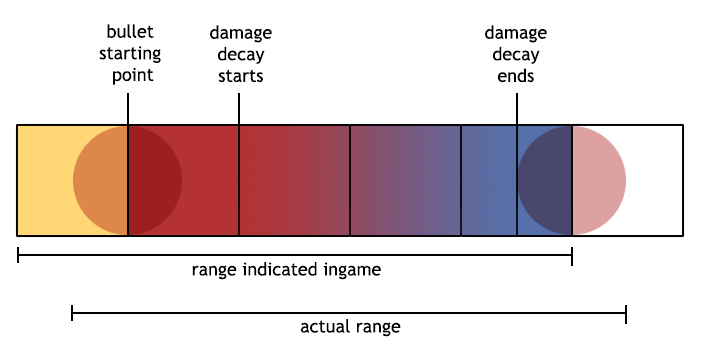
Because the hitbox is 0.5 tiles and the starting point is the edge of Melanite’s tile, it’s functional range is shifted half a tile forward. The bullet can reach halfway into the fifth tile, but cannot hit the back half of Melanite’s own tile. This also means that enemies 1.5 tiles away will still be hit with the full damage, even though the damage decay technically starts at 1 tile already, and enemies in the fourth tile will actually still take slightly more than the lowest amount of damage. The circular hitbox means that enemies on the side edges of the far ends of the bullet’s range also won’t be hit.
Melanite gets a bunch of different modifiers from her traits, talents, modules, and skill itself, so her damage is a bit hard to intuit just from looking at her on paper. The modifier on s2m3 is 500% at base and decays to 180%. Her talent increases skill damage by 15% from the second use onwards, which her module increases to 24%. The module also increases her damage to 105% when hitting enemies in the line in front of her, which always applies to s2. Her potentials give her a modest 30 atk and 1% extra damage on her talent, but because of all her different multipliers, those combine into a significant damage increase. All of these modifiers are multiplicative with regular atk buffs too, so she scales well with any source of party buff.
| | no module or potentials | module no potentials | module and potentials | first use | second use | | | ———————– | –––––––––– | ——————— | ——— | ––––– | | 4785 - 1723 | 5024 - 1809 | 5182 - 1865 | | 5503 - 1981 | 6230 - 2243 | 6477 - 2332 |
The module additionally lets her ignore the physical dodge of enemies within that straight line in front of her. This is really useful against enemies like Nethersea Predators, which have 80% dodge but only 4k hp and 50 def, or Sarkaz ‘Flying Boots’ Mercenaries, who have 40% dodge but only 4k hp and 100 def. Their EX stage counterparts have 5k hp / 80 def and 5.2k hp / 120 def respectively. A well positioned Melanite can just explode these enemies instantly, no matter how many of them rush you at once.
Another great Melanite use case is against Bloodborn Spawn, which clusters in large tightly-packed swarms when it respawns but has only 4k hp and 200 def at base. The Blood Amber they drop on death spawns fast enough that the bullet will not have left the tile yet when it does, so she can kill a group of Bloodborn Spawn of any size and also damage the Amber in the same shot. Blood Amber has 3k hp and 3k def by default, so without any additional stage modifiers, one shot is enough to both kill the Spawn and clean up the Amber.
S2 is an instant attack, so it can also be used to circumvent aspd reductions to some extent.

Her s1 is less likely to see use if you have literally anyone else to do heavyshooter things, it’s the kind of skill that’s there just in case Melanite is your only option and you need her to do something more generic than blast a single line. This is awesome for me, who is playing a niche where Melanite is the only sniper, and it’s a really good skill for simply getting the job done. It increases her attack interval but also raises her atk by 180% for a sweet 2680 damage per hit or 2814 in front of her, lasts a generous 30 seconds for 40 sp, and it can also benefit from her talent to go up to 3323/3489 damage per hit from the second use onward. The cycling doesn’t improve any with masteries though, so if you do have other options it’s not really worth investing in.
Melanite appears to be a highly specialised unit, but she’s actually pretty versatile. Her ability to instantly explode weak enemies with a 9 second startup, in addition to her status as one of the cheaper snakes to deploy, make her a good opener on fast maps. Heavyshooters aren’t really meant to be dedicated anti-air and Melanite sometimes struggles to focus on drones or kill them fast enough before they zoom out of her range, but here too, the instant damage against everything in a line on s2 helps her a lot. Melanite is just a very consistent and reliable unit.
Corroserum
Corroserum is a highly specialised unit, which means he’s kind of ass except when he’s godlike. His main features beyond his blast caster subclass traits are his fast skill cycling and the ability to silence all the enemies in his range with his s2, and silence is one of those things that’s useless until it’s not. However, his single line range and high dp cost can make it hard to actually make use of that debuff even in cases where it would be useful.
Corroserum’s talent increases his sp recovery by +0.45 (0.5 with potentials) after he hasn’t attacked for 4 seconds, and his module raises this to +0.65 (0.7) in addition to the trait update of increasing his damage with distance. If there’s a bit of downtime between waves Corroserum can fairly easily have his skills available for every wave, which makes him a very consistent aoe damage option in cases where his line range works. It also has some synergy with the 10 seconds of stun at the end of his s1, earning him a bonus 2.7 (3) sp before module and 3.9 (4.2) sp with module before taking any further downtime into account. My own Corroserum is max potential, so that’s the numbers I’ll be using from now on.
| | S1 | S2 | Damage per hit (close) | Damage per hit (far) | SP cost | Duration | Charge time (downtime) | Charge time (uptime) | Charge time (downtime + module) | Charge time (uptime + module) | | | – | – | ———————— | ––––––––––– | —–– | –––– | ———————— | ––––––––––– | ––––––––––––––––– | –––––––––––––––– | | 2216 | 1886 | | 2438 | 2075 | | 30 sp | 40 sp | | 30 seconds | 25 seconds | | 20 seconds | 26.6 seconds | | 27 seconds | 40 seconds | | 17.6 seconds | 23.5 seconds | | 25.8 seconds | 40 seconds |
S1 has a longer duration, faster cycling, and higher multipliers than s2, so unless you need the silence debuff it’s pretty much always the better option. Because of his long attack interval he only loses 3 attacks over the duration of the stun, and the skill duration is long enough that the stun at the end will usually happen during or close to downtime between waves anyway.
S2 being manual deactivation means it resets his attack interval at the start and end of the skill, meaning you can activate the skill right after he used an attack to immediately attack again, and then end it for another immediate attack. This is something that applies to all manual deactivation skills, and there are some niche cases where this will allow him to squeeze just a little bit more damage in. S1 doesn’t reset his attack interval, so to get the maximum use out of it you should use it right when he initiates his attack animation.

When silence is useful, Corroserum has the unique ability to apply it from 5 tiles away, to flying enemies, and to absolutely everything in range. Corroserum’s infinite target count means he won’t get distracted by other enemies or overwhelmed by sheer numbers the way more popular options like Lappland or Jaye would (shoutout to 14-12, the map with Literally One Hundred Exploding Spiders). He also has all the occasional advantages that a blast caster range offers, such as reaching tiles meant to be out of range for most operators, or covering multiple parallel lanes at once.
Corroserum is rather difficult to sell people on as a unit because he’s in an unfortunate position where each individual thing he does is incredibly replaceable, and the overlap between those things almost never comes up. Aoe arts damage is available in many flavours, most of which cost significantly less DP with a significantly easier range to work with. Silence is a powerful debuff when it’s relevant, but likewise can be found on cheaper and more easily obtainable operators, several of which are popular for reasons beyond their silence debuff too. Frankly, he’s just undertuned. Corroserum is functional, but it’s rare that he’s necessary.
For general gameplay use I honestly wouldn’t suggest investing in either Corroserum’s masteries or his module. His job is to soften up groups of enemies and silence them when necessary, and he’s perfectly fine at that without all that extra investment. His skill cycling doesn’t improve with masteries at all, and if you’re relying on Corroserum’s damage to win the run you should probably revise your strategy anyway. His module will get you a few seconds less charge time on his skills under optimal conditions, but again, if those 3 seconds make or break your strategy in normal play there are other things you can adjust to make up for that.
Of course, all that just makes it all the better when I find a good use for Corroserum.
Indigo
I like mystic casters. Their subclass quirks give them a set of obvious strengths and weaknesses that are rewarding and not too hard to play around, and if you’ve read this far you may have intuited that I love a unit that is strong in a gimmicky way. Indigo’s particular quirk is that her every attack has a chance to bind the target for a generous 4 seconds, and she won’t attack bound enemies, regardless of whether she was the one who inflicted the bind.
Bind is arguably one of the strongest debuffs in the game, because getting to tell an enemy to stop moving is insanely potent, and almost no enemy is immune to it. Indigo being able to do it theoretically at any moment is strong as hell, and also dangerous to real life sanity.
"This will work if Indigo rolls bind good" - statement of the copium addled.
Her base attack interval is 3 seconds, so if it’s just one target in her range she will store up one attack before hitting them again 2 seconds after the initial bind wears off. Her module gives her a bit of aspd, which reduces her base attack interval to 2.88 seconds and the gap between the bind wearing off and Indigo’s next attack to 1.76 seconds.
Stored attacks each separately roll the bind chance, and a mystic caster’s stored attacks are added to the actual attack being done after storing them. Her module increases her maximum charges to 4 and the bind chance to 27%, meaning at maximum charges she rolls for bind 5 times for a total 79% chance to bind, and at the much more common 1 charge (meaning 2 attacks) the chance is 46%. That’s pretty generous for something she can do before taking any skills into account.
Her s2 increases the bind chance of each attack to 81% and reduces her attack interval to 1.73 seconds with module, allowing her to store up two charges instead of one between bind procs when there is a single target in range, as well as making the next attack happen 1.19 seconds after the last bind runs out. With only one target in range during s2 those two attacks she stores up while the target is bound create a 99.3% chance to bind on Indigo’s next attack after the previous bind runs out, making the skill mostly reliable on a single target with diminishing returns the more targets are in range.
| Charges | Offskill bind chance | S2 bind chance | 0 | 1 | 2 | 3 | 4 |
|---|---|---|---|---|---|---|---|
| 27% | 81% | ||||||
| 46% | 96% | ||||||
| 61% | 99.3% | ||||||
| 71% | 99.8% | ||||||
| 79% | 99.9% |
Aside from the bind itself, s2 also inflicts damage over time on bound enemies in her range, and this bind does not have to come from Indigo herself to trigger the damage. This is 264 damage per 0.5 seconds on a fully invested Indigo. Indigo is often combined with Ethan in 4* stall strategies, because Indigo targeting specifically the enemies that Ethan didn’t bind yet compensates for both their random chances, and Ethan being able to theoretically bind all targets in his range allows Indigo to inflict her dot on a much larger amount of enemies than she would be able to alone.

Indigo s1 is a remnant of an era of the game where particular subclasses would all have the same s1 and only get some unique flavour on their s2, so it’s The Mystic Caster Skill 1, which doesn’t particularly mesh well with anything else she does or have a lot of practical uses. The single line range that extends beyond her normal range, short duration and cycle, and fast burst of hits has some potential niche uses though, like preventing her from being distracted by enemies on the sides of her range in critical moments, or quickly storing up attacks to compensate for a lack of actual downtime. Since Indigo won’t attack bound enemies, if one of the half-power attacks she does in her s1 duration triggers bind, she will store the rest to use them at full damage once the bind is over instead.
Indigo generally isn’t a unit you bring for the damage, but as a mystic caster she has absurdly high atk and damage per hit, and the ability to store attacks lets her instantly explode some poor schmuck who happened to come into her range after some downtime. She probably has some of the highest damage potential among 4*, I haven’t done any math on that and don’t care to, that’s just how mystic casters are built. Her large hits also make Shalem’s debuff really noticable when they’re attacking high res enemies together.
All issues one might have with Indigo essentially come down to the fact that she’s a 4*, which makes her like 10% less reliable than if she’d had an extra star. She already punches pretty high above her weight class as-is, if her binds were any stronger she’d have no business whatsoever sitting in her current rarity. Indigo works better the fewer enemies there are, which is completely normal for mystic casters, and it’s only because I’m doing low operator niche clears that I need to rely on her rolling the right binds as much as I do anyway.
Verdant
Snakeknights has some major weaknesses it has to play around. Snakes are pretty expensive to deploy across the board, making it hard to open some maps because the first enemy will have reached the gate by the time natural DP generation allows me to put anyone down. Ranged damage can be a significant threat; my own ranged units don’t actually have all that much range, Rose Salt can only do so much as an aoe medic, and while main powerhouses Zuo Le and Eunectes have ways to heal themselves, they still need enemies to actually come close first. Eunectes in particular is also pretty weak to arts damage and can’t always rely on her skills to save her from it.
If ONLY there was a unit that was cheap to deploy, had enough damage to take out early map enemies, and specialised in taking ranged arts damage to the face forever. Alas, there are no such units in this game, let alone in my tiny, tiny niche.

Lmao
Verdant is a dollkeeper which means he has 2 block, low-ish def but high-ish atk that lets him take out early map trash, a very modest 12 dp cost, and is extremely difficult to kill. In fact, Verdant is probably the most durable dollkeeper of them all, because all the others have their doll do some dumb shit like dealing damage instead of surviving forever. A fully invested Verdant on s1 has 15 res and 3389 hp. The substitute has 23 res, 3795 hp, and recovers 152 hp per second. It lasts 20 seconds, so it has 6832 effective hp, and if enemies can’t deal that much damage in those 20 seconds they can’t kill him at all.
Verdant is fucking awesome. Verdant is the glue actually keeping this niche together. I love Verdant.
If you put Verdant on a tile he’s not leaving that tile until you tell him to. He’s not gonna be blocking all of the time while on that tile, but he’s sure as hell not leaving it, and this neutralises a huge chunk of the mechanics in this game. The ability to simply sit on a tile and bait damage without dying is extremely underrated and extremely valuable. Imagine if Gravel instantly redeployed herself after she got blown up. That’s Verdant and people have the gall to call him a bad unit. Verdant is fucking awesome.
Verdant can sit on nethersea brand no problem to prevent it from spreading. Verdant can put out burning reeds. Verdant can safely take constant fire from two hostile grammophones at once with hp to spare. Verdant can hold chains in Babel maps without the burdenbeasts breaking all his bones. Verdant can jumpscare those guys who call in drones and then take the drone fire. Verdant can eat that high damage first hit from enemies like the various Sarkaz lancers or the Gourmet pirates from Exodus to the Pale Sea. Verdant can be placed in dangerous positions to redirect Realigned Flux because none of those Leithanian casters can do jack shit to him. Verdant can be dropped in the middle of a bunch of caster sheep and live. Verdant turns the Witch King into a joke because he doesn’t give a shit where on the map he’s teleported, he’ll keep baiting those global arts attacks. The list goes on and on and on. Verdant is fucking awesome.
Dollkeepers clear all their debuffs when switching to or from their substitute, including for example the otherwise permanent defense reduction from corrosion or acid originum slugs, or debuffs that normally have to be removed by other operators attacking them.
Now to be fair, Verdant is not actually immortal. I’ve had Verdant die on me a few times, to my surprise and dismay. His limits are usually around like, four enraged elite imperial strikers, or four double aspd caster sheep while on pink steam, or six witch king orchestra drummers, or any other situation where any other unit would have exploded twice as fast. Can we blame this humble plant boy for not being made of the same stuff as an s2 Specter? He’s a 4* and doesn’t need you to do literally anything after deploying him. I tried using Specter the Unchained instead of Verdant once and she died to ranged arts damage. Verdant is fucking awesome.
Aside from being really hard to kill, Verdant’s substitute also has the standard 3x3 tile range, which makes him flexible when dealing with directional or positional mechanics. I’ve used this to make him break soda bottles deployed behind him in So Long Adele, attack tuning nodes in multiple positions around him in Zwillingstürme im Herbst, and light emergency heaters located on two diagonals from him in The Rides to Lake Silberneherze for example.
His s2 is niche next to his s1, rather than a damage button it’s better thought of as a way to control when he’s on his substitute. Sometimes you don’t even need to actually use it, just not having the increased hp and res from s1 makes the difference. You could heal him while he’s using s2 and get some melee arts damage out of him, and it’s gonna be some pretty decent melee arts damage because dollkeepers have good stats, but there’s better ways to get some melee arts damage even within the very limited lineup of snakeknights (yay Shalem), and the primary Verdant use case is having him hold a tile or bait damage that you can’t or don’t want to dedicate a healer to.
Verdant is extremely easy to use because you literally just put him down and he sits there eating damage forever and this wins you the map. Verdant’s paradox simulation struggles to even show off what makes him so good because the solution is to drop him right in front of the red box and then look away. There’s really only one major problem with using Verdant, which is that he’s untargetable for a few frames while switching to and from his substitute, leaving an opening for other units who do die when they’re killed to get targeted instead. Verdant is fucking awesome.
Rose Salt
Rose Salt was announced on CN about a month after I started playing snakeknights and concluded we could really use a healer to help Shalem out. The delay between CN and global servers put her global release in early June, right around my birthday. This is because I am heaven’s favourite child and I always win.
Rose Salt is a multi-target medic with a talent that increases the healing received by allies within her range, 17% at base and 22% with module. Healing received buffs increase any type of heal that shows a green number above the operator, including of course any attack done by medics, as well as the HP recovery from musha and reaper traits, but excluding the regen effect on for example bards. Within snakeknights, this means Zuo Le’s hp recovery trait can benefit, but not Eunectes s3 or Verdant’s substitute. Zuo Le’s s3 briefl