It was late last night. The kids were finally in bed, the house was quiet, and I found myself with that dangerous combination of exhaustion and curiosity. I had a couple of hours of freedom, and I decided to tackle something that had been itching to do for a while: getting Claude Code running on my RHEL 10 laptop which is running in Image Mode (bootc). An immutable system is convenient, and prevents an LLM from mucking up your system, which is good. But, it also prevents you from experimenting quite as easily, creates a little friction that you have to get over.
What started as a technical tinker ended with a massive strategic epiphany about the future of our products. But first, I had to get the thing working.
The Setup: Eating Our Own Dog Food
I started by asking Gemini a…
It was late last night. The kids were finally in bed, the house was quiet, and I found myself with that dangerous combination of exhaustion and curiosity. I had a couple of hours of freedom, and I decided to tackle something that had been itching to do for a while: getting Claude Code running on my RHEL 10 laptop which is running in Image Mode (bootc). An immutable system is convenient, and prevents an LLM from mucking up your system, which is good. But, it also prevents you from experimenting quite as easily, creates a little friction that you have to get over.
What started as a technical tinker ended with a massive strategic epiphany about the future of our products. But first, I had to get the thing working.
The Setup: Eating Our Own Dog Food
I started by asking Gemini and Claude a simple question: How do I get Claude installed on a UBI container?
I figured, a UBI container is close enough to my bootc system, and would arm me with the right commands to get things installed.
Armed with their advice, I started hacking. I manually installed Claude on my system while running a copy of it as a local container. Let me repeat that, my laptop runs in image mode, and I ran an exact copy of my laptop, on my laptop, as a container. It’s a little mind bending at first, but when you get used to experimenting this way, it’s very convenient, and powerful.
I hacked on the container until I figured out the dependencies. Once I had figured things out, I carefully added three lines to my Containerfile, rebuilt the image, and tested it as a container locally. I ran Claude Code locally in a container-copy of my system to make sure it worked. Satisfied, I pushed it to my registry, and ran a local bootc update.
Just like that, my OS was rebased, and Claude Code was running native on my laptop. I authenticated Claude Code using the local browser, and the cursor blinked back at me, ready for input.
The Freeze (and the Thaw)
And then… I froze.
It’s a funny thing. You spend some time fighting to get a tool installed, and the moment it works, your mind goes blank. I had the “blank page” syndrome. What should I try to build?
To break the ice, I started small:
Test 1: “Write a Python-based Hello World program.” Claude batted that away without breaking a sweat.
Test 2: “Write a Rust-based Hello World program.” Here, we hit a snag. Claude struggled because it couldn’t install Rust directly on my immutable, Image Mode RHEL 10 laptop.
This is where the “agentic” nature of the tool surprised me. I told it to use a UBI (Universal Base Image) container instead of trying to fight the host OS. It hacked its way to success in about 3 to 5 minutes. It listened to my new instructions, adapted, and executed inside a container. I spent a couple of minutes inspecting the Rust code, Rust binary, and Rust compiler container image it built as part of the process. Confident that I could run and use these outside of Claude, I got more curious…
The Deep Dive: The MCP Server
That success sparked my curiosity. I created a directory called insights-mcp and gave it a much vaguer, more complex command:
“Configure a local Red Hat Insights MCP server to work.”
For the next while, I just watched it work. It hacked, failed, retried, and hacked some more. I’ll be honest—I understood maybe 60% of what it was doing. At one point, it told me to create a service account on console.redhat.com. I’ve worked at Red Hat for years, and I didn’t even know we could create service accounts there, let alone how to do it.
Claude walked me through it.
After a lot of trial and error (and a fair bit of ridiculousness), it suddenly output a list. It was a list of my servers, registered to Insights. It had successfully configured itself to talk to the local Model Context Protocol (MCP) server.
The Epiphany
I got bold. I asked, “What else can I do with the Insights MCP Server?”
It returned a crisp, confident list of capabilities. One item stood out immediately: Planning. Specifically, it mentioned Roadmap and Lifecycle. These are near and dear to my heart, they were a major part of the RHEL 10 launch. I couldn’t resist.
I typed: “Show me a roadmap for RHEL.”
It displayed it in a few seconds. Right there in the terminal.
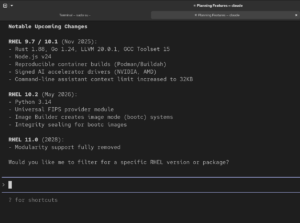
I sat back, pretty blown away. In that moment, the gap between “technical cool factor” and “business value” completely closed. I am now 110% convinced of the critical importance of the roadmap data inside Insights and Lightspeed. I’ve told customers before, if we execute this right, you won’t need to call me for a roadmap in RHEL 11, you’ll be able to look at it yourself. Admittedly, I didn’t quite think they’d do it from a terminal window, using English.
Why This Matters
In the near future, customers won’t just log in to console.redhat.com to get lifecycle dates or a list of feature on the RHEL roadmap. They are going to use LLMs and agents to drive their automation, planning, and upgrades. Every customer is going to use tools like Claude Code in a similar capacity to what I did last night.
If an agent can query our roadmap to help a sysadmin plan a migration, that creates value. It’s not just about PDFs and slide decks anymore for roadmaps; Red Hat is innovating here, making our data machine-readable, pristine, and accessible via these protocols. I truly think we’re innovating here, in a way that no other Enterprise Software company is. I hope we serve as an example, and the rest of the industry adopts similar methodologies.