Lisa Torres woke up with an unexplained chest pain on July 29, 2017. She was in Guanajuato, visiting family. She thought she was going to get sick. She had a feeling something was wrong, although at that moment she didn’t know that her 22-year-old son, Roberto Franco Jr., had just disappeared on the way to where she was. Roberto had left Houston, Texas, at the wheel of a vehicle around 4:00 a.m. He was due to arrive in the Mexican city by 10:00 a.m. Hours passed without Lisa hearing from him. She called him, but no one answered. There ar…
Lisa Torres woke up with an unexplained chest pain on July 29, 2017. She was in Guanajuato, visiting family. She thought she was going to get sick. She had a feeling something was wrong, although at that moment she didn’t know that her 22-year-old son, Roberto Franco Jr., had just disappeared on the way to where she was. Roberto had left Houston, Texas, at the wheel of a vehicle around 4:00 a.m. He was due to arrive in the Mexican city by 10:00 a.m. Hours passed without Lisa hearing from him. She called him, but no one answered. There are currently 1,756 American citizens missing in Mexico, and Roberto is one of them.
That day, Luz Francisca Rivera was at her ranch, recently recovered from gallbladder surgery, with no internet or cell service. To talk to her son, Juan Francisco, she always had to walk to the nearest town. Juan Francisco Hernández, 24, worked cleaning tanks at a refinery in the Houston area. Born in Texas, he had to return to Mexico as a child with his mother while she sorted out her paperwork. At 18, he decided to travel from Houston to San Luis Potosí to get his U.S. passport because he wanted to go home.
Every time they spoke, he would tell Luz Francisca, “No worries, ma.” That’s all she remembers. Juan Francisco was in the car with Roberto, and they went missing. Her mother walked to town to call a phone that was never answered.
A month later, Jeanette Cerecer was organizing a party for her son. It was August 30, and Ernesto Garnica Jr. was turning 29. He worked at a shelter for migrant children and lived between Texas and Matamoros. On his birthday, he got off work late and called: “Mom, what’s up?” He told her he had plans to have a barbecue with friends, but that he would eat with her the next day.
At 5 a.m., Jeanette was alerted that Ernesto was missing. Three days later, his truck was found burned on the highway between Matamoros and Reynosa, with two charred bodies inside. Jeanette spent months believing her son was dead, but DNA results confirmed that neither of the bodies found was his. He remains missing.
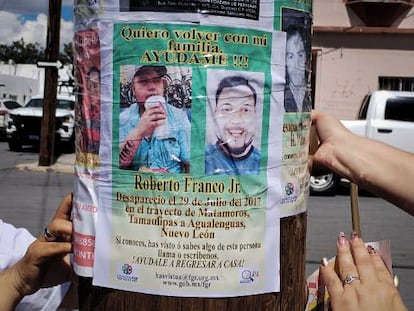
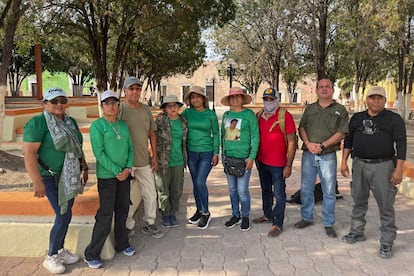
Months later, these three mothers created the Association of American Citizens Missing in Mexico (ACMMA). Their children, born in Texas to immigrant parents, crossed the border and never returned. These women have had to become investigators of their own cases and haven’t lost faith in solving them.
Self-employed researchers
In such a situation, the first step is to file a police report, explains Melissa Rangel, case coordinator at the Texas Center for the Missing, a local organization that assists in the search for missing persons. She then recommends contacting organizations that, like hers, offer additional support.
In 2024, 10,458 new missing persons cases were reported in Harris County: 3,513 adults and 6,945 children. With these figures, the largest county in the United States also became the county with the most disappearances in Texas, which in turn is the state with the most unsolved cases nationwide. Last January, Houston, the county seat of Harris County, was the U.S. city with the most missing persons, with 442. Of those, 196 were Latino. Rangel says that Hispanic families are increasingly hesitant to report disappearances to the police, or at least that’s what she has observed in recent months. They are doing so primarily out of fear of being arrested or deported.
However, when a disappearance occurs in a foreign country, the State Department recommends that families contact the relevant embassy or consulate. Staff can work with local authorities to locate the missing person, verify reports of hospitalizations or arrests, and keep the family informed of any updates. But that’s about it. Consulates do not investigate crimes or conduct searches. They also cannot provide legal advice, although they can provide lists of private investigators or lawyers. Families must fund their own investigations.
According to the National Registry, there are more than 8,000 missing persons in Mexico whose nationality is unknown, so the number of Americans could be higher. In March 2023, four Americans were kidnapped in Matamoros, Tamaulipas, and authorities responded quickly, coordinating their rescue with the U.S. However, many families of missing persons in Mexico have reported that they do not receive the same level of attention.
For Lisa, Luz Francisca, and Jeanette, the consulates turned out to be nothing more than suggestion boxes. “It’s like an administrative assistant, a messenger,” says Jeanette. Texas authorities took the report. They issued an alert at the border bridge. Without much institutional support, the three began to move heaven and earth on their own.
Jeanette quit her job. She says she spent seven sleepless months traveling around Tamaulipas, pulling strings, and reviewing security camera footage until she identified two people using Ernesto’s bank card. She dedicated herself to tracking them down. She obtained videos and purchase receipts and identified several people involved, including a friend of her son. To this day, she says, no one has been arrested.
Lisa checked her son’s iCloud account and discovered that someone had taken a selfie with his phone days after he disappeared. Lisa took the photo to the police in Mexico. She called repeatedly asking if they had identified the person, but nothing came of it. She began searching Facebook pages about organized crime and looking at photos of unidentified bodies online, trying to recognize her son.
Luz Francisca was sick in Mexico without the necessary papers to cross the border. When she called the prosecutor’s office with her case number, they told her, “We have nothing.”
“Thirst for justice”
Jeanette describes a disappearance as an “endless nightmare,” like a grenade in the middle of a family. “It explodes and we’re all shattered into pieces. The impact is so immense that we can’t rebuild ourselves or help each other rebuild.” Eight years later, she’s still in pieces, but she never speaks of Ernesto in the past tense. “Anything can happen, my son could be alive, recruited by a cartel and doing things he doesn’t want to do,” she says.
After seven months of investigating, she grew afraid of organized crime and sought asylum at the border bridge. An official advised her not to stay in the area, but to move far away. “I’m a cold woman. I haven’t grieved because if I did, I would die,” says Jeanette, who believes her son “is a victim of crime and a victim of the authorities.” “I thirst for justice. A justice that has been denied me.”
Lisa, meanwhile, believes that “you have to know how to survive.” “Trauma takes a lot of effort,” she adds, recalling how she joined a search collective in the border city of Reynosa, Mexico, to dig in clandestine graves. “I didn’t go hoping to find Roberto. I just felt I had to do something with my hands.”
Luz Francisca is more direct: “My life has no meaning anymore,” she says. Her update on the case: none. “The only thing I have is faith in my Holy Father.”
In 2018, the three mothers met and founded the Association of Missing American Citizens in Mexico. “I believe God put us on this path for a reason,” says Jeanette. “We’ve forged a friendship out of tragedy.”
There were search collectives in Mexico focused on Mexicans, and there were missing persons organizations in Texas and the rest of the country. But U.S. citizens who disappeared in Mexico were almost invisible to both sides. Moreover, the families of these individuals, along with the pain of not knowing, the anxiety, and the depression, face financial hardship: the cost of constantly traveling between the two countries in search of answers and of funding private investigations.
They, who at that time didn’t really know how the system worked, dedicated themselves to studying it and passing on what they had learned. “There are many mothers who don’t know Spanish, who don’t know the language, they are lost, they don’t know what to do,” they explain.
Jo Ann Lowitzer, an activist whose teenage daughter, Alexandria Lowitzer, disappeared in 2010, says that the families of the disappeared have become like an extended family to her over the years. “When a missing person touches your life, it’s like a piece of you disappears with them,” she says. “That’s really what you long for: to feel that you’re not alone.”
In Texas, where nearly 45,000 disappearances were reported last year, that extended family continues to grow.
Sign up for our weekly newsletter to get more English-language news coverage from EL PAÍS USA Edition