The U.S. Secretary of Defense — what U.S. President Donald Trump prefers to call the “Secretary of War” — has announced to European countries that they will have to assume “the bulk of NATO’s conventional defense capabilities” on their soil starting in 2027. Washington’s new National Security Strategy, published on December 5, aims to “reestablish strategic stability with Russia.” It has sent shockwaves through a Europe long accustomed to relying on U.S. military support.
The prospect of a clash in Eastern Europe hangs in the air on both sides of the border. “Russia …
The U.S. Secretary of Defense — what U.S. President Donald Trump prefers to call the “Secretary of War” — has announced to European countries that they will have to assume “the bulk of NATO’s conventional defense capabilities” on their soil starting in 2027. Washington’s new National Security Strategy, published on December 5, aims to “reestablish strategic stability with Russia.” It has sent shockwaves through a Europe long accustomed to relying on U.S. military support.
The prospect of a clash in Eastern Europe hangs in the air on both sides of the border. “Russia does not intend to fight Europe, but if Europe starts, we are ready right now,” warned President Vladimir Putin in early December. The reality, according to military experts on both sides, is that neither Europe — without U.S. support — nor Russia are prepared to prevail in a hypothetical conflict today.
This new sense of isolation is forcing Europe to draw lessons from the most significant conflict to take place on its soil since World War II. The main conclusion is that air superiority is key to keeping the enemy at bay. Without air power, tanks are left vulnerable to waves of drones.
Since Putin launched the large-scale invasion of Ukraine in February 2022, the nature of the war has changed radically. Tanks are increasingly absent from the front lines. Videos of multi-ton turrets exploding have been replaced on social media by drones striking motorcycles and bicycles. The expensive Russian T-14 Armata was never deployed to the front. Western Leopard and M1 Abrams tanks arrived late and in limited numbers to a war that today bears little resemblance to what it was in 2022 and 2023.
Military experts from Russia and NATO now question whether it makes sense to invest billions in weapons that are defenseless against drones that are hundreds of times cheaper.
Russian military Telegram channels occasionally post videos of their armored columns being destroyed in seemingly pointless attacks. In October, a battalion of 22 tanks and armored transports advanced from a forest toward the villages of Volodymyrivka and Shakhove under cover of bad weather. Over several miles, Ukrainian drones and guided artillery destroyed nine Russian vehicles and damaged four more. This was the fourth failed mechanized assault by the Kremlin in a single month.
Today, troops are dispersed in tiny groups along the front, and the real rearguard begins 30 miles back, not just a few miles as before. In between lies the kill zone, a roughly nine-mile-deep area where swarms of enemy drones stalk everything that moves, including civilian, military, and press vehicles. And at the very front, horror: the contact line, a gray zone about 1.8 miles wide, littered with mines, corpses, and wounded soldiers who cannot be rescued.
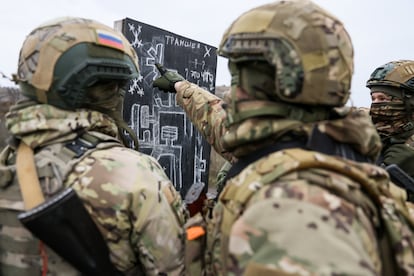
“The armed struggle will turn primarily into a battle for ‘drone superiority’ in the air,” declare Yuri Baluyevsky, former chief of the general staff of the Russian Armed Forces, and Defense Ministry adviser Ruslan Pukhov in an essay, warning that the full digitalization of the battlefield — the instant communication between soldiers, robotic weapons, and the command center — combined with artificial intelligence, will be decisive in creating “strike and defensive systems with colossal density and effectiveness” against today’s massed military forces.
The idea, broadly speaking, is to detect and suppress enemy fire in a minute or two. And once the enemy is defenseless, bombard them. The fastest side wins.
Sending waves of men against the enemy is doomed to fail, says Pujov in a telephone conversation with EL PAÍS: “Any buildup of forces is impossible; it is destroyed immediately upon discovery. Besides drones, there is also drone-guided and drone-corrected artillery.”
The Ukrainian and Russian militaries currently rely on commercial Starlink satellites and cell phone SIM cards to connect their drones, but Baluyevsky and Pujov believe this will not be enough in a future war. “Russia will fall behind the leading countries in technological development in the medium term. This must be addressed immediately,” they warn.
A misguided lesson
Russia plans to double its production of T-90M main battle tanks over the next four years and intends to manufacture and modernize 1,118 tanks of all types between 2027 and 2029, according to leaked documents. Meanwhile, the United States has unveiled a new variant of the M1 Abrams for a drone-saturated environment, the M1E3. And Europe has announced Project MARTE, its new main battle tank.
In the sky, the race is very different. In addition to its military satellites, Washington has more than 7,800 commercial Starlink satellites. The second largest international network is Europe’s Eutelsat, with more than 650 satellites. Russia, for its part, expects to have 292 Rassvet units deployed by 2030.
“Building tanks is a waste of money. It’s worse than a crime; it’s a mistake,” says Pujov. According to the expert, “the transparency of the battlefield and real-time target designation [by drones and guided artillery] are eliminating direct fire, replacing it with indirect fire.”
Spanish Admiral Juan Rodríguez Garat disagrees with the conclusions of Pujov and the former Russian chief of staff. “The war in Ukraine, seen from the West, is an anomaly: two powerful armies are fighting on the ground without either being able to take advantage of their air forces,” the retired officer tells EL PAÍS.
“Without air power — something unthinkable in the Atlantic Alliance — and mechanized weapons neutralized by drones, what we see now in Ukraine is a struggle that leads nowhere,” Garat adds.
According to the admiral, “If the war in Ukraine demonstrates anything, it is that without tanks there is no possible mobility on the ground front.” He adds that NATO is not considering abandoning armored vehicles, “but rather protecting them from artillery and, above all, from low-cost drones.”
Pujov admits that a powerful air force could significantly influence the course of this hypothetical war, “but today only one country possesses such an air force: the United States.”
According to the Russian expert, Europe could not assert that air superiority on its own if the U.S. stood aside: “A war with U.S. air superiority is unlikely to preserve armored columns, but it would increase the depth and isolation of the combat zone [...] This would generate overall fire superiority that will partially neutralize the effect of drones and allow the front to advance.”
Outmatched anti-aircraft systems
Russia did not achieve air superiority over Ukraine when it launched its offensive, but the Israeli and U.S. bombings of Iran have shown that air defense systems can still be overcome.
Beyond the supposed superiority of the U.S. F-35 stealth fighter over the Russian Su-57, some Western experts point to a key strategic difference: Israeli doctrine prioritizes achieving air superiority in order to continue bombing, whereas Russia subordinates its air force to supporting ground army operations.
Kendall Ward and Alexander Palmer, from the Center for Strategic and International Studies (CSIS), and Jeremy Shapiro, from the European Council on Foreign Relations (ECFR), have analyzed both conflicts and concluded that Israeli intelligence was crucial in locating mobile enemy air defense systems and decapitating Iran’s high command during the initial strikes.
“NATO, which faces the (distant) possibility of a future Russian military campaign against its eastern flank, needs to learn from Israel’s success,” Shapiro warns in his report.
Drones
Oleshki, taken by the Russians, is on the opposite bank of Kherson, controlled by the Ukrainians. There is a distance of three miles between both cities. “Those birds [the drones] crush everything they cross, brother,” a Russian soldier tells this newspaper.
“Ukraine has much to teach its allies,” adds William Courtney, a research associate at the Rand Center, in an email. “There are several low-cost countermeasures against drones. The development of interceptor drones is an emerging field, and further advances are likely.”
Garat, for his part, argues that the most important thing now is to have production lines ready in Europe. “There’s no point in stockpiling commercial devices; what’s needed is to develop the industrial capacity to design and build them quickly when they’re needed,” he says.
Sign up for our weekly newsletter to get more English-language news coverage from EL PAÍS USA Edition