No one could imagine that Jeisel Hernández would die in the night, at the age of five, far from home.
Just before dawn on December 10, there’s a terrifying noise: a chorus of stunned voices reverberates around the progressive care unit of the Pepe Portilla Pediatric Hospital, in the province of Pinar del Río. In one of the rooms, Yarisleidy Ramos and Alianys Labrador — the mothers of two girls admitted to the ward — wake up startled. Something is wrong. They go outside and find Yanelis Hernández, her soul seemingly about to break in two. Jeisel, her son, had fallen asleep the night before. But now, when she went to his bed to check on him, the boy did not respond.
Yanelis will gather her things, dismantle the small camp — where she lived for more than a month — and go home… the ho…
No one could imagine that Jeisel Hernández would die in the night, at the age of five, far from home.
Just before dawn on December 10, there’s a terrifying noise: a chorus of stunned voices reverberates around the progressive care unit of the Pepe Portilla Pediatric Hospital, in the province of Pinar del Río. In one of the rooms, Yarisleidy Ramos and Alianys Labrador — the mothers of two girls admitted to the ward — wake up startled. Something is wrong. They go outside and find Yanelis Hernández, her soul seemingly about to break in two. Jeisel, her son, had fallen asleep the night before. But now, when she went to his bed to check on him, the boy did not respond.
Yanelis will gather her things, dismantle the small camp — where she lived for more than a month — and go home… the home she left with Jeisel, because of the lack of electricity. She will return there now, shrouded in a much deeper darkness.
In October, the blackouts in their neighborhood of Los Palacios were like those across almost all of Cuba: a black blanket that cast a shadow over the lives of the residents. This impacted Jeisel’s quality of life. As a patient with type 1 spinal muscular atrophy — also known as Werdnig-Hoffmann disease — he desperately needed electricity to live. The inverter and batteries had begun to fail. The boy’s body was turning red from the heat; his food was spoiling because the fridge wasn’t working. His mother was finding it difficult to use the suction device to remove his saliva. And Jeisel’s ventilator couldn’t possibly be without power. So, on October 25, Hernández packed a bag and left her house for the hospital, the place she never wanted to be.
It was no secret to Hernández that Jeisel’s life could be short. That’s why she wanted to ensure that he could stay at home, with his older brother and grandmother. A week before the boy died, his mother recounted how difficult it was not only to have her son bedridden all the time, but also to “see him suffer through the daily power outages.” Waiting for a solar panel kit that never arrived, they had to move indefinitely to the hospital, which was an electrified fortress in the middle of the dark nights of Pinar del Río.
In a country where almost everything is scarce, this mother never asked for luxuries. She pleaded with the authorities to provide her with an electric generator, so that her son wouldn’t have to be confined to a hospital room, far away from the rest of the family, living with the constant reminder that he was condemned to his illness.
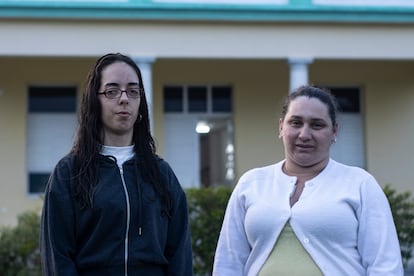
Death came before the government could respond and before a generator or solar panel could appear. “I know how much that mother longed to be home with her son; they always denied her the opportunity,” says Yarisleidy, 38, the mother of Valentina Ramos, who is also in the progressive care ward. “When I see these things happen, it makes me so angry, because it’s not easy to deny these children the chance to be home for as long as God decides.”
“Can you imagine what will happen to my daughter?” she laments. “Will I ever be able to take her home?”
Today, there are people in Cuba who don’t ask for electricity to watch television, to plug in an iron to get their children’s uniforms ready, or even to cook. For some, it’s a matter of life or death: in a country that’s collapsing, there are those who need electricity just to survive.
“For a child on a ventilator, electricity is vital, because without power, the machine malfunctions,” a nurse from the progressive care ward of the Pediatric Hospital — who asked to remain anonymous — tells El PAÍS. “That’s not something we can provide. It’s difficult for a mother to live here for years; [the space doesn’t have] the comfort of home. And they have to leave their other children and their families behind.”
A country in darkness
The mothers interviewed for this report have experienced four deaths throughout their time inside the hospital. Each time a patient dies, the progressive care ward becomes a silent, much sadder place. Those who remain ask themselves the same question: how long will they be there, trapped, watching life pass by through the clouded windowpane?
Inside the hospital, the ward — like the rest of the country — is overwhelmed by the arbovirus that has Cuba on edge. There’s not enough medication, making it difficult to treat so many patients. According to the nurse interviewed by El PAÍS, even though the medical staff tries to provide all necessary care, there’s a shortage of suction catheters, cannulas, gastrostomy buttons and wound care supplies. In the hallways and waiting rooms, stretchers have been set up for children arriving with various ailments, while doctors rush back and forth trying to calm the desperate parents. Some patients leave early, some remain hospitalized, and some live in the hospital.
Outside the facility, Pinar del Río — the capital of the province — is an extension of almost all of Cuba. People walk about listlessly. Motorcycles and tanker trunks drive over the potholed roads. The odd canteen offers Neapolitan pizzas for 200 Cuban pesos ($0.45), while long lines form in front of the ATMs. Clients hope to withdraw a few bills. In the city, people complain about the unstable electrical supply — it can be turned on at 3:00 p.m. and then cut off an hour later — and they cook with firewood in the street. Neighbors fan themselves to ward off mosquitoes, the heat, the tedium and the helplessness that the blackouts bring.
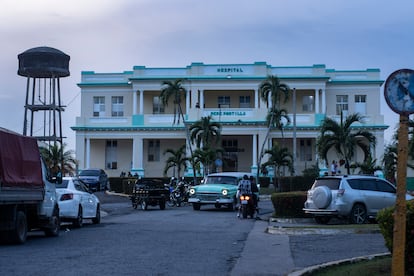
2025 has been a year of chronic blackouts: Cubans have had to cope with daily power cuts lasting more than 20 hours at a time. The situation has led them to take to the streets in protest on several occasions. Some of the reasons for the scarcity include the ongoing collapse of the National Energy System (SEN) due to a lack of maintenance, limited resources for infrastructure investment, as well as a shortage of foreign currency to import fuel. All of this occurs within the context of a country whose economy is completely depressed.
Furthermore, it has come to light that the government in Havana is allegedly selling off most of the fuel shipped in from Venezuela, the country that provides 70% of the island’s crude oil supply. According to documents obtained by The New York Times, an oil tanker named Skipper — seized by the United States off the Venezuelan coast — was carrying nearly two million barrels of crude, of which some 50,000 were destined for the island. The remainder, however, would have been sold by the Cuban authorities to China.
Since the massive blackout that left the entire islandwithout power for several days in 2024, Cuba has never managed to completely light itself up again. By mid-December of 2025, the generation deficit was nearly 2,000 MW, in a country with a demand of 2,350 MW.In statements made to El PAÍS, Cuban researcher Jorge Piñón — an energy expert — asserts that there will be no change in the Cuban electricity sector “until the government changes its economic model, decentralizes the economy and allows for open investment.”
Life in the ward
In a 16-by-10-foot room at the Pepe Portilla Pediatric Hospital, Ramos and Labrador live with their two daughters. The space is furnished with the bare essentials: a rice cooker, some dishes, clothes and a few toys. While the girls lie in two beds, the mothers spend the night rocking in two armchairs. They’ve been doing this for a very long time.
Valentina — Ramos’s one-year-and-nine-month-old daughter — has never lived anywhere but the Pediatric Hospital. After a chronic health issue at birth, she had to undergo a tracheotomy and gastrostomy. She doesn’t yet have a confirmed diagnosis, but it’s suspected that she has some type of muscular atrophy.
Her grandfather has only been able to see her once. And her father — who observes her through a glass partition — barely knows her. In El Yayal — the tobacco-growing region where the family lives and where the electricity is cut off every four hours — her mother worked as a laborer, sorting tobacco leaves. But she had to leave her job.
“I wasn’t earning much, but it was enough to live a balanced life,” she sighs. Since being confined to the hospital with her daughter, Ramos receives 2,400 Cuban pesos from the government each month for her role as a caregiver. She tells EL PAÍS that this amount isn’t even enough to purchase a large pack of disposable diapers.
Last November, Yeilín — Labrador’s daughter — arrived in the same room where Valentina lives, just a month after turning one. She had been diagnosed with spinal muscular atrophy type 1, a condition that’s “painful and devastating.” After respiratory arrest, which led doctors to perform a tracheotomy and a gastrostomy, a mechanical ventilator took over her lung function. In the neighborhood Los Palacios, where they’ve always lived, the 27-year-old mother had to leave Valentina’s twin brother in the care of his grandparents.
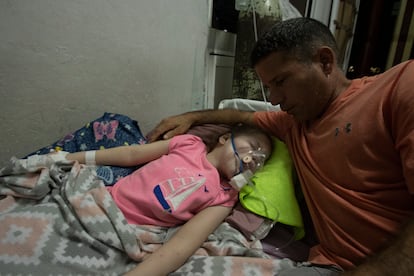
Every so often, the mothers glance at each other in the room. The setting is a far cry from the life they once had. They have nothing left to talk about or to share: the only thing that disrupts their routines is some mishap with the girls. But if all goes well, their daily lives are usually the same.
The mothers get up at around 6:00 a.m. to feed the little ones and get them ready. At 8:00 a.m., the doctors arrive to examine the toddlers, or the physical therapist leads them in their exercises. Then, they bathe them. At midday, it’s time for lunch, which is very well prepared for the little ones, but terrible for the mothers. In the afternoon, the girls can watch cartoons and listen to children’s music. They have dinner at night and go to bed. It’s a repetition of a routine that could be much more bearable if they had electricity in their homes.
“We’re still waiting for the solar panel,” Ramos sighs, exhausted. The government is turning a blind eye to the situation. This mother has also requested housing from the authorities, so that she can leave the remote location where she lives and move to a place where she can quickly reach a doctor in case of an emergency. “But the government claims it doesn’t have the resources to help me,” she explains. “This indifference hurts me; they don’t value the lives of our children.”
Ramos can’t go home right now: she’s scared that a power outage will prevent her daughter from breathing, or that a room without air-conditioning will further harm her health. The lack of electricity means that even blending the food that Valentina needs is impossible. “My daughter’s illness, being separated from my loved ones, not being able to return home, everything I’ve had to endure here is very hard,” says the mother.
While she acknowledges that the care at the hospital “has been good” and that the doctors and nurses have done their best, she emphasizes that the situation — which has taken a toll on everyone — is desperate. “We have to see our family members through a glass partition,” she laments. “I just want to be home with my daughter and enjoy her away from the hospital, for as long as God decides.”
Waiting to go home
Sometimes, he has to mash the food, because there’s no electricity to power the blender. To keep the yogurt fresh, he puts it in buckets of cold water. “Preparing her food is a struggle,” says Baysel Acosta Moreno, age 40. He’s the father of six-year-old Milena Acosta Sánchez. “It’s very difficult for anyone to have a child in these conditions and for everything to depend on electricity.”
Moreno has often had to suction out his daughter’s phlegm by himself. “Because of the lack of electricity, I’ve had to help her,” he describes. The girl suffers from Lennox-Gastaut syndrome, a neurological disorder that causes epilepsy and other severe health problems.
Father and daughter are currently in the Pediatric Hospital in Pinar del Río. But, for a long time, they lived in the admissions ward of the municipality of Guane, for the same reason: they don’t have a generator at home. In the rural area where they live, there are power outages of up to 30 hours at a time. “We’ve been requesting a generator for two years and nothing,” the father shrugs. “[We’ve] been through some very difficult times. She’s had seizures in the middle of the night and I haven’t had any way to turn on the lights or call an ambulance.”
In the province, there are more than 100 households that have children who are living with chronic illnesses. And while government media recently announced that the Tabacuba company has distributed solar panel systems to about 20 of the households, several families who are in contact with this newspaper confirmed that they haven’t received any.
“The answer [from the authorities] is that there’s no equipment available right now. But has anyone considered what our lives are like, or the lives of these children? So many sleepless nights! How much deprivation! We’re waiting to be able to go home together again. Being here [in the hospital] exposes our children to all sorts of illnesses.”
The other parents also share this fear: that not being able to go home might become a permanent situation. “Our children are at greater risk of contracting a virus or a hospital-acquired bacteria,” says Labrador, Yeilín’s mother. “The government and the [Communist Party] always tell me the same thing: that there’s no generator, that I have to wait. This [causes me to have] a mix of feelings: pain, sadness, anger and rage.”
*Translated by Avik Jain Chatlani. *
Sign up for our weekly newsletter to get more English-language news coverage from EL PAÍS USA Edition