The third transfer of Mexican criminal leaders to the United States in the last year is reverberating south of the Rio Grande, with citizens aware that transfers and expulsions of this kind shape the present, and possibly the future, of the bilateral relationship. In Sinaloa, the region from which many of those transferred come, both now and in the two previous transfers in August and February, the feeling is one of caution. The departure of criminal figures from the country illustrates the progress made by…
The third transfer of Mexican criminal leaders to the United States in the last year is reverberating south of the Rio Grande, with citizens aware that transfers and expulsions of this kind shape the present, and possibly the future, of the bilateral relationship. In Sinaloa, the region from which many of those transferred come, both now and in the two previous transfers in August and February, the feeling is one of caution. The departure of criminal figures from the country illustrates the progress made by the Security Cabinet in the region, but the problem — the war between factions of the Sinaloa Cartel — persists. “There has been progress, but the security problem remains unresolved,” says one of the experts consulted.
The arrest of Daniel Alfredo Blanco, alias “El Cubano,” one of the 37 men transferred on Tuesday, sheds light on the above. Captured last week, his removal from the criminal scene and expedited extradition to the U.S. effectively ends his criminal activities in Mexico, a move that benefits Washington’s demands. The U.S. government, led by Donald Trump, sought El Cubano’s extradition to try him for being one of the Sinaloa Cartel’s financial operators, specifically for the Los Chapitos faction, commanded by Iván Archivaldo Guzmán, one of the sons of the group’s historical leader, Joaquín “El Chapo” Guzmán.
But the absence of El Cubano, like those of Güero Canobbio before him, Martín Zazueta, alias “Piyi,” or Juan Carlos Félix Gastelum, “El Chavo Félix,” does not necessarily imply a reduction in street violence in the northwestern Mexican state: 2024 was one of the deadliest years in Sinaloa’s history, but 2025 was even worse. A comparative analysis of reports filed between January and December 2024 with those from January to December 2025, with thousands dead and missing, confirms that Sinaloa faces a persistent and escalating cycle of violence.
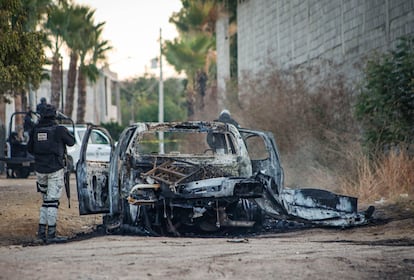
The war between Los Chapitos and the faction led by the sons of El Chapo’s old ally, Ismael “El Mayo” Zambada, which began in September 2024, has left the state reeling. The numbers bear this out. For example, femicide cases jumped from 31 in 2024 to 72 in 2025, a 132% increase. Vehicle thefts, committed by criminals on both sides, rose by 70%, with 6,851 reports in 2025 compared to 4,019 in 2024. Murders have also increased, rising by 66%, from 993 to 1,653 reported cases. The same is true for disappearances, which increased by 44%, with 2,208 reports in 2025 compared to 1,529 in 2024.
For the State Council for Public Security (CESP), a citizen organization working in Sinaloa to research and propose policies on the matter, the arrest and transfer of Daniel Alfredo Blanco broadly reflects what these operations have meant: a strategy with little impact on reducing crime. “It’s like a thousand-headed monster; you grab one and 10 more appear. What we’ve been observing is that these are kids of 13, 14, 16, 20 years old, doing jobs where they’re paid 6,000 pesos (around $340)… or less. Maybe they’re not even paid; they’re beaten, forced,” one of the CESP researchers told this newspaper.
“We’ve been living with a monster for 50 years, one that was everywhere, even before the war — in business, on the streets, everywhere. We saw it when the war started, when many of those businesses closed, when many people left,” the investigator added. Blanco is just one of the 3,236 people arrested in Sinaloa in the last year. In the last 12 months, authorities have also seized 5,271 firearms, more than one million rounds of ammunition, and 5,832 improvised explosive devices. They also located more than 29 tons of drugs, 258 clandestine laboratories, and 5,954 marijuana and poppy fields, according to official data from the Public Security Secretariat.
The war has meant spending millions on technology and weaponry. The Sinaloa state government, led by Rubén Rocha of the ruling Morena party, purchased four armored Super Duty trucks, 29 patrol cars, six motorcycles, 124 firearms, 480 magazines, and 250,133 rounds of ammunition, as well as an outlay of 108 million pesos to buy 613 security cameras — a favorite target of criminals in the first months of the war — and 100 new monitoring points.
For the CESP, the war won’t end solely with arrests and seizures. As the state secretary of public security said on January 21 in the local Congress: “Without shifting the blame, I think the solution for Sinaloa… I believe we all have a little something to contribute, a little bit… At home, at school, those who are parents, all of us together, otherwise we won’t be able to do it.” He added: “The numbers are there, numbers of arrests, of weapons, and we’re going to keep arresting them, taking away their weapons and ammunition. We’re not going to stop. I don’t recall, and I have 40 years of service, any other time in the country, anywhere else in the country, with so many seizures, and we’re going to continue operating every day.”
Sign up for our weekly newsletter to get more English-language news coverage from EL PAÍS USA Edition