Key Takeaways:
- Outsourcing continues to grow rapidly, with the U.S. market expected to surpass $500 billion by 2030.
- More American companies than ever are outsourcing, with 66% already doing so and 80% planning to expand their use of third-party talent.
- Cost savings and access to specialized talent remain the strongest drivers of outsourcing for both small businesses and large enterprises.
- Offshoring amplifies the benefits of outsourcing, enabling companies to tap global labor markets with more favorable wage structures.
- A wide range of roles can be outsourced, including admin, customer support, marketing, IT, development, accounting, and more.
- The Philippines stands out as a top outsourcing destination, offering a strong talent pool, cul…
Key Takeaways:
- Outsourcing continues to grow rapidly, with the U.S. market expected to surpass $500 billion by 2030.
- More American companies than ever are outsourcing, with 66% already doing so and 80% planning to expand their use of third-party talent.
- Cost savings and access to specialized talent remain the strongest drivers of outsourcing for both small businesses and large enterprises.
- Offshoring amplifies the benefits of outsourcing, enabling companies to tap global labor markets with more favorable wage structures.
- A wide range of roles can be outsourced, including admin, customer support, marketing, IT, development, accounting, and more.
- The Philippines stands out as a top outsourcing destination, offering a strong talent pool, cultural compatibility, and exceptional value for U.S. companies.
Outsourcing labor is more popular than ever. As of 2024, approximately 300,000 jobs in the US were outsourced, and the entire industry was estimated to be worth $300 billion. These numbers are only expected to increase. By 2030, the US outsourcing industry is expected to be worth over $500 billion. This significant growth reflects a clear trend among American companies outsourcing their operations.
Outsourcing labor is a complicated topic. Businesses naturally have many questions, and they are all worth asking. So, what exactly is outsourcing, and why do companies outsource? Let’s explore why companies that outsource are succeeding, the roles they should consider, where to find global talent, and how to get started.
Outsourcing Today
Outsourcing and offshoring are intertwined, and both are more popular than ever, with their popularity expected to grow. Many businesses and many countries benefit greatly from the practice. Any business needs to understand the nuances of outsourcing and offshoring, and, just as importantly, have an idea of which countries are ideal for the practice.
Outsourcing Vs Offshoring
What is the difference between outsourcing and offshoring?
Outsourcing today, in terms of labor, is the practice by which a company contracts with an external, third-party provider to perform specific tasks, functions, or services that its own internal employees would otherwise carry out.
When this outsourced labor is performed by individuals or teams located in a country other than the contracting company’s primary operations, the practice is known as offshoring. This strategic model involves leveraging global talent pools and differences in wages and cost of living to get any business the best workforce for less.
Why do companies outsource?
In current business conditions, companies are looking for cost-effective solutions that maintain quality and support growth. Outsourcing provides a potent strategy to achieve this by allowing firms to access skilled labor, support functions, and technology services without the full cost or overhead of building them in-house.
Why do large companies outsource?
Large enterprises outsource for reasons including: reducing operating costs, accessing specialised talent, scaling quickly, redirecting internal resources to strategic priorities, and improving overall efficiency. According to a recent report, 92% of Global 2000 companies have active IT outsourcing contracts. Another key driver: many U.S. companies outsource to cut costs and focus on core business tasks.
“Outsourcing has evolved into a strategic necessity, giving companies instant access to global expertise while keeping costs controllable.”
Outsourcing in the USA
Roughly 66% of American businesses reported outsourcing at least one department by 2024, and the practice is only going to get more common in the coming years, with 80% of executives planning to maintain or increase their use of third-party outsourcing.
Why US Companies are Outsourcing
Offshoring itself has a long history in the US. Multinational conglomerates that emerged early in the nation’s history leveraged their international presence to build a customer and manufacturing base spanning the globe. The practice of offshoring as we know it today began in the 1960s and ’70s as a way for American companies to outsource manufacturing at lower cost. Among the early innovators in the field was International Business Machines (IBM). The practice has taken off since its origins, and countless businesses now use offshoring not just for manufacturing, but also for everything from customer service and tech support to product design and development, showcasing the evolving reasons companies outsource.
Cutting labor costs
Reducing labor expenses is one of the primary reasons why companies outsource. Outsourcing can significantly reduce a business’s costs. Labor alone can account for over 70% of a business’s expenses, and any reduction could make a massive difference in its ability to operate. By switching to an offshore labor force, companies can reduce labor expenses by upwards of 70%, and the savings don’t seem to be slowing down anytime soon.
Accessing the best talent
A lack of talent is also one of the most significant drivers of companies’ outsourcing and offshore operations today. Specialized, experienced employees can be hard to find in the US, and when they are, they often command a premium. By outsourcing, businesses can easily bring in talent from anywhere in the world, access specialized and experienced workers no matter where they are, and do so more affordably than their domestic counterparts.
Economic and political reasons
The current economic and political scene is also a major driving factor. Trump’s tariffs have created - and continue to make - a significant amount of financial uncertainty. Businesses are naturally looking to hedge their bets against a murky future, and many companies that outsource workers see outsourcing as an effective way to reduce expenses and risk.
Businesses today see all of these reasons and more as justifications for outsourcing. Even if your company doesn’t face these specific challenges, all businesses face challenges, and outsourcing can provide the solutions you may need.
“With two-thirds of U.S. businesses already outsourcing, American companies are embracing global talent more aggressively than ever.”
Outsourcing Stats & Trends
2025 Outsourcing Statistics
Labor outsourcing is on the rise, and the numbers prove it:
- Roughly 48% of American businesses offshore at least part of their workforce.
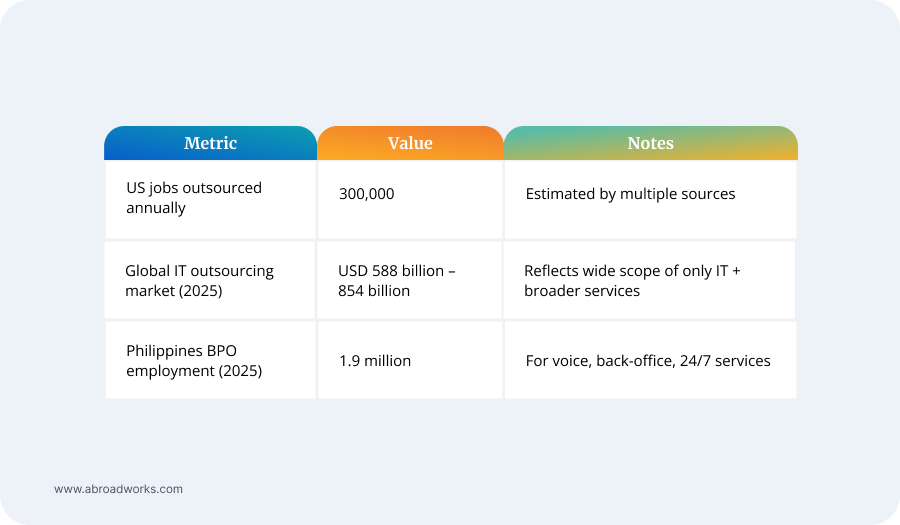
- Roughly 300,000 American jobs are outsourced every year.
- Approximately 70% of businesses that outsource did so for cost-saving reasons.
- The global outsourcing market is worth over $90 billion in total contract value.
- The outsourcing market is expected to reach $525.23 billion by 2030.
- More than 33% of small businesses reported outsourcing at least one department, and over 50% plan to do so.
- Roughly 9% of the Philippines’ entire GDP.
- Approximately 300,000 jobs are outsourced from the United States each year.
- Global spending on outsourcing is forecast at about** **USD 588–854 billion in 2025, depending on segment and definitions.
- Around 92% of G2000 companies use IT outsourcing.
- The offshore outsourcing industry in the Philippines employed nearly 1.9 million full-time workers in 2025 for BPO/KPO functions.
Trends & job counts
Quick facts
- 59% of companies say they outsource to reduce costs and focus on core tasks.
- Small-business uptake: 37% of small businesses outsource at least one process.
“The U.S. outsourcing industry is projected to surge past $500 billion by 2030, signaling a permanent shift toward distributed workforces.”
What Roles Should Be Outsourced?
Outsourcing today isn’t fixed to any specific role, but the times have changed, and American companies outsourcing today have more options than ever. Historically, the outsourcing and offshoring of labor was limited to low-skilled labor: cheap manufacturing jobs, basic customer support, and sales, but outsourcing can now be used to fill countless roles that were once reserved exclusively for highly educated in-office workers.
Virtual Assistants
Virtual assistants are a standard position for companies that outsource. They can work from anywhere in the world and still help manage a business’s operations, provide support, manage schedules, and handle day-to-day tasks. They can significantly increase any business’s productivity and are quickly becoming an indispensable resource. By using an offshore virtual assistant, a company can drastically reduce the expenses associated with hiring a domestic one, making them the go-to option for any business looking to hire one.
Accountants and Bookkeepers
Businesses can easily outsource accounting and financial positions anywhere in the world. Almost every qualified accountant or financial professional today has literacy in the international aspects of the trade and can be helpful in any business anywhere in the world. To work effectively in today’s business environment, knowing the rules and regulations across borders is a virtual necessity, and any business can find a skilled accountant who can work within their local tax code anywhere in the world.
Marketing Specialists and Graphic Designers
Marketing and graphic design are also ideal positions for offshore workers and teams. A skilled artist is a skilled artist no matter where they are in the world, and they can easily create something that meets a business’s desired specifications. But marketing is no longer just about simple graphics. Skilled employees who can manage your online presence might make all the difference. Employees who specialize in optimizing your business for search engine compatibility and always keep you at the top are a vital resource in today’s market. Both can be readily managed by an employee anywhere on the planet.
IT & Tech Support
Companies can also easily manage tech support offshore. An employee from anywhere in the world can give you or anyone in your business a hand with whatever computer issues pop up. The fundamentals of computers are virtually universal, no matter where you are in the world. Operating systems are standardized across the board, and applications right alongside them. For American companies outsourcing, IT is a prime target.
Companies that outsource have an advantage in both their ability to find talent and fill roles without the premium price tag. Any business should seek to take the same advantage.
“From administrative support to highly technical roles, outsourcing lets companies fill talent gaps quickly without sacrificing quality.”
Where Should You Outsource?
Where can companies that outsource find talent today? The sky’s the limit. Skilled individuals can be found anywhere in the world, but there are a handful of popular destinations often preferred by American companies outsourcing.
India
India has long been a tech hub of the world. The nation has some of the best engineering and IT universities on the planet. English is also one of the most popular languages in the country, with over 100 million speakers. The country’s low cost of living, combined with its low wages and favorable exchange rates, makes it attractive and a top choice for companies that outsource.
Philippines
The Philippines is another popular destination for American companies outsourcing. It is the fifth-largest English-speaking country in the world, with English one of the nation’s two official languages. The country also boasts a high-quality education system, producing top-notch graduates with degrees in computer science, finance, accounting, and marketing. Like India, the Philippines also benefits from low wages and a low cost of living.
South Africa
South Africa is also growing in popularity as a destination for the outsourcing and offshoring of labor. South Africa is considered part of the Anglosphere, and English is one of the most widely spoken languages in the nation. South Africa is well known for having some of the best universities on the planet and has become a technological and economic hub of the African continent. Like many other popular destinations for American companies outsourcing, South Africa also has low wages and a low cost of living.
For businesses that outsource or are looking to outsource, there is no place in the world they cannot go to find the right employees for the job.
“Choosing the right country to outsource to can dramatically impact cost, quality, culture fit, and long-term scalability.”
Outsourcing to the Philippines
Why outsourcing to the Philippines?
The Philippines stands out as a leading offshore destination for several reasons:
- Cost efficiency without compromising quality. Firms achieve lower wage costs yet maintain high standards.
- Highly-skilled workforce with strong English proficiency and Western cultural alignment.
- Time-zone flexibility, enabling near real-time operations with US/Western clients.
- Government support in the form of tax incentives, infrastructure, and promotion of the BPO/KPO sector.
Key advantages
- **Cost efficiency **- Compared to US or Western wage levels, labor in the Philippines is significantly lower while retaining quality.
- **Workforce skills & English proficiency **- English is an official language, and the country ranks high on indices of non-native proficiency.
- Cultural compatibility - The Philippines enjoys a strong cultural affinity with Western markets, helping smooth communication and customer-facing services.
- Time zone flexibility & 24/7 operations - Ideal for companies that need continuous service or wish to extend operating hours economically.
- Government support - The industry receives regulatory support and is a key sector in the economy.
Overcoming outsourcing challenges
While there are many advantages to outsourcing to the Philippines, here are some common challenges and how to overcome them:
- Internet connectivity - Some locations may still experience unstable connectivity. Look for providers with strong infrastructure and backup systems.
- Time-zone coordination - Even though there is overlap, management tools (Trello, Asana, Slack) and clear workflows help coordinate effectively.
- Data security - Compliance (e.g., ISO 27001) and strong cybersecurity practices are essential.
- **Cultural & workflow integration **- Onboarding and regular communication help integrate offshore teams into existing processes.
- Talent retention & turnover - Employees in the BPO sector may shift; offering career growth, competitive pay, and engagement will help retain top talent.
“The Philippines has become a global outsourcing powerhouse thanks to its skilled workforce, cultural alignment, and exceptional English proficiency.”
FAQ
Why do US companies continue outsourcing?
They seek cost savings, access to skilled talent, scalability, and the ability to focus internal resources on core business activities.
Why do large companies outsource?
Large companies outsource to reduce overhead, achieve operational efficiency, access global talent, accelerate growth, and manage risk.
How many US jobs are outsourced?
Estimates suggest that about 300,000 jobs are outsourced from the United States each year.
What is the role of an outsourced staffing agency?
An outsourced staffing agency should be considered the starting point for any business looking to work with offshore outsourced labor. Outsourcing and offshore staffing agencies are essential for any business to leverage offshore labor successfully.
A reputable outsourced staffing agency can help a business find the best candidates for the job, manage the hiring process, and assist with the bureaucratic and legal steps. They can also help streamline the payment process, benefits, and holiday scheduling.