December 10, 2025
3 min read
Making fire on demand was a milestone in the lives of our early ancestors. But the question of when that skill first arose has been difficult for scientists to pin down
By Meghan Bartels edited by Andrea Thompson
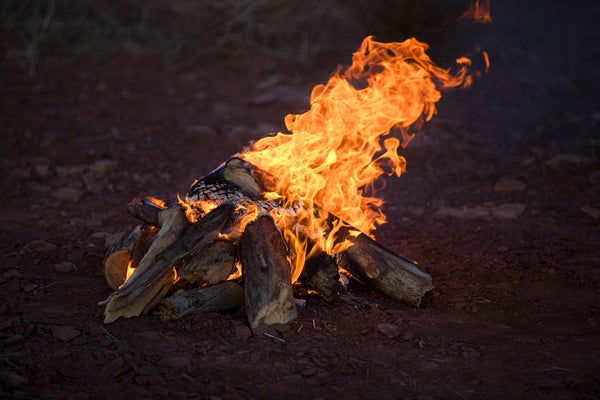
New evidence suggests humans made fire 400,000 years ago, some 350,000 years before the previous earliest evidence.
THEPALMER/Getty Images
Set aside your matches or lighter …
December 10, 2025
3 min read
Making fire on demand was a milestone in the lives of our early ancestors. But the question of when that skill first arose has been difficult for scientists to pin down
By Meghan Bartels edited by Andrea Thompson
New evidence suggests humans made fire 400,000 years ago, some 350,000 years before the previous earliest evidence.
THEPALMER/Getty Images
Set aside your matches or lighter and try to start a fire—chances are you’d be left cold and hungry. But as early as 400,000 years ago, ancient hominins may have had the skills to conjure flame, according to groundbreaking new evidence of fire making that is 350,000 years older than scientists’ previous earliest example.
Investigators looking to understand our ancestors have long been interested in the technology surrounding fire that they possessed. Researchers argue that as ancient hominins developed the ability to control fire, they would have changed physically—developing a smaller stomach and a more powerful brain thanks to cooking providing them with the ability to more easily metabolize food—as well as socially, with individuals being able to build more complex relationships around a hearth.
But traces of fire use are difficult to come by, leaving archaeologists’ attempts to date these developments frustrated. “Things like ash and charcoal, they’re very light, so they move very easily,” says Sarah Hlubik, a paleoarchaeologist at St. Mary’s College of Maryland, who was not involved in the new research. “A lot of the evidence kind of disappears.”
On supporting science journalism
If you’re enjoying this article, consider supporting our award-winning journalism by subscribing. By purchasing a subscription you are helping to ensure the future of impactful stories about the discoveries and ideas shaping our world today.
In addition, it’s challenging to distinguish whether ancient hominins were making fire themselves or capturing fire from natural lightning strikes and tending to it. Overall, scientists believe that some human ancestors in Africa may have been using fire as early as 1.5 million years ago but have fiercely debated whether hominins could have been making their own fire so far in the past. To date, the earliest evidence of hominins making fire has been much more recent—from only 50,000 years ago.
“Before seeing this, I would have said, no, people didn’t make fire at this time period,” says Amy Clark, an archaeologist at Harvard University, who was also not involved in the new research.
The new evidence comes from an English site called Barnham, which scientists have been excavating for decades. Researchers noticed a patch of soil that was unusually red, a characteristic that is known to occur when dirt is repeatedly heated. Tests confirmed that the material developed in place and did so from being repeatedly heated to temperatures of 400 to 750 degrees Celsius (752 to 1,382 degrees Fahrenheit), independent of any regional fire activity.
One of two small nodules of iron pyrite found at Barnham, a 400,000-year-old archaeological site in England.
Jordan Mansfield, Pathways to Ancient Britain Project
Continued excavations turned up four stone hand axes that had been shattered by fire. Most convincingly of all, the researchers uncovered two tiny fragments of iron pyrite. This mineral—not naturally found within nearly 10 miles of the Barnham site—can create sparks when it’s struck by flint.
This is not a perfect finding: in an ideal world, the researchers would also have found the scars left behind on flint and pyrite from the fire-sparking process. But it’s unprecedented evidence of early fire making.
“To me, the modern-day equivalent would be if the police found a burned-out car in a remote bit of woodland with an empty petrol can, and they drew the conclusion one was related to the other,” says study co-author Nick Ashton, an archaeologist at the British Museum.
Even researchers who are not affiliated with the work agree that the team has made a compelling discovery. “The evidence for fire is really quite solid,” says Gilliane Monnier, an archaeologist at the University of Minnesota. “It’s a very rare find.”
No hominin remains have been found at the site, leading to some uncertainty about who precisely would have been conjuring flames. Scientists have found a skull with Neandertal characteristics farther south in England, but the inhabitants of the Barnham site may have instead been Homo heidelbergensis, a second early hominin species. Either way, these ancient humans were skilled foragers and hunter-gatherers who lived in small groups of perhaps a dozen people and only rarely crossed paths with other bands.
These hominins’ isolated lifestyle may also make it dangerous for scientists to extrapolate evidence from a single site to the population at large, says Dennis Sandgathe, an archaeologist at Simon Fraser University in British Columbia, who was not involved in the new research. He says he’s convinced that the Barnham finds do represent early fire making but argues that such technology would have been discovered and—likely more often—forgotten many times in many places over the hundreds of millennia at play in scientists’ reconstruction of the time line of fire making.
After all, he says, archaeologists have explored dozens of sites from this portion of the Paleolithic, representing hundreds of ancient human groups over time. At no site besides Barnham has anyone ever found iron pyrite, the “smoking gun” of the new research. If this technology were widespread, he says, someone would have noticed before now.
“We’d all love to find a piece of pyrite,” Sandgathe says. “We’d pounce on it if it showed up.”
It’s Time to Stand Up for Science
If you enjoyed this article, I’d like to ask for your support. Scientific American has served as an advocate for science and industry for 180 years, and right now may be the most critical moment in that two-century history.
I’ve been a Scientific American subscriber since I was 12 years old, and it helped shape the way I look at the world. SciAm always educates and delights me, and inspires a sense of awe for our vast, beautiful universe. I hope it does that for you, too.
If you subscribe to Scientific American, you help ensure that our coverage is centered on meaningful research and discovery; that we have the resources to report on the decisions that threaten labs across the U.S.; and that we support both budding and working scientists at a time when the value of science itself too often goes unrecognized.
In return, you get essential news, captivating podcasts, brilliant infographics, can’t-miss newsletters, must-watch videos, challenging games, and the science world’s best writing and reporting. You can even gift someone a subscription.
There has never been a more important time for us to stand up and show why science matters. I hope you’ll support us in that mission.