December 9, 2025
7 min read
On our Best Fiction of 2025 list, Emma Pattee imagines Portland’s worst Earthquake in her debut novel Tilt
By Brianne Kane edited by Jeanna Bryner
Climate journalist Emma Pattee has been worried about the so-called big one—an off-the-charts earthquake—hitting her town in Portland, Ore., for some time now. She’s not alone: scientists estimate at least a 37 percent lik…
December 9, 2025
7 min read
On our Best Fiction of 2025 list, Emma Pattee imagines Portland’s worst Earthquake in her debut novel Tilt
By Brianne Kane edited by Jeanna Bryner
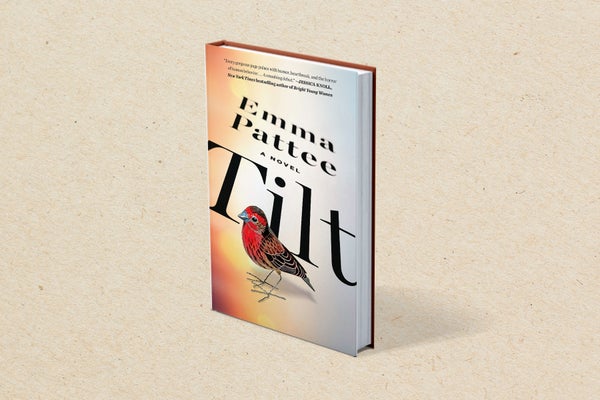
Climate journalist Emma Pattee has been worried about the so-called big one—an off-the-charts earthquake—hitting her town in Portland, Ore., for some time now. She’s not alone: scientists estimate at least a 37 percent likelihood that such a temblor will strike the Pacific Northwest, which sits along the Cascadia subduction zone, in the next 50 years. In her debut novel Tilt, voted one of Scientific American’s best fiction books of 2025, Pattee explores this hypothetical day through the eyes of Annie, a Portland local who is nine months pregnant and shopping for cribs at IKEA when disaster strikes. Through the novel, Annie goes on an epic journey to get home and in doing so makes some profound discoveries.
Scientific American spoke with Pattee about what the inspiration for her book was and why it was so important for her to get the science right.
[An edited transcript of the interview follows.]
On supporting science journalism
If you’re enjoying this article, consider supporting our award-winning journalism by subscribing. By purchasing a subscription you are helping to ensure the future of impactful stories about the discoveries and ideas shaping our world today.
Your book opens with a detailed map of Portland. Why did you decide to focus on this location?
I came to this idea, like so many writers, because I live in Portland and I’m a climate journalist. I was at IKEA, and the idea came to me; I knew that I wanted to write something hyperrealistic, not realizing how hard of a challenge it would be to write a “nonfiction fiction” book about something that hasn’t happened yet.
As a science journalist, what science messages do you hope readers will take away from this book?
Just to be clear, this is not a work of climate fiction, though certainly it is an allegory of climate fiction. I think what I hope people will take from the book is that the “big” earthquake is not a scenario where everyone is going to die. And in Portland around the time I was writing, that’s how a lot of people talked about this hypothetical earthquake, saying things like, “What’s the point of prepping—because everyone’s just going to die.” Very few people were speaking in a grounded way. Something that came from writing this book is the understanding that not that many people are going to die in the earthquake, but you are going to deeply want water, and the people around you are going to need water, and you’re going to feel like such a bad human that you didn’t get water for the vulnerable and sick people around you.
Why did you decide to explore this hypothetical earthquake through fiction?
I think a lot of really great nonfiction has already been written about this earthquake. There’s a book called Full-Rip 9.0 by Sandi Doughton. It’s fantastic. There’s the Pulitzer Prize–winning article in the New Yorker by Kathryn Schulz about earthquake risk in the Pacific Northwest; there’s not much I could add to that. What interested me the most is that you can write so much about science, but people still struggle to take it home, to see how it’s going to impact their lives. I started to feel like a lot of the work I was doing around climate change was just writing for other scientists. There’s really not a lot written that would just tell a regular person living in Portland what they might need to expect, emotionally or otherwise.
The story does a good job of not sensationalizing or invoking too much fear in the reader, but it also illustrates that a mega earthquake would be very bad. It almost sounds like a kind of preparedness exercise for you. Is that accurate?
I don’t think it was a preparedness prompt mainly because, without spoiling the ending, she’s not prepared! I’m not prepared for the earthquake. How do we live under the shadow of something that’s coming that everyone says we should get prepared for, but there’s actually no way to prepare for it? That’s climate change, and that’s an earthquake that’s going to destroy our city. But that’s also parenthood and having a child. I think that was more what I was writing about than, like, how could someone life-hack the earthquake, which I still don’t know.
This book is disturbingly mundane in parts; I think your opening scene is the perfect example of this. Why did you start off with Annie shopping in IKEA?
I’m sure a lot of that is about my work as a climate journalist. I would talk to these scientists, and then we would turn off the recorder and have these incredibly painful conversations; then I would have to grab my kid from school and go food shopping. I’m somehow holding this idea that we potentially are looking at extinction, and I still have to go get yelled at by a daycare teacher because I brought the wrong size diapers. I am very interested in that aspect of modern life right now. In the beginning Annie is so shaped by consumerism, and the earthquake literally shakes her free of that. At the end, she maybe comes back to her more authentic, beastly form. That’s terrifying, but in some ways, is that also beautiful?
How did you keep track of Annie through time and space so closely?
I extensively used Google Maps and mapped her route. I wrote a lot of this book on the streets where it happened. I wrote a lot of this book in IKEA. I spent so much time in these physical spaces, really trying to describe things as accurately as possible. I went to an earthquake drill at a brick school [building]. I went to an emergency training day with our neighborhood emergency teams here, and I had first-person interviews with people who were on site after major earthquakes in China [in 2008] and in [the autonomous region Azad Kashmir in Pakistan in 2005]. I even rode a bike while 40 weeks pregnant because people kept saying they didn’t think the bike scene was believable. I worked with a graduate student—basically we came up with the magnitude of earthquake and picked the date the earthquake was going to happen. We came up with how much rainfall there had been so we could come up with soil conditions. That level of accuracy almost became a North Star for me. I do think it’s a really hard way to write fiction, and I wouldn’t recommend it to anybody.
One feature of the novel that stood out was your use of flashbacks. Were you just giving the reader a breath, or is there something else that you were trying to explore?
Yeah, I mean, 9/11 was the primary source material that I used for this book. I really leaned so heavily on 9/11 accounts. I read a lot of accounts about people [who needed] to take long walks to get home and along the way came to really big decisions about their lives. And that was so interesting to me. Why does Annie need to change her life? And why does this change feel sort of impossible without the earthquake? I think for her it’s also about the sort of internal inventory of her life. I’ve met people who have experienced this suspended moment in time where their priorities became really, really clear, and you have a chance to change your life. For me, that is the central message of the book: there’s still time to change your life.
One of the most harrowing scenes involves Annie finding some parents who are looking for their lost children in a collapsed school building. How did you keep that scene so touching as a human and also scientifically accurate?
The school scene was very complicated for me because there are almost two dozen schools here in Portland at risk of collapse in a large earthquake. As I was writing the book, I really learned how this is a profound moral dilemma to send children to school in buildings like that. I felt such a moral weight about writing a scene like that; it was so important to me that it was very accurate. I brought in actual rescue experts to read that and tell me if it was realistic. I am a parent of young children in Portland. A lot of my friends have kids who go to those schools. It was really important that I wasn’t going to make it worse than it would be and I wasn’t going to make it better than it would be. In a sort of a strange twist of fate, the local paper here ran that scene the week my book was published next to a reported article that I wrote. There was just an enormous amount of uproar from it that pushed the school board to commit to fixing 10 of the most dangerous brick buildings, which was something that parents had been working on for more than a decade.
How did writing this book change your perspective on earthquakes, humanity and life in general?
When I started writing it, I thought a big earthquake meant people would be breaking into my home to take my food and water. I have had such a profound shift. Part of that is becoming a parent and being much more connected to my community. I really started to see that my goal in preparing for the earthquake is not so that I have food and water for myself and my kids but that I have enough to share with the most vulnerable people on my street. Preparedness, for me, has become more of a civic duty—shifting from this feeling of fear to thinking it might actually be an opportunity where I could help other people fills me with so much meaning.
Can you tell me what other books on this subject—or that you used in your research or maybe that you’ve read recently—you could recommend?
For my research I read The Dog Stars by Peter Heller. I read a book called Wave by Sonali Deraniyagala, who lost her children in the tsunami in the Indian Ocean. It is a very, very intense read. I’m reading a book called Confidence by Rafael Frumkin, and it’s fantastic. Another book that really had a big impact on me was Weather by Jenny Offill, a fictional book about climate change.
It’s Time to Stand Up for Science
If you enjoyed this article, I’d like to ask for your support. Scientific American has served as an advocate for science and industry for 180 years, and right now may be the most critical moment in that two-century history.
I’ve been a Scientific American subscriber since I was 12 years old, and it helped shape the way I look at the world. SciAm always educates and delights me, and inspires a sense of awe for our vast, beautiful universe. I hope it does that for you, too.
If you subscribe to Scientific American, you help ensure that our coverage is centered on meaningful research and discovery; that we have the resources to report on the decisions that threaten labs across the U.S.; and that we support both budding and working scientists at a time when the value of science itself too often goes unrecognized.
In return, you get essential news, captivating podcasts, brilliant infographics, can’t-miss newsletters, must-watch videos, challenging games, and the science world’s best writing and reporting. You can even gift someone a subscription.
There has never been a more important time for us to stand up and show why science matters. I hope you’ll support us in that mission.