December 10, 2025
2 min read
Cross-species “defense pacts” help animals keep tabs on parasites and predators
By Jesse Greenspan edited by Sarah Lewin Frasier
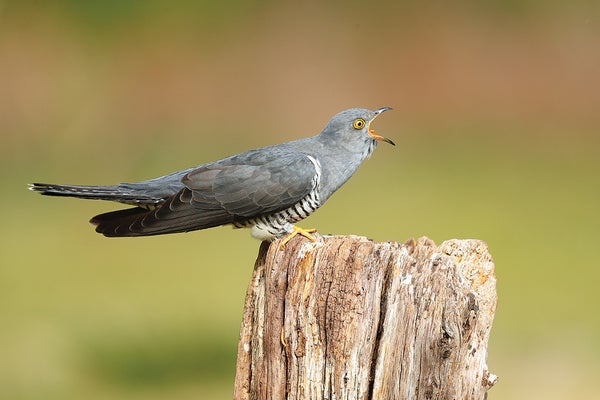
Parasitic cuckoos are many birds’ common enemy.
Bebedi/Getty Images
Join Our Community of Science Lovers!
When danger approaches, many creatures seem to follow the ancient proverb that “the enemy of my enemy is my friend.” R…
December 10, 2025
2 min read
Cross-species “defense pacts” help animals keep tabs on parasites and predators
By Jesse Greenspan edited by Sarah Lewin Frasier
Parasitic cuckoos are many birds’ common enemy.
Bebedi/Getty Images
Join Our Community of Science Lovers!
When danger approaches, many creatures seem to follow the ancient proverb that “the enemy of my enemy is my friend.” Researchers have recently been finding subtle ways that animals communicate with other species in this kind of cooperative defense pact.
For example, a recent study in Nature Ecology & Evolution* *documented more than 20 bird species on four continents that emit virtually identical “whining” calls when they spot brood parasites such as cuckoos. That call is essentially “the word for ‘cuckoo,’” says study co-lead author James Kennerley, an ornithologist at Cornell University. “And it’s recruiting individuals to come together [against] this common enemy.”
On supporting science journalism
If you’re enjoying this article, consider supporting our award-winning journalism by subscribing. By purchasing a subscription you are helping to ensure the future of impactful stories about the discoveries and ideas shaping our world today.
Brood parasites lay eggs in other birds’ nests, manipulating the host parents into raising their chicks for them. At a field site in Australia, Kennerley has witnessed individuals from a dozen or more species mob a cuckoo in response to a chorus of whining calls. These mobs can be so ferocious that Kennerley and his colleagues need to cage the taxidermy cuckoo used in their experiments to protect it. Otherwise the attacking birds would have “just completely shredded it to pieces,” Kennerley says.
Many birds also share a common vocabulary for predators. Research by wildlife ecologist Erick Greene, an emeritus professor at the University of Montana, and others shows that various songbirds—and even red squirrels—produce recognizable “seet” calls to warn of a raptor in flight. The calls are too high-pitched for raptors to hear well, so the predators remain oblivious as info about their arrival shoots through the forest. If the raptor perches, songbirds switch to “mobbing” calls, a distinct vocalization that, as Greene puts it, “draws in the troops [to] drive that raptor out of Dodge.”
Monkeys, lemurs and chipmunks also recognize other species’ alarm calls. And in coral reefs, unrelated fish seem to swap visual and chemical cues as protection against dangers such as hungry barracudas. But cooperative defense is not the only reason for cross-species communication. Among other things, it may help birds migrate and enhance food intake among mixed-species monkey troops and dolphin pods. A recent study in the Proceedings of the National Academy of Sciences USA found that when seabirds with good vision, such as black-browed albatrosses, forage with seabirds with strong senses of smell, such as white-chinned petrels, they both have far greater success at catching krill. Unlike with the seet and whining calls, however, it’s unclear whether they’re deliberately signaling to one another or “just randomly following other birds,” says study lead author Jesse Granger, an organismal biophysicist at Duke University.
But clearly, “very complex multispecies communication networks are pervasive,” Greene says. “It really behooves [animals] to pay attention to one another,” he adds. “It can save their lives.”* *
It’s Time to Stand Up for Science
If you enjoyed this article, I’d like to ask for your support. Scientific American has served as an advocate for science and industry for 180 years, and right now may be the most critical moment in that two-century history.
I’ve been a Scientific American subscriber since I was 12 years old, and it helped shape the way I look at the world. SciAm always educates and delights me, and inspires a sense of awe for our vast, beautiful universe. I hope it does that for you, too.
If you subscribe to Scientific American, you help ensure that our coverage is centered on meaningful research and discovery; that we have the resources to report on the decisions that threaten labs across the U.S.; and that we support both budding and working scientists at a time when the value of science itself too often goes unrecognized.
In return, you get essential news, captivating podcasts, brilliant infographics, can’t-miss newsletters, must-watch videos, challenging games, and the science world’s best writing and reporting. You can even gift someone a subscription.
There has never been a more important time for us to stand up and show why science matters. I hope you’ll support us in that mission.