Deep inside the labyrinth of corridors at the British Museum, once every so often, the ringing of a school bell can be made out.
Its clattering noise can send new employees skidding down between offices in search of the commotion, but for those accustomed to the quirks within the institution’s four walls, the ritual is a well-known celebration.
Whenever there is a breakthrough in the quest to find hundreds of missing treasures from the museum’s Greek and Roman collections, the hardy six-…
Deep inside the labyrinth of corridors at the British Museum, once every so often, the ringing of a school bell can be made out.
Its clattering noise can send new employees skidding down between offices in search of the commotion, but for those accustomed to the quirks within the institution’s four walls, the ritual is a well-known celebration.
Whenever there is a breakthrough in the quest to find hundreds of missing treasures from the museum’s Greek and Roman collections, the hardy six-person team will raise the signal to sound the golden bell in a moment of feverish excitement.
”It’s become a slightly weird rituation within the team,” says Professor Tom Harrison, leader in the search, who was persuaded to buy the bell by an ex-colleague inspired by television programmes where estate agents ring it when they make a sale.
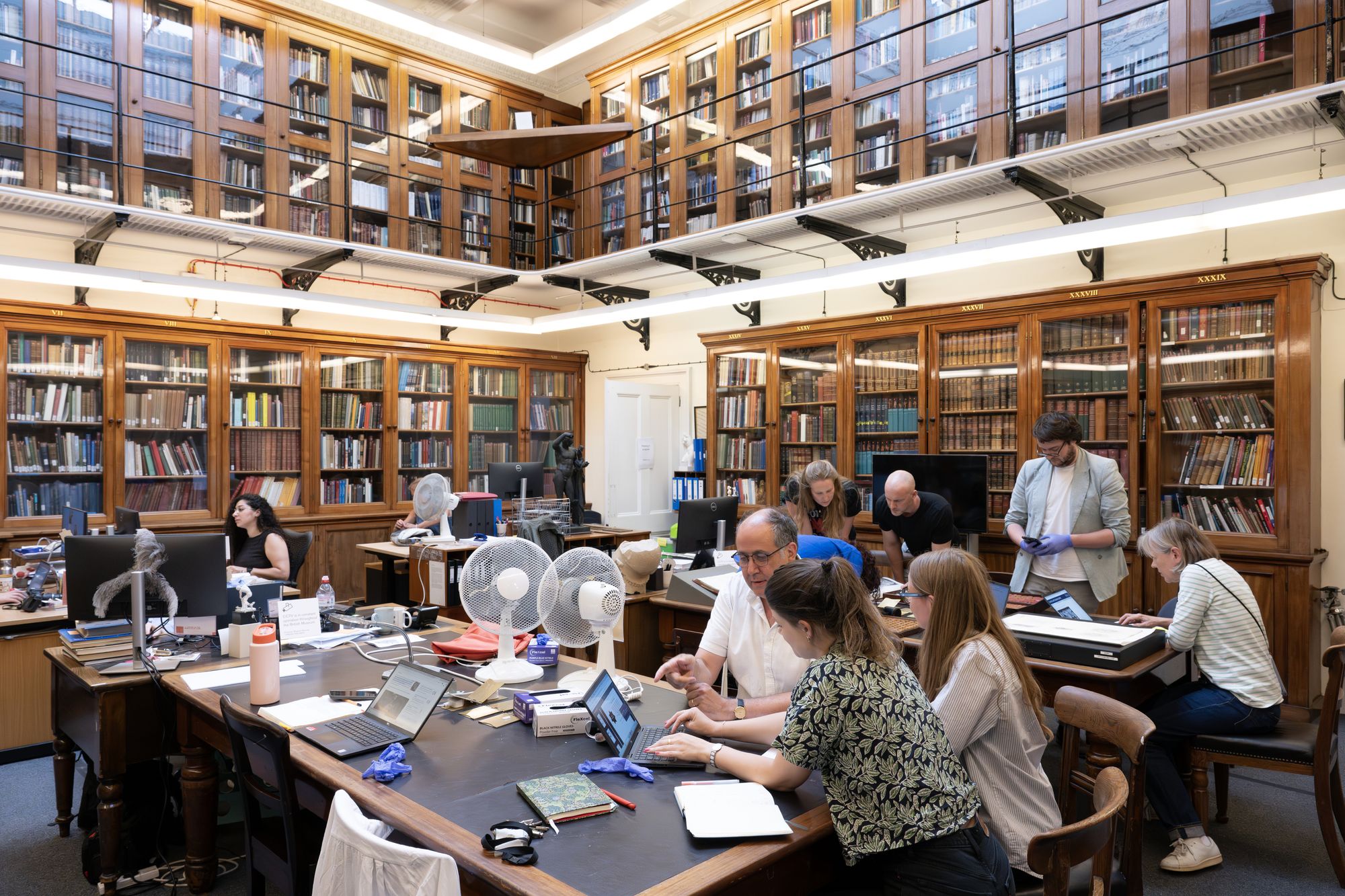
Professor Tom Harrison (centre front) working with his team inside the British Museum on tracing missing items (British Museum)
“At the beginning, we hadn’t built up databases to make lots of matches [for missing items], so when we were able to identify a missing object, it was like a needle in a haystack moment where you think, ‘My God, how did we do that?’”
It is now more than two years since the institution broke the news that many of its precious artefacts were missing, stolen or damaged – later disclosed as around 2,000 items – from its Greece and Rome collections.
The revelation triggered a Metropolitan Police investigation, which is still ongoing, and prompted in-house emergency measures to improve security before an independent review recommended the museum document its entire collection.
At the time, George Osborne, chairman of the museum, declared recovering the missing treasures was a top priority – a job that fell on the shoulders of Prof Harrison, who had just been put in charge of the department.
The hoard of valuable items, many of them unregistered, included gold jewellery and classical gems dating as far back as the late Bronze Age.
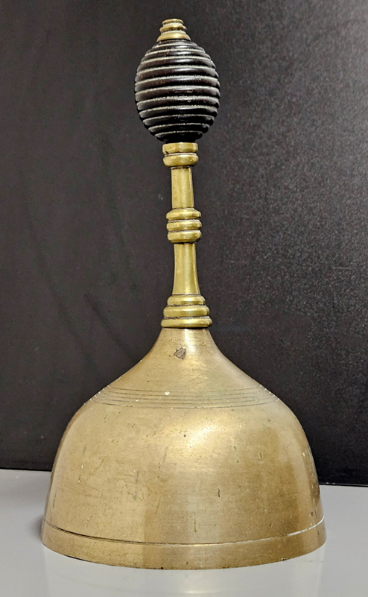
The bell rung by members of the British Museum’s recovery team with every major breakthrough in finding missing items (British Museum)
“I took a real holiday about a year after I arrived because there was so little time and so much pressure,” Prof Harrison says.
Assigned with a recovery team of enthusiastic workers, Prof Harrison began the painstaking work of not only tracing objects through recorded transactions and sales catalogues, but also creating a database of all the items.
With a lack of information recorded digitally, their methods could be described as old-fashioned police detective work.
Some members scoured handwritten notes on collections purchased by the museum hundreds of years ago to identify missing items, while others checked in-stock items against archive catalogues to ensure they were fully intact.
Some searched out items known to be missing, using a growing database of known-missing artefacts, as well as tip-offs, to check artefacts up for sale, or sold on up to more than a decade ago.

Among the gems recovered is this ancient glass intaglio with Bacchus standing, leaning on Silenus Roman. It is dated to between late 1st century BC and 1st century AD (British Museum)
“In some cases, we’ve had to track things down that have had four or five different possessors, and have sometimes gone on rather long and elaborate journeys, ending up, weirdly, not far from us,” says Prof Harrison.
“We’ve had things that have gone all around Europe, three or four countries, then returned to London, where we’ve found them. Equally, we’ve retrieved items from European countries and North America.”
But finding a suspected missing object isn’t always the final challenge.
Before bringing an item to the UK from abroad, the team must get an export licence, sometimes taking many months to secure. The country’s law enforcement agencies in the countries need to also be informed.
Then, crucially, the owner of the item must be persuaded to let go of their possession. Under its own guidance, the museum will not pay more than the price the person paid for it.
-with-Jupiter-as-an-eagle-abducting-Ganymede-Roman-late-1st-century-B.jpeg)
Another gem recovered is this ancient glass intaglio with Jupiter as an eagle abducting Ganymede Roman. It dates to between 1st Century BC and 1st Century AD (British Museum)
However, most people are cooperative, says Prof Harrison.
“An awful lot of people have only been too happy to give the items back to us without payment,” he says. “They get the offer of payment, but they don’t in the end choose to take it, which is incredibly decent and big of them.
“I can see that sometimes people have to go through a bit of a grieving process as they like the object and they might ask for evidence that we think it is ours, but then actually they behave entirely reasonably and want to be part of the positive story.”
But there are dead ends.
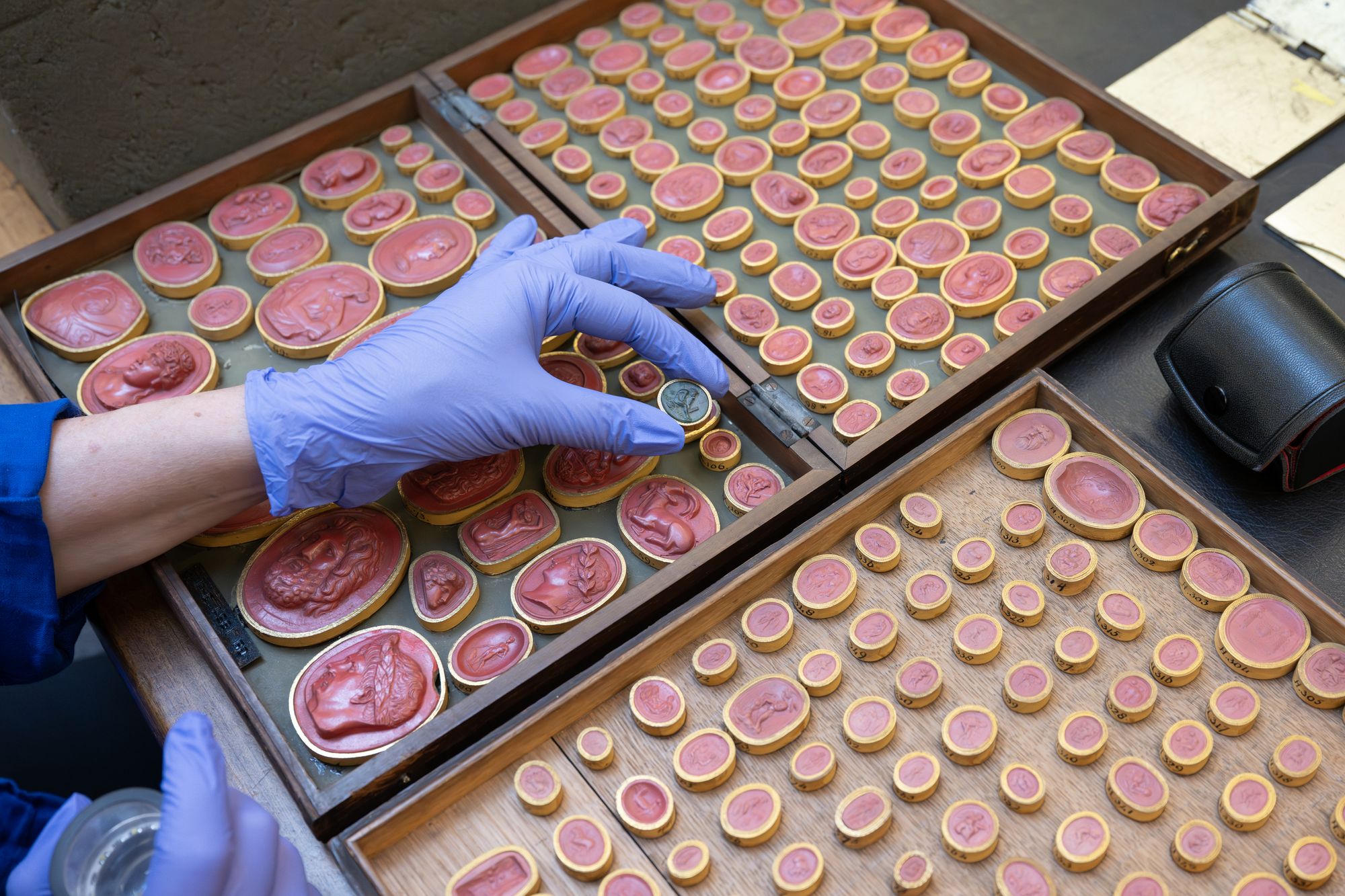
Gems in stock are also checked for damage or missing parts as part of the recovery team’s work (British Museum)
The team will receive a tip-off of a missing item that, after spending time researching and inspecting, will turn out to be a copy.
“It’s why when you keep plugging away, that when you get an item returned, it feels amazingly liberating and wonderful, because you’ve gone through the struggle to track it down, while there are other items we only know the last location.”
Out of the estimated 1,500 items missing, Prof Harrison and his team have recovered 654. But with many of the items found so far from large groups of gems, progress on the figure has slowed, with the team dealing more with small numbers, or even individual gems.
There is also a race to track down the gold items, which could be melted down as its price continues to soar.
How many of the items will get recovered?
“The melting down of gold is a major limitation on us, but we’re ambitious to try and get as much as we can back,” says Prof Harrison. “It will keep continuing. I strongly suspect things will continue to come back long after I’ve retired or died.”
Sitting on Prof Harrison’s desk, the golden bell waits for the next breakthrough.