December 2025
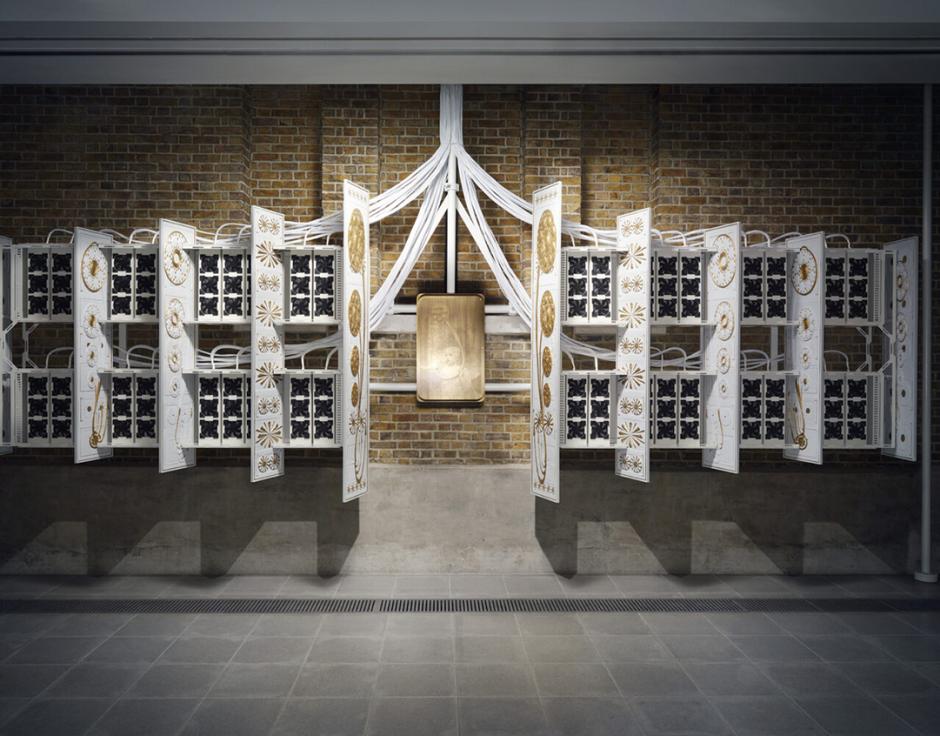
The Call: Holly Herndon and Mat Dryhurst’s exhibition at the Serpentine Gallery, London. Photo by Leon Chew
The music industry’s uptake of AI complicates the boundaries between listener, artist and music in troubling new ways, argues DeForrest Brown, Jr
Automating ourselves out of existence is trending.
Our habit of referring to music as an aesthetic object has guided a widespread shift in the way we experience a musician’s workflow as recorded audio. The conversation around – as opposed to resistance against – music streaming services largely focuses on the ac…
December 2025
The Call: Holly Herndon and Mat Dryhurst’s exhibition at the Serpentine Gallery, London. Photo by Leon Chew
The music industry’s uptake of AI complicates the boundaries between listener, artist and music in troubling new ways, argues DeForrest Brown, Jr
Automating ourselves out of existence is trending.
Our habit of referring to music as an aesthetic object has guided a widespread shift in the way we experience a musician’s workflow as recorded audio. The conversation around – as opposed to resistance against – music streaming services largely focuses on the accessibility and fungibility of music that far exceeds the capacity of our collective attention spans. Without much headroom, sound circulates as editable waveforms in a loop that does not require interpretation or participation. This de-centering of the musician’s workflow enables large streaming catalogues to be animated by AI-enabled virtual instruments and protocols that subvert authorship – partially to the comfort of the listener, who is no longer burdened by the intentions or emotions of any given song or album’s author. In this sense, platforms such as Spotify, TikTok, and AI-generated music systems act as quasi-sovereign actors, shaping which cultural narratives circulate and which are excluded, functioning as vectors of soft power across global audiences.
The automation of music did not begin with artificial intelligence or streaming, but with a quiet social agreement that sound could be managed like inventory. In 1998, in the beginning pages of More Brilliant Than The Sun: Adventures In Sonic Fiction, Kodwo Eshun outlined a transatlantic logistics and distribution system of physical music and ephemeral culture. “As a US or Euro import, a test pressing, a white label DJ promo, a double pack, a triple pack or a 10", the single is the rare object that everyone wants, that most people never get to see,” he wrote. “The 12" is the hardback of music, the ltd-edn run of 2000 copies that sells out in three days, never to be seen again.” Eshun’s description of a pre-internet network of music circulating among DJs, journalists, and eventually the consumer, resembles that of book publications where reissues in different formats determine the overall availability of music in the public sphere.
Much thought has been put into unlocking the algorithmic function of Spotify’s ‘black box’ that begets both curated and assembly line-like ‘playlists’ that replaced, or for now, operate in parallel with weekly album releases. Much less thought has been put into why we create music within this specific age of post-internet, end-stage capitalism where music has been normalised into sono-semiotic databases.
In reality, sound is not measured in decibels or beats per minute, but is instead experienced in real time as an unfiltered acoustic phenomenon. Songwriting marshals sounds in a supposedly organised fashion that leads the mind along a linear path within a specific span of time. Within that time, a song could technically do or be anything within the limits of what has been recorded, mixed and mastered in the moments prior to reaching a listener’s ears. And yet, much music adheres to a standard of chorus-verse-chorus-bridge-chorus among other logical variations.
Spending time with music and its surrounding mediasphere, I began to notice a pattern in the way music is being released and consumed: a quasi-reciprocal choreography between artists (creator) and audience (consumer). This customisable relationship of give-and-receive operates in an ambient commons that in many ways resembles and represents the tastes and imaginations of everyday society. Loops of attention and algorithmic recommendation function as a form of soft power, subtly dictating what is culturally legible, while the infrastructure of streaming itself – code, metadata, and interface design – acts as governance, shaping behaviour and influence beyond explicit human intervention.
In January 2023 an online publication titled “After the Creative Economy” by Yancey Strickler, co-founder of Metalabel and former CEO of Kickstarter, critiqued the revenue-focused ecosystem defining the “creative economy”, where attention online is monetised rather than cultivated. He reproached the way in which digital music distribution has been entirely geared around revenue with less focus on the process of creation. Digital music distribution, he argued, prioritises commodification over creation: “Everyone treated music as this infinite resource to be endlessly commoditised and sold, but nobody thought about the conditions of the musicians who made it, where new music came from, or how it was meant to be financed.” What we’ve seen of the creative economy has in many ways illustrated cultural dependence on corporate-controlled platforms: artists and audiences alike become enmeshed in systems whose governance is algorithmic and opaque, while the infrastructure of distribution itself posits a governing architecture that subtly choreographs participation, labour and value.
Imagining a music industry without people has been a recurring thought of mine since the emergence of vaporwave, a digital-native non-genre that metabolised nostalgia for late 1990s and early 2000s retail, pop and cyber culture. Vaporwave did not produce new music per se, but instead reimagined existing commercial audio production and consumption, accelerating them into sample packs of metamodernist aesthetics to vibe to. Pre-digital generations tend to be nostalgic for iconic, socially shared moments in music history, while post-digital generations desire playback as affirmation of music’s aesthetic potential for the future.
This future-oriented nostalgia has reshaped music distribution: ‘old music’ from pre-file sharing eras now outsells new music, signalling a potential post-internet scarcity of music that has not already been archived within the circulatory system of physical recording formats – or, further still, a scarcity of collective memory not indexed by platforms. For example, Oneohtrix Point Never’s Tranquilizer salvaged digitised sample CDs of 1990s commercial muzak, while the sibling duo Chuquimamani-Condori and Joshua Chuquimia Crampton’s Los Thuthanaka infused self-released, unmastered CD-Rs with ancestral wisdom and ceremonial textures, actively resisting algorithmically curated flows rather than supplying them.
Instrumentalising artificial intelligence has become a nonspherical approach to culture production and distribution in the absence of object-permanence in an online marketplace. Holly Herndon and Mat Dryhurst have used their own online ecosystem of the Interdependence podcast as well as two major art exhibitions at the Serpentine Gallery in London and the KW Institute for Contemporary Art in Berlin as a way to organise and publicly build a ledger of the ever-changing landscape of AI specific technology and its effects on musical expression.
For more than a decade, the two have advocated for the use of laptops and other computerised instruments to be considered legitimate modes of creative cultural production while also using the podcast industry, art world and speculative economics to demonstrate the potential benefits of advanced technology and other vapourware in their prototype stages. “AI is a deceptive, over-abused term. Collective Intelligence (CI) is more useful,” Herndon suggested in a tweet later quoted by Jacobin: “It’s often just us (our labour/data), in aggregate, harnessed to produce value by a few, who maybe have an easier time acting with impunity because we are distracted by fairytales about sentient robots.” The article goes on to explore another observation of Herndon’s in which AI music is described as an evolution of audio samples that should be imagined as a “recording technology 2.0”.
Inside the digital audio workstation (DAW), the logic of a recording technology 2.0 intensifies. Suno, an emerging generative AI platform designed to create music from text prompts, entered a landmark partnership with Warner Music Group. This acquisition addressed prior copyright disputes while also establishing a framework for fully licensed AI music models similar to a previous deal WMG made with the personalised soundscape app Endel in 2019. A recording music 2.0 might allow users to describe genre, tempo, mood and instrumentation without real world acoustic resonance into fully realised tracks or stems based on legal intellectual property and behavioural metadata that can then be mixed, edited and exported in standard audio formats compatible with DAWs and DJ software for further processing and analysis.
The CDJ as a prosumer player device could potentially standardise workflow into a “prosumptive listening”, in which Suno and AlphaTheta facilitate a parallel domain of performance, where authorship dissolves into prompts, skill into compatibility, and listening into metrics. As of 18 December, Universal Music Group entered into a partnership with cloud-based music creation platform Splice, to offer prosumers AI-powered virtual instruments and workflows trained on UMG’s entire catalogue of over seven million recordings and compositions. With minimal human input, this potential experimentation with platform convergence places a new emphasis on how intellectual properties might be distributed and valued between creator and consumer, if at all.
Music has always been haunted by the tension between creation, distribution and consumption. From Kodwo Eshun’s rare vinyl to Spotify’s algorithmic playlists to AI generated tracks, the evolution of music reflects shifts in cultural and economic priorities. The question is not whether automation will replace human creativity, but how we choose to participate in a culture industry that increasingly blurs the lines between audience, creator and product.
You can read more critical reflections on the state of underground music in 2025 in The Wire 503/504. Wire subscribers can also read the issue in our online magazine library.