Efficient memorization using the spacing effect: literature review of widespread applicability, tips on use & what it’s good for.
Spaced repetition is a centuries-old psychological technique for efficient memorization & practice of skills where instead of attempting to memorize by ‘cramming’, memorization can be done far more efficiently by instead spacing out each review, with increasing durations as one learns the item, with the scheduling done by software. Because of the greater efficiency of its slow but steady approach, spaced repetition can scale to memorizing hundreds of thousands of items (while crammed items are almost immediately forgotten) and is especially useful for foreign languages & medical studies.
I review what this technique is useful for, some of the large r…
Efficient memorization using the spacing effect: literature review of widespread applicability, tips on use & what it’s good for.
Spaced repetition is a centuries-old psychological technique for efficient memorization & practice of skills where instead of attempting to memorize by ‘cramming’, memorization can be done far more efficiently by instead spacing out each review, with increasing durations as one learns the item, with the scheduling done by software. Because of the greater efficiency of its slow but steady approach, spaced repetition can scale to memorizing hundreds of thousands of items (while crammed items are almost immediately forgotten) and is especially useful for foreign languages & medical studies.
I review what this technique is useful for, some of the large research literature on it and the testing effect (up to ~2013, primarily), the available software tools and use patterns, and miscellaneous ideas & observations on it.
One of the most fruitful areas of computing is making up for human frailties. They do arithmetic perfectly because we can’t1. They remember terabytes because we’d forget. They make the best calendars, because they always check what there is to do today. Even if we do not remember exactly, merely remembering a reference can be just as good, like the point of reading a manual or textbook all the way through: it is not to remember everything that is in it for later but to later remember that something is in it (and skimming them, you learn the right words to search for when you actually need to know more about a particular topic).
We use any number of such neuroprosthetics2, but there are always more to be discovered. They’re worth looking for because they are so valuable: a shovel is much more effective than your hand, but a power shovel is orders of magnitude better than both - even if it requires training and expertise to use.
Spacing Effect
You can get a good deal from rehearsal, If it just has the proper dispersal. You would just be an ass, To do it en masse, Your remembering would turn out much worsal.
Ulrich Neisser3
My current favorite prosthesis is the class of software that exploits the spacing effect, a centuries-old observation in cognitive psychology, to achieve results in studying or memorization much better than conventional student techniques; it is, alas, obscure4.
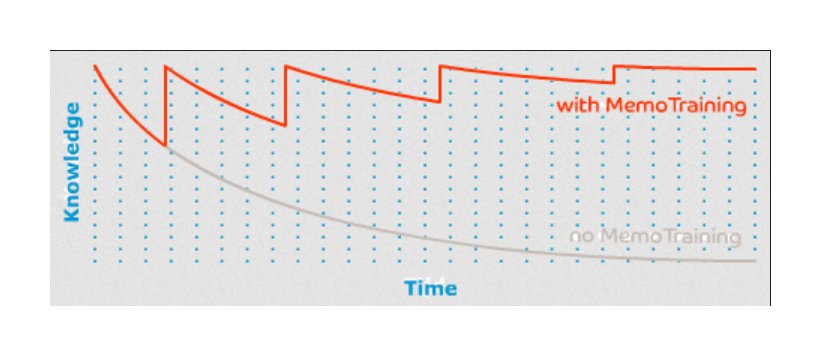
The spacing effect essentially says that if you have a question (“What is the fifth letter in this random sequence you learned?”), and you can only study it, say, 5 times, then your memory of the answer (‘e’) will be strongest if you spread your 5 tries out over a long period of time - days, weeks, and months. One of the worst things you can do is blow your 5 tries within a day or two. You can think of the ‘forgetting curve’ as being like a chart of a radioactive half-life: each review bumps your memory up in strength 50% of the chart, say, but review doesn’t do much in the early days because the memory simply hasn’t decayed much! (Why does the spacing effect work, on a biological level? There are clear neurochemical differences between massed and spaced in animal models with spacing (>1 hour) enhancing long-term potentiation but not massed5, but the why and wherefore - that’s an open question; see the concept of memory traces or the sleep studies.) A graphical representation of the forgetting curve:

Stahl et al 2010; CNS Spectrums
Even better, it’s known that active recall is a far superior method of learning than simply passively being exposed to information.6 Spacing also scales to huge quantities of information; gambler/financier Edward O. Thorp harnessed “spaced learning” when he was a physics grad student “in order to be able to work longer and harder”7, and Roger Craig set multiple records on the quiz show Jeopardy! 2010–201114ya in part thanks to using Anki to memorize chunks of a collection of >200,000 past questions8; a later Jeopardy winner, Arthur Chu, also used spaced repetition9. Med school students (who have become a major demographic for SRS due to the extremely large amounts of factual material they are expected to memorize during medical school) usually have thousands of cards, especially if using pre-made decks (more feasible for medicine due to fairly standardized curriculums & general lack of time to make custom cards). Foreign-language learners can easily reach 10-30,000 cards; one Anki user reports a deck of >765k automatically-generated cards filled with Japanese audio samples from many sources (“Youtube videos, video games, TV shows, etc”).
A graphic might help; imagine here one can afford to review a given piece of information a few times (one is a busy person). By looking at the odds we can remember the item, we can see that cramming wins in the short term, but unexercised memories decay so fast that after not too long spacing is much superior:

Wired (original, Wozniak?); massed vs spaced (alternative)
It’s more dramatic if we look at a video visualizing decay of a corpus of memory with random review vs most-recent review vs spaced review.
If You’re so Good, Why Aren’t You Rich
Most people find the concept of programming obvious, but the doing impossible.10
Of course, the latter strategy (cramming) is precisely what students do. They cram the night before the test, and a month later can’t remember anything. So why do people do it? (I’m not innocent myself.) Why is spaced repetition so dreadfully unpopular, even among the people who try it once?11

Scumbag Brain meme: knows everything when cramming the night before the test / and forgets everything a month later
Because it does work. Sort of. Cramming is a trade-off: you trade a strong memory now for weak memory later. (Very weak12.) And tests are usually of all the new material, with occasional old questions, so this strategy pays off! That’s the damnable thing about it - its memory longevity & quality are, in sum, less than that of spaced repetition, but cramming delivers its goods now13. So cramming is a rational, if short-sighted, response, and even SRS software recognize its utility & support it to some degree14. (But as one might expect, if the testing is continuous and incremental, then the learning tends to also be long-lived15; I do not know if this is because that kind of testing is a disguised accidental spaced repetition system, or the students/subjects simply studying/acting differently in response to small-stakes exams.) In addition to this short-term advantage, there’s an ignorance of the advantages of spacing and a subjective illusion that the gains persist1617 (cf. Son & Simon201218, Mulligan & Peterson2014, Bjork et al 2013, Deslauriers et al 2019); from Kornell2009’s study of GRE vocab (emphasis added):
Across experiments, spacing was more effective than massing for 90% of the participants, yet after the first study session, 72% of the participants believed that massing had been more effective than spacing….When they do consider spacing, they often exhibit the illusion that massed study is more effective than spaced study, even when the reverse is true (Dunlosky & Nelson, 1994; Kornell & Bjork, 200817yaa; Simon & Bjork2001; Zechmeister & Shaughnessy, 1980).
As one would expect if the testing and spacing effects are real things, students who naturally test themselves and study well in advance of exams tend to have higher GPAs.19 If we interpret questions as tests, we are not surprised to see that 1-on-1 tutoring works dramatically better than regular teaching and that tutored students answer orders of magnitude more questions20.
This short-term perspective is not a good thing in the long term, of course. Knowledge builds on knowledge; one is not learning independent bits of trivia. Richard Hamming recalls in “You and Your Research” that “You observe that most great scientists have tremendous drive….Knowledge and productivity are like compound interest.”
Knowledge needs to accumulate, and flashcards with spaced repetition can aid in just that accumulation, fostering steady review even as the number of cards and intellectual prerequisites mounts into the thousands.
This long term focus may explain why explicit spaced repetition is an uncommon studying technique: the pay-off is distant & counterintuitive, the cost of self-control near & vivid. (See hyperbolic discounting.) It doesn’t help that it’s pretty difficult to figure out when one should review - the optimal point is when you’re just about to forget about it, but that’s the kicker: if you’re just about to forget about it, how are you supposed to remember to review it? You only remember to review what you remember, and what you already remember isn’t what you need to review!21
The paradox is resolved by letting a computer handle all the calculations. We can thank Hermann Ebbinghaus for investigating in such tedious detail than we can, in fact, program a computer to calculate both the forgetting curve and optimal set of reviews22. This is the insight behind spaced repetition software: ask the same question over and over, but over increasing spans of time. You start with asking it once every few days, and soon the human remembers it reasonably well. Then you expand intervals out to weeks, then months, and then years. Once the memory is formed and dispatched to long-term memory, it needs but occasional exercise to remain hale and hearty23 - I remember well the large dinosaurs made of cardboard for my 4th or 5th birthday, or the tunnel made out of boxes, even though I recollect them once or twice a year at most.
Literature Review
But don’t take my word for it - Nullius in verba! We can look at the science. Of course, if you do take my word for it, you probably just want to read about how to use it and all the nifty things you can do, so I suggest you skip all the way down to that section. Everyone else, we start at the beginning:
Background: Testing Works!
“If you read a piece of text through twenty times, you will not learn it by heart so easily as if you read it ten times while attempting to recite from time to time and consulting the text when your memory fails.” –The New Organon, Francis Bacon
The testing effect is the established psychological observation that the mere act of testing someone’s memory will strengthen the memory (regardless of whether there is feedback). Since spaced repetition is just testing on particular days, we ought to establish that testing works better than regular review or study, and that it works outside of memorizing random dates in history. To cover a few papers:
Allen, G.A., Mahler, W.A., & Estes, W.K. (196956ya). “Effects of recall tests on long-term retention of paired associates”. Journal of Verbal Learning and Verbal Behavior, 8, 463-470
1 test results in memories as strong a day later as studying 5 times; intervals improve retention compared to massed presentation. 1.
Karpicke & Roediger (200322ya). “The Critical Importance of Retrieval for Learning”
In learning Swahili vocabulary, students were given varying routines of testing or studying or testing and studying; this resulted in similar scores during the learning phase. Students were asked to predict what percentage they’d remember (average: 50% over all groups). One week later, the students who tested remembered ~80% of the vocabulary versus ~35% for non-testing students. Some students were tested or studied more than others; diminishing returns set in quickly once the memory had formed the first day. Students reported rarely testing themselves and not testing already learned items.
Lesson: again, testing improves memory compared to studying. Also, no student knows this. 1.
Roediger & Karpicke (200619yaa). “Test-Enhanced Learning: Taking Memory Tests Improves Long-Term Retention”
Students were tested (with no feedback) on reading comprehension of a passage over 5 minutes, 2 days, and 1 week. Studying beat testing over 5 minutes, but nowhere else; students believed studying superior to testing over all intervals. At 1 week, testing scores were ~60% versus ~40%.
Lesson: testing improves memory compared to studying. Everyone (teachers & students) ‘knows’ the opposite. 1.
Karpicke & Roediger (200619yaa). “Expanding retrieval promotes short-term retention, but equal interval retrieval enhances long-term retention”
General scientific prose comprehension; from Roediger & Karpicke2006b: “After 2 days, initial testing produced better retention than restudying (68% versus 54%), and an advantage of testing over restudying was also observed after 1 week (56% versus 42%).” 1.
Roediger & Karpicke (200619yab). “The Power of Testing Memory: Basic Research and Implications for Educational Practice”
Literature review; 7 studies before 194184ya demonstrating testing improves retention, and 6 afterwards. See also the reviews “Spacing Learning Events Over Time: What the Research Says” & “Using spacing to enhance diverse forms of learning: Review of recent research and implications for instruction”, Carpenter et al 2012. 1.
Agarwal et al 2008, “Examining the Testing Effect with Open- and Closed-Book Tests”
As with #2, the purer forms of testing (in this case, open-book versus closed-book testing) did better over the long run, and students were deluded about what worked best. 1.
Bangert-Drowns et al 1991. “Effects of frequent classroom testing”
Meta-analysis of 35 studies (1929–60198936ya) varying tests during school semesters. 29 found benefits; 5 found negatives; 1 null result. Meta-study found large benefits to testing even once, then diminishing returns. 1.
Cook2006, “Impact of self-assessment questions and learning styles in Web-based learning: a randomized, controlled, crossover trial”; final scores were higher when the doctors (residents) learned with questions. 1.
Johnson & Kiviniemi2009, “The Effect of Online Chapter Quizzes on Exam Performance in an Undergraduate Social Psychology Course” (“This study examined the effectiveness of compulsory, mastery-based, weekly reading quizzes as a means of improving exam and course performance. Completion of reading quizzes was related to both better exam and course performance.”); see also McDaniel et al 2012. 1.
Metsämuuronen2013, “Effect of Repeated Testing on the Development of Secondary Language Proficiency” 1.
Meyer & Logan2013, “Taking the Testing Effect Beyond the College Freshman: Benefits for Lifelong Learning”; verifies testing effect in older adults has similar effect size as younger 1.
Larsen & Butler2013, “Test-enhanced learning” 1.
Yang et al 2021, “Testing (Quizzing) Boosts Classroom Learning: A Systematic And Meta–Analytic Review”
(One might be tempted to object that testing works for some learning styles, perhaps verbal styles. This is an unsupported assertion inasmuch as the experimental literature on learning styles is poor and the existing evidence mixed that there are such things as learning styles.24)
Subjects
The above studies often used pairs of words or words themselves. How well does the testing effect generalize?
Materials which benefited from testing:
foreign vocabulary (eg. Karpicke & Roediger2003, Cepeda et al 2009, Fritz et al 200725, de la Rouviere2012)
GRE materials (like vocab, Kornell2009); prose passages on general scientific topics (Karpicke & Roediger, 200619yaa; Pashler et al, 200322ya)
trivia (McDaniel & Fisher1991)
elementary & middle school lessons with subjects such as biographical material and science (Gates1917; Spitzer193926 and Vlach & Sandhofer201227, respectively)
Agarwal et al 2008: short-answer tests superior on textbook passages
history textbooks; retention better with initial short-answer test rather than multiple choice (Nungester & Duchastel1982)
LaPorte & Voss1975 also found better retention compared to multiple-choice or recognition problems
Duchastel & Nungester, 1981: 6 months after testing, testing beat studying in retention of a history passage
Duchastel1981: free recall decisively beat short-answer & multiple choice for reading comprehension of a history passage
Glover1989: free recall self-test beat recognition or Cloze deletions; subject matter was the labels for parts of flowers
Kang et al 2007: prose passages; initial short answer testing produced superior results 3 days later on both multiple choice and short answer tests
Leeming2002: tests in 2 psychology courses, introductory & memory/learning; “80% versus 74% for the introductory psychology course and 89% versus 80% for the learning and memory course”28
This covers a pretty broad range of what one might call ‘declarative’ knowledge. Extending testing to other fields is more difficult and may reduce to ‘write many frequent analyses, not large ones’ or ‘do lots of small exercises’, whatever those might mean in those fields:
A third issue, which relates to the second, is whether our proposal of testing is really appropriate for courses with complex subject matters, such as the philosophy of Spinoza, Shakespeare’s comedies, or creative writing. Certainly, we agree that most forms of objective testing would be difficult in these sorts of courses, but we do believe the general philosophy of testing (broadly speaking) would hold-students should be continually engaged and challenged by the subject matter, and there should not be merely a midterm and final exam (even if they are essay exams). Students in a course on Spinoza might be assigned specific readings and thought-provoking essay questions to complete every week. This would be a transfer-appropriate form of weekly ‘testing’ (albeit with take-home exams). Continuous testing requires students to continuously engage themselves in a course; they cannot coast until near a midterm exam and a final exam and begin studying only then.29
Downsides
Testing does have some known flaws:
interference in recall - ability to remember tested items drives out ability to remember similar untested items
Most/all studies were in laboratory settings and found relatively small effects:
In sum, although various types of recall interference are quite real (and quite interesting) phenomena, we do not believe that they compromise the notion of test-enhanced learning. At worst, interference of this sort might dampen positive testing effects somewhat. However, the positive effects of testing are often so large that in most circumstances they will overwhelm the relatively modest interference effects.
multiple choice tests can accidentally lead to ‘negative suggestion effects’ where having previously seen a falsehood as an item on the test makes one more likely to believe it.
This is mitigated or eliminated when there’s quick feedback about the right answer (see Butler & Roediger2008 “Feedback enhances the positive effects and reduces the negative effects of multiple-choice testing”). Solution: don’t use multiple choice; inferior in testing ability to free recall or short answers, anyway.
Neither problem seems major.
Distributed
A lot depends on when you do all your testing. Above we saw some benefits to testing a lot the moment you learn something, but the same number of tests could be spread out over time, to give us the spacing effect or spaced repetition. There are hundreds of studies involving the spacing effect:
Cepeda et al 2006 is a review of 184 articles with 317 experiments; other reviews include:
Ruch1928, “Factors influencing the relative economy of massed and distributed practice in learning”
Crowder1976, Principles of learning and memory
Dempster1989, “Spacing effects and their implications for theory and practice”
Delaney et al 2010, “Spacing and testing effects: A deeply critical, lengthy, and at times discursive review of the literature”
Donovan & Radosevich1999, “A meta-analytic review of the distribution of practice effect: Now you see it, now you don’t”
Greene1992, Human memory: Paradigms and paradoxes
Janiszewski et al 2003, “A meta-analysis of the spacing effect in verbal learning: Implications for research on advertising repetition and consumer memory”
Pavlik & Anderson2003, “An ACT-R model of the spacing effect”
Balota et al 2007, “Is Expanded Retrieval Practice a Superior Form of Spaced Retrieval? A Critical Review of the Extant Literature”
Carpenter et al 2012, “Using Spacing to Enhance Diverse Forms of Learning: Review of Recent Research and Implications for Instruction”
Almost unanimously they find spacing out tests is superior to massed testing when the final test/measurement is conducted days or years later30, although the mechanism isn’t clear31. Besides all the previously mentioned studies, we can throw in:
Peterson, L. R., Wampler, R., Kirkpatrick, M., & Saltzman, D. (196362ya). “Effect of spacing presentations on retention of a paired associate over short intervals”. Journal of Experimental Psychology, 66(2), 206-209
Glenberg, A. M. (197748ya). “Influences of retrieval processes on the spacing effect in free recall”. Journal of Experimental Psychology: Human Learning and Memory, 3(3), 282-294
Balota et al 1989, “Age-related differences in the impact of spacing, lag and retention interval”. Psychology and Aging, 4, 3-9
The research literature focuses extensively on the question of what kind of spacing is best and what this implies about memory: a spacing that has static fixed intervals or a spacing which expands? This is important for understanding memory and building models of it, and would be helpful for integrating spaced repetition into classrooms (for example, Kelley & Whatson2013’s 10 minutes studying / 10 minutes break schedule, repeating the same material 3 times, designed to trigger LTM formation on that block of material?) But for practical purposes, this is uninteresting; to sum it up, there are many studies pointing each way, and whatever difference in efficiency exists, is minimal. Most existing software follows SuperMemo in using an expanding spacing algorithm, so it’s not worth worrying about; as Mnemosyne developer Peter Bienstman says, it’s not clear the more complex algorithms really help32, and the Anki developers were concerned about the complexity, difficulty of reimplementing SM’s proprietary algorithms, lack of substantial gains, & larger errors SM3+ risks attempting to be more optimal. So too here.
For those interested, 3 of the studies that found fixed spacings better than expanding:
Carpenter, S. K., & DeLosh, E. L. (200520ya). “Application of the testing and spacing effects to name learning”. Applied Cognitive Psychology, 19, 619-63633 1.
Logan, J. M. (200421ya). Spaced and expanded retrieval effects in younger and older adults. Unpublished doctoral dissertation, Washington University, St. Louis, MO
This thesis is interesting inasmuch as Logan found that young adults did considerably worse with an expanding spacing after a day. 1.
Karpicke & Roediger, 200619yaa
The fixed vs expanding issue aside, a list of additional generic studies finding benefits to spaced vs massed:
Cepeda et al 2006 (large review used elsewhere in this page)
Karpicke & Roediger2006a
Rohrer & Taylor2006. “The effects of over-learning and distributed practice on the retention of mathematics knowledge”. Applied Cognitive Psychology, 20: 1209–1224 (see also Rohrer & Taylor2007, Rohrer et al 2005)
Seabrook et al 2005. “Distributed and Massed Practice: From Laboratory to Classroom”
Keppel, Geoffrey. “A Reconsideration of the Extinction-Recovery Theory”. Journal of Verbal Learning & Verbal Behavior. 6(4) 196758ya, 476-486
A week later, the massed reviewers went from 5.9 correct → 2.1; the spaced reviewers went from 5.5 → 5.0. (Note the usual observation: massed was initially better, and later much worse, less than half as good.)
Bloom & Schuell1981, “Effects of massed and distributed practice on the learning and retention of second-language vocabulary”
Four days after the 2 high school groups memorized 16 French words, the spaced group remembered 15 and the massed 11.
Rea & Modigliani1985, “The effect of expanded versus massed practice on the retention of multiplication facts and spelling lists”34
A test immediately following the training showed superior performance for the distributed group (70% correct) compared to the massed group (53% correct). These results seem to show that the spacing effect applies to school-age children and to at least some types of materials that are typically taught in school.35
Donovan & Radosevich1999, “A meta-analytic review of the distribution of practice effect: Now you see it, now you don’t”:
According to Donovan & Radosevich’s meta-analysis of spacing studies, the effect size for the spacing effect is d = 0.42. This means that the average person getting distributed training remembers better than about 67% of the people getting massed training. This effect size is nothing to sneeze at-in education research, effect sizes as low as d = 0.25 are considered “practically significant”, while effect sizes above d = 1 are rare.36
In one meta-analysis by Donovan & Radosevich1999, for instance, the size of the spacing effect declined sharply as conceptual difficulty of the task increased from low (eg. rotary pursuit) to average (eg. word list recall) to high (eg. puzzle). By this finding, the benefits of spaced practise may be muted for many mathematics tasks.37
The Donovan meta-analysis notes that the effect size is smaller in studies with better methodology, but still important.
Bahrick, Harry P; Phelphs, Elizabeth. “Retention of Spanish vocabulary over 8 years”. Journal of Experimental Psychology: Learning, Memory, & Cognition. Vol 13(2) April 198738ya, 344-349; the extremely long delay after the initial training period makes this particularly interesting:
Harry Bahrick and Elizabeth Phelps (198738ya) examined the retention of 50 Spanish vocabulary words after an eight-year delay. Subjects were divided into three groups. Each practiced for seven or eight sessions, separated by a few minutes, a day, or 30 days. In each session, subjects practiced until they could produce the list perfectly one time….Eight years later, people in the no-delay group could recall 6% of the words, people in the one-day delay group could remember 8%, and those in the 30-day group averaged 15%. Everyone also took a multiple choice test, and again, the spacing effect was observed. The no-delay group scored 71%, the one-day group scored 80%, and the 30-day group scored 83%.
…Bahrick and his colleagues varied both the spacing of practice and the amount of practice. Practice sessions were spaced 14, 28, or 56 days apart, and totaled 13 or 26 sessions. They tested subjects’ memory one, two, three, and five years after training. Once again, it took a bit longer to reach the criterion within each session when practice sessions were spaced farther apart, but again, this small investment paid dividends years later. It didn’t matter whether testing occurred at one, two, three, or five years after practice-the 56-day group always remembered the most, the 28-day group was next, and the 14-day group remembered the least. Further, the effect was quite large. If words were practiced every 14 days, you needed twice as much practice to reach the same level of performance as when words were practiced every 56 days!
Pashler et al 2003; “Is Temporal Spacing of Tests Helpful Even When It Inflates Error Rates?”
Long intervals between tests necessarily means you will often err; errors were thought to intrinsically reduce learning. While the extra errors do damage accuracy in the short-run, the long intervals are powerful enough that they still win.
works in ill subpopulations:
works on short-term review conducted with Alzheimer’s patients; spacing used on the scale of seconds and minutes, with modest success in teaching object locations or daily tasks to do38:
Camp, C. J. (198936ya). “Facilitation of new learning in Alzheimer’s disease”. In G. C. Gilmore, P. J. Whitehouse, & M. L. Wykle (Eds.), Memory, aging, and dementia (pp. 212-225)
Camp, C. J., & McKitrick, L. A. (199233ya). “Memory interventions in Alzheimer’s-type dementia populations: Methodological and theoretical issues”. In R. L. West & J. D. Sinnott (Eds.), Everyday memory and aging: Current research and methodology (pp. 152-172) -
works with traumatic brain injury; Goverover et al 2009, “Application of the spacing effect to improve learning and memory for functional tasks in traumatic brain injury: a pilot study”
and multiple sclerosis; Goverover et al 2009, “A functional application of the spacing effect to improve learning and memory in persons with multiple sclerosis”
math39:
multiplication (Ria & Modigliani1985)
permuting a sequence (Rohrer & Taylor2006)on
calculating the volume of polyhedrons (Rohrer & Taylor2007)
statistics (Smith & Rothkopf1984)
pre-calculus (Revak199740 but there’s a related null ‘calculus I’ result as well) and algebra (Mayfield & Chase2002, Patac & Patac2013; possible null, Sutherland2013)
medicine (Kerfoot & Brotschi2009, Shaw et al 2012; Kerfoot2009, a 2 year followup to Kerfoot et al 2007 and Kerfoot has a number of other relevant studies; Gyorki et al 2013) and surgery (Moulton et al 2006, “Teaching Surgical Skills: What Kind of Practice Makes Perfect? A Randomized, Controlled Trial”, distributed practice of microvascular suturing; Spruit et al 2014)
introductory psychology (Balch2006, “Encouraging Distributed Study: A Classroom Experiment on the Spacing Effect”41. Teaching of Psychology, 33, 249-252)
8th-grade American history (Carpenter, Pashler, and Cepeda2009)
learning to read with phonics (Seabrook et al 2005)
music (Stambaugh2009)
biology (middle school; Kelly & Whatson2013)
statistics (introductory; Maas et al 2015)
memorizing website passwords (Bonneau & Schechter2014, Blocki et al 2014, Blum & Vempala2017)
possibly not Australian constitutional law (Colbran et al 2015)
Generality of Spacing Effect
We have already seen that spaced repetition is effective on a variety of academic fields and mediums. Beyond that, spacing effects can be found in:
various “domains (eg. learning perceptual motor tasks or learning lists of words)”42 such as spatial43
“across species (eg. rats, pigeons, and humans [or flies or bumblebees, and sea slugs, Carew et al 1972 & Sutton et al 2002])”
“across age groups [infancy44, childhood45, adulthood46, the elderly47] and individuals with different memory impairments”
“and across retention intervals of seconds48 [to days49] to months” (we have already seen studies using years)
The domains are limited, however. Cepeda et al 2006:
[Moss1995, r