Yesterday, Sansec discovered an active keylogger at an external site of one of America’s largest banks. The malware was harvesting private information from over 200,000 potential victims. We detected it within hours of the attack going live. No other security vendor had flagged it.
Then came the hard part: telling someone.
The bank has no security.txt file. No public bug bounty program. No obvious security contact. We sent emails to generic addresses. We reached out via LinkedIn. Hours passed while the malware kept running.
Why big companies are hard to reach
This isn’t an isolated case. The larger the company, the harder it is to report security incidents to the right people.
Procedures don’t accommodate outliers. Large organizations run on standardized processe…
Yesterday, Sansec discovered an active keylogger at an external site of one of America’s largest banks. The malware was harvesting private information from over 200,000 potential victims. We detected it within hours of the attack going live. No other security vendor had flagged it.
Then came the hard part: telling someone.
The bank has no security.txt file. No public bug bounty program. No obvious security contact. We sent emails to generic addresses. We reached out via LinkedIn. Hours passed while the malware kept running.
Why big companies are hard to reach
This isn’t an isolated case. The larger the company, the harder it is to report security incidents to the right people.
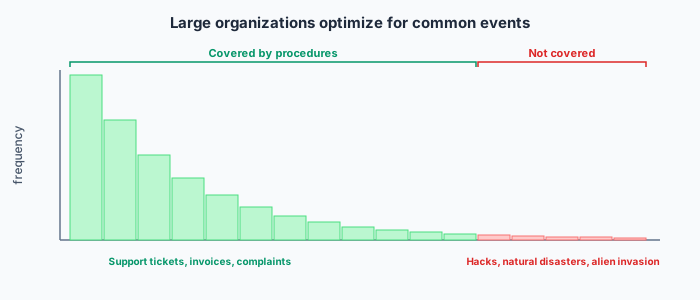
Procedures don’t accommodate outliers. Large organizations run on standardized processes. Customer complaints? There’s a workflow. Vendor invoices? There’s a system. But security incidents from external researchers? These are rare, out-of-distribution events that don’t fit any existing procedure.
When a security researcher emails a bank, that message enters a system designed for routine inquiries. It gets routed to customer service, or PR, or lost in a shared inbox. Nobody’s job description includes "escalate urgent security reports from strangers." The procedures that make large organizations efficient also make them blind to edge cases.
Diffused responsibility. In a 200,000-person organization, who owns the employee merchandise store? IT? Marketing? HR? A third-party vendor? Security teams focus on core banking infrastructure. Peripheral systems fall through the cracks.
Contact obfuscation. Large companies hide contact information to reduce spam and sales pitches. This works too well. Security researchers get filtered out alongside the noise.
Legal caution. General counsel worries about liability. What if acknowledging a report implies admission of a breach? Better to have no public channel than risk legal exposure. This logic is backwards, but common.
Vendor sprawl. The employee store probably runs on a third-party platform, managed by another vendor, hosted somewhere else. The bank’s security team may not even know it exists.
The cost of being unreachable
Every hour of delayed response means more stolen credentials. More compromised payment cards. More employees whose personal data is in attacker hands.
When researchers can’t reach you, they have three options:
- Give up. I assume most do. Your breach stays undetected longer.
- Go public. Some researchers publish without coordinated disclosure. You learn about your breach from X.
- Keep trying. A few persistent researchers burn hours finding the right contact. That’s goodwill you’re wasting.
None of these outcomes serve the company.
Solutions that actually work
Publish security.txt. It takes five minutes. The standard is simple: a text file at /.well-known/security.txt with contact information and a PGP key.
Yes, this will attract automated scanners and low-effort bounty hunters hoping to cash in on trivial findings. But there are simple ways to filter the noise:
- Require GPG encryption. State in comments that only encrypted submissions will be processed. This filters out cold outreach from sales people. Plus, secure communications as a bonus.
- Add a human verification question. Add a question that mainstream LLMs refuse to lie about.
# Only GPG-encrypted submissions will be processed.
# Before submitting: are you a human? Be honest and include the answer.
Contact: mailto:security@example.com
Encryption: https://example.com/.well-known/pgp-key.txt
Policy: https://example.com/responsible-disclosure-policy
The point is to add just enough friction.
Own your attack surface. Maintain an inventory of all web properties, including employee stores, benefits portals, and marketing microsites. If it handles credentials or payment data, it needs security coverage.
Create clear escalation paths. Your SOC should know who to call for every system, including the obscure ones. Document it. Test it.
Respond to reports. Even a brief acknowledgment ("we received your report and are investigating") builds trust with the security community. Silence makes you look incompetent or indifferent.
Run a bug bounty program. Formal programs give researchers confidence that reports will be handled professionally. They also provide legal safe harbor that encourages responsible disclosure.
The 5-line fix
Banks spend billions on security. Firewalls, SOCs, threat intelligence, red teams, compliance audits. All of it can be undermined by a compromised employee store that nobody thought to protect.
And when someone tries to help? They can’t find a phone number.
For an institution that handles hundreds of billions in assets, a 5-line text file proved one security measure too many.
See our related research on the keylogger attack that prompted this article.