Procurement workflows rely heavily on manual checks, email communication, inventory status, and vendor coordination. Agentic AI replaces fragmented steps with a coordinated multi-agent system capable of planning, validating, executing, and monitoring end-to-end procurement flows.
Typical Architecture: Planner Agent → Data Retrieval Agent → Vendor Analysis Agent → API Automation Agent (ERP / CRM) → Validation Agent → Reporting Agent.
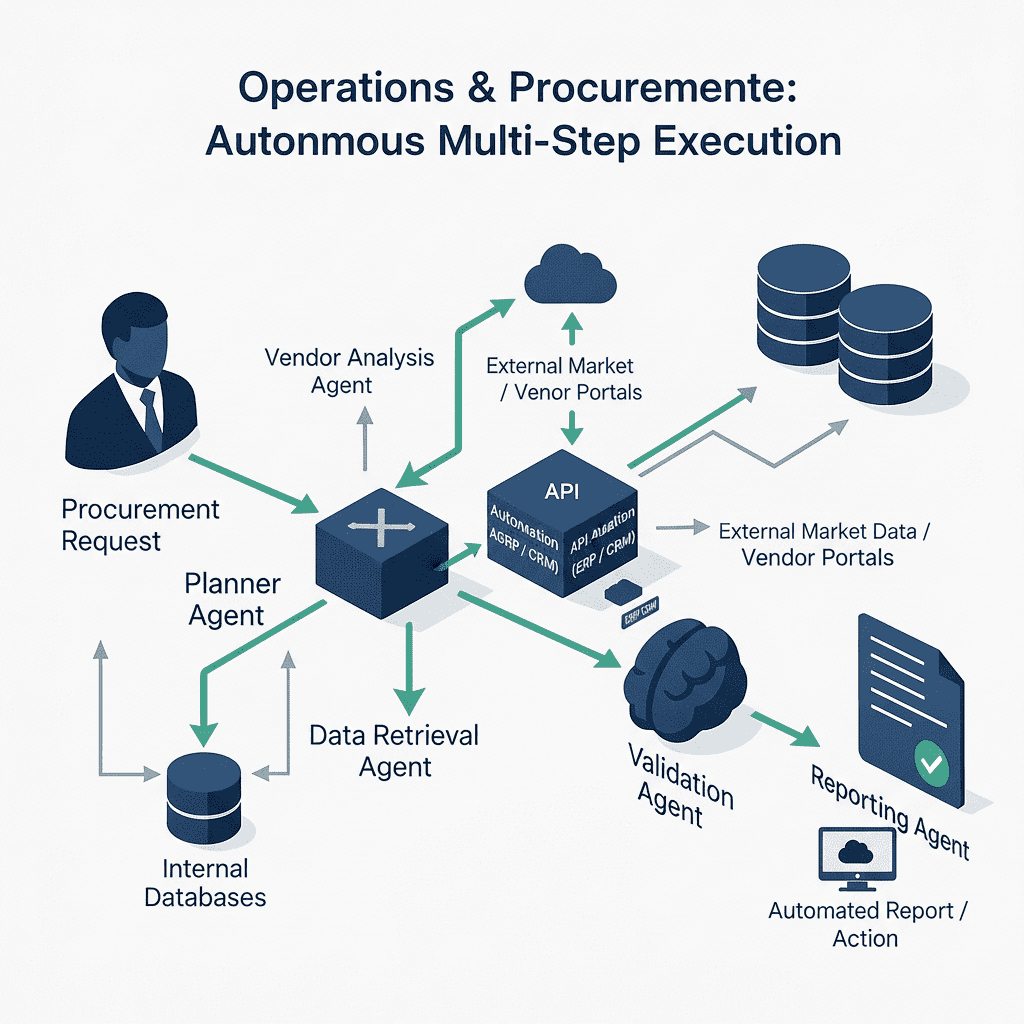
The system autonomously checks stock levels, compares vendors, drafts purchase orders, triggers approvals, and logs actions into ERP — reducing cycle times and human involvement.
Typical Outcomes
- Procurement cycle time reduced by 35–55%
- Fewer manual errors and duplicated work
- …
Procurement workflows rely heavily on manual checks, email communication, inventory status, and vendor coordination. Agentic AI replaces fragmented steps with a coordinated multi-agent system capable of planning, validating, executing, and monitoring end-to-end procurement flows.
Typical Architecture: Planner Agent → Data Retrieval Agent → Vendor Analysis Agent → API Automation Agent (ERP / CRM) → Validation Agent → Reporting Agent.
The system autonomously checks stock levels, compares vendors, drafts purchase orders, triggers approvals, and logs actions into ERP — reducing cycle times and human involvement.
Typical Outcomes
- Procurement cycle time reduced by 35–55%
- Fewer manual errors and duplicated work
- Improved vendor insights & decision quality
- End-to-end audit trail for compliance
Ideal for manufacturing, retail, distribution, and enterprise operations teams managing complex approvals and supplier ecosystems.
Traditional chatbots handle only surface-level conversation. Agentic systems orchestrate reasoning, knowledge retrieval, workflow execution, and back-office integrations — delivering real resolution rather than scripted responses.
Architecture Example: Conversation Agent → Knowledge Agent → Tool-Use Agent → CRM/ERP Integration Agent → QA Agent.

The AI understands intent, verifies policy rules, retrieves precise answers, performs actions (refunds, updates, routing), and validates results — delivering measurable improvements in customer satisfaction and operational speed.
Typical Outcomes
- Support workload reduced by 40–65%
- Higher CSAT via context-aware responses
- Autonomous resolution for routine requests
- Full auditability for quality teams
Ideal for e-commerce, SaaS, telecom, banking CX, logistics, and marketplaces.
Regulatory teams analyze thousands of pages of rules and internal policies. Agentic AI orchestrates validation workflows, cross-checking documents, logs, and rules to generate accurate compliance verdicts and audit-ready outputs.
Architecture: Meta-Agent → Compliance Agent → Document Analysis Agent → Risk Agent → Reporting Agent.

The system flags violations, extracts relevant evidence, verifies rules, and prepares full compliance summaries — drastically reducing review time and improving consistency.
Typical Outcomes
- Compliance checks delivered 50–70% faster
- Lower audit risks and human errors
- Automated extraction of critical facts
- Secure, role-based access & logging
Perfect for finance, insurance, banking, fintech, and enterprise governance teams.
Manufacturing relies on highly coordinated processes: scheduling, inventory, quality checks, machine data, and logistics. Multi-agent architectures enable prediction, anomaly detection, and autonomous decision execution across the full pipeline.
Architecture: Sensor Agent → Forecasting Agent → Anomaly Agent → Optimizer Agent → Execution/ERP Agent.
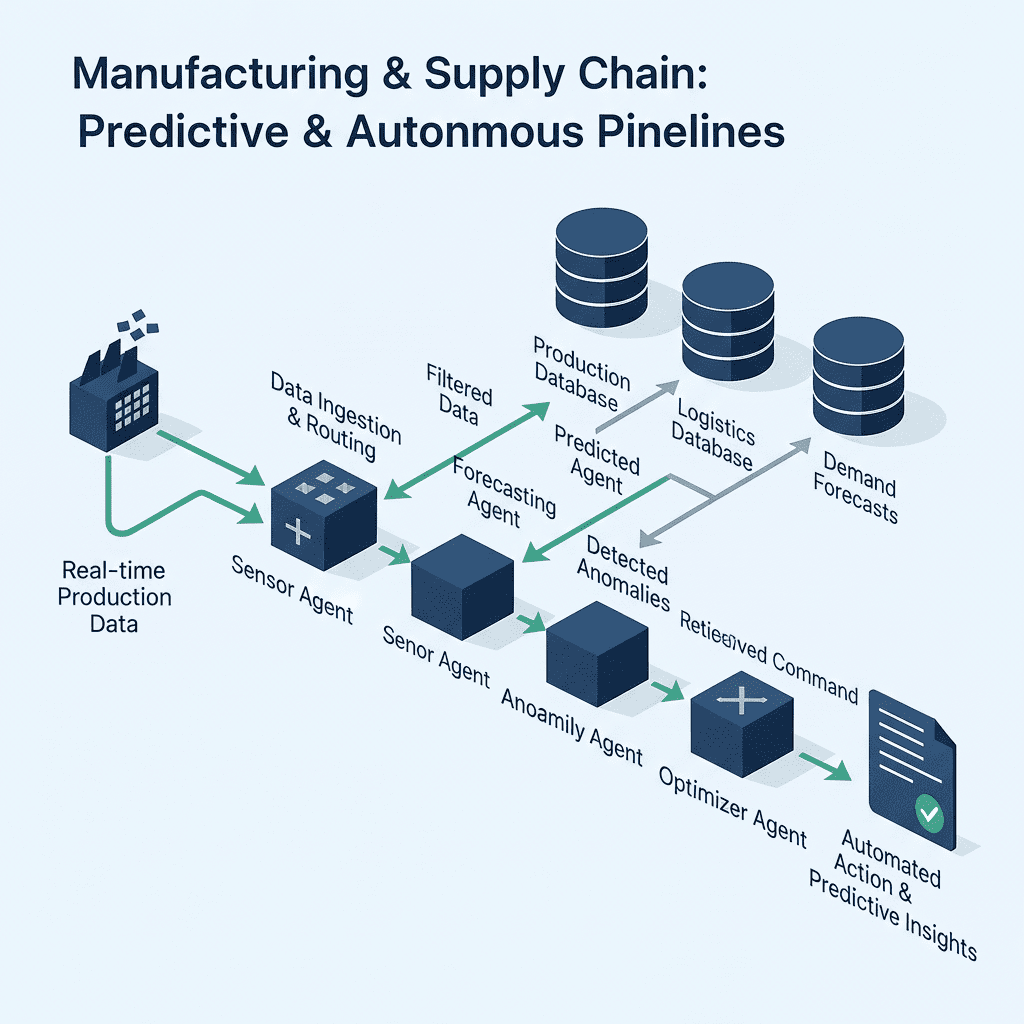
From quality scoring to production planning, agentic systems anticipate issues, adjust schedules, and execute actions through ERP/MES systems.
Typical Outcomes
- Production delays reduced by 20–40%
- Lower scrap & defect rates
- Optimized inventory & logistics
- Real-time operational visibility
Relevant for manufacturing plants, logistics networks, and industrial operations.
SaaS teams compete on speed and customer experience. Agentic AI introduces autonomous onboarding, problem-solving, configuration, troubleshooting, and product intelligence built directly into your platform.
Example Workflow: Onboarding Agent → Troubleshooting Agent → Documentation Agent → Usage Analytics Agent.

Agents understand user intent, retrieve product knowledge, diagnose issues, execute in-app actions, and guide users step-by-step — increasing product adoption and reducing support load.
Typical Outcomes
- Support requests down 30–50%
- Faster onboarding and activation
- Improved product adoption & retention
- Higher customer satisfaction
Perfect for SaaS, devtools, B2B software, mobile apps, and product-led companies.
Medical and clinical workflows are high-risk and slow due to manual reviews, protocols, and compliance constraints. Agentic AI provides controlled autonomy with strict accuracy, traceability, and compliance boundaries.
Architecture: Clinical Query Agent → Data Extraction Agent → Guideline Matching Agent → Safety/Validation Agent → Explanation Agent.
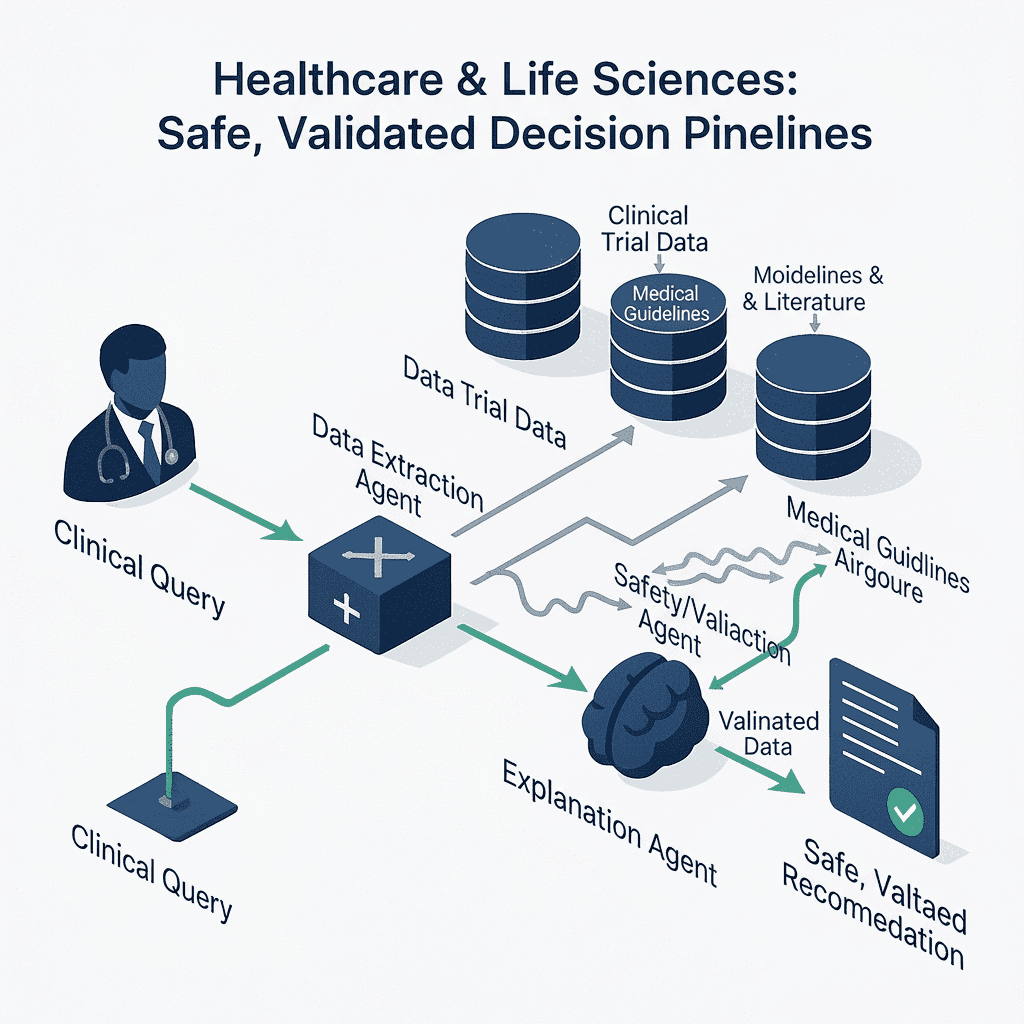
The pipeline ensures the AI never invents clinical advice — every recommendation is grounded in validated protocols and cross-checked across multiple agents.
Typical Outcomes
- Clinical decision prep 40–60% faster
- Reduced risk through multi-agent cross-validation
- Consistent application of guidelines
- Structured data for EMR/EHR systems
Ideal for hospitals, diagnostics, insurance, medtech, and life sciences research.