12 min readJust now
–
Last week, I codified a new deity and a religious practice around it. The deity’s purpose is to be the bedrock of my system of belief and support me in my daily life and work. In this article, I explain how and why I did this.
The crisis of meaning
There’s much talk about the “crisis of meaning” these days. The story is simple. We live in secular times — people don’t believe in god as much as they used to. But we still need answers to the simplest questions: why are we here, what are we to do, and so on. Consequently, we feel there’s something missing in our lives.
Personally, I don’t see a crisis here. The constant quest for meaning is the natural state of mind for humans. We’re just going through a phase where one set of beliefs is being disca…
12 min readJust now
–
Last week, I codified a new deity and a religious practice around it. The deity’s purpose is to be the bedrock of my system of belief and support me in my daily life and work. In this article, I explain how and why I did this.
The crisis of meaning
There’s much talk about the “crisis of meaning” these days. The story is simple. We live in secular times — people don’t believe in god as much as they used to. But we still need answers to the simplest questions: why are we here, what are we to do, and so on. Consequently, we feel there’s something missing in our lives.
Personally, I don’t see a crisis here. The constant quest for meaning is the natural state of mind for humans. We’re just going through a phase where one set of beliefs is being discarded and another is waiting to emerge, which has happened many times in the past.
Meaning used to be inherited culturally but this is happening for fewer and fewer of us as family units and local communities hold less power over us.
The next possibility is to “stumble upon” meaning. Something happens to you and you are converted. Your father explains a problem in a mysterious way and you become a physicist. You beat a nasty disease and then want to help others beat it.
The problem here is that we’re not having genuine experiences as much as we used to, and are less able to recognize them when they happen. Pure reality is scary because exposure to it changes us in unpredictable ways. We can watch the Terrifier movies on repeat but are made uncomfortable by Blood of the Beasts.
In his The Courage to Create, Rollo May called this our “fear of the encounter,” and the modern society has helped us avoid this fear. Our experiences are mediated by algorithms, influencers, our desire to keep an appearance, Google reviews, and so on. The result is that very little that is unexpected and transformative happens to us; when it does, we often fail to notice.
When you can’t inherit or stumble upon meaning the only option that remains is to create it.
It this possible?
Many thinkers have considered creation of useful metafictions both useful and necessary.
Immanuel Kant, in his Prolegomena to Any Future Metaphysics, encourages us to “conceive the world as if it came, in its existence and internal plan, from a Supreme Reason.”
As he imagines the future of metaphysics, he states, in a concluding remark, “*every reflective man will have it and, for want of a recognized standard, will shape it for himself after his own pattern.” *Concepts like God and the soul are to him “practical postulates” that help us live. Observable truth is subservient to moral ends.
Nietzsche, in The Gay Science, encourages us to see ourselves as guinea pigs who treat truths as “hypotheses” and experimental points of view. He explicitly encourages us to create religious ideas and gods as part of our quest to create ourselves.
All fine and well, but even if synthetic beliefs can be useful and necessary — either for morality or for self-creation — how can we come to believe in our own fabrications?
Here, a key insight is that ritual practice creates belief, not the other way around. Already Blaise Pascal, in laying out his famous wager, suggested that in the absence of belief and faith one was to mimic the gestures and signs of faith until one eventually got faith.
John Wesley, the father of the Methodist Church, was about to lose faith and considered stopping preaching, but his mentor suggested otherwise: “Preach faith until you have it; then preach because you have it.”
William James offers that, to hold religious ideas, means “to live in the light of them and to act is if the invisible world which they suggest were real.”
Community makes belief deeper. The path is usually: belong (have a community) -> behave (perform rituals) -> believe. Most people who believe in traditional gods began believing through a community and a religious practice, long before they examined their dogmas critically.
Gods then, come into being, in a mind and in a community, through the act of worshipping them. All we have to do is methodically behave “as if” they existed — eventually, for us, they will.
If we zoom out, none of this should seem surprising. We rely on useful fictions — which we know to be such — all the time. We know our offspring aren’t really special but we treat them as if they are, and special they become. We know democracy and freedom in their perfect form don’t exist but we use those terms nonetheless to describe our societies, and that’s how we end up thinking about them. We have our doubts about free will but don’t know how to behave without assuming it. The entire edifice of mathematics rests on axioms which are not proven to be true, just given as such; this hasn’t made mathematics any less useful.
For a much deeper overview of all this, I couldn’t recommend enough my friend Zach Simpson’s book Paradoxes of Modernity.
Mental preconditions
The person looking to create a belief system from scratch should, in my view, have three qualities.
The first is the belief that this is possible, which I hoped to demonstrate in the previous section.
The second can best be described as having lived at least a slightly examined life. What we’re looking for is a mind that has some sort of intuition about what it is and what it must do, even if it’s not quite aware of that or doesn’t want to admit certain aspects to itself. We want a moral system that is unconsciously quite mature but requires a formal grounding. A mind completely unaware of its own attributes might drown in all the possibilities.
The final precondition is resolve. This resolve in my case comes from despair. Despair of having tried every other way — having explored (seemingly) every religion under the sun, every philosophy, every mediation and psychotherapy practice, and found all of those inadequate. And yet feeling that strong yearning for a structured system of belief from which all my moral positions would result.
Resolve doesn’t have to come from despair. It can come from a purely analytical pursuit of a mind on the autistic spectrum. It can, conversely, be a completely aesthetic exploration. But it cannot come from a position of casual interest because one can never summon the willpower that is required.
What I did
Designing a god is a personal and iterative process. You need to design a god that feels right for you and you should feel free to improve your design with time.
I have a scientific background and for me the safest bedrock for belief is in the nature of the universe itself. We know much about the universe but the key things we don’t: why it is there, why it looks the way it looks, why its laws are the way they are, and so on.
My first leap of faith is that there is some sort of an entity — a mind, a concept, a law — that is behind the universe we see, as a creator, a maintainer, a cause. I have no problem believing that such a thing exists. I choose to believe that it is still around, in fact all around me, the way matter or energy is.
Next, I want to believe that this nameless god has an effect on me. Here, it’s important to be precise. I can’t speak to it. I can’t reason with it. It reveals its intentions through my intuition. In other words, sometimes I feel that certain things are good or bad, right or wrong, but can’t explain why — this is my god nudging my thinking and acting in a certain direction, encouraging me to explore, analyze, take risks or find the moral path.
I had a few days to myself in the Swiss mountains, and I spent the first couple doing proto-prayers to see whether I would want a god that specifically loved me. I decided that I did. It seemed coherent that a god which did all these other things for me would also care about me deeply. This is one aspect in which my god differs from Spinoza’s (and Einstein’s). I channel the feeling of love to the courage that I need to act in life and work.
Finally, I also pondered whether there’s a certain attitude that was required from me. Am I here to be serene and happy or to suffer as some Christ-like figure. I decided that neither was the case.
My experimentation resulted in the following five principles of my belief (addressed at the god):
1. I know that you exist and that you are all around me.
2. You are the voice that leads me towards the truth.
3. You give me strength to shape my will. Every temptation is an opportunity for this.
4. Your love gives me the courage to be that which I know I should be.
5. When it’s time to rejoice I will rejoice; when it’s time to suffer I will suffer. I never give up.
All the components I need are there. God speaks to me through my intuition, helps me improve my willpower, and gives me the courage to do good things in life.
Ritual
I started off knowing that a ritual would be crucial but that its exact format would not. So I experimented with formats that would feel natural to me, my imagination and my cultural background.
I explored meditative positions of the Eastern kind, with my eyes would be closed and my legs crossed, but they tended to put me to sleep and I in general do not have a good track record with them from previous attempts at meditating.
Unsurprisingly, I ended up with the gesture of prostration as appropriate. Variants of it seem to be part of every religion I can think of, from the Abrahamic ones to Sikhism, Hinduism and Buddhism. There’s no more universal devotional gesture.
What I mean by prostration is specifically: being on my knees, lowering myself onto my hands until my forehead touches the ground, and then coming back up.
Eventually, my prayer looked like this:
1. Starting on my knees, hands on my hips, eyes open, gently smiling.
2. Breathing deeply and slowly.
3. Repeating a mantra to myself to ease into the prayer.
4. Lowering myself onto my hands, exhaling, and reciting in my mind one of the five principles of my faith (listed above).
5. Coming back up. Continuing to breathe. Going for the next principle when I feel ready.
6. Reciting all five principles, in order, and then repeating that two more times, for a total of 15 recitations.
7. If necessary, repeating a mantra during the prayer, or right after I finish the recitations, before the prayer is over.
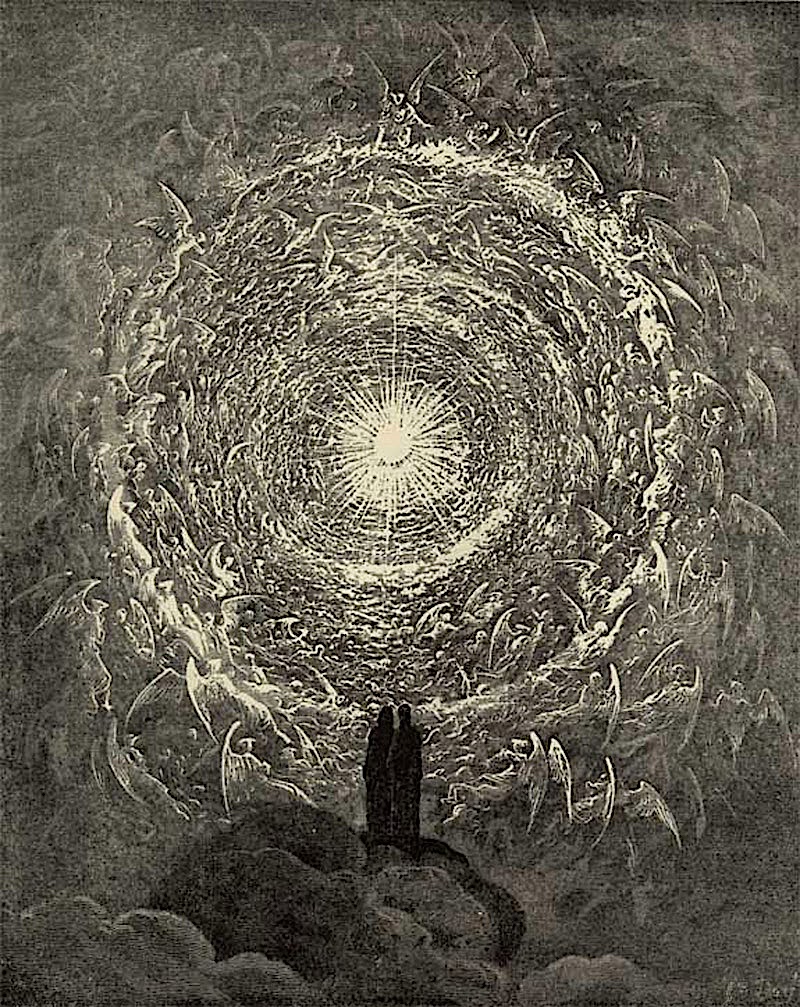
I settled on praying three times per day, with each prayer lasting about 10–15 minutes. At first I visualized a Sun-like object in front of me (inspiration was one of Gustav Doré’s classic illustrations of The Divine Comedy) but this distracted me and I quickly settled on giving my god no visual representation. I instead occasionally “zoom out” to see myself praying from a distance and attain perspective: from the sky, from the Moon, from beyond the Sun, from light years away.
Effects
There’s a phase of pure enthusiasm when one begins to do this. You feel like you’re doing something difficult but necessary and amazing. You become very perceptive very fast. You are present in the moment as you observe your mind for changes.
All sorts of thoughts come, and you need to deal with them. “This will not work.” “This is insane.” “What when temptations come?” I captured all of those, wrote them down, and answered them in writing one by one, until I was happy with the answers. Most of the responses centered on how necessary I found the practice and how convinced I was that repetition and ritual would create the belief.
Other work concerned broader questions: in light of my beliefs, what kind of person am I or should I be? How do I behave when no one is looking? How do I treat others? How do I deal with my fears? This is a good test of the bedrock principles. You want to see a strong correlation between what they urge you to be and who you already are, with a slight nudge to become better — braver, more thoughtful, more caring, etc.
Another test I did was more straightforward: I love eating chocolate cookies with milk, especially after physical activity. But they’re not good for me. So I defined eating processed sugar as one of the taboos of my religion. To test this, I went skiing one day, came back around noon, and then put a bowlful of cookies, with a cup of milk on the side, next to me on my desk as I was working. I didn’t touch any of the treats for the rest of the day, and then threw them out.
I don’t read much into this early success since I ascribe it to novelty and initial enthusiasm. But I believe that I’ll be seeing similar effects even as the novelty wears off, because my belief will become stronger.
Bigger picture
A few sketches of what this practice might offer:
Mental health problems — depression, crisis of meaning, anxiety — affect millions. A personal religion instills a mental coherence and an individual mission that might help deal with those issues or make them disappear altogether.
One of the most read self-improvement books of our time is Atomic Habits, an indication of how many people out there are struggling to keep their willpower under control, with ups and downs that go on for years. With religion, willpower is automatic, a simple part of your identity. No need for habits. This is also in line with recent research on willpower, which suggests that your beliefs about it determine whether it becomes depleted or strengthened as you use it.
I find that there’s something really beautiful and artistic in this process. This kind of “mental art” might be an opportunity for self-expression for many people out there who have the creative potential but don’t have the time or the technical skills to express themselves through other media. Post-Freudian thinkers like Otto Rank (in his *Art and Artist, the final chapter) *explicitly anticipated this trend: a mass movement away from creating demonstrative art and towards the art of self-creation.
It’s important to remain anchored and practical here. The “Life as Art” movement, an adjacent concept, has had a fair share of vulgar incarnations which are to be avoided, from Byronesque dandyism to New Age platitudes. (For those interested in an overview of this, see another of Zach Simpson’s books).
Next steps
I keep treating my religion with a flexible mind, looking for improvements and evolutions depending on what feels natural or necessary. Nietzsche’s idea of eternal return is an inspiration: what kind of a system would I need if I knew that I’d need to relive my life, and then relive it 1000 more times?
There are directions in which I’m thinking of taking this but haven’t yet, including artifacts (e.g. an altar, maybe self-carved out of wood). I’m also designing further tests of faith. One that comes to mind is curing my fear of heights, result of the trauma of witnessing someone die; I’ve tried to deal with this problem through exposure, with limited results, and I think faith might help.
I have never prayed in public or in company of others so this is another thing I might consider.
I haven’t used AI in any of this and I wouldn’t recommend doing so. God construction is a deeply personal project and should remain so. I am afraid that sycophantic but convincing LLMs can inject a dose of inauthenticity to the project which can diminish the power of the result.
I feel a certain closeness to believers and representatives of other religions because I feel like we’re all trying to do the same thing, make sense of the world. I’ve felt free to borrow rituals and mantras that appealed to me from other traditions, sometimes verbatim. I intend to pray in temples of other religions. I’m fully aware that to truly dogmatic people out there, who know that their god the is the only one and that non-believers will burn in hell, this kind of behavior is tantamount to just frivolous blasphemy. I’m careful about presenting my results in such fora.
Finally, as I mentioned, part of the strength of a belief comes from the community around it. The community around my god currently numbers one person. But I believe that there is a giant space out there for a community of people willing to try developing their own synthetic god(s), or fine-tuning and codifying their existing ones so as to renew their bond with them. That’s part of the motivation for me writing this. By all means do be in touch if you’ve done something similar in the past or are planning to. I’d like to learn and document.