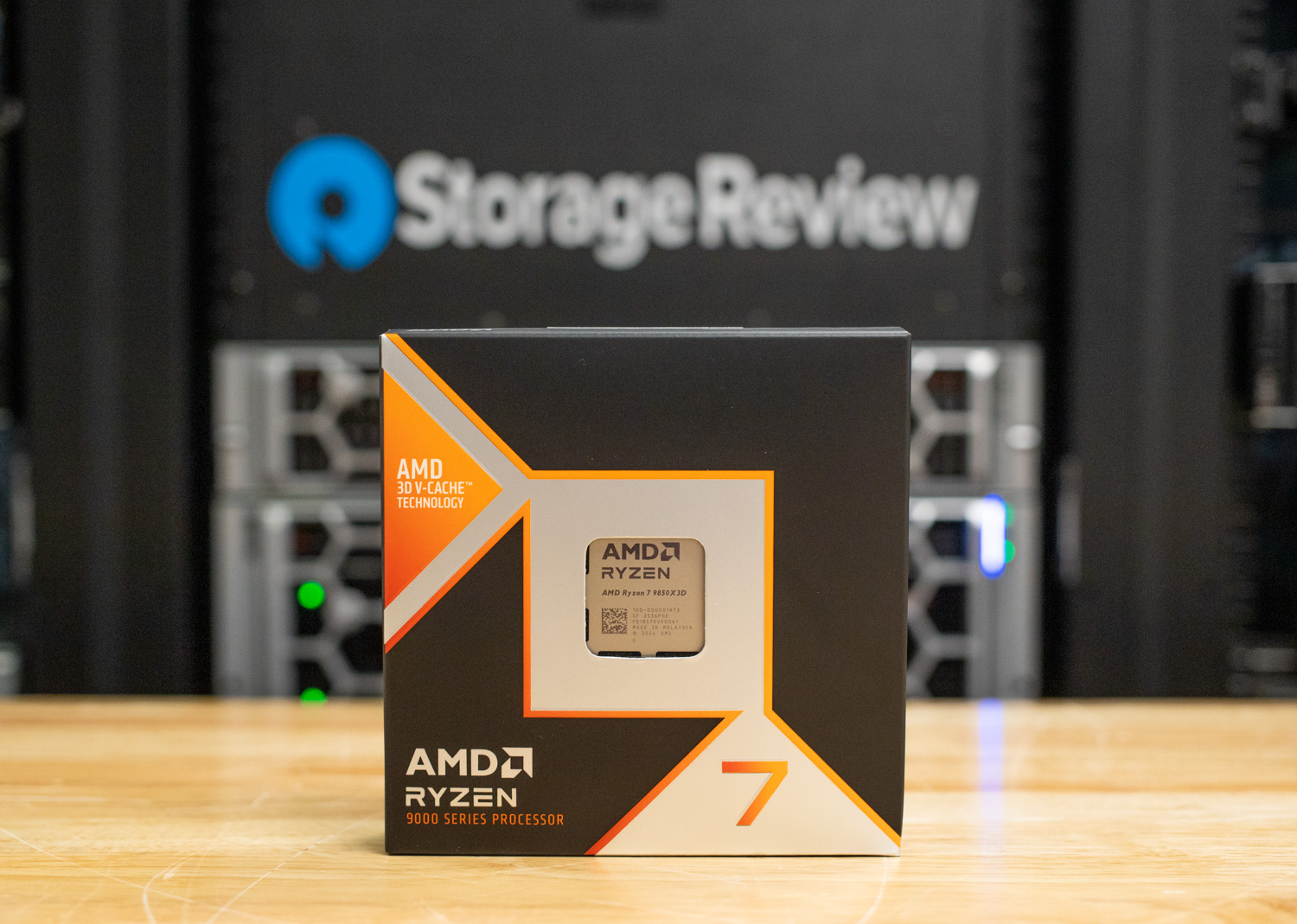
AMD continues to expand its Ryzen 9000 series family with the introduction of the Ryzen 7 9850X3D. It’s an 8-core, 16-thread processor designed to build on the strengths of AMD’s earlier X3D offerings. We received a Ryzen 7 9850X3D sample in the lab and ran a comprehensive set of benchmarks to compare it with the Ryzen 7 9800X3D we reviewed in 2024. Available today with a launch price of $499, the 9850X3D targets enthusiasts looking for strong gaming performance and solid all-around responsiveness without stepping up to higher-core-count models.
Rather than reinventing AMD’s X3D formula,…
AMD continues to expand its Ryzen 9000 series family with the introduction of the Ryzen 7 9850X3D. It’s an 8-core, 16-thread processor designed to build on the strengths of AMD’s earlier X3D offerings. We received a Ryzen 7 9850X3D sample in the lab and ran a comprehensive set of benchmarks to compare it with the Ryzen 7 9800X3D we reviewed in 2024. Available today with a launch price of $499, the 9850X3D targets enthusiasts looking for strong gaming performance and solid all-around responsiveness without stepping up to higher-core-count models.
Rather than reinventing AMD’s X3D formula, the Ryzen 7 9850X3D focuses on refinement. It retains the exact core count and cache configuration as its predecessor while introducing architectural updates and higher boost clocks to improve efficiency, responsiveness, and consistency across a wide range of workloads. In this review, we take a closer look at platform compatibility, specifications, and real-world performance to see whether those refinements translate into meaningful gains over the 9800X3D.
AMD Ryzen 7 9850X3D Platform and Compatibility: Easy AM5 Upgrades
The AMD Ryzen 7 9850X3D continues AMD’s commitment to the AM5 platform, which is welcome news for users already running modern Ryzen systems. If you’re upgrading from an earlier AM5 processor, there’s no need to replace your motherboard. A simple CPU swap and BIOS update is typically all that’s required, making the upgrade process far less disruptive than moving to an entirely new socket.
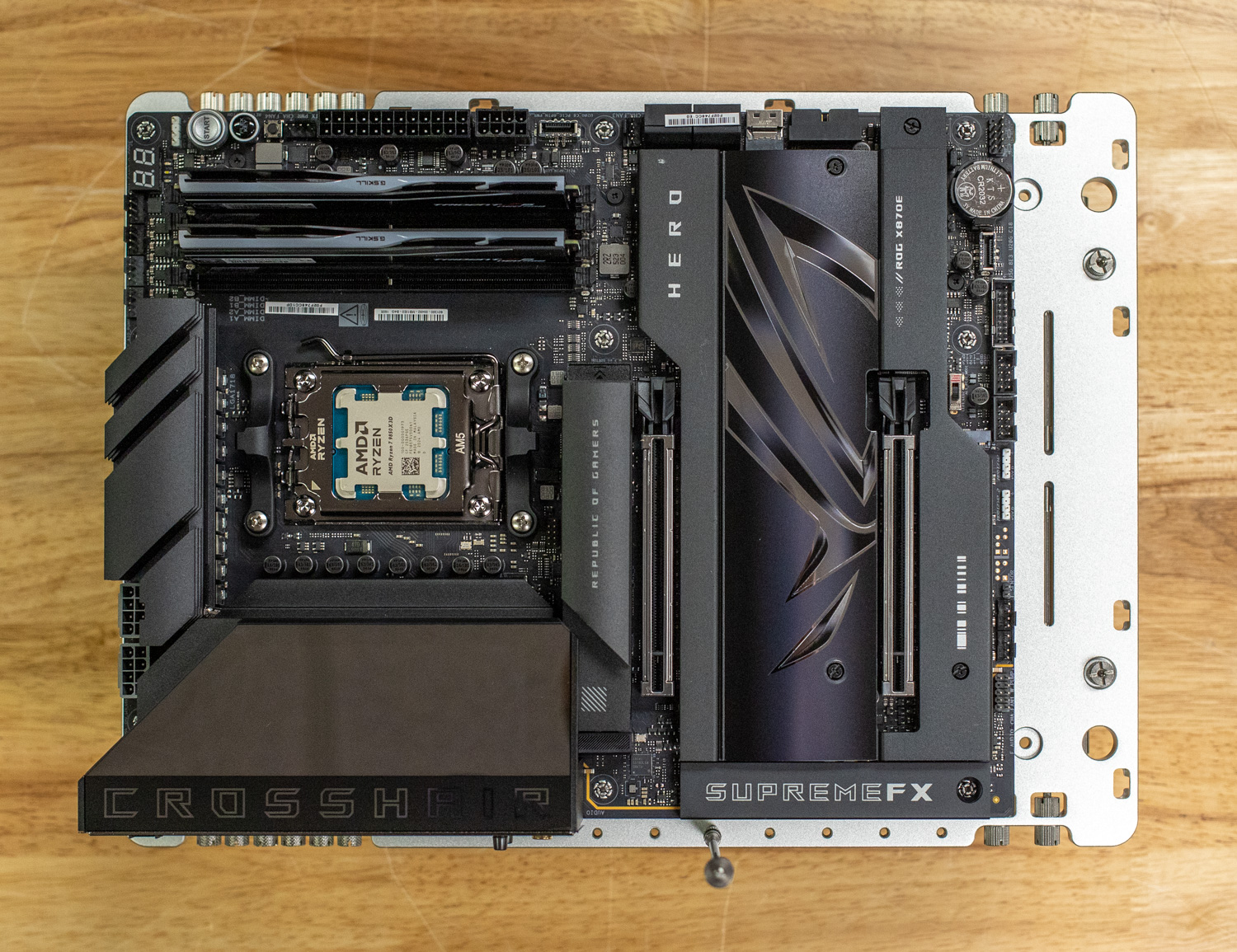 The 9850X3D is compatible across a wide range of AM5 chipsets, including A620, B650, B650E, X670, X670E, as well as the newer B840, B850, X870, and X870E platforms. This broad chipset support gives users flexibility, whether they’re working with a budget-focused board or a higher-end platform with expanded I/O and PCIe Gen5 support.
Paired with a Radeon GPU, the 9850X3D also benefits from Smart Access Memory (SAM), which enables more efficient communication between the CPU and GPU and can potentially improve performance in select gaming workloads. As with other X3D processors, traditional manual overclocking remains locked, but Precision Boost Overdrive (PBO) is supported, providing limited tuning headroom and automatic boost optimization without the complexity or risk of manual overclocking.
Ryzen 7 9850X3D vs. Ryzen 7 9800X3D
On paper, the AMD Ryzen 7 9850X3D is positioned as a refinement of the Ryzen 7 9800X3D rather than a significant architectural shift. Both processors share the same 8-core / 16-thread configuration and identical 96MB L3 cache, meaning core count and cache capacity remain unchanged. As a result, any differences between the two are expected to come from architectural updates, frequency behavior, and efficiency improvements rather than brute-force scaling.
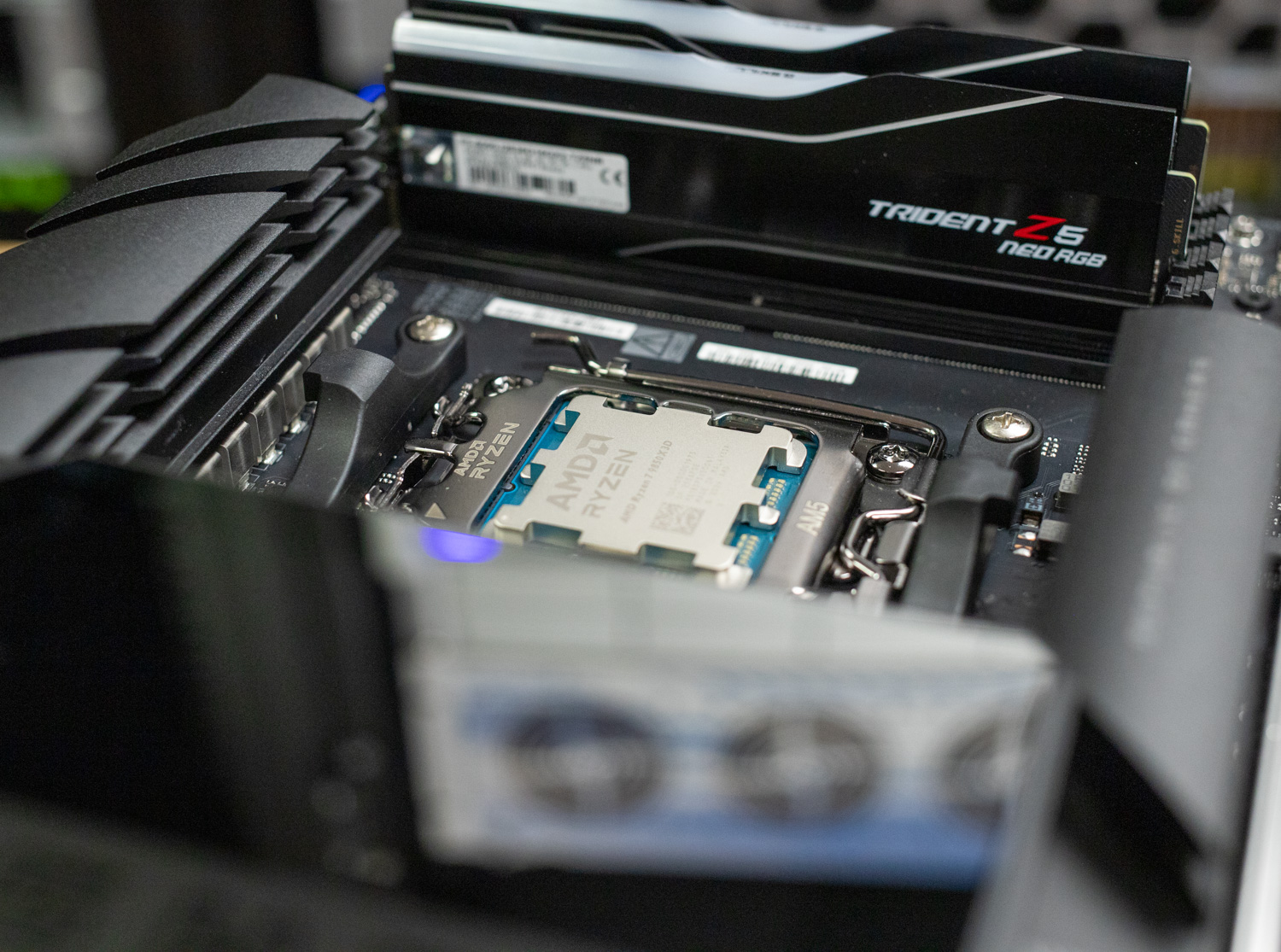 The 9850X3D carries higher boost clocks, which should translate into improved responsiveness in lightly threaded and mixed workloads. Multithreaded performance is expected to remain broadly similar given the matching core counts, though subtle gains may appear in sustained workloads due to improved scheduling and boost behavior.
From a gaming perspective, both CPUs leverage AMD’s 3D V-Cache technology, so cache-sensitive titles should continue to perform well on either chip. However, the higher clocks and architectural refinements of the 9850X3D may help improve frame consistency and reduce CPU bottlenecks in specific scenarios, particularly at high frame rates.
Importantly, both processors retain a 120W TDP and share the same AM5 platform, meaning users should not expect increased power or cooling requirements when moving from the 9800X3D to the 9850X3D. Overall, the 9850X3D appears to be an incremental update focused on refinement and efficiency, with expectations set for modest gains rather than a dramatic generational leap.
**AMD Ryzen 7 ****9850X3d **Specifications
The table below shows the AMD Ryzen 9000-series X3D lineup, placing the Ryzen 7 9850X3D in context alongside the rest of the family.
| Specifications | AMD Ryzen 9 9950X3D | AMD Ryzen 9 9900X3D | AMD Ryzen 7 9850X3D | AMD Ryzen 7 9800X3D |
|---|---|---|---|---|
| Cores/Threads | 16/32 | 12/24 | 8/16 | 8/16 |
| Platform | AM5 | AM5 | AM5 | AM5 |
| Frequency (up to) | 5.7/4.3GHz | 5.5/4.2GHz | 5.6/4.7GHz | 5.2/4.7GHz |
| L2 Cache | 16MB | 12MB | 8MB | 8MB |
| L3 Cache | 128MB | 128MB | 96MB | 96MB |
| Total Cache | 144MB | 140MB | 104MB | 104MB |
| Architecture | Zen 5 | Zen 5 | Zen 5 | Zen 5 |
| PCIe | Gen5 | Gen5 | Gen5 | Gen5 |
| DRAM | DDR5 | DDR5 | DDR5-5600 | DDR5-5600 |
| TDP | 170W | 120W | 120W | 120W |
| Graphics | Radeon | Radeon | Radeon | Radeon |
| AMD Recommended Cooler | 280mm Liquid | 280mm Liquid | 240-280mm Liquid | 240-280mm Liquid |
AMD Ryzen 7 9850X3d performance
To evaluate overall performance, we compared the AMD Ryzen 7 9850X3D against the AMD Ryzen 7 9800X3D. Both processors are closely matched on paper, featuring 8 cores and 16 threads with AMD’s 3D V-Cache design. The primary distinction between the two lies in clock speeds: the newer 9850X3D offers higher boost frequencies up to 5.6 GHz, compared to 5.2 GHz on the 9800X3D.
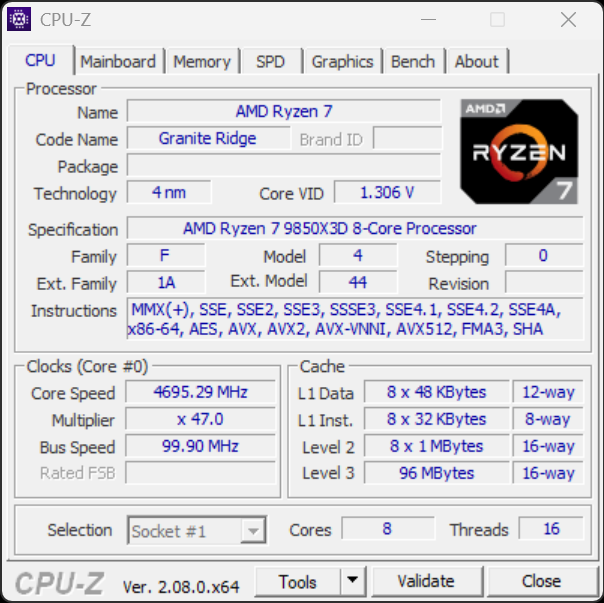
To keep the testing environment as consistent as possible, we ran both CPUs on the ROG CROSSHAIR X870E HERO motherboard with the same DDR5 memory type and configuration. Here’s a full rundown of our testing rig:
- Motherboard: ASUS ROG Crosshair X870E Hero (provided by AMD)
- **Memory: **SKILL Trident Z5 Royal Series DDR5-6000 (2x16GB), running on EXPO 1
- Cooling: High-performance liquid cooling solution
- Operating System: Windows 11 Pro
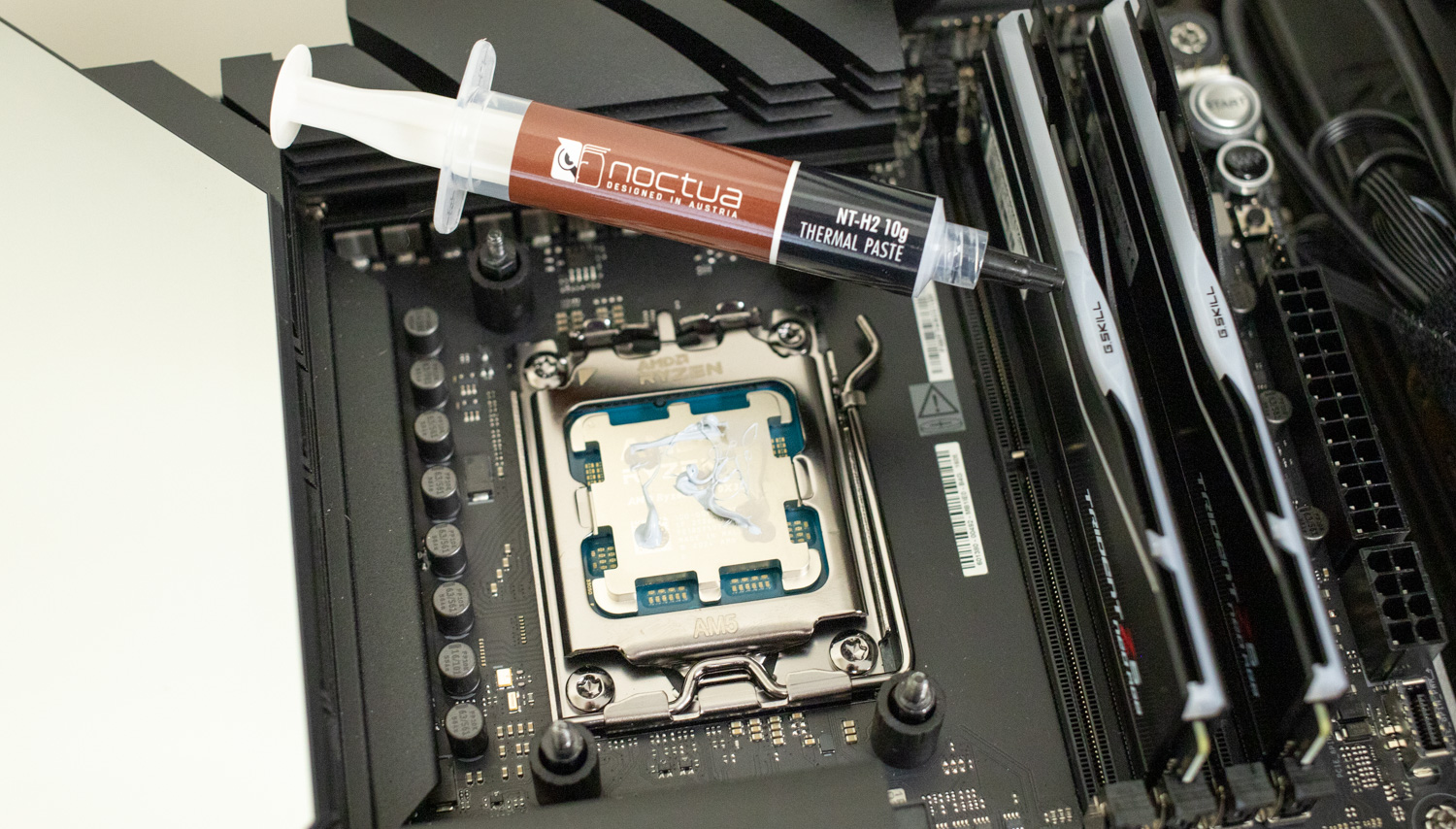
Our testing focused on a mix of synthetic and real-world workloads designed to highlight both single-threaded and multithreaded performance. Benchmarks included 3DMark CPU Profile, y-cruncher (standard and BBP), 7-Zip compression and decompression, UL Procyon AI Inference, PCMark 10, and SPECworkstation 4.4.0. This combination allows us to evaluate raw compute throughput, scaling behavior, productivity performance, and emerging AI-focused workloads, providing a well-rounded view of how the two CPUs compare in practical use.
3DMark CPU Profile
The 3DMark CPU Profile measures CPU performance across different workloads by testing 1, 2, 4, 8, 16, and max threads. It highlights how the CPU handles single-threaded tasks, gaming workloads, and heavily threaded applications like 3D rendering. The benchmark minimizes GPU impact, offering a clear view of the CPU’s performance in various scenarios.
In the 3DMark CPU Profile, the 9850X3D consistently outperforms the 9800X3D across all thread levels, delivering small but repeatable gains depending on the workload. At the high end, the 9850X3D shows a 2.4% improvement at max threads and a 2.5% gain at 16 threads, pointing to slightly stronger scaling in heavily threaded workloads such as rendering and simulation. That lead becomes more noticeable as thread counts drop, with the 9850X3D posting a 4.1% advantage at 8 threads and a 4.8% gain at 4 threads, which is particularly relevant for gaming and mixed productivity use cases. The uplift continues in lighter workloads as well, with a 3.9% improvement at 2 threads and a 4.5% increase in single-threaded performance.
| 3DMark CPU Profile (higher is better) | AMD Ryzen 7 9850X3D | AMD Ryzen 7 9800X3D |
|---|---|---|
| Max Threads | 10,261 | 10,018 |
| 16 Threads | 10,285 | 10,034 |
| 8 Threads | 8,611 | 8,269 |
| 4 Threads | 4,867 | 4,646 |
| 2 Threads | 2,487 | 2,394 |
| 1 Threads | 1,267 | 1,213 |
**y-cruncher
**
y-cruncher is a popular benchmarking and stress-testing application that launched in 2009. This test is multithreaded and scalable, computing Pi and other constants up to the trillions of digits. Faster is better in this test.
In the y-cruncher benchmark, the 9850X3D shows a clear and more meaningful advantage over the 9800X3D when both CPUs are constrained to 8 cores, highlighting stronger compute efficiency under sustained, fully loaded workloads. At the 1-billion-digit run, the 9850X3D completes the test 13.9% faster, setting the tone for the rest of the results. The gap widens further at higher digit counts, with an 18.2% improvement at 2 billion digits and a 19.7% reduction in completion time at 5 billion digits.
| y-cruncher (lower time is better) | AMD Ryzen 7 9850X3D | AMD Ryzen 7 9800X3D |
|---|---|---|
| 1 Billion | 18.503 s | 21.487 s |
| 2 Billion | 52.589 s | 64.273 s |
| 5 Billion | 115.581 s | 143.891 s |
y-cruncher (Bailey-Borwein-Plouffe)
This y-cruncher benchmark utilizes the Bailey-Borwein-Plouffe (BBP) formulas to compute massive hexadecimal digits of Pi, measuring the CPU’s total computation time, utilization, and multi-core efficiency.
In the y-cruncher BBP benchmark, the 9850X3D and 9800X3D deliver effectively identical performance, indicating that this workload places both CPUs on very even footing. At the 1 BBP run, the results are separated by just 0.3%, which is well within run-to-run variance. That trend continues at 10 BBP, where the difference narrows further to 0.1%, and at 100 BBP, where the gap remains under 0.5%.
| y-cruncher BBP (lower time is better) | AMD Ryzen 7 9850X3D | AMD Ryzen 7 9800X3D |
|---|---|---|
| 1 BBP | 0.669 s | 0.671 s |
| 10 BBP | 7.501 s | 7.497 s |
| 100 BBP | 83.719 s | 83.345 s |
7-Zip Compression
The 7-Zip Compression Benchmark evaluates CPU performance during compression and decompression, measuring GIPS (Giga Instructions Per Second) and CPU usage. Higher GIPS and efficient CPU usage indicate superior performance.
In the 7-Zip Compression benchmark, the 9850X3D only holds a minor advantage over the 9800X3D, with differences unlikely to be noticeable in real-world use. Looking at the resulting ratings, the 9850X3D finishes compression 4.4% higher, while decompression shows an even smaller 2.0% lead. When both phases are combined, the total rating favors the 9850X3D by 3.1% overall.
7-Zip Compression AMD Ryzen 7 9850X3D AMD Ryzen 7 9800X3D Compressing Current CPU Usage 1,394% 1,387% Current Rating/Usage 8.864 GIPS 8.488 GIPS Current Rating 123.563 GIPS 117.745 GIPS Resulting CPU Usage 1,390% 1,393% Resulting Rating/Usage 8.852 GIPS 8.466 GIPS Resulting Rating 123.073 GIPS 117.895 GIPS Decompressing Current CPU Usage 1,564% 1,570% Current Rating/Usage 8.821 GIPS 8.365 GIPS Current Rating 137.919 GIPS 135.527 GIPS Resulting CPU Usage 1,567% 1,564% Resulting Rating/Usage 8.820 GIPS 8.663 GIPS Resulting Rating 138.223 GIPS 135.448 GIPS Total Rating Total CPU Usage 1,479% 1,478% Total Rating/Usage 8.836 GIPS 8.564 GIPS Total Rating 130.648 GIPS 126.671 GIPS
**UL Procyon
**
UL Procyon AI Inference is designed to gauge a workstation’s performance in professional applications. It should be noted that this test does not take advantage of multiple CPU capabilities. Specifically, this tool benchmarks the workstation’s ability to handle AI-driven tasks and workflows, providing a detailed assessment of its efficiency and speed in processing complex AI algorithms and applications.
In the UL Procyon AI Inference benchmark, the 9850X3D shows a meaningful advantage over the 9800X3D, even though this test does not leverage multi-core CPU scaling. The overall result clearly reflects this, with the 9850X3D delivering an 11.2% higher AI Computer Vision score, indicating stronger performance in lightly threaded, latency-sensitive AI workloads. Looking at individual models, the 9850X3D consistently completes the heavier inference tasks faster, finishing 15.1% quicker on ResNet-50, 13.2% faster on Inception V4, 14.9% ahead on DeepLab V3, and 14.1% faster on YOLO V3. REAL-ESRGAN also favors the 9850X3D, with a 13.9% reduction in processing time, reinforcing its advantage in more demanding inference scenarios.
| UL Procyon (higher score & lower ms is better) | AMD Ryzen 7 9850X3D | AMD Ryzen 7 9800X3D |
|---|---|---|
| Overall AI Computer Vision Score | 209 | 188 |
| MobileNet V3 | 0.70 ms | 0.61 ms |
| ResNet 50 | 5.95 ms | 7.01 ms |
| Inception V4 | 19.34 ms | 22.28 ms |
| DeepLab V3 | 20.40 ms | 23.98 ms |
| YOLO V3 | 48.17 ms | 56.07 ms |
| REAL-ESRGRAN | 2,348.97 ms | 2,728.62 ms |
**PCMark 10
**
PCMark 10 evaluates CPU performance by simulating real-world office productivity tasks like word processing, web browsing, video conferencing, and spreadsheet calculations. The benchmark uses a combination of workloads that reflect the demands of modern workplaces, providing a comprehensive assessment of how a CPU handles day-to-day applications.
In PCMark 10, which focuses on everyday office and productivity workloads, the 9850X3D holds a slight but clear lead over the Ryzen 7 9800X3D. The 9850X3D posts an overall score that is 2.1% higher, indicating slightly better responsiveness across common tasks like web browsing, document editing, video conferencing, and spreadsheet work.
| PCMark10 (higher score is better) | AMD Ryzen 7 9850X3D | AMD Ryzen 7 9800X3D |
|---|---|---|
| Overall Score | 10,461 | 10,250 |
SPECworkstation 4.4.0
SPECworkstation 4 specializes in benchmarks designed to test all key aspects of workstation performance. It uses over 30 workloads to test CPU, graphics, I/O, and memory bandwidth. The workloads fall into broader categories, including Media and Entertainment, Financial Services, Product Development, Energy, Life Sciences, and General Operations. We will list each broad-category result instead of the individual workloads. The results are an average of all the individual workloads in each category.
In SPECworkstation 4, the 9850X3D and 9800X3D trade places depending on workload category, resulting in an overall mixed showing rather than a clear performance separation. The 9850X3D holds small leads in AI & Machine Learning (1.0% advantage), Energy workloads (3.3% higher), Product Design (2.9% gain), and Productivity & Development (1.8% ahead), pointing to slightly stronger performance in technical and general workstation tasks. However, those gains are offset by narrow losses in Life Sciences, where the 9800X3D leads by 1.9%, and Media & Entertainment, where the difference is effectively negligible at 0.4%. Financial Services lands as a tie between the two CPUs.
| SPECworkstation 4.4.0 (higher score is better) | AMD Ryzen 7 9850X3D | AMD Ryzen 7 9800X3D |
|---|---|---|
| AI & Machine Learning | 2.95 | 2.92 |
| Energy | 2.20 | 2.13 |
| Financial Services | 1.42 | 1.42 |
| Life Sciences | 2.11 | 2.15 |
| Media & Entertainment | 2.56 | 2.57 |
| Product Design | 2.14 | 2.08 |
| Productivity & Development | 1.14 | 1.12 |
Conclusion
The Ryzen 7 9850X3D positions itself as a thoughtful refinement rather than a dramatic generational shift, and the benchmark results clearly reflect that intent. Across a wide range of tests, the 9850X3D consistently outperforms the Ryzen 7 9800X3D, with gains that are most noticeable in lightly threaded workloads, gaming-relevant scenarios, and compute-heavy tasks like y-cruncher. Improvements in single-threaded performance, frame consistency, and sustained compute efficiency reinforce AMD’s focus on incremental optimization rather than brute-force scaling.
In gaming and mixed workloads, the 9850X3D benefits from higher boost clocks and continued reliance on 3D V-Cache, delivering smoother performance and improved responsiveness without increasing power draw. Productivity-focused benchmarks such as PCMark 10 and 7-Zip show smaller margins, but still favor the newer processor, while SPECworkstation results highlight that both CPUs remain closely matched for professional workloads. Importantly, these gains come without an increase in TDP, preserving the same 120W power envelope and AM5 platform compatibility as the 9800X3D.
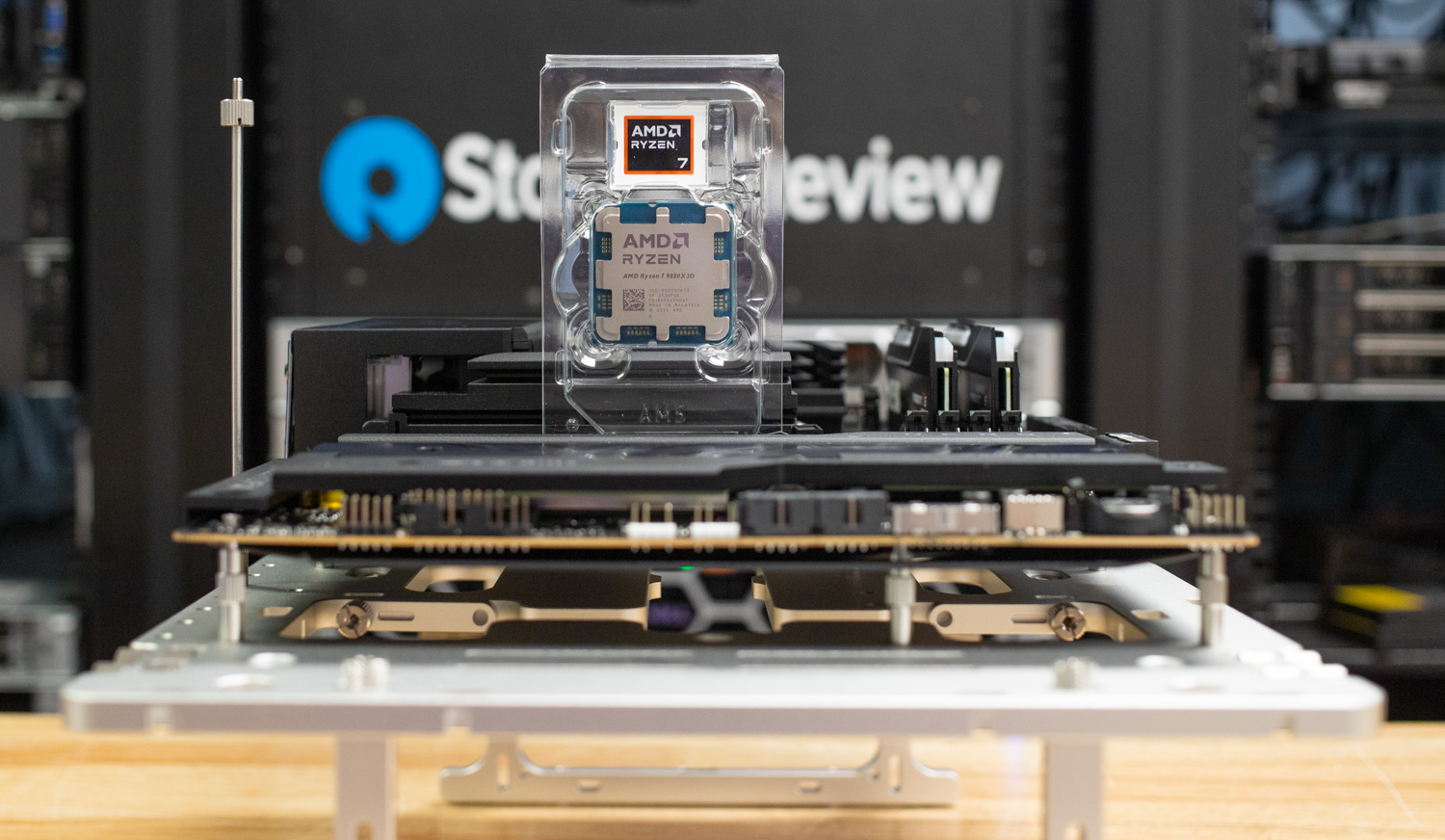 At a launch price of $499, the Ryzen 7 9850X3D is best suited for enthusiasts who prioritize gaming performance and overall system responsiveness but do not require higher-core-count CPUs like the Ryzen 9 X3D models. For users already on AM5, it offers a straightforward drop-in upgrade with modest but consistent performance improvements. Those currently running a Ryzen 7 9800X3D may find the upgrade less compelling unless they are chasing incremental gains, while users coming from older AM4 or early AM5 systems will see a more meaningful jump.
Overall, the Ryzen 7 9850X3D delivers precisely what it sets out to do: refine an already strong gaming-focused CPU with measurable improvements in efficiency and consistency, making it a well-balanced option for high-performance gaming rigs and all-around enthusiast systems.