‘Original Source’ 2025 Wrap Up: Part II
In Pt. I of the 2025 year-end ‘Original Source’ round up, I looked at two recordings a bit off the beaten path in terms of repertoire. Well, now we get to some more well-trodden territory.
Today we’re looking at a disc of orchestral war horses from Italian conductor Carlo Maria Giulini leading the Chicago Symphony Orchestra, an ensemble for which he was once principal guest conductor. The majority of the LP is taken up by Pictures at an Exhibition, Modest Mussorgsky’s (1839-1881) programmatic music depicting paintings by his friend and colleague Victor Hartmann.
Hartmann, who in many regards shared Mussorgsky’s vision of artistic nationalism, had gifted a number …
‘Original Source’ 2025 Wrap Up: Part II
In Pt. I of the 2025 year-end ‘Original Source’ round up, I looked at two recordings a bit off the beaten path in terms of repertoire. Well, now we get to some more well-trodden territory.
Today we’re looking at a disc of orchestral war horses from Italian conductor Carlo Maria Giulini leading the Chicago Symphony Orchestra, an ensemble for which he was once principal guest conductor. The majority of the LP is taken up by Pictures at an Exhibition, Modest Mussorgsky’s (1839-1881) programmatic music depicting paintings by his friend and colleague Victor Hartmann.
Hartmann, who in many regards shared Mussorgsky’s vision of artistic nationalism, had gifted a number of paintings to the composer in the late 1860s. After the painter died in 1873, there was a posthumous gallery exhibition of his work, and it is that exhibition that in 1874 inspired Mussorgsky to rapidly pen and publish his most famous work: *Pictures at an Exhibition *for solo piano.
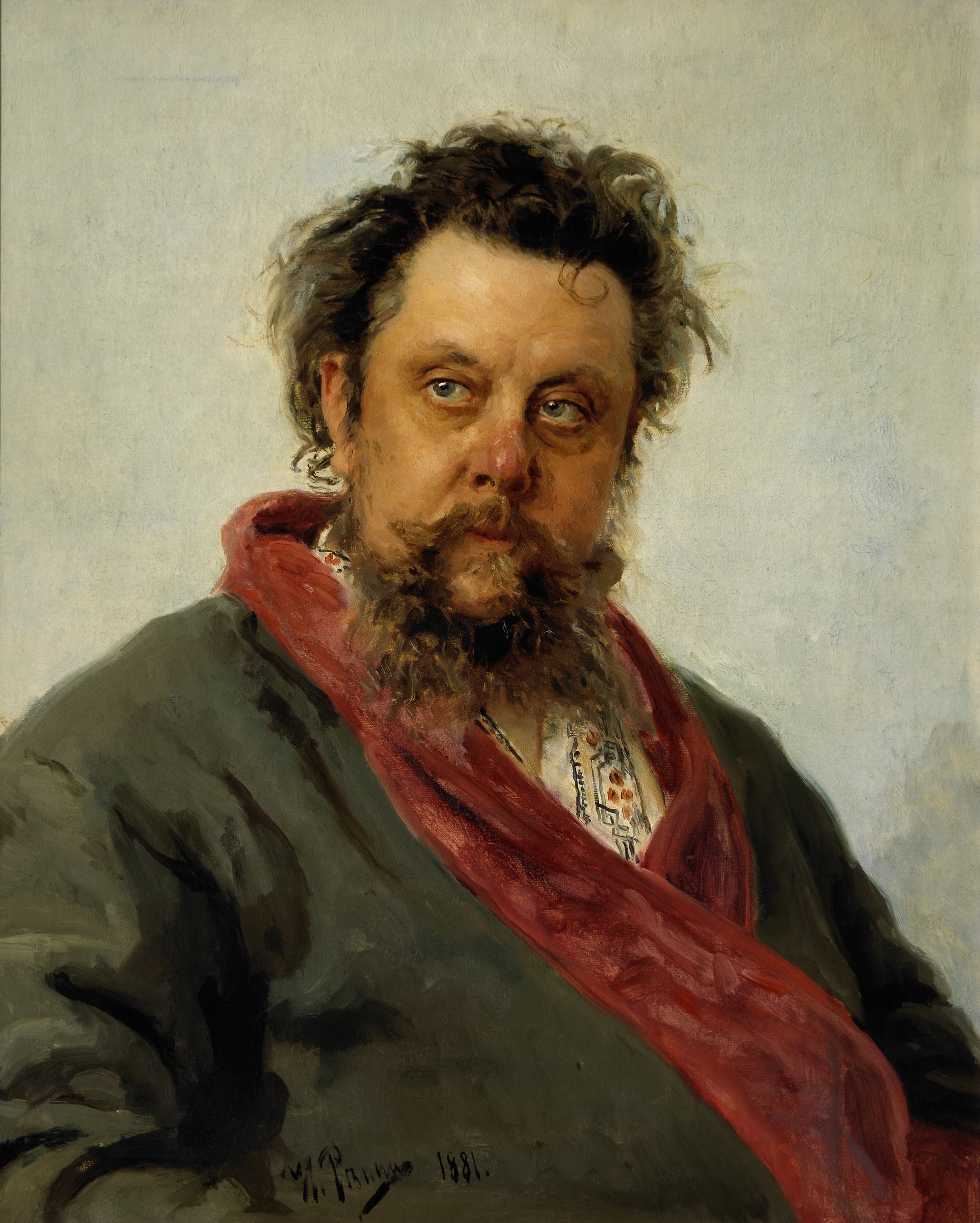 Modest Mussorgsky, painted by Ilya Repin just a few days before the composer’s death
Plagued with alcoholism for most of his life, which caused his early death at age 42, we have very little completed work by Russian composer Modest Mussorgsky.
The quick speed and inspiration of Pictures was a bit of a miracle given the inactivity and depression that would haunt him in the following years. The work is composed of 10 miniature movements, each depicting one of Hartmann’s works from the memorial gallery in St. Petersburg. Interspersed into these musical images are five separate ‘Promenades’ depicting the viewer or composer walking through the gallery. How quickly or slowly the performer takes the promenade theme can create a programmatic image of their mood, stride and stature.
Below is the program order of the suite:
1. Promenade
2. Gnomus
3. Promenade
4. The Old Castle)
5. Promenade
6. Tuileries
7. Bydlo
8. Promenade
9. Ballet of the Unhatched Chicks
10. Samuel Goldberg and Schmuyle
11. Promenade [most orchestral versions leave this movement out]
12. The Market Place at Limoges
13. Catacombs (Roman Tomb)
14. Cum mortuis in lingua mortua (With the Dead in a Dead Language)
15. The Hut on Hen’s Legs (Baba-Yaga)
16. The Great Gate of Kiev
Some of the paintings and drawings on which Mussorgsky based his miniatures are now lost, but many remain. I really recommend giving the surviving images a view when digesting this piece as it can place the music in the imagination in a way that textual descriptions cannot.
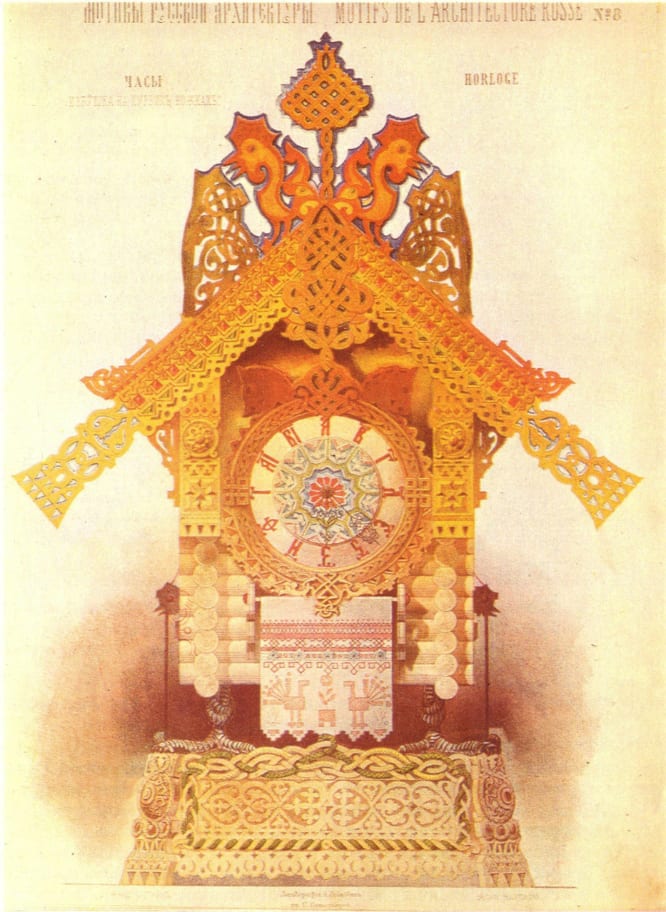 The Hut On Fowl’s Legs, also known as "Baba Yaga"
Despite the success of Mussorgsky’s short piano suite, he never attempted an orchestration, which is saying something because the composer left behind mountains of unfinished works and keyboard orchestrations, so much so that finishing Mussorgsky’s compositions became almost a cottage industry.
There are many orchestral transcriptions of Pictures, in fact almost too many to mention here. The first was an incomplete 1886 orchestration by Mikhail Tushmalov, a student of Nikolai Rimsky-Korsakov. But, in 1922, conductor Serge Koussevitzky commissioned French composer Maurice Ravel to take up the task, and his version quickly outshined all previous and future versions.
I’ve performed this orchestrated work on about half a dozen occasions, and the Ravel was always the maestro’s selection without hesitation (although as a student at Interlochen Arts Camp I did once hear the WYSO perform a rather peculiar arrangement by Sergei Gorchakov). As per usual, Carlo Giulini’s selection is the Ravel orchestration.
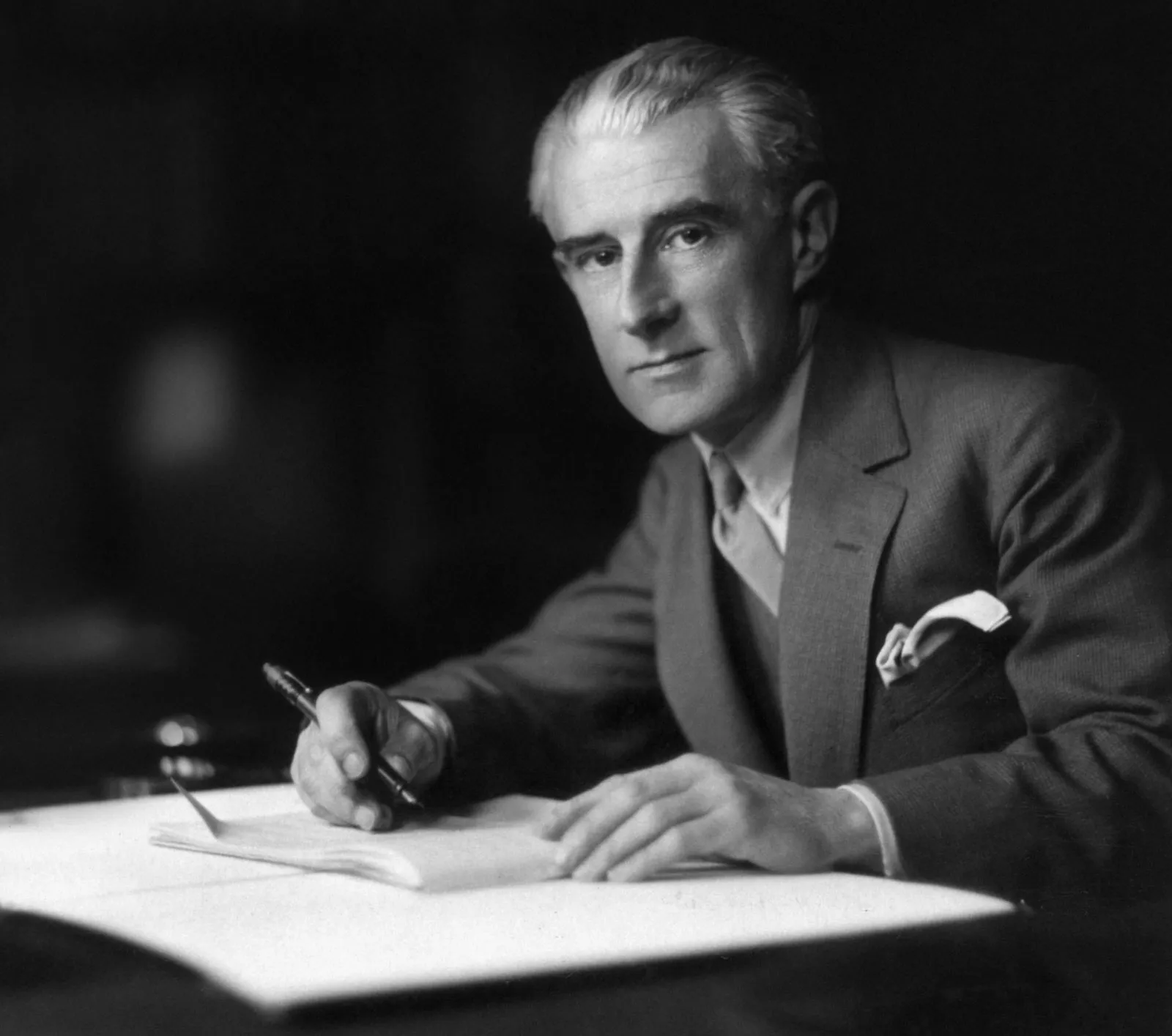 Composer Maurice Ravel (1875-1937)
On side two of this LP, after the conclusion of Pictures, we are greeted by Sergei Prokofiev’s (1891-1953) *Symphony No. 1 in D Major *otherwise known as the Classical Symphony. Prokofiev was just 25 when he began work on his first numbered symphony, but he already had a bit of a scandalous reputation as a dissonant modernist due to his first (1911) and second (1912) Piano Concertos, a reputation the composer was happy to trade on. It is then somewhat curious that he proposed his first symphony be written in a neoclassical style (although Prokofiev reportedly hated that term), mirroring that of Haydn or Mozart. Still, Prokofiev himself considered the work a musical experiment, and commented that the piece was what Haydn perhaps would have written if he had lived another 100 years.
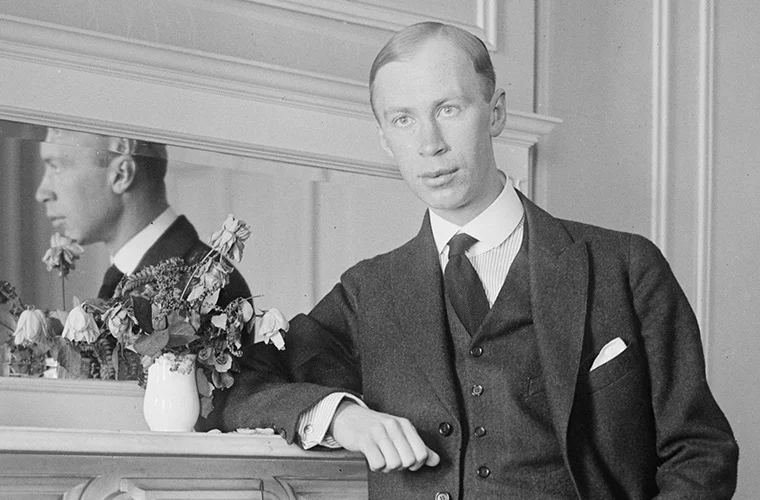 The young Sergei Prokofiev
The Classical Symphony is a very short work, much like the symphonies of the classical era, clocking in at just under 15 minutes, and that’s if you take conservative tempi. Bold performances can ring in at around 12 minutes if you really hate your woodwind section. I say that because while the texture of Prokofiev’s musical experiment is light like his inspiration suggests, the small orchestration contains rather perilous technical writing for all the soli voices. I’ve only had the pleasure of performing this work one time, but the fourth movement ‘Molto Vivace’ is a long-time staple of second oboe auditions, requiring incredible finger and tongue dexterity. The playability of this movement, depends entirely on how merciful the conductor wants to be that day…
Now’s the part where we talk about the sound and performance on this disc, and that presents a delightful challenge, mainly because audiophile record buyers have been blessed with a wealth of great recordings of this repertoire.
Myself, I had on hand approximately four other significant AAA reissues containing Pictures. They were:
-
René Leibowitz/Royal Philharmonic- ‘The Power of The Orchestra’ (Analogue Productions 45rpm AAPC 2659-45)
-
Antal Dorati/Minneapolis Symphony (Speakers Corner SR90217)
-
Fritz Reiner/Chicago Symphony (Analogue Productions 45rpm AAPC 2201-45)
-
Ricardo Muti/Philadelphia Orchestra (Hi-Q Records HIQLP013)
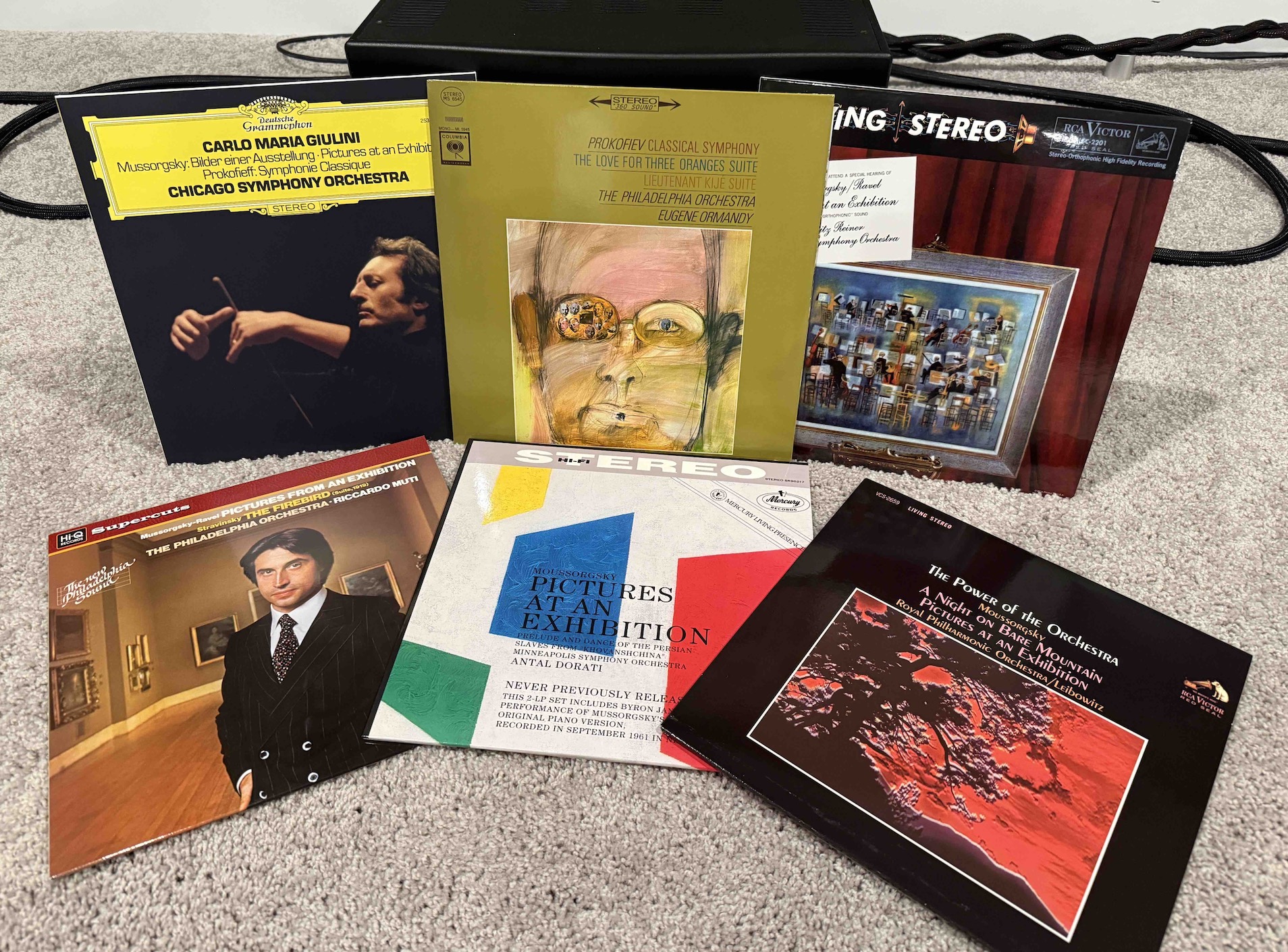 A selection of comparable reissues
I think I own one or two more older versions, and of course the old mono Mercury with Kubelik, but there is actually a thing as too many comparisons and for the purposes of our readers I figured these would be the interesting LPs to compare this release to musically and sonically.
First off, having not listened to the Leibowitz in quite some time, I was astonished at how powerful (cliché I know…) and transparent this recording is. This was by far the best record I played sonically. Better than the new Giulini, better than the other AP Living Stereo", better than anything else I heard. The sound of the plucked strings at the end of ‘Il Vecchio Castello’ was simply chill-inducing. The bass was full and deep and shocking at moments. End of review, right?
Well, no. The problem was that this is far from the performance top tier. Ravel’s orchestration relies heavily on virtuosic soloists from every section and that just isn’t here on this recording. Not to say anything was offensively bad, but the competition is fierce, and from the opening Trumpet solo with “wah-wah” phrasing that made me scratch my head, or the inconsistent technique and articulation of the flutes and oboe in the ‘Tuilleries’, I just wasn’t impressed.
Moving on to the Dorati, a conductor whom I usually enjoy, I could hear his musical ideas, but again the playing was just not at that top-tier I’ve come to expect from recordings of this piece. The sound is also, at least on my Speakers Corner reissue, not up to the transparent, 3-dimensional stereo image of the Decca-recorded "Living Stereo". It’s just a tad on the dry side, and that makes it feel a little artificial, at least by comparison. I will say however, the dynamics on this are explosive. This is just a situation in which “very good” isn’t enough praise to rise to the top of the pack.
Then things got difficult. I say that because the remaining three contenders: The Reiner, the Muti, and this new TOS Giulini, are very, very good, both musically and sonically. It’s an interesting comparison because Giulini and Reiner are performing with the same orchestra (albeit 9 years apart) on different labels. Muti however, is fresh on his arrival to the Philadelphia orchestra, and one year away from taking up the position of music director there, following the long tenure of Eugene Ormandy. In the time period of these recordings (1957-1979), Philadelphia and Chicago couldn’t have been more different in terms of sound. Chicago was a big and bold technical orchestra thanks to the tenure of Fritz Reiner and Georg Solti, while Philadelphia was a refined color palate of texture and finesse thanks to the work of Stokowski and Ormandy in the early 20th century.
I want to talk about the music first, as I think all three of these recordings as they are presented on these remasterings, sound excellent in their own way. The recording that I and many other orchestral musicians have grown up with is the Reiner. When this recording came out the level of technical perfection the Chicago Symphony was able to play with was almost unbelievable. Reiner’s reign over symphony hall was brutal, but he did succeed in building that orchestra into a force to be reckoned with. All you have to do is go back and listen to the Kubelik recording from 1951 to hear the huge difference in musical polish between pre-Reiner and post-Reiner.
It’s also worth mentioned just how much Adolph “Bud” Herseth absolute owns the opening promenade. He recorded the work with Chicago seven times during his long 53 year tenure as principal trumpet from 1948-2001. His phrasing is compact but elegant on every version I’ve heard, and his sound resonates through the hall with such vibrancy that I don’t think I’ve ever heard anyone top it. I haven’t heard every version he’s recorded, but the two here with Reiner and Giulini are both top notch, but wildly different interpretations.
Reiner’s 1957 account is quite frankly the musical reference, it’s tight when it needs to be, but spacious when required. Take for instance the second miniature, ‘Gnomes’ which Reiner and Chicago attack with a large and firm accent at the beginning of the sextuplet run. It shows firmly where the rhythmic placement should lie, on the larger subdivision, not the smaller one. And when the orchestra comes in at a pianissimo echo, the line is so carefully delivered, and every note is clear and audible. Very rarely have I head this section played with such musicality and precision all in.
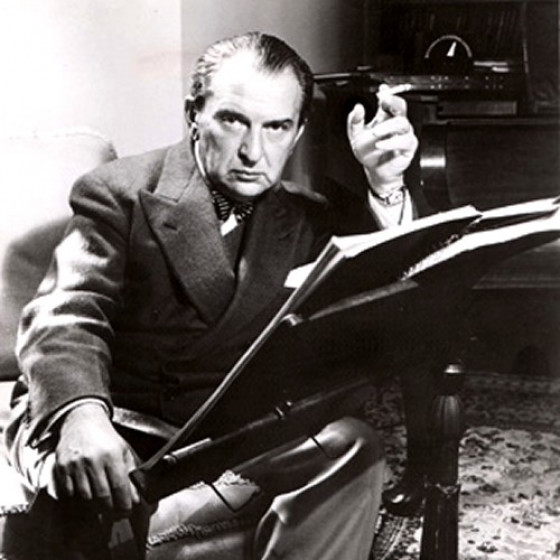 Dr. Fritz Reiner, music director of the Chicago Symphony from 1953-1962
Other movements have incredible lightness and agility, like the ‘Tuileries’ which are spritely yet never sound “technical” despite the great technical feats involved in playing the parts. Within all this structure, there is great care taken in the musical phrases. You can tell this most apparently in Samuel Goldenberg and Schmuÿle where the string phrasing and Herseth’s piercing trumpet obligato is shaped with a clear direction and weight. Overall, musically Reiner sets the standard in this recording, one that all others after are compared to, whether for good or bad.
Giulini had big shoes to fill when sitting down with the same orchestra in 1976. His interpretation is different enough to truly stand out. The Italian maestro has a bit of a reputation for slower, more thoughtful tempi, and in this outing that is definitely the case. There is also a smoother, and less angular approach to the individual promenades, where they are often of a similar pace to the Reiner versions, but because of the note length and weight, makes the pace of the gallery viewer feel more reserved.
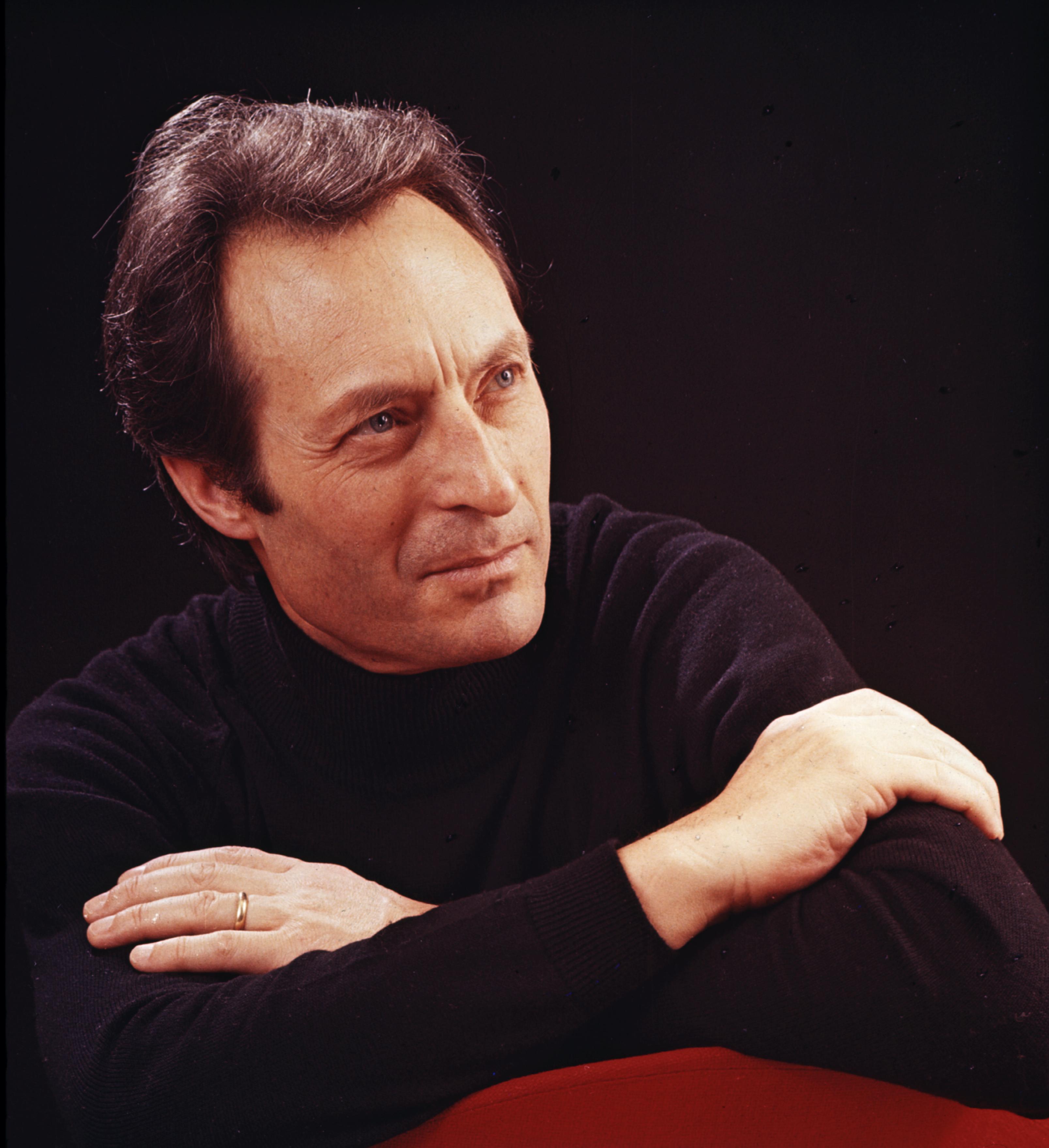 Carlo Maria Giulini
The playing on this account is likewise universally fine, but lacks a bit of athletic punch when called for, such as in the ‘Tuileries’ where it sounds much too heavy and a bit lethargic. In other places though, the approach works better like in ‘Ballet of the Unhatched Chicks’. Reiner’s version is very impressive here, but somehow Giulini’s slower tempo and reduced intensity makes the movement sound more playful and lighthearted, which the character of the miniature truly needs. Other choices are much more a matter of personal taste. Giulini’s ‘Baba Yaga’ sounds menacing and heavy, while Reiner’s sounds like a scene from an action movie and I’m not sure which sounds more “correct”, only that the Giulini account took me by surprise.
Then in 1979 (recorded in 1978) we are greeted with Ricardo Muti and the Philadelphia Orchestra, originally on EMI (ASD 3645). Right away this is a brighter, more energy-infused Pictures starting with the opening trumpet ‘Promenade’ likely played by Philadelphia principal trumpet (and former West Point bandsman) Frank Kaderabek. Kaderabek’s playing sounds nothing like Herseth’s, he places his sound with much more high end energy, sounding far more brassy (almost a French sound) than Herseth’s broad, deep tone. Muti’s ‘Gnomes’ fly with much more vicious speed than either other conductors’, and his ‘Limoges’ achieve flight with technical mastery and precision.
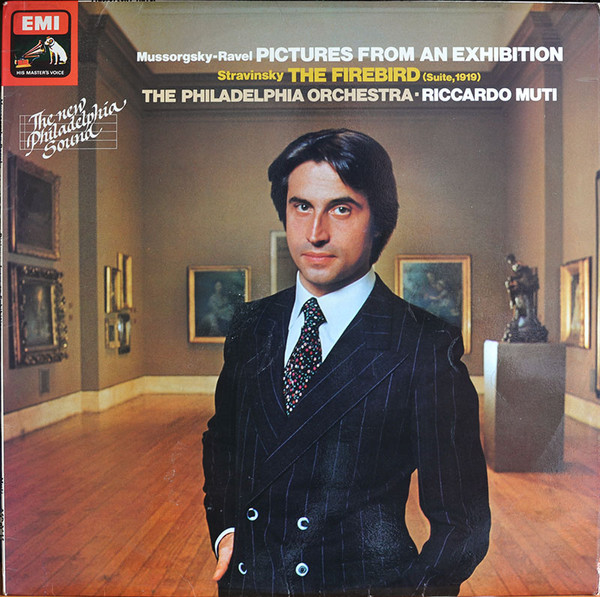
Muti’s account is very exciting, and in many ways it establishes a new standard of technical perfection surpassing the one Fritz Reiner set 20 years prior. However, it doesn’t quite achieve the level of nuance Reiner is able to capture; speed is great but can sacrifice musical sincerity in the process. The best example of this is the final ‘Great Gate of Kiev’ which Muti almost rushes through at the beginning, only pulling back the reigns at the end for the final pass of the melody. It’s exciting, but perhaps sacrifices some grandeur. Giulini gets much less of the excitement, but his account really captures the reverence and scale of the image.
Now let’s talk about sound. The Reiner doesn’t need much introduction, and Ryan K. Smith did an outstanding job bringing this tube recording to the 45rpm format. It’s spacious, has incredible bass, but most importantly it gets the tone and body of the instruments correct. They sound real and the scale is congruent with the scale I would except to hear in the orchestra hall. This recording was done in December of 1957 at Chicago’s Orchestra Hall, engineered by Lewis Layton and produced by Richard Mohr. It doesn’t quite pack the punch of the other RCA Pictures recorded in the UK, but the musical performance more than makes up for the difference.
My Hi-Q Muti, which was cut from the original EMI tapes at Abby Road (still not sure who cut these, as neither the deadwax nor the marketing give any clues) has some nice audiophile qualities like transient response and detail, but the imaging is not particularly focused, and sometimes comes across as blurry. The highs are also a bit shouty which becomes obvious in moments like ‘The Great Gate of Kiev’. In tems of image stability and soundstage depth, the Reiner beat it handily, and luckily I also prefer that performance.
Getting to the most important recording (aka why I’m writing this review), the Giulini offers a very interesting sonic perspective. Despite recording with the same orchestra, for this outing they moved across the street to the Medinah Temple, a popular recording location for the orchestra in the 1970s. Engineered by Klaus Scheibe, produced by Gunter Breest, and of course remixed/remastered by Rainer Maillard and cut by Sidney Meyer at EBS like all Original Source reissues. The picture of the orchestra here on this new cut is more detailed than either the Reiner or the Muti, it also has a much larger soundstage. So it must be better right? Well, sort of. It handily trounces the Muti, at least my Hi-Q reissue. Maybe someone that has the original EMI or the MFSL cut can comment better…
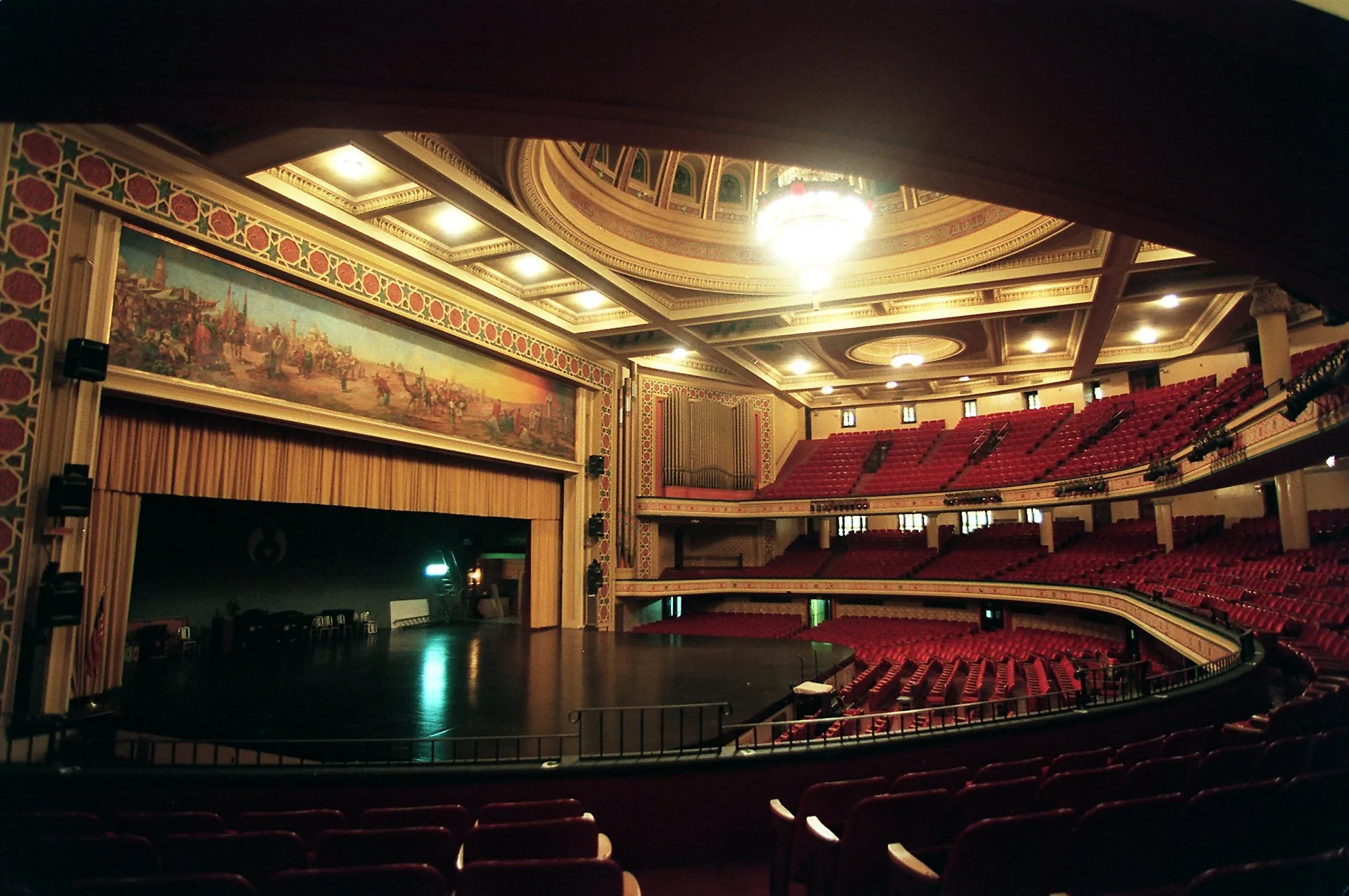 Medinah Temple in Chicago
But this new Giulini does have some flaws perhaps from the way it was recorded by Scheibe. For one, this is a much more reverberant recording than the Reiner. The Reiner has air, but the sound is more direct than indirect, the reverberance from the hall acoustic is secondary and less noticeable. The Giulini on the other hand is very “wet”. I’m not sure if this is just something DG liked to capture in its recordings, but it is very peculiar to hear such detail, but such a long reverb “tail.” I don’t think it ruins the otherwise good qualities here, but whether you like it will depend a lot on the wet sound signature.
What else? Well if I’m very picky there is just a bit of a lower midrange suckout that hurts a few instruments most apparently the Timpani. If you put this LP on and cue up ‘Baba Yaga’ and listen to the opening timpani strikes, they really do not have a lot of body to them, only tone, the transient slam is almost completely absent. It’s very weird because the snare drum and bass drum do not have this problem, It could be the acoustic of Medinah (although I don’t remember this issue in Barenboim’s Bruckner 4 recording), or it could also be because of the engineering. Either way, all you have to do to hear what’s missing is put on the same movement on the AP Reiner and wah-la! The timpani sounds like a real timpani.
I’m being picky though, the other aspects of this LP are very, very nice, there is this incredible three-dimensionality to the sound on this TOS disc that even the Reiner cannot keep up with. The brass sound incredible, and there is amazing tangibility to sections like the lower strings and the French horns which sound hyper-realistic.
“But” you say as you gloss over 2700 words about different Mussorgsky recordings, “What about the Prokofiev??”
Well, the Classical Symphony is the short dessert to the program here, and it’s delightfully conducted and performed by Giulini and Chicago. However, musically it’s not going to be to everyone’s tastes, it is slow and far-less energetic than many of the more popular performances of this piece. To me, that makes its charming, and believe me I bet Ray Still and Donald Peck appreciated the careful tempo in the finale.
Just for fun, I threw on the recording I usually turn to for this piece, Eugene Ormandy and the Philadelphia Orchestra (Columbia MS 6545) from 1961. The original Columbia pressing is nothing to write home about, but the Speakers Corner reissue cut by Kevin Gray does improve the sound substantially, making it more full range in the bass, and bringing out the detail and dynamics of the orchestra. It’s a shame the bright Columbia string tone still is a bit painful at times, which keeps me from considering this an “audiophile” recording, even with Mr. Gray’s wizardry.
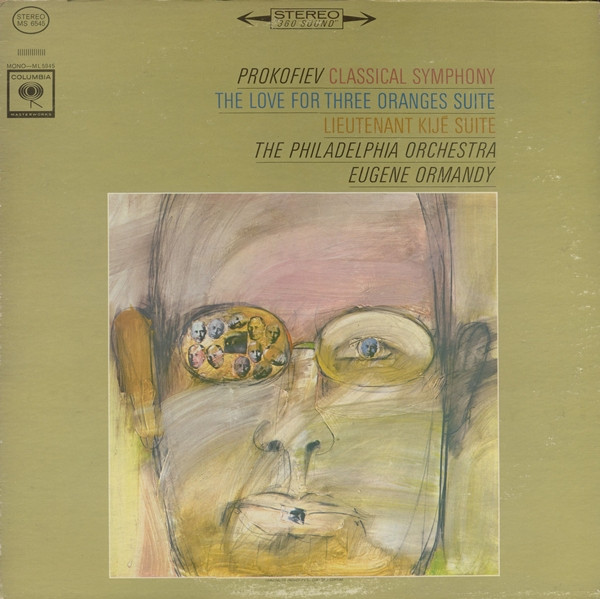
But musically the Philadelphia recording is a reference for a reason, it’s marvelously controlled, colorful, and when required, the orchestra takes off like a wild animal into breakneck speed. Just listen to the sweet and sublime ‘Gavotte’ movement, and then the incredible beginning of the Finale to hear what I’m talking about.
The good news here is that sonically it’s no contest, this Original Source disc sound far more balanced and full than the Columbia recording. But I’m not convinced Giulini’s approach here is bringing out the best of the work. There are many things to like, like how his more measured tempi create longer lines, and how you can really hear the interactive texture of all the interweaving parts. But I think the real problem is that Giulini’s account sacrifices energy for beauty, and this more “regal” account of the Classical Symphony just doesn’t engage me the way others do. But in all things regarding taste, listen and judge for yourself.
The Original Source have done well to resurrect more Chicago Symphony recordings from the DG vault, and this outing with Carlo Maria Giulini is an excellent continuation of their endeavor. The orchestra is playing at the height of their power and the sound is transparent and vivid despite my nit-picks. The only issue is really that while both performances on this disc are excellent, they can be bested in my opinion by other in-print or recently in-print performances.
Listen, if you’ve never owned a copy of Pictures at an Exhibition on vinyl, just do yourself a favor and go get the Reiner from Analogue Productions on either 33 or 45rpm. It’s just going to give you a better introduction to the piece and glorious tubey RCA sound. BUT, if you already have that recording and want to hear something with a vastly different musical interpretation, this Giulini really is excellent. Of all the Pictures recordings I listened to for this review, it would be my next choice, and that’s saying something because the field of great performance and sound for this work is very crowded. Add on the Classical Symphony for a nice bonus. It isn’t going to top any critic’s lists, but at the very least it should give you a nice introduction to a work that doesn’t always get its deserved due.
Stay tuned for Pt III where I tackle the dynamic duo of Mstislav Rostropovich and Martha Argerich!