Many times, Domus has been sitting down with designer Konstantin Grcic; it is an ongoing relationship that has now entered its fourth decade. This time we are in Milan, at the Triennale, sitting in front of one of the large windows opening onto the park and De Chirico’s bathers, and a very specific object hanging in front of us, which will play a role in this story.
This time it is different, as we are sitting inside a new exhibition dedicated to sport that Grcic curates after the one in Paris: “White Out”, a reflection on winter sports conceived with Marco Sammicheli to be more design-focus…
Many times, Domus has been sitting down with designer Konstantin Grcic; it is an ongoing relationship that has now entered its fourth decade. This time we are in Milan, at the Triennale, sitting in front of one of the large windows opening onto the park and De Chirico’s bathers, and a very specific object hanging in front of us, which will play a role in this story.
This time it is different, as we are sitting inside a new exhibition dedicated to sport that Grcic curates after the one in Paris: “White Out”, a reflection on winter sports conceived with Marco Sammicheli to be more design-focused while still capable of engaging a broad audience.
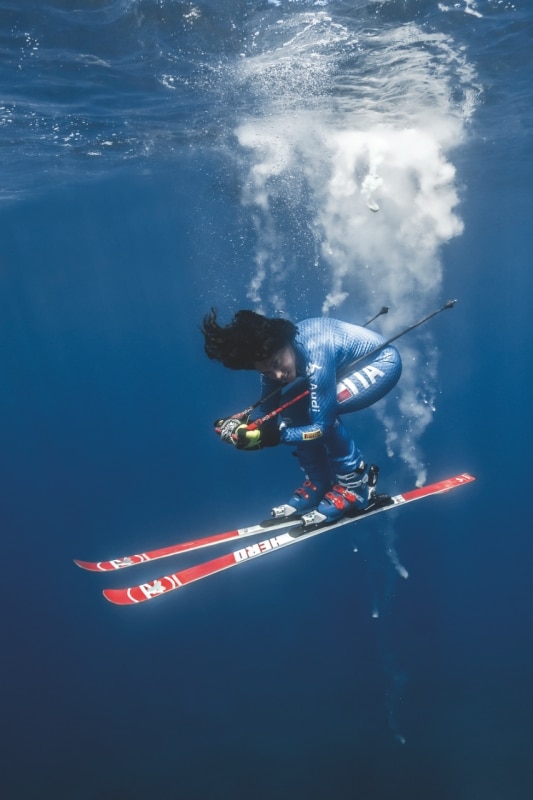 Trajectories Liquide, Federica Brignone, first trajectory 2017. Photo Giuseppe La Spada
The objects selected to tell the present and future of winter sports – skis, suits and equipment, of course, but also rescue devices, projects for fixed and mobile structures such as the Refuge Tonneau by Charlotte Perriand and Pierre Jeanneret – describe one of the fronts on which design has done more than anywhere else to push forward the boundaries of what is possible.
“A very important part of the exhibition is the very first stretch, Skins, which is about the human being and the first layer of protection, about being out there in this extreme condition: I think this is where the design story started in winter sports”. He would have liked to show the equipment actually used in competition by Federica Brignone, but he was only able to display a new example. The Prada suit of ski jumper Ryōyū Kobayashi and that of hockey player Erik Salomonsson, on the other hand, are visibly worn, with all the marks and scratches that come with use.
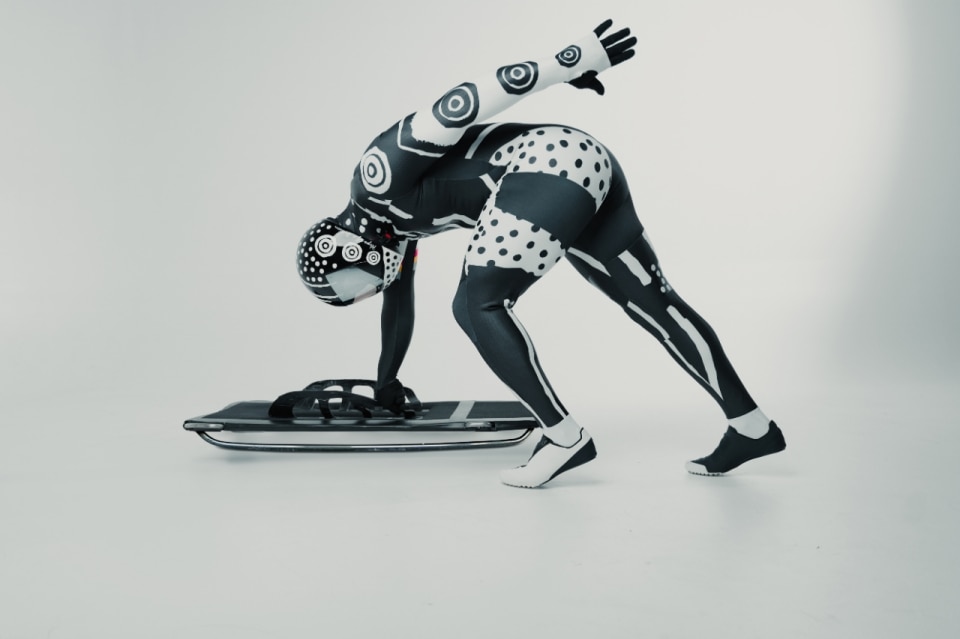 Ghanaian athlete Akwasi Frimpong with his skeleton; suit design by Matt Millette, helmet design by Peter Pen Art. Photo Nate Athay, 2024
Beyond the marketable product there are then different territories where design is crucial: for Grcic this mainly concerns the infrastructural world. But what takes us onto that bridge connecting two apparently distant worlds is once again an object, the one hanging in front of us since the beginning of the interview: a skeleton, the micro-sled for athletes to launch themselves head-first at over 150 km/h down ice-paved half-pipes. In fact, it is Grcic’s favorite object among those on display, so raw and apparently “undesigned”, anonymous and covered with adhesive tape. Yet it concentrates an extremely high density of what design today can truly be: “It’s designed in the way that it does everything it needs to do, and no more. It’s a steel plate, it gives stability to the person. It has these handles to push it, and that’s it. These things are very much prototypes, (but) even the more commercial design can adapt or learn something from such rougher nature of how things can be”. And although new technologies such as 3D printing may themselves produce an aesthetic, feelings will always end up prevailing: “I love these things that are very rough and ‘wrong’”.
Starting from the world of winter sports, it seems that products are still a main factor in changing the ways we live. This is, however, an evolution, Grcic tells us; a matter of reciprocal exchange, almost a negotiation, between practices, markets and industry: “Athletes, and a dynamic evolution of sport make it necessary to rethink, to re-engineer, to reinvent things, every year, every second year, and so on. A continuous progression”. But the scale of infrastructure comes back into the discourse, on the slopes as in cities: “There are many things in everyday life, roads, traffic lights, that we take for granted. But there’s a precise engineering and design behind it, not only the design of the traffic light, for instance, but also the timing of traffic lights. For example, Copenhagen changed the timing of their traffic lights to the speed of cyclists. It’s a design decision, that could have a big implication into traffic in Copenhagen; more people would use bicycles”.
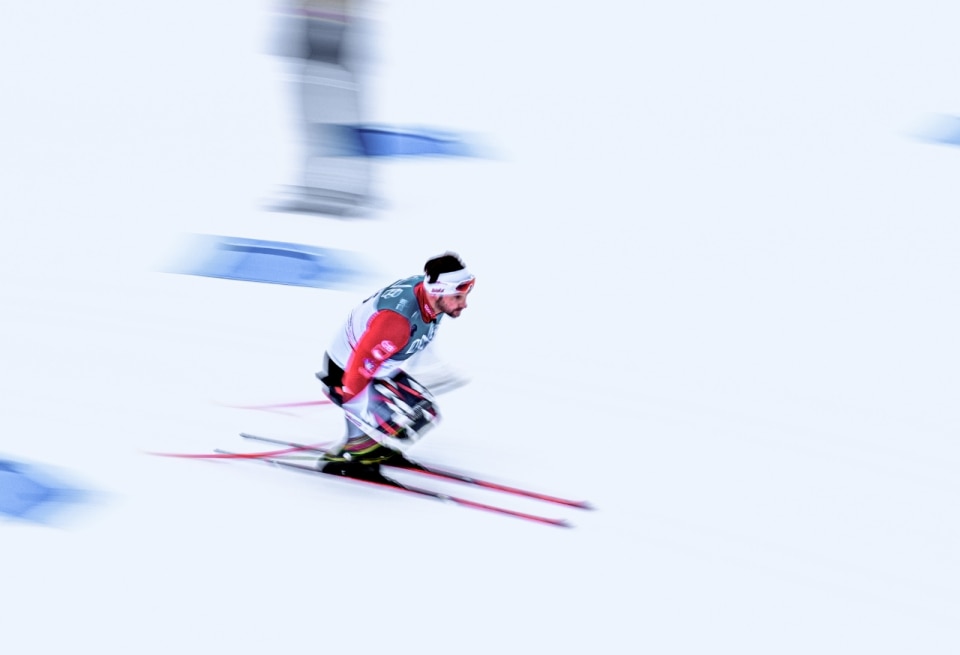 Steven Arnold. Photo Gisle Johnson
And industry, too, has to follow: “They’re all interested in selling their products and making money, for sure. But I think they’re all smart enough to know that, unless they really become smarter and take on that responsibility, they will kick themselves out of the job; winter sport resorts are only needed as long as we find all of that acceptable and sustainable”.
Designers are a very important factor: they mediate between all those people who can analyze a problem, and those who can build something. They have the tools; they have a place.
Between the “shell” shaped by marketing and the “core” – land of engineers – design finds its place in a wide “land of in-between”. That is where designers find their role today: “Design is this discipline which is on the interface between the problem and the facts, the content, the science” Grcic tells us, “the feasible solutions that turn into implementation. So, whether it’s about the traffic lights in Copenhagen or the design of a snow cannon or a lift in the mountains, so I think designers are a very important kind of factor in the whole development; they mediate between all those people that can analyze a problem, and those who can build something. They have the tools; they have a place”. Their territory today is more in conceptualization and process planning, which then translate into forms.
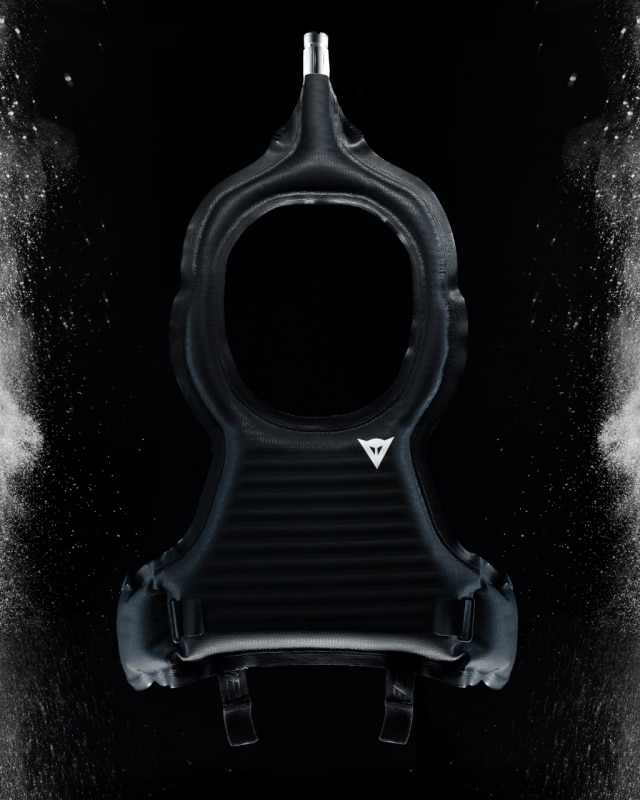 D-air® Ski 2 Evo. Courtesy Dainese spa
All right, Grcic, but in the end, are we saying that designers actually have some kind of power? “Yes, and this power is growing. Since when I started, to today, my power has multiplied, not because I’m now older, more experienced, or even have a name: the responsibility, the job profile has expanded enormously. Designers are, first of all, thinkers, and their power has grown as design process is integrated into a lot of processes from the very beginning, we sit around the table of decision makers at the very beginning”.
With Milano Design Week kicking in, I’m not a producer or an exhibitor in the classic sense. I want to contribute, make my product become part of some other activities. It’s about being present, and I love it.
He himself translates such hybridization between process and product into his current practice – with his new brand 25Kg he will launch a project at the next Milan Design Week, but more than a presentation he would like a presence, a participation in many different activities – and this new phase, he adds, has partly taken him back to where everything began for him, to “the direct contact with all that it takes to produce something of value”, especially now that he can produce his objects firsthand and at the same time be involved strategic decision making with some of the clients he is working with. Of course: “Times are extremely difficult now – think of winter sports in times of climate change – but I’m still passionate about things, I’m not quitting design!”
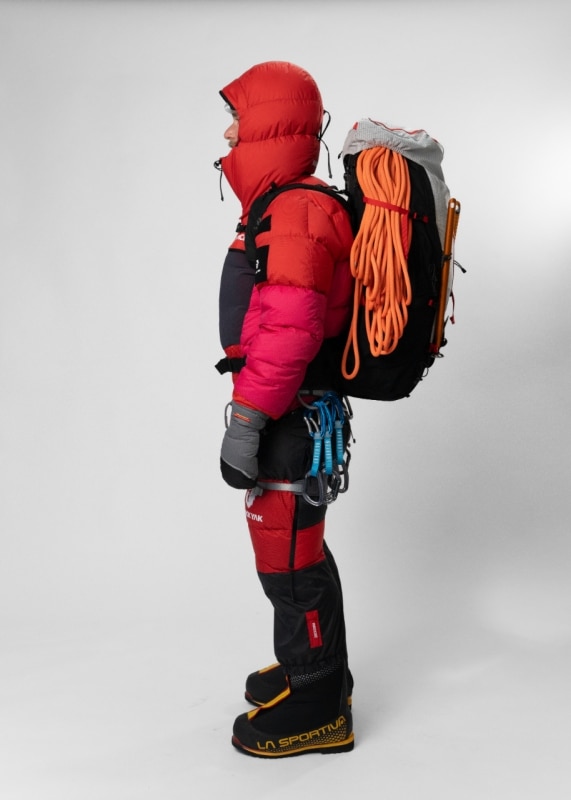 Courtesy Byn Blackyak
It has become more a matter of asking questions: who needs a new product, first of all? Then, how can it be designed in such a way that it constitutes a step forward compared to what came before, more sustainable, more rooted in reality. “I feel right now, it’s not the moment to make any big wow-effect. The good work is in the detail, in the small scale”– just one year ago we had a very similar conversation with Sabine Marcelis as well – “maybe a regional scale where you speak directly with people, where you understand immediately what is the problem, and not an abstract idea of a problem. I feel the world, the good world, is coming back to that”. It is no longer the time for certain nostalgic ideas of the future – and as he says this, he points to the photo of Leo Gasperl with his large aerodynamic shell used in attempts to set ski records in the 1930s.
Times are extremely difficult now (…) but I’m still passionate about things, I’m not quitting design!
We remain, however, immersed, surrounded by objects: in the end, is it sustainable to keep thinking up new ones? “There’s too many objects” Grcic confirms, “but already 50 years ago, I’d say there were too many things. The answer is not ‘let’s all stop’. As a designer, I can question or even refuse projects. And I do so. The impact may be little, but at least, I don’t support this process. Still, things are part of culture, of mankind, but let’s be very considerate, intelligent and resourceful about it, even though it’s a difficult discussion: we cannot define (absolutely) things that are worth making. There may be things, that are good to someone else”.
But in the end, did Konstantin Grcic have fun designing the exhibition set-up as well? “Yes”.
Exhibition: White Out The Future of Winter Sports Curated by: Konstantin Grcic and Marco Sammicheli Location: Triennale Milan, Milan, Italy Dates: Until March 15, 2026
Opening image: Konstantin Grcic, 2025. Photo Markus Jans