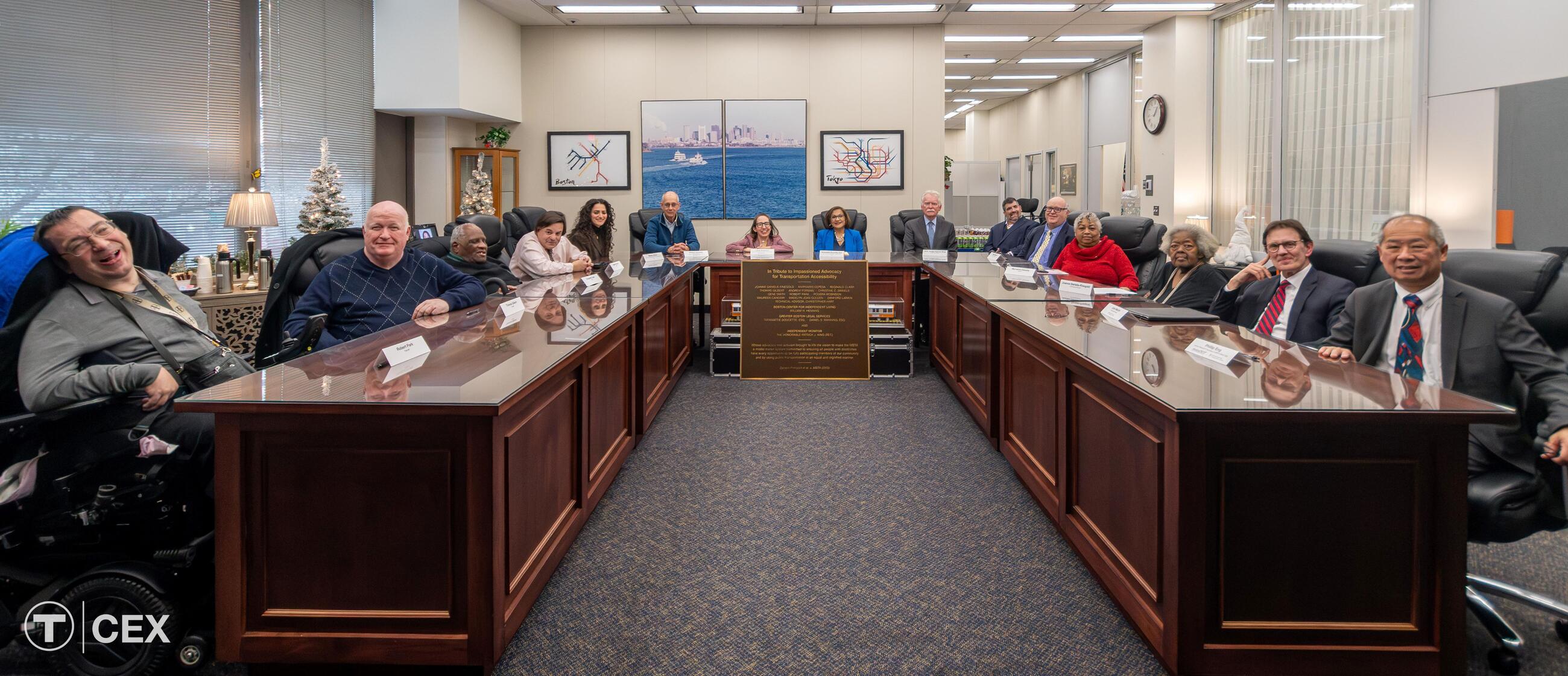
Pictured above (from L to R): Robert Park, Thomas Gilbert, Reginald Clark, Andrew Forman, Majda Abbas (GBLS), Bill Henning (BCIL), Laura Brelsford (MBTA), Taramattie Doucette (GBLS), Independent Monitor Judge …
Pictured above (from L to R): Robert Park, Thomas Gilbert, Reginald Clark, Andrew Forman, Majda Abbas (GBLS), Bill Henning (BCIL), Laura Brelsford (MBTA), Taramattie Doucette (GBLS), Independent Monitor Judge Patrick King, Chris Hart (MBTA), additional GBLS counsel, Myrnairis (Mic) Cepeda, Joanne Daniels-Finegold, John Martin (MBTA), Interim MassDOT Secretary and MBTA General Manager Phillip Eng
The Massachusetts Bay Transportation Authority (MBTA), disability advocates, and original plaintiffs of a landmark accessibility lawsuit came together December 10, 2025, to celebrate a historic milestone in the ongoing effort to make public transit accessible to all.
In honor of this milestone, and to demonstrate its ongoing commitment to advancing accessibility system-wide, the MBTA has worked with the original named plaintiffs, the Boston Center for Independent Living (BCIL), and Greater Boston Legal Services (GBLS) to enter into the Next Generation Accessibility Agreement with BCIL, which includes numerous commitments related to delivering best-in-class accessible service for all riders. This agreement also shifts oversight responsibility from a court-appointed monitor to the Riders’ Transportation Access Group (RTAG). RTAG is the MBTA’s citizen-led advisory committee on accessibility matters, and the organizations will work together to make more progress across the entire MBTA network. Anyone is welcome to become a member of the group.
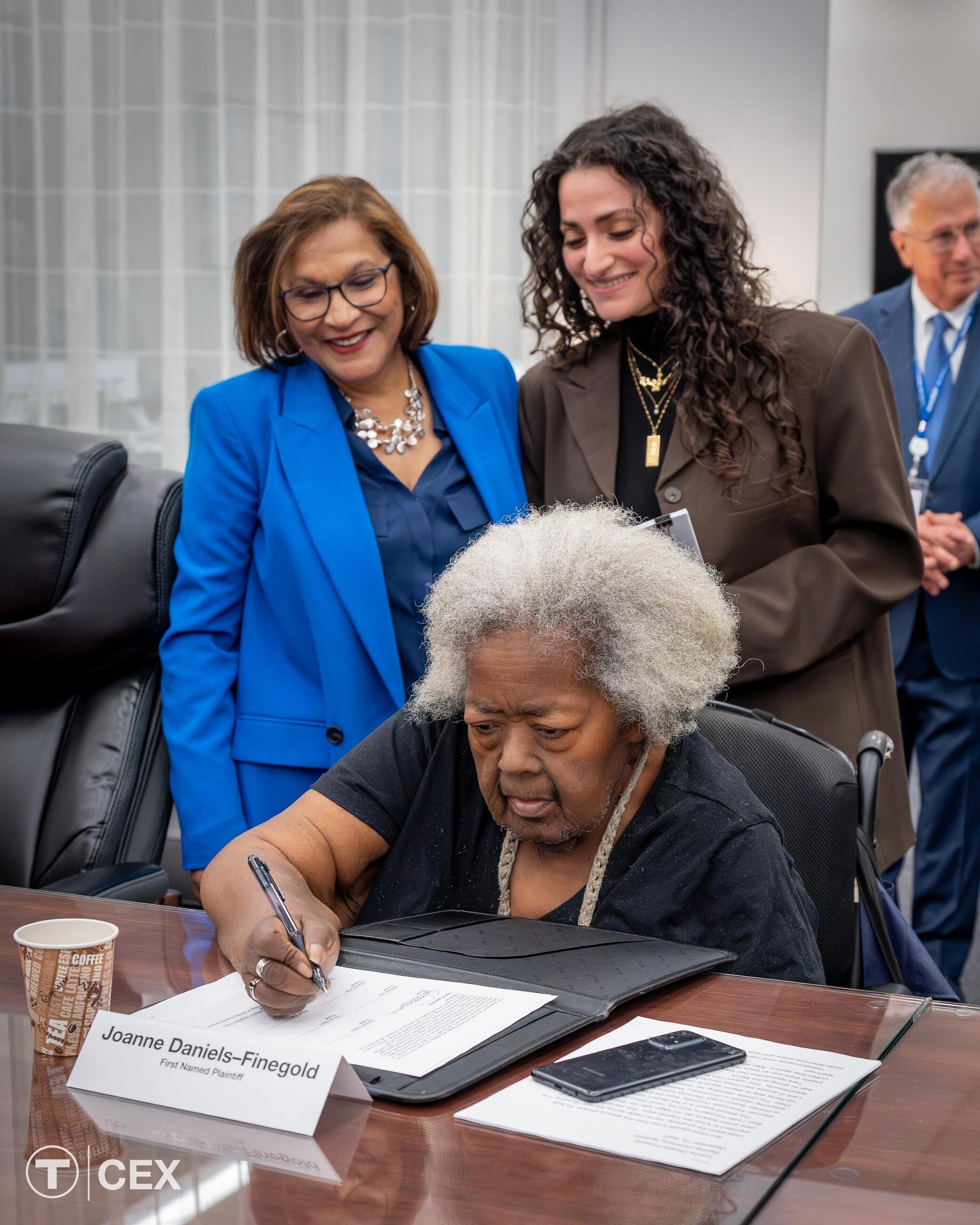
First-named Plaintiff Joanne Daniels-Finegold signing the agreement.
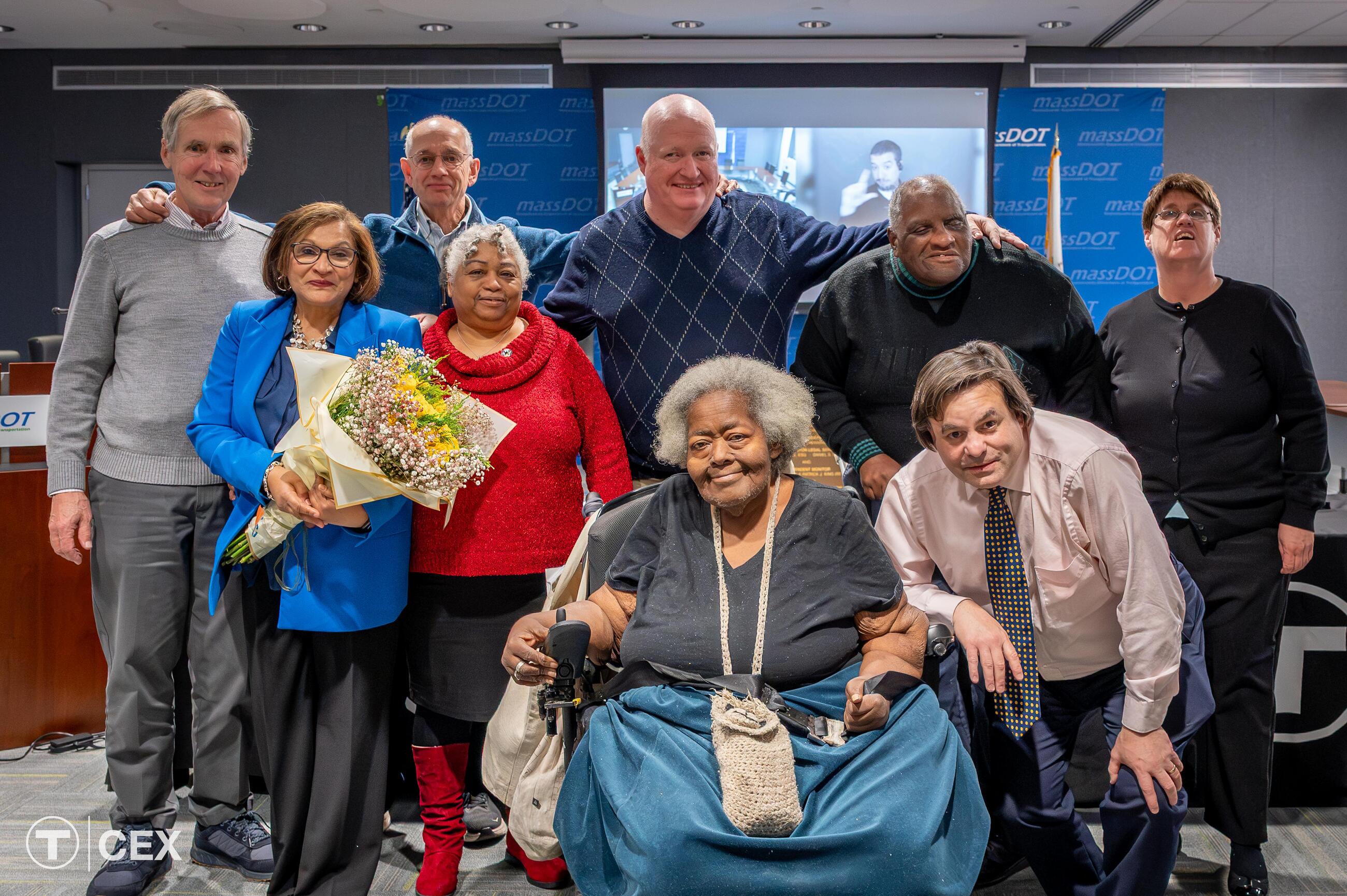
Disability advocates, original plaintiffs, the BCIL, and GBLS leadership today celebrated this historic milestone.
"Since my very initial days at the MBTA, it was evident that the plaintiffs in the Daniels-Finegold landmark lawsuit were now partners. Their long-term commitment of working with us to improve and advance accessibility was not about the case but rather ensuring that all who wanted and needed to use mass transportation had the same access as everyone else — something that we at the T value equally. That is why this settlement agreement is not only a major milestone but so meaningful for myself and the MBTA leadership as we share that goal. While nationally, the MBTA is one of the most accessible legacy systems in the United States today, we also know we have much more to do,”** said Interim Secretary and MBTA General Manager Phillip Eng**. “I value the dedication shown by each of the plaintiffs – in particular, Joanne Daniels-Finegold, Myrnairis Cepeda, Reginald Clark, Thomas Gilbert, Andrew Forman – along with, BCIL led by Bill Henning, Taramattie Doucette and the entire team at GBLS, and Independent Monitor Judge King. I offer my sincerest gratitude for their decades of open communication and partnership as we strived to address accessibility at the MBTA. In addition, I would like to thank Christine Daniels, a community advocate, for her help on this important work. I am so proud of System-Wide Accessibility Assistant General Manager Laura Brelsford and her entire team’s efforts that led the progress we see today. We remain committed to ensuring one day, each and every individual can use the MBTA with safety, dignity, and confidence as we work with RTAG who has now assumed oversight responsibilities.”
“The story of the Daniels-Finegold lawsuit and settlement is one that should be shared far and wide,” said Assistant General Manager of System-Wide Accessibility, Laura Brelsford. “Two decades ago, a small group of disabled riders, with help from a dedicated legal services organization, spoke up after experiencing years of inaccessible service. And when no one would listen, they kept fighting — ultimately securing what has been recognized as the most comprehensive accessibility-related settlement agreement in public transportation. What’s even more impressive, is that, once the settlement was signed, they shifted quickly from litigants to partners and have consistently and constructively guided us into becoming one of the most accessible systems in the country today. It has been a privilege to work alongside them and be part of this story.”
“For more than 20 years, the named plaintiffs, Greater Boston Legal Services (GBLS) and the community have worked with the MBTA to make accessibility improvements that benefit all riders. I’m glad that RTAG will now have the resources and a strong platform to take our legacy into the future,” said Joanne Daniels-Finegold.
“It marks a huge step towards ensuring equal rights for riders of all abilities,” said Myrnairis (Mic) Cepeda.
“I’m glad we were able to bring the right people at the MBTA together with the community to solve the access problems. Now, it’s up to the community to keep the work going with RTAG,” said Reginald Clark.
“It means we have come a really long way compared to 20 years ago. It’s far better than it was. We have made a real difference, not just for the MBTA, but worldwide. The MBTA has become a benchmark standard for accessibility,”** said Thomas Gilbert.**
“Thanks to the leadership and foundational work of Greater Boston Legal Services and the plaintiffs, and with the strong team we have assembled — including System-Wide Accessibility, the Boston Center for Independent Living, and the Riders Transportation Access Group — I am confident that we will continue to advance accessibility at the MBTA. Although the transition presents significant challenges, our productive working relationship with the MBTA gives me confidence that full accessibility will ultimately be achieved,”** said Andrew Forman.**
“Today, I am very pleased to see the MBTA’s transformation from a decrepit system to one that is finally accessible, dependable, and built for all riders,”** said Gene Smith.**
“BCIL extols the amazing individual plaintiffs who’ve given over twenty years of personal time to improve accessibility at the T, the great GBLS legal team, and the ongoing commitment throughout the MBTA’s ranks to get it right on the ADA,”** said Bill Henning, the Director of the organizational plaintiff, Boston Center for Independent Living (BCIL).**
“Now that plaintiffs will be transitioning to RTAG, it is important to note that the work is not done,”** said Taramattie Doucette, Esq, who serves as lead counsel for the plaintiffs on behalf of the Greater Boston Legal Services (GBLS)**. “Accessibility is not a box we check; it is a standard we must continue to raise. As systems age, as ridership grows, and as new technologies emerge, the community via BCIL/RTAG must insist that progress continues — steadily, boldly, and inclusively.”
“On behalf of the Riders’ Transportation Access Group (RTAG), I am honored to accept the baton of responsibility from the Daniels-Finegold plaintiffs, who have worked tirelessly for over two decades to improve MBTA access for everyone,” said RTAG Facilitator and Community Organizer Katarina Torres Radisic, “Our commitment will extend beyond the settlement as we continue to promote transparency, equitable and inclusive service delivery, and build public trust in the MBTA.”
Since the Settlement Agreement was reached in 2006, the MBTA has made sweeping improvements to virtually every aspect of its fixed-route system in order to ensure riders with disabilities have access to safe and reliable service. Upgrades have included:
Creating and growing the Department of System-Wide Accessibility — a clearinghouse of accessibility expertise
Prioritizing elevator maintenance — in the early 2000s, many of the MBTA’s most frequently use elevators were out of service the majority of the time. Today, elevators on average are operational 99.4% of the time. Additionally, a new elevator standard was created, resulting in larger, more transparent elevators
Transitioning to an entirely low-floor, ramp-equipped bus fleet
Fully revising and refreshing trainings for frontline employees on how to provide best-in-class accessible service
Restructuring the process for handling accessibility-related complaints to ensure a fully closed loop system
Expanding outreach and engagement to older adults and people with disabilities through the MBTA’s Mobility Center
Developing and administering an Internal Accessibility Monitoring Program in order to systematically evaluate the experience of riders with disabilities
Significantly expanding station accessibility — in 2005, less than 60% of stations were accessible; today, 83% are; 93% of stations are projected to be accessible in the next five years
Advancing dual-mode public information systems so that important information is broadcast audibly as well as visually
Rolling out new wayfinding signage standards to make navigating the system easier
And although not part of the Daniels-Finegold settlement, the RIDE has seen a number of improvements in recent years — including improved on-time performance and a new rider-facing app
Numerous accessibility improvements are planned for the coming years, including:
Major accessibility upgrades at over 30 stations
Advancing the automatic enforcement of blocked bus stops using bus camera technology
Issuing a first-of-its-kind accessibility training for Transit Police officers
For full list of ongoing initiatives, please visit MBTA.com/accessibility-initiatives and check out MBTA.com/accessibility for additional information.
Media Contact Information
For questions or comments about this press release, please contact:
MBTA Media Relations
Members of the press can request to join our media list by emailing MediaRelations@mbta.com. We’ll send you MBTA press releases and media advisories directly.