The open-source Linux operating system has emerged to be the foundation for cloud and networking across industries.
Enterprise Linux distributions form the core of modern networking setups. They deliver reliable, secure platforms for data centers, cloud systems, edge devices and telecom networks.
While there is a core open-source Linux kernel that is at the heart of the operating system, there are many different vendor distributions. Beyond just the kernel there are also different ways that distributions handle networking.
The modern landscape is dominated by distributions that emphasize long-term support, compatibility and specialized features for telecommunications and general networking. There are both general-purpose operating systems that have networking capabilities as well …
The open-source Linux operating system has emerged to be the foundation for cloud and networking across industries.
Enterprise Linux distributions form the core of modern networking setups. They deliver reliable, secure platforms for data centers, cloud systems, edge devices and telecom networks.
While there is a core open-source Linux kernel that is at the heart of the operating system, there are many different vendor distributions. Beyond just the kernel there are also different ways that distributions handle networking.
The modern landscape is dominated by distributions that emphasize long-term support, compatibility and specialized features for telecommunications and general networking. There are both general-purpose operating systems that have networking capabilities as well as purpose-built network operating systems (NOS) available. This article examines the key players where they come from, what they offer and how they differentiate on networking capabilities.
Red Hat Enterprise Linux (RHEL)
Red Hat Enterprise Linux (commonly referred to as RHEL) is arguably the first enterprise Linux distribution to have hit the market in the early 2000s. The basic idea behind the ‘Enterprise’ designation originally was all about long term support and stability.
Red Hat was acquired by IBM in 2019 for $34 billion and has continued as an operating unit of IBM ever since.
Latest release.RHEL 10 was released on May 25, 2025 and will be supported until 2035.
Standout features: RHEL 10 integrates the Lightspeed AI set of tools that aim to help improve overall system management and administration. The update also has post-quantum cryptography (PQC) support, optimized cloud integration and improved SELinux for security. RHEL also integrates the Podman container platform which is Red Hat’s competitive offering to the Docker containers used by other vendors. It’s also worth noting that Red Hat’s OpenShift is a leading Kubernetes cloud-native distribution and RHEL is often the primary base, providing optimizations and easier integration.
Key networking features:
- Encrypted DNS. Support for DNS over TLS (DoT) and DNS over HTTPS (DoH)
- DPDK. Support for the Data Plane Development Kit (DKPK) enables Network Function Virtualization (NFV).
- **Netavark. **Podman Container Networking which is RHEL’s default for container uses the Netavark system instead of the Container Network Interface (CNI) that is common on other distributions.
- NetworkManager, RHEL 10 uses the open-source NetworkManager as its standard tool for network configuration.
- Real-Time. There is an available Real-Time kernel that is useful for telco and mission-critical industries for more deterministic processing times
Other RHEL-based Linux distributions
Of note, there are multiple distributions that are largely based on RHEL in the market today as well.
Among them are Oracle Linux which enables users to swap in an Oracle Unbreakable Linux kernel, which can offer potential advantages.
The Alma Linux and Rocky Linux distributions got their starts from Red Hat’s CentOS community version of RHEL. Oracle, Alma and Rocky Linux all adhere to theOpenELA (Open Enterprise Linux Association) specifications to align with RHEL for approximate feature compatibility.
SUSE Linux Enterprise Server (SLES)
SUSE Linux got its start in Europe and now serves organizations around the world. The company is currently privately-held and has a vibrant open-source community.
Latest release: SUSE Linux Enterprise Server 16.0 became generally available on November 4, 2025 and will be supported until November 30, 2038.
**Standout features: **AI integration is a standout feature with built-in model context protocol (MCP) host for agentic AI applications. SUSE also has integrated its Adaptable Linux Platform that eliminates dependency hell by decoupling applications from the host.
Key networking features:
- **NetworkManager. **SLES had previously relied on the ‘wicked’ networking stack but as of SLES 16 has standardized on NetworkManager.
- NFTables firewall framework: Modern packet filtering replacement for IPTables with simplified syntax and improved performance
- KEA DHCP server: Next-generation DHCP implementation replacing ISC DHCP,
- Cockpit web-based network management: Remote network administration through browser interface with real-time monitoring and configuration capabilities
Canonical Ubuntu
** ** Ubuntu got its start in 2004, originally largely based on the popular Debian community Linux distribution. Canonical, the lead commercial vendor behind Ubuntu has emphasized telco and networking use cases and the distribution is widely deployed in communications infrastructure.
Latest release. The latest release is Ubuntu 25.10 though that isn’t a long term supported release. The most recent long term support (LTS) release is Ubuntu 24.04, which was released in April 2024. The next Ubuntu LTS is set to debut in April 2026 with a 12-year support lifespan.
**Standout features. **Ubuntu is known for its easy to use desktop interface and it has strong Kubernetes integrations with the platform’s MicroK8s system. The Metal-as-a-Service (MaaS) system enables simplified bare-metal provisioning and the Juju orchestration system can help administrators with application deployments.
Key networking features:
- Netplan. Ubuntu stands out with its Netplan tools which is a YAML markup based declarative configuration tool that abstracts away the complexity of the systemd-networkd foundation.
- **Open vSwitch. **SupportsIPv4/IPv6, DHCP and SDN deployments.
- SR-IOV (Single Root I/O Virtualization). Enables a single network interface card (NIC) to appear as multiple system for a virtual machine (VM).
Dedicated Linux-based networking operating systems
Beyond the general-purpose enterprise Linux platform that are well-suited for networking, there are also a series of purpose-built Linux-based networking operating systems as well. Among the most widely deployed are:
SONiC (Software for Open Networking in the Cloud)
Microsoft launched SONiC in 2016 and it became a Linux Foundation project in 2022.SONiC is a Debian Linux based open network operating system for switches that is largely hardware-agnostic and modular. SONiC is used by a growing list of both established and startup networking vendors to provide a base NOS.
Latest release. SONiC 4.5 was released in May 2025 and will be community-supported until at least October 2026. Each commercial vendor that provides its own SONiC-based system can extend and support the platform for longer periods of time.
Key networking features:
- **MCLAG **(Multi-Chassis Link Aggregation) at Layer 2 and Layer 3.
- **Weighted ECMP ** (Weighted Equal Cost Multipath) for fine-grained traffic engineering.
- BGP, OSPF, BFD, and IS-IS routing protocol support via FRRouting
Nvidia Cumulus Linux
Cumulus Linux was an early pioneer in the NOS space back in 2010. The company wasacquired by Nvidia a decade later in 2020. Like SONiC it is a switch optimized NOS.
Latest release: Cumulus Linux 5.15 is the most recent version, though it is not a long term supported release. Cumulus Linux 5.11 which debuted in 2024 is an LTS and is supported until 2027.
Key networking features:
- **Unnumbered Interfaces: **Simplified IP approach for BGP and OSPF, requiring only one template for leaf and spine nodes
- Redistribute Neighbor (RDNBR): Enables VM and host mobility with layer-3 discovery
- Prescriptive Topology Manager (PTM): Verifies connections and resolves issues efficiently
- Nvidia User Experience (NVUE): Full CLI object model enabling advanced programmability
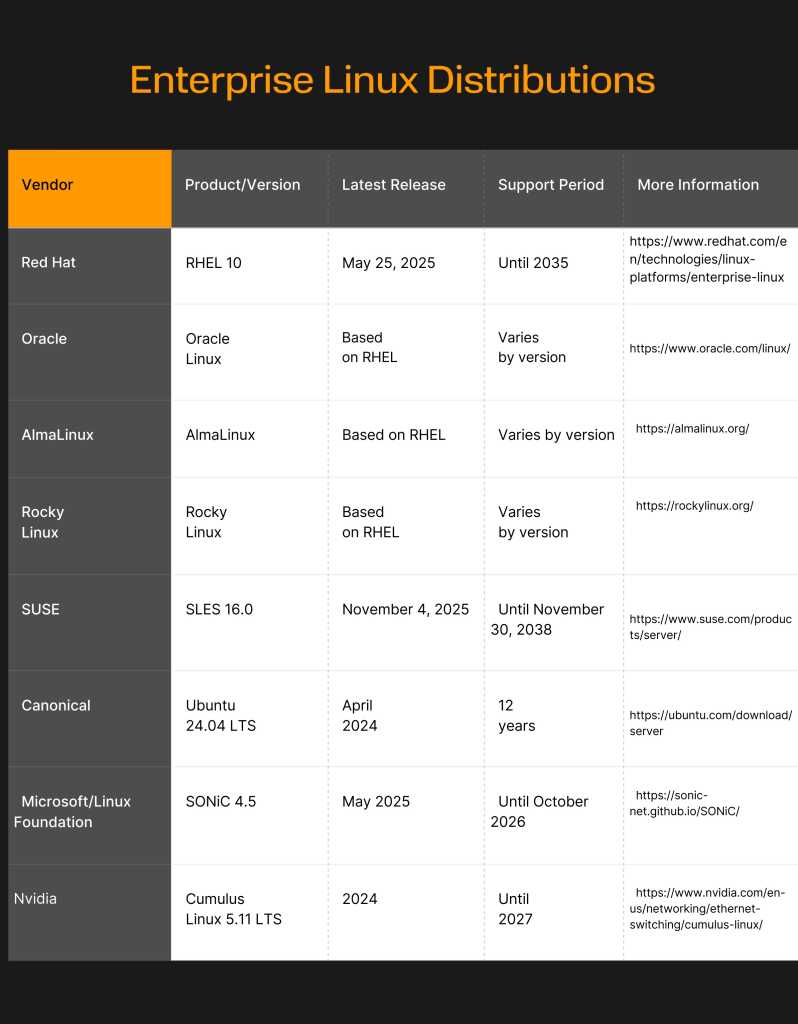
Copy of NW 5 column table – dark – 5 column, 2-line headline
Foundry
SUBSCRIBE TO OUR NEWSLETTER
From our editors straight to your inbox
Get started by entering your email address below.