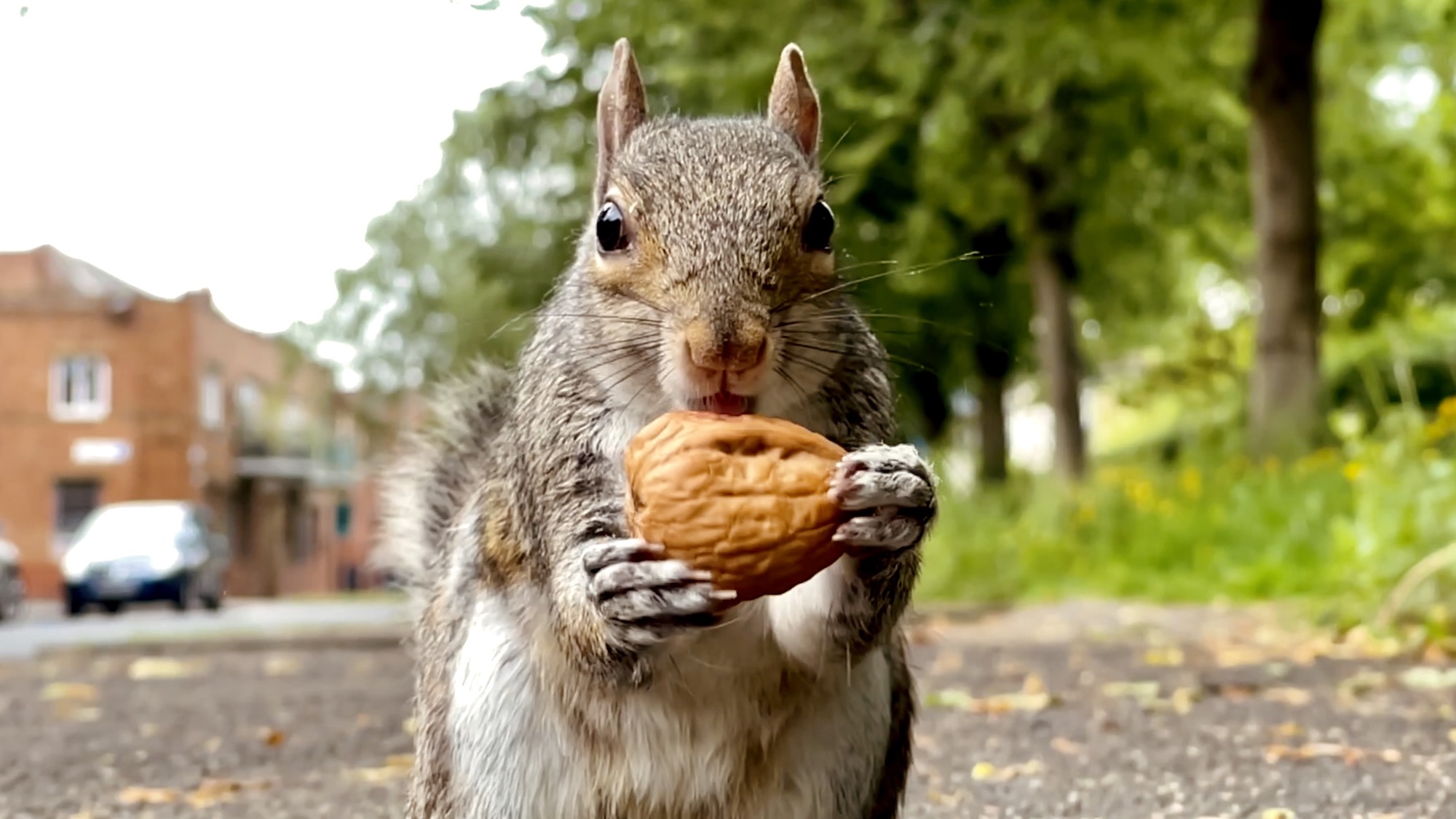
Squirrels don’t use a single strategy to recover their stashes. Image: Zachary Rathore / Getty Images
Get the Popular Science daily newsletter💡
Breakthroughs, discoveries, and DIY tips sent every weekday.
Every fall, squirrels stash thousands of nuts and other snacks in preparation for winter. For our fluffy-tailed friends, survival depends on being able to locate these food stores months later. So, how do they do it? In this episode of Ask Us Anything, we talk about the skills squirrels use to find their food and debunk a common misconception about how many nuts they lose.
*[Ask Us Anything](https://www.popsci.com/category/as…
Squirrels don’t use a single strategy to recover their stashes. Image: Zachary Rathore / Getty Images
Get the Popular Science daily newsletter💡
Breakthroughs, discoveries, and DIY tips sent every weekday.
Every fall, squirrels stash thousands of nuts and other snacks in preparation for winter. For our fluffy-tailed friends, survival depends on being able to locate these food stores months later. So, how do they do it? In this episode of Ask Us Anything, we talk about the skills squirrels use to find their food and debunk a common misconception about how many nuts they lose.
Ask Us Anything answers your most outlandish, mind-burning questions—from the everyday things you’ve always wondered to the bizarre things you never thought to ask. So, yes, there’s a reason we have two nostrils instead of one big nose hole and no, snakes don’t just slither. If you have a question for us, send us a note. Nothing is too silly or simple.
This episode is based on the Popular Science article “How squirrels actually find all their buried nuts.” You can also read about Tommy Tucker, a dress-wearing squirrel that sold war bonds during World War II.
Subscribe to Ask Us Anything
Listen and follow Ask Us Anything on your favorite podcast platform:
Spotify | Apple Podcasts | YouTube | Or wherever you get your podcasts.
Full Episode Transcript
Sarah Durn: Well, we’re fully in December, so we all know what that means. It’s Nutcracker time.
[“Dance of the Sugar Plum Fairy” plays]
No, I’m not talking about that kind of nutcracker. I’m talking about our delightful, furry neighbors: squirrels.
[Squirrel chattering]
That’s right, every year as the weather starts to turn, squirrels get busy collecting and stealing as many nuts as they can for winter. But how are these adorable creatures able to find all their buried loot?
Welcome to Ask Us Anything from the editors of Popular Science, where we answer your questions about our weird world. From “are cats really afraid of cucumbers?” to “why are most people right-handed?” No question is too outlandish or mundane. I’m Sarah Durn, an editor at Popular Science.
Annie Colbert: And I’m Annie Colbert, editor-in-chief at Popular Science.
SD: Here at Popular Science, we’re always pondering oddball questions. Curiosity is basically our office air supply.
AC: And this week our curiosity has led us to how squirrels find all their buried nuts in winter, something Sarah just edited a piece on. So, Sarah, how are squirrels able to find all these nuts?
SD: Yeah, well, the short answer is that they rely on a long list of special squirrel skills. Squirrels use a whole toolkit: smell, sight, memory, and they’ll even steal from one another to recover food stores. Spatial memory does a lot of the heavy lifting here, and field studies find they recover a surprisingly high fraction of what they cache.
In other words, despite the jokes, these bushy tailed hoarders are really good at finding their buried loot.
AC: I love that. So right away we are correcting that very famous Sarah Silverman joke.
SD: Oh yeah. The one about how squirrels forget where they put their nuts and how that’s how trees are planted.
AC: Yes, exactly. I’ve seen it on TikTok many times.
SD: Yeah. No shade to Silverman, but squirrels aren’t planting trees.
AC: I mean, I never really thought comedians were a good source for squirrel facts. And of course, I never doubted our squirrel friends and their abilities to hide nuts.
SD: I know they’re too adorable not to be very good at their jobs.
AC: Exactly. Now, before we dive deep into the nut hoard, we wanna know what questions are keeping you curious. If there’s something you’ve always wanted to know, submit your questions through popsci.com/ask. Again, that’s popsci.com/ask.
SD: We can’t wait to hear your questions.
AC: We’ll be back with all of the nutty details of how squirrels are able to find their winter food stores after this short break.
Welcome back. So let’s get into it.
SD: Let’s do it.
AC: Okay. For starters, I had wrongly assumed that all squirrels stashed their nuts in the same way.
SD: Tell me more.
AC: So Eastern gray squirrels, which are common across the Northeast and Midwest, are what scientists call scatter hoarders. They stash hundreds of nuts across a wide area rather than keeping them all in one place.
Other species, like red squirrels, which are common in Europe and across Russia, basically stockpile their food in a single defended pantry of sorts. Scientists call this technique larder hoarding.
SD: Oh, now I’m imagining them in like little kitchens.
AC: Oh, Food Network, but it’s all squirrels. Oh, okay, sorry, I got distracted. But an important note is that they won’t stockpile their food near their nests.
SD: Oh, really?
AC: Yeah. I’m not sure if scientists know exactly why. Maybe it’s safer to keep the food out of the nest so other squirrels aren’t lurking around or other animals.
SD: But all squirrels do have nest, right?
AC: Yes. So tree squirrels build their nests out of twigs and leaves and moss and whatever else they might find while scrounging around. These nests are called dreys, and I actually had a squirrel build a nest right outside the window of my apartment and I will say it didn’t end well on a very windy day, but we’ll save that story for another day.
SD: Oh no!
AC: But ground squirrels, so ground squirrels like the California ground squirrel they live in, burrows in the ground.
SD: Uh huh, I really wish I could visit a squirrel home.
AC: Ooh, squirrel HGTV!
SD: A whole squirrel network.
AC: Yeah, the whole cable network, just squirrels! All right, Sarah, so when the weather gets cooler, what exactly are these squirrels storing? Is it all nuts?
SD: Nuts are probably one of the most common things that they’re storing because you know, they can last a while. But squirrels eat all sorts of things: leaf buds, wild fruits, bird eggs, tree bark. So they store whatever, you know, they can get their little paws on. They’ll even dry out things like mushrooms to store.
AC: Oh, that’s so cool, little variety.
SD: I know.
AC: I mean, the squirrels in Brooklyn are super bold. I once helplessly watched a squirrel steal an entire baguette out of the bottom of my stroller a few years ago. He just grabbed it and scampered off for like a little bread feast with his friends.
SD: Yeah. I mean, New York squirrels are so intense.
AC: All right, Sarah, so it’s time for the all important question. How exactly are squirrels able to find all this food they’re storing?
SD: I mean, honestly, they’re geniuses. Most squirrels have a home range that spans six to eight acres, roughly the size of four football fields. And that area can include several nests. And across those four football fields of dense forest or whatever habitat a squirrel lives in, a single squirrel can hide up to 3000 nuts.
AC: What?
SD: I know, so if they’re burying nuts primarily between mid-August and the end of November, which is when most tree nuts mature, they’re basically burying 30 nuts a day.
AC: I mean, that’s a lot. So where are they actually burying all these nuts?
SD: Well, in cold places, squirrels don’t always actually bury their nuts in the ground. They’ll stash food in tree hollows or branches so they don’t have to dig through ice and snow.
AC: Oh, very smart. What about in warmer places?
SD: Yeah, so I live in New Orleans where it’s pretty warm year round and it’s probably easier for squirrels to actually bury their nuts and other food in the ground here.
AC: Okay, so another potentially silly question. They still need to bury the nuts in warmer places, right? Like there aren’t nuts or food year-round.
SD: Yeah, I was actually wondering that too. But basically, yes, trees will still lose their nuts and fall even in New Orleans. So squirrels still need to stockpile food for winter. But I would think southern squirrels maybe have an easier time than squirrels in say Canada.
AC: Totally. So squirrels, regardless of climate, all get busy hiding thousands of nuts every fall.
SD: Yeah.
AC: Hmm. So how do they actually find these nuts months later?
SD: Okay, so that’s an excellent question. So let’s start with the basics. Squirrels really don’t rely on a single trick. They use smell, sight, and memory, plus social cues from other squirrels. One of the sources from this story, Dr. Noah Perlut, a professor at the University of New England, who leads gray squirrel research on campus, says they “use the whole toolkit.” Spatial memory, remembering places and how those places relate to landmarks, is especially important for when they dig their food back up.
AC: Okay, but when you say spatial memory, do you mean they remember the exact spot or more like kind of general areas?
SD: Typically they’re returning to the exact spot, even months later. In one experiment, scientists tried to fool squirrels with fake stashes that looked identical to the real ones. And they even swapped the grass patches, so the imposter stashes carried the real scent of the original places, but the squirrels didn’t fall for it. They ignored the imposters and dug up their actual caches. That tells us that their memory for where they buried things is accurate enough to beat a scent trick.
AC: That’s wild. So smell isn’t enough to trick them. They’re actually remembering where things are buried?
SD: Right. Smell helps, especially under snow, but it’s not the whole story. Field work also shows squirrels use visual landmarks. Another layer to this is that many squirrels actually steal nuts from other squirrels.
AC: Nice drama.
SD: Yeah, so they’ll watch each other hide their winter food stores and often steal from one another.
So squirrels aren’t only keeping track of “where did I put my food?” But also “where did that other squirrel put theirs?” Scientists call this pilfering.
AC: Hmm. That’s nice. I guess it’s a little less mean sounding.
SD: Yeah, right. Perlut thinks that squirrels actually try to pilfer AKA steal another squirrel stash first, and then if that fails, they go for their own stashes
AC: Wow. It’s a real squirrel-eat-squirrel world out there.
SD: Yeah. At least when it comes to their nuts. To avoid getting pilfered, squirrels will even pretend to bury nuts in one place and then actually bury them in another place ultimately. And it’s all a way to confuse the other squirrels who may be spying on them.
AC: So there’s a whole social game going on. Do we know how well they do overall? Like how many hidden nuts do squirrels actually recover?
SD: Yeah, so one urban study estimated gray squirrels retrieve about 85 percent of their cached nuts, or, you know, whatever else they’re burying. A more recent 2023 study reported that red squirrels in an urban park quickly found the majority of the nuts they cached, even with competition.
AC: Wow. They’re much better than I am when I lose my wallet or keys or everything else I lose.
SD: I know. I mean, we should all have like little squirrels help us find things we lose around the house.
AC: Honestly, that would be a dream. Welcome the squirrels to my home.
SD: I know, that would be amazing. Perlut also notes that squirrels can remember things for up to two months.
AC: Wow.
SD: And they’re really, really smart about the timing of how they eat things too. They’ll eat certain nuts sooner, for example. So acorns from a white oak sprout quickly, so squirrels often eat those first, while red oak acorns germinate more slowly, and they can be stored for longer.
AC: So wise, our little friends.
SD: I know. One thing Perlut said really struck me. He noted that gray squirrels, for instance, spend a lot of time not foraging. They rest, watch, socialize. So that’s in a way, evidence of how effective their stashing system is. They’re not busy all day hiding nuts. I love that.
AC: They work smart, but not nonstop. I feel like those are icons for all of us.
SD: So to recap, squirrels use a combination of spatial memory, smell, visual landmarks, social observation, and even watching what other squirrels are up to, plus all that fake bearing drama to throw off furry thieves to protect and recover their caches. All in all squirrels are really good at finding what they hide.
Different species go about it in different ways, whether that’s scatter hoarding all over the place or keeping one big pantry stash, AKA larder hoarding.
AC: And they’re really pros.
SD: They really are.
AC: I’ve learned so much today. With that, we’ll be right back to wrap up this episode with the story of Tommy Tucker, a squirrel who was adopted by the Bullis family in 1944.
SD: A squirrel who wore little outfits to help raise money for war bonds and other philanthropic causes.
AC: A squirrel who even did radio spots with FDR!
SD: Clearly we’re excited.
AC: Yes, that’s coming up next after this short break.
Okay, Sarah, as promised, let’s talk Tommy Tucker, someone we’re very excited about when we discovered this story and America’s most glamorous wartime squirrel. And I really, when we found this out, I couldn’t believe that this guy actually existed.
SD: I know he is iconic, so yes, Tommy Tucker was an Eastern gray squirrel, who became a full blown home front celebrity during World War II.
AC: So how did he go from random baby squirrel to icon?
SD: It’s an excellent question. He literally fell out of a hickory tree in Washington, DC. A little girl found him on her walk to school, fed him warm milk, and made him a tiny bed in a red wool hat. Then her family had to move and she gave Tommy Tucker to her neighbor, Zadie Bullis, and that’s when his life really took off.
AC: I am so obsessed with this.
SD: So Zadie basically turned Tommy into a tiny, furry fashion icon. He had more than a hundred handmade outfits. Everything from a silk pleated dress for company to a Red Cross nurse dress for visiting the hospital.
AC: Uh, and famously all dresses because pants don’t really work with a squirrel tail.
SD: Exactly. Life Magazine even joked about it at the time.
AC: Okay, so. How does a squirrel and a dress become a war hero?
SD: Yeah, so Bullis started taking him around DC to the bakery, the grocery store, the children’s hospital, and people really started to fall in love with him.
AC: Of course.
SD: Eventually the US Treasury built him a custom booth so he could sell war bonds. He’d show up in red, white, and blue satin, and he even had a fan club with something like. 30,000 members.
AC: Okay. That is more than a lot of influencers.
SD: And Air Force bomber crews literally carried his picture with them on missions. Soldiers wrote to him from the front lines saying he gave them confidence. During the war he traveled the country by train, making a radio appearances with President Franklin Delano Roosevelt.
AC: Ugh, what a furry hero.
SD: And then after the war ended, he road tripped with the Bullis’s until he died on a sightseeing trip to the Grand Canyon in 1949.
AC: Oh no, Tommy.
SD: I know!
AC: But you can still see him today, right?
SD: You can. He and all his wardrobes are preserved at the Smithsonian Archives. You just have to make an appointment.
AC: Oh, a national treasure and a style icon.
SD: Truly, may we all leave behind such an impeccable wardrobe.
AC: Absolutely a hero for all time.
And that’s it for this episode, but don’t worry, we have more awesome Ask Us Anythings live in our feed right now. Follow or subscribe to Ask Us Anything by Popular Science, wherever you enjoy your podcasts. And if you like our show, please leave a rating and review.
SD: We really care what you think. Our theme music is from Kenneth Michael Reagan, and our producer is Alan Haburchak. This week’s episode was based on our article written for Popular Science by Jennifer Byrne.
AC: Thank you team, and thanks to everyone listening.
SD: And one more time, if you wanna have something you’ve always wondered about explained on a future episode, go to popsci.com/ask. Until next time. Keep the questions coming.
AC: Yeah, don’t hold your questions. Like our furry friends for their food.
SD: Obviously.
AC: I’ve been waiting this whole episode to make a squirrel noise too, so
[Annie makes squirrel noises]
SD: I know they have really cute little hands.

2025 PopSci Outdoor Gift Guide
20+ editor-approved presents for the hikers on your list