December 9, 2025
1 min read
X-ray space telescopes caught a supermassive blackhole flinging matter into space at a fifth of the speed of light
By Claire Cameron edited by Jeanna Bryner
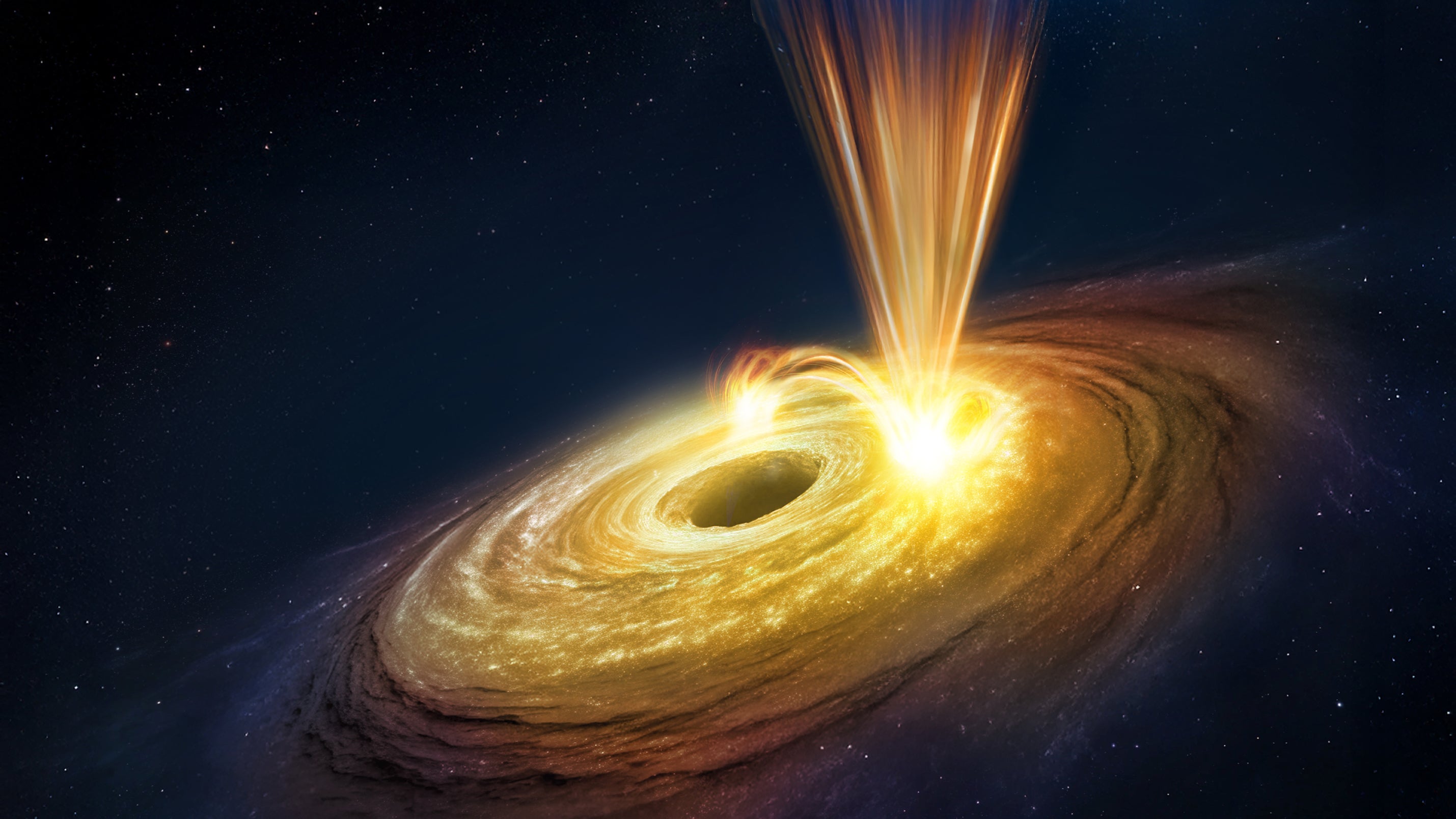
And illustration shows the black hole within the galaxy NGC 3783 as it erupts.
ESA
Join Our Community of Science Lovers!
Supermassive black holes are the monsters of the universe, so it is perhaps only fitting that astronomers discovered one of these behemoths unleashing a bright x-ray flare that one of the researchers, Matteo Guainazzi, described as “almost too big to imagine.”
Within hours of erupting, the blast faded, and the black hole began to whip up winds more powerful than anything we can imagine on Earth and flinging material into space at 134 million miles per hour—a fifth of the speed of light. For comparison, plasma ejected during a coronal mass ejection from the sun typically travels at a mere three million mph.
To study the black hole, astronomers used two x-ray space telescopes: the European Space Agency’s (ESA’s) XMM-Newton and the X-Ray Imaging and Spectroscopy Mission, which is a collaboration between the ESA, NASA and Japan’s space agency, JAXA. Lurking at the center of the spiral galaxy NGC 3783, the supermassive blach ole—weighing the equivalent of 30 million suns—powers the galaxy’s heart, a region known as an active galactic nucleus.
On supporting science journalism
If you’re enjoying this article, consider supporting our award-winning journalism by subscribing. By purchasing a subscription you are helping to ensure the future of impactful stories about the discoveries and ideas shaping our world today.
According to Guainazzi, tangled magnetic fields in this region may have suddenly “untwisted,” generating the winds. Knowing more about active galactic nuclei, and the way that they generate such powerful jets and winds, is key to understanding how galaxies form and evolve over time, the researchers say.
The research was published on Tuesday in Astronomy & Astrophysics.
It’s Time to Stand Up for Science
If you enjoyed this article, I’d like to ask for your support. Scientific American has served as an advocate for science and industry for 180 years, and right now may be the most critical moment in that two-century history.
I’ve been a Scientific American subscriber since I was 12 years old, and it helped shape the way I look at the world. SciAm always educates and delights me, and inspires a sense of awe for our vast, beautiful universe. I hope it does that for you, too.
If you subscribe to Scientific American, you help ensure that our coverage is centered on meaningful research and discovery; that we have the resources to report on the decisions that threaten labs across the U.S.; and that we support both budding and working scientists at a time when the value of science itself too often goes unrecognized.
In return, you get essential news, captivating podcasts, brilliant infographics, can’t-miss newsletters, must-watch videos, challenging games, and the science world’s best writing and reporting. You can even gift someone a subscription.
There has never been a more important time for us to stand up and show why science matters. I hope you’ll support us in that mission.