December 11, 2025
2 min read
Tantalizing observations suggest marine mammals may be teaming up to hunt
By Meghan Bartels edited by Andrea Thompson
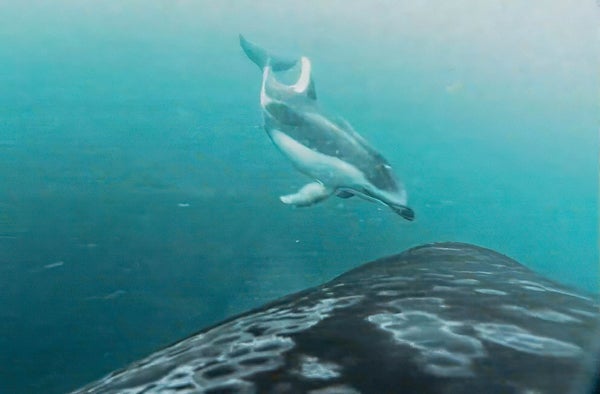
A Pacific white-sided dolphin approaching a northern resident killer whale with a camera mounted to it.
A. Trites/University of Brit…
December 11, 2025
2 min read
Tantalizing observations suggest marine mammals may be teaming up to hunt
By Meghan Bartels edited by Andrea Thompson
A Pacific white-sided dolphin approaching a northern resident killer whale with a camera mounted to it.
A. Trites/University of British Columbia/S. Fortune/Dalhousie University/K. Holmes/Hakai Institute/X. Cheng/Leibniz Institute for Zoo and Wildlife Research
Join Our Community of Science Lovers!
We could all use a buddy to help us track down dinner from time to time.
New research published on December 11 in *Scientific Reports *posits that killer whales (Orcinus orca) off the coast of British Columbia may be forging hunting partnerships that bridge a species divide.
Sarah Fortune, a marine ecologist at Dalhousie University in Nova Scotia, and her colleagues used drones and camera-equipped tags to study the killer whales over two weeks in August 2020. As they observed, they noticed something strange—the regular presence of Pacific white-sided dolphins (Lagenorhynchus obliquidens).
On supporting science journalism
If you’re enjoying this article, consider supporting our award-winning journalism by subscribing. By purchasing a subscription you are helping to ensure the future of impactful stories about the discoveries and ideas shaping our world today.
“We kept finding that when the killer whales were feeding, the dolphins were there,” Fortune says. “This gave us a bit of a tip that perhaps there was something of significance occurring.”
A Pacific white-sided dolphin seen during a new study on potential hunting partnerships between orcas and dolphins.
A. Trites/University of British Columbia/S. Fortune/Dalhousie University/H. Holmes/Hakai Institute/X. Cheng/Leibniz Institute for Zoo and Wildlife Research
So the scientists dug into the data, looking for evidence of how these different marine mammals were interacting during killer whale mealtimes, when animals hunt for large adult Chinook salmon (Oncorhynchus tshawytscha). The researchers noticed that the hunting killer whales they were studying seemed to show a noticeable preference for following dolphins. In one particularly striking observation, a killer whale snagged a salmon and dined while nearby dolphins gobbled up loose pieces of the fish.
For Fortune and her colleagues, the interactions suggest that these killer whales—part of what is called the northern resident population—and dolphins are teaming up, with one or more dolphins helping a killer whale snag its prey and then sharing in the feast in a striking display of interspecies cooperation. “Killer whales that are salmon specialists, that is what they rely on,” Fortune says. “The fact that they were following the dolphins, trailing behind them and kind of letting the dolphins lead them was really surprising to me.”
But it may be too soon to announce a marine mammal power match, says Janet Mann, a behavioral ecologist at Georgetown University, who specializes in marine mammals and was not involved in the new research. She’d like to see more evidence that the dolphins are truly benefiting and seeking out the partnership rather than merely being exploited by killer whales that are eager to make use of their hunting skills.
“I don’t think it’s been shown as cooperation because I think the standards for cooperation are a little bit higher,” Mann says. “It’s not like the dolphins wait for the killer whales to come and then they say, ‘Let’s go.’”
Fortune agrees, saying that her and her colleagues’ observations support the scientific definition of cooperation they used—behavioral coordination—but don’t yet fit a definition of mutualism, which requires both species to benefit.
Editor’s Note (12/11/25): This article was updated after posting to include an additional comment from Sarah Fortune.
It’s Time to Stand Up for Science
If you enjoyed this article, I’d like to ask for your support. Scientific American has served as an advocate for science and industry for 180 years, and right now may be the most critical moment in that two-century history.
I’ve been a Scientific American subscriber since I was 12 years old, and it helped shape the way I look at the world. SciAm always educates and delights me, and inspires a sense of awe for our vast, beautiful universe. I hope it does that for you, too.
If you subscribe to Scientific American, you help ensure that our coverage is centered on meaningful research and discovery; that we have the resources to report on the decisions that threaten labs across the U.S.; and that we support both budding and working scientists at a time when the value of science itself too often goes unrecognized.
In return, you get essential news, captivating podcasts, brilliant infographics, can’t-miss newsletters, must-watch videos, challenging games, and the science world’s best writing and reporting. You can even gift someone a subscription.
There has never been a more important time for us to stand up and show why science matters. I hope you’ll support us in that mission.