December 11, 2025
2 min read
More than 1,900 people, mostly children, have been sickened by measles in the U.S. in 2025. The outbreaks are moving the country toward losing its measles-free status by early next year
By Claire Cameron edited by Tanya Lewis
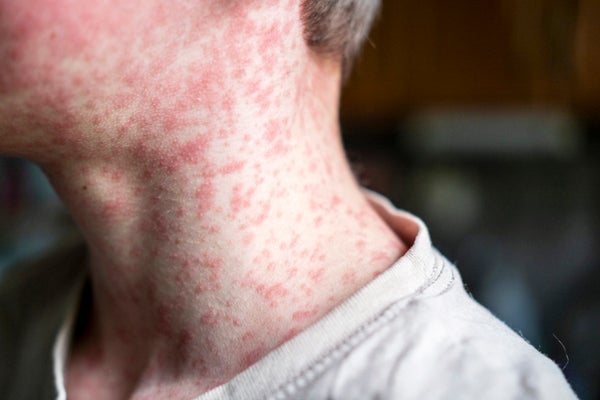
Natalya Maisheva via Getty Images
Join Our Community of Science Lovers!
South Carolina is the epicenter of what state officials call an “accelerating” measles outbreak. Hundreds of people are…
December 11, 2025
2 min read
More than 1,900 people, mostly children, have been sickened by measles in the U.S. in 2025. The outbreaks are moving the country toward losing its measles-free status by early next year
By Claire Cameron edited by Tanya Lewis
Natalya Maisheva via Getty Images
Join Our Community of Science Lovers!
South Carolina is the epicenter of what state officials call an “accelerating” measles outbreak. Hundreds of people are in quarantine, and the disease has sickened at least 111 individuals, most of whom—105—were not vaccinated against the disease. The rash of cases is merely the latest in a string of measles outbreaks across the U.S. this year. Each of these outbreaks has brought the country ever closer to losing its measles-free status after more than 25 years.
As of December 10, the U.S. Centers for Disease Control and Prevention reported 1,912 measles cases, most of which were linked to 47 outbreaks of the disease, this year. For comparison, 2024 saw just 16 outbreaks and 285 cases. At least two children have died of measles in the current outbreaks.
A growing decline in vaccination rates in communities across the country is driving these grim trends. Measles vaccines are generally given as part of the combined measles, mumps and rubella (MMR) shot, two doses of which are 97 percent effective against the disease. The U.S. effectively eliminated measles in 2000 because enough people got the vaccine to suffocate the virus’s spread through the population.
On supporting science journalism
If you’re enjoying this article, consider supporting our award-winning journalism by subscribing. By purchasing a subscription you are helping to ensure the future of impactful stories about the discoveries and ideas shaping our world today.
As part of that effort, the MMR vaccine is required for children to attend public school throughout the country, but many states offer parents the choice to exempt their child for religious or personal reasons. In a media briefing yesterday, South Carolina’s state epidemiologist Linda Bell said that vaccination levels there were simply “lower than hoped for.”
The state has seen vaccination rates of its schools’ students decline from almost 96 percent in 2020 to 93.5 percent in 2025—for context, robust herd immunity from measles requires about 95 percent of the population to be vaccinated, according to the World Health Organization.
Both Secretary of Health and Human Services Robert F. Kennedy, Jr., and President Donald Trump have criticized the shot, suggesting it should be broken up into separate jabs and linking it, without evidence, to autism. Numerous studies have debunked this link.
Editor’s Note (12/11/25): This article was edited after posting to correct the number of people who have been sickened in the current measles outbreak in South Carolina, the description of cases this year that have been linked to 47 outbreaks and the date of the media briefing with Linda Bell.
It’s Time to Stand Up for Science
If you enjoyed this article, I’d like to ask for your support. Scientific American has served as an advocate for science and industry for 180 years, and right now may be the most critical moment in that two-century history.
I’ve been a Scientific American subscriber since I was 12 years old, and it helped shape the way I look at the world. SciAm always educates and delights me, and inspires a sense of awe for our vast, beautiful universe. I hope it does that for you, too.
If you subscribe to Scientific American, you help ensure that our coverage is centered on meaningful research and discovery; that we have the resources to report on the decisions that threaten labs across the U.S.; and that we support both budding and working scientists at a time when the value of science itself too often goes unrecognized.
In return, you get essential news, captivating podcasts, brilliant infographics, can’t-miss newsletters, must-watch videos, challenging games, and the science world’s best writing and reporting. You can even gift someone a subscription.
There has never been a more important time for us to stand up and show why science matters. I hope you’ll support us in that mission.