- Protecting regions inhabited by uncontacted Indigenous peoples is vital from both a human rights and environmental perspective; these territories represent some of the planet’s last intact ecosystems, and are also rich carbon sinks.
- But in recent years, these communities that choose to live in isolation have been seen and contacted more frequently by outsiders like illegal miners and loggers, and the results have at times been violent, with reports about these incidents going viral.
- *“Some argue that isolation is no longer possible, that climate change, deforestation and economic pressure will make contact inevitable. I believe that argument is defeatist and ethically indefensible. It assumes that outsiders know what is best for these communities, repeating the same paternali…
- Protecting regions inhabited by uncontacted Indigenous peoples is vital from both a human rights and environmental perspective; these territories represent some of the planet’s last intact ecosystems, and are also rich carbon sinks.
- But in recent years, these communities that choose to live in isolation have been seen and contacted more frequently by outsiders like illegal miners and loggers, and the results have at times been violent, with reports about these incidents going viral.
- “Some argue that isolation is no longer possible, that climate change, deforestation and economic pressure will make contact inevitable. I believe that argument is defeatist and ethically indefensible. It assumes that outsiders know what is best for these communities, repeating the same paternalism that has caused centuries of harm,” the writer of a new op-ed states.
- This article is a commentary. The views expressed are those of the author, not necessarily of Mongabay.
Deep within the remaining tropical forests of the world, the last uncontacted peoples live in near-total isolation. Their very presence carries unintended yet powerful implications for all of us. Studies show that Indigenous territories — especially those of uncontacted groups — are among the least disturbed ecosystems on Earth.
Protecting regions inhabited by uncontacted Indigenous peoples is vital from both a human rights and environmental perspective; these territories represent some of the planet’s last intact ecosystems. The human dimension of respecting their isolation is a moral imperative, grounded in the fundamental rights to existence and self-determination.
Equally significant are the longer-term environmental implications. Protected Indigenous lands function as natural sanctuaries of biodiversity, safeguarding countless plant and animal species, many of which remain undocumented by science. By preserving these untouched forests, the world also protects vast carbon sinks that regulate the planet’s climate and slow global warming.
 Malocas, or longhouses, of an Indigenous community living in isolation in the Loreto region of the Peruvian Amazon. Image courtesy of ORPIO.
In essence, ensuring the survival of uncontacted territories not only defends the autonomy of their inhabitants, it also sustains the living systems that uphold the Earth’s atmosphere, biodiversity and climate.
In the western Amazon, the region holding the uncontacted peoples I know best, dense Indigenous territories rank among the most biodiverse places on Earth. They also hold the planet’s highest concentration of uncontacted peoples, and they are under increasing siege. While Peru and Brazil have designated large swaths as protected Indigenous land, enforcement is weakening. In Peru, key legislation safeguarding uncontacted peoples is perilously close to being rolled back. Political turmoil, organized crime and shrinking conservation budgets have left these regions vulnerable to loggers, miners and narco-traffickers who move almost at will.
Every meeting between outsiders and uncontacted peoples carries danger — centuries of mistrust and violence can be condensed into a single, volatile moment. Illegal loggers, miners and people seizing land are increasingly venturing into territories of uncontacted groups, sometimes triggering violent confrontations and forcing isolated groups into defensive action. Fatal encounters have occurred on both sides, including uncontacted peoples defending their territories and outsiders venturing too far into protected land.
On a recent expedition, I woke just before dawn to a river wrapped in mist, with a pale orange glow rising from the water and dark emerald forest beyond. The air was still and heavy with humidity from relentless overnight storms. As I walked along a stretch of exposed sand, I saw a figure through the haze — a man, barely clothed, with long hair and what looked like a blowpipe or club in his hand. For a moment, he stood motionless. Then, without a sound, he slipped back into the wall of forest. The encounter lasted only seconds, but it was penetrating. In a single glance, the distance of ten thousand years had dissolved before me. It was a moment that bridged two worlds.
We were outside any protected Indigenous territory and had taken every precaution to avoid contact. Yet there he was, real and undeniable. His footprints in the sand were as clear as the morning light. It deepened my conviction that these regions — and the people who remain hidden within them — must be protected at all costs.
 Members of an Indigenous community living in isolation in the Peruvian Amazon. Image courtesy of SERNANP.
Among them, the Mashco Piro, or Nomolie, of Peru stand apart. In recent years, small numbers of Nomolie have occasionally emerged from the forest, approaching riverbanks or nearby settlements. Their appearance raises the same unsettling question each time, like why now?
These brief encounters are unlikely to be signs of curiosity; more likely, they are acts of desperation. Across Peru’s Madre de Dios region, illegal roads, mining camps and logging operations are cutting into their ancestral lands, fragmenting the territory that has sustained them for generations. Drug traffickers now move through areas once untouched. Their world is closing in. The Nomolie’s occasional emergence from the forest reflects not a desire for contact, but a fight for survival.
In this context, the imperfect term “uncontacted” feels even more misleading. Unlike many uncontacted peoples, the Nomolie are not invisible; they are defining the boundaries of their own visibility by choosing when to appear and when to disappear. It is an act of autonomy, one of the few forms of self-determination left to them.
The stakes could not be higher. Isolated peoples have almost no immunity to pathogens carried by outsiders. History shows that contact can devastate entire communities through disease, violence and displacement. Reports also continue to emerge from Brazil of uncontacted people killed by illegal miners. International law — including the U.N. Declaration on the Rights of Indigenous Peoples (UNDRIP) and ILO Convention 169 — guarantees their right to remain uncontacted, but enforcement on the ground is inconsistent and political will is fading.
Some argue that isolation is no longer possible, that climate change, deforestation and economic pressure will make contact inevitable. I believe that argument is defeatist and ethically indefensible. It assumes that outsiders know what is best for these communities, repeating the same paternalism that has caused centuries of harm.
True respect means allowing the uncontacted to decide for themselves, on their own time, if contact should ever occur. Indigenous-protected territories can remain inviolate if governments and global society commit to defending them. Respecting the uncontacted is, at its core, a moral test of our time. Will we repeat the catastrophic mistakes that decimated Indigenous peoples across the world, or can we finally act with restraint, humility and respect?
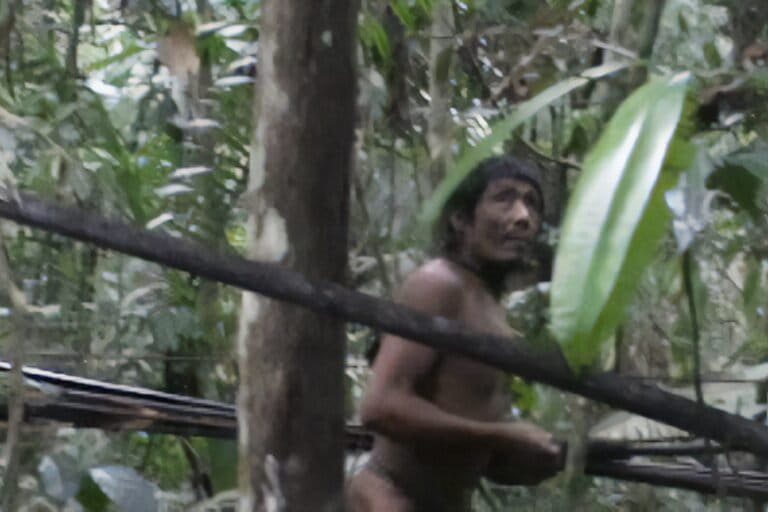 This blurred image resulted from a chance encounter with a Brazilian government official. It shows one of the last of the Kawahiva Indigenous group, living near the Rio Pardo in Mato Grosso state, Brazil. Today, they are forced to live on the run from illegal loggers. Image courtesy of FUNAI.
This question of whether to engage or protect extends beyond the Amazon. It forces us to confront a deeper moral crisis: how humanity treats the last cultures that live beyond the reach of modern civilization. Across the world, Indigenous peoples are protecting the richest ecosystems on the planet. Their stewardship, often unacknowledged, is one of the strongest barriers against deforestation and climate change. A recent study showed that once Indigenous land rights were legally recognized, deforestation dropped by 75%. Protecting Indigenous autonomy is, in a very real sense, a climate solution.
Over the years, I’ve witnessed echoes of this same struggle in distant corners of the world. In the cool highlands of Papua New Guinea, where stone tools were still in use, communities fought to preserve their traditions against a rapidly advancing world. On India’s Andaman Islands, the Jarwa once halted a military convoy I was traveling with — bows drawn — in a powerful act of defiance against outsiders crossing their land. Everywhere, the same fault line emerges: those who live in rhythm with the natural world, and those determined to master it.
The uncontacted peoples of the Amazon including the Nomolie are living proof of endurance. Their existence challenges our ideas of progress, civilization and belonging. They compel us to ask a tough moral question: What are the responsibilities of a modern state toward people who may not even know it exists? Their independence mirrors our own ethical boundaries, how we value freedom, diversity and the right to live without interference.
To protect their silence is to protect something essential in ourselves: the understanding that freedom, in its purest form, may simply be the right to be left alone. For the Nomolie, and for all uncontacted peoples, that freedom hangs by a thread. Whether we defend it or destroy it will reveal who we truly are, and whether we have learned anything from the long, painful history of Indigenous interactions.
At the edges of the known world, small, hidden groups of people continue to live in ways that most of humanity has forgotten. Their survival, and the forests they guard, may be among the last true measures of our own humanity. Respecting the uncontacted means respecting the principle that no culture, no government and no economy has the right to consume another’s existence.
Their silence in the forest is not absence; it is sovereignty. It is a reminder that freedom does not always speak loudly — it often lives quietly, beneath the canopy, where the human spirit remains truly untamed.
Kerry Bowman, Ph.D., is a bioethicist and an assistant professor at the University of Toronto.
Banner image: Malocas (traditional longhouses) of Indigenous communities living in isolation on the Peru-Brazil border. Image courtesy of ORPIO.
Podcast:* A discussion with the director of the Tenure Facility which has helped Indigenous and local communities gain (or regain) rights to tens of millions of hectares of their traditional territories worldwide, listen here:*
***See related reading: ***
Report urges full protection of world’s 196 uncontacted Indigenous peoples
Peru congress debates stripping isolated Indigenous people of land and protections
Citations:
Fa, J. E., Watson, J. E. M., Leiper, I., Potapov, P., Evans, T. D., Burgess, N. D., … Garnett, S. T. (2020). Importance of Indigenous Peoples’ lands for the conservation of intact forest landscapes. Frontiers in Ecology and the Environment, 18(3), 135-140. doi:10.1002/fee.2148
Garnett, S. T., Burgess, N. D., Fa, J. E., Fernández-Llamazares, Á., Molnár, Z., Robinson, C. J., … Leiper, I. (2018). A spatial overview of the global importance of Indigenous lands for conservation. Nature Sustainability, 1(7), 369-374. doi:10.1038/s41893-018-0100-6
Schleicher, J., Peres, C. A., Amano, T., Llactayo, W., & Leader-Williams, N. (2017). Conservation performance of different conservation governance regimes in the Peruvian Amazon. Scientific Reports, 7, 11318. doi:10.1038/s41598-017-10736-w
Walker, W. S., Gorelik, S. R., Baccini, A., Aragon-Osejo, J. L., Josse, C., Meyer, C., … Schwartzman, S. (2020). The role of forest conversion, degradation, and disturbance in the carbon dynamics of Amazon indigenous territories and protected areas. Proceedings of the National Academy of Sciences, 117(6), 3015-3025. doi:10.1073/pnas.1913321117
Ricketts, T. H., Soares-Filho, B., da Fonseca, G. A. B., Nepstad, D., Pfaff, A., Petsonk, A., … Victurine, R. (2010). Indigenous lands, protected areas, and slowing climate change. PLOS Biology, 8(3), e1000331. doi:10.1371/journal.pbio.1000331
Blackman, A., Corral, L., Santos Lima, E., & Asner, G. P. (2017). Titling indigenous communities protects forests in the Peruvian Amazon. Proceedings of the National Academy of Sciences, 114(16), 4123-4128. doi:10.1073/pnas.1603290114
