At the end of the 18th century, a large swath of French society agreed on an astonishing idea: they could create a new world. So fervent was this belief that it included changing religion for Reason, the names of the months (Brumaire, Germinal, Thermidor), the way of measuring things (the metric system, which we still use today) and, fundamentally, the political and social system. To a large extent, they made it happen.
[The French Revolution](https://english.elpais.com/culture/2023-03-24/robespierre-to-danton-before-sending-him-to-the-guillotine-i-love-you-more-than-ever-and-until-death.html?usg=AOvVaw3oB71tkXrsw8OJ_GVfSAQZ&ved=2ahUKEwjBjojXppH_AhUHwzgGHTSHAsEQFnoECFMQAg “https://english.elpais.com/culture/2023-03-24/robespierre-to-danton-before-sending-him-to-the-guillotine-i-l…
At the end of the 18th century, a large swath of French society agreed on an astonishing idea: they could create a new world. So fervent was this belief that it included changing religion for Reason, the names of the months (Brumaire, Germinal, Thermidor), the way of measuring things (the metric system, which we still use today) and, fundamentally, the political and social system. To a large extent, they made it happen.
The French Revolution was a historic turning point that paved the way for modern societies. It sowed the seeds of freedom, equality, citizenship and sovereignty that would ultimately shape liberal democracies and the contemporary world. A world that, incidentally, some on the far-right are now calling into question, reviving traditional values more typical of the Ancien Régime than of the Enlightenment era that ushered in modernity.
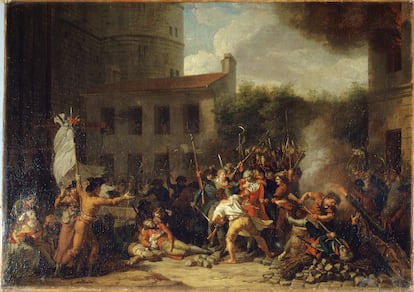
But what was taking place in the decades that lead up to the storming of the Bastille in 1789, which sparked what was perhaps the most important revolution in history? How did that “revolutionary spirit” develop, leading the French — specifically Parisians — to believe they could reinvent the world? There are the immediate historical causes: a succession of poor harvests and rising bread prices, the economic crisis caused by war efforts and poor fiscal management, and the inequality between the lavishness of the court at Versailles and the starving masses: the infamous line “If they are hungry, let them eat cake,” is famously attributed to Queen Marie Antoinette. She probably never said such a thing, but it does illustrate the era’s sentiment towards monarchy.
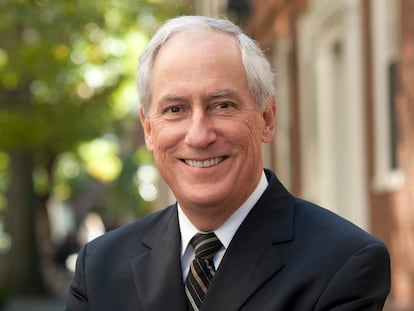
Historian Robert Darnton, 86, made his career as an expert on the history of books and reading, and was a professor at Princeton University and library director at Harvard University. He wanted to study this period, focusing not so much on the major causes of History with a capital H, but rather on how Parisians saw the situation in the moment, how ideas circulated through the streets of Paris, a society not so different from our own. There were parodies, pamphlets and novels, channels of information that ran through cafés, parks and under the Krakow Tree in the Palais Royal, where the latest rumors and news were shared (yesteryear’s social media), from the juiciest court gossip to fascination with travel by balloon.
As such, the most attention-grabbing aspects of Darnton’s book *The Revolutionary Temper: Paris, 1748-1789 *are indeed its subject (the French Revolution) as well as the methods used in the era to compile information. The book’s interest in the forms of communication in 18th-century Paris proves that it too was an “information society,” that all-too-contemporary of concepts.
“The popular phrase ‘we live in an information society’ is true, but also misleading, because all societies have been information societies, each in its own way, according to available measures,” the historian tells EL PAÍS. Darnton attempts to show how information got to average Parisians, common workers, and elite assistants in sophisticated salons alike. At the time, Paris didn’t have newspapers in the modern sense of the word — unlike Amsterdam and London — so it was beneath the Krakow Tree that the *nouvellistes *met to exchange information. There were other such hotspots: certain benches in the Luxembourg Gardens, cafés, street corners, and markets.
“The nouvellistes à la main wrote down rumors and compiled them in clandestine newsletters, which were later printed and became underground bestsellers,” explains Darnton. Songs, whose lyrics changed over standard melodies, were another way of finding out about things, through street singers. Engravings, gossip, graffiti, public readings of pamphlets — all contributed to what the author calls “the revolutionary spirit”.
That spirit included the love of freedom and commitment to nation, familiarity with violence and the denouncement of vice, displeasure with the degeneracy of the aristocracy and a distancing from the Church, and was based on the widespread conviction that the political system had fallen into despotism. “The French understood it as ministerial despotism. They directed their anger against the government — in particular, against ministers like Maupeou, Terray, Calonne, Lamoignon and Brienne — not against the king. In my book, I try to show how this collective consciousness developed over 40 years, how it took shape in response to events, and how it gained enough strength to mobilize an uprising in 1789,” says the author.
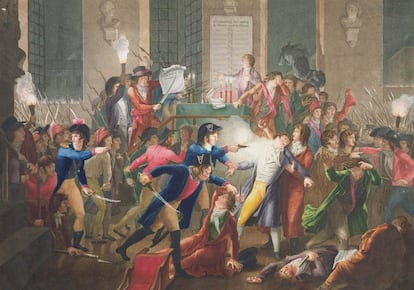
Although we associate the French Revolution with many of the virtues of modern society, the truth is that, as the book shows, it was a period of unusual violence, not only because of the famous guillotine (which was considered a merciful and civilized way of killing), but also because of other types of riots, lynchings, and dismemberments. How do we square this violence with our appreciation of its ideals? “Much of the violence remains incomprehensible, at least to me,” says the historian, “yet we must bear in mind that violence existed in everyday life before 1789, in public hangings and riots known as ‘popular emotions.’” Darton tries to show how these “emotions” had their root in the Ancien Régime, as well as record the violence of the counterrevolution that also generated its own brutality. “Without downplaying the bloodshed, I think it is essential to highlight how the Revolution freed the French from the arbitrary power and oppression embedded in the political and social order of the Ancien Régime,” adds Darnton.
The French Revolution is portrayed in the book as a prodigious moment when anything seemed possible, when everything seemed capable of transformation, when the world itself could start afresh. Today, common sentiment seems quite the opposite. As Margaret Thatcher put it in the 1980s, “There is no alternative.” How did this feeling come about? “We could call it ‘possibilism’, that is, the conviction that the sociopolitical order is not fixed in its current form, but can change, that ordinary people can intervene to modify it, that things as they are can be transformed into things as they should be,” says the historian.
The way in which this conviction develops is long and complex and, in the author’s opinion, has much to do with how information was transmitted and interpreted, and how as a result, the system gradually lost its legitimacy. “Without downplaying factors like the price of bread, I believe that the conviction of legitimacy acts as the glue that holds political systems together. When it erodes, revolution becomes possible.”
The idea of revolution has long enjoyed prestige. Some, like the French and American revolutions, created the modern world. Others, like the Russian Revolution, which was heavily criticized, changed the course of history and gave rise to an entire geopolitical bloc that contested global hegemony for decades. Today, the word seems to be used only in advertising or to talk about technological advances. What remains of the idea of revolution? “I agree that the notion of revolution has been trivialized, as in advertisements about a ‘revolution’ in clothing or hairstyles. Few people know much about the French or American revolutions, or find inspiration in the revolutionary tradition,” says Darnton. “But when people face injustice, they need to draw on some historical tradition to resist,” he concludes.
Sign up for our weekly newsletter to get more English-language news coverage from EL PAÍS USA Edition