
Illustrations by Niklas Wesner.
This is the second in a series of short essays considering notable film restorations of the last year.
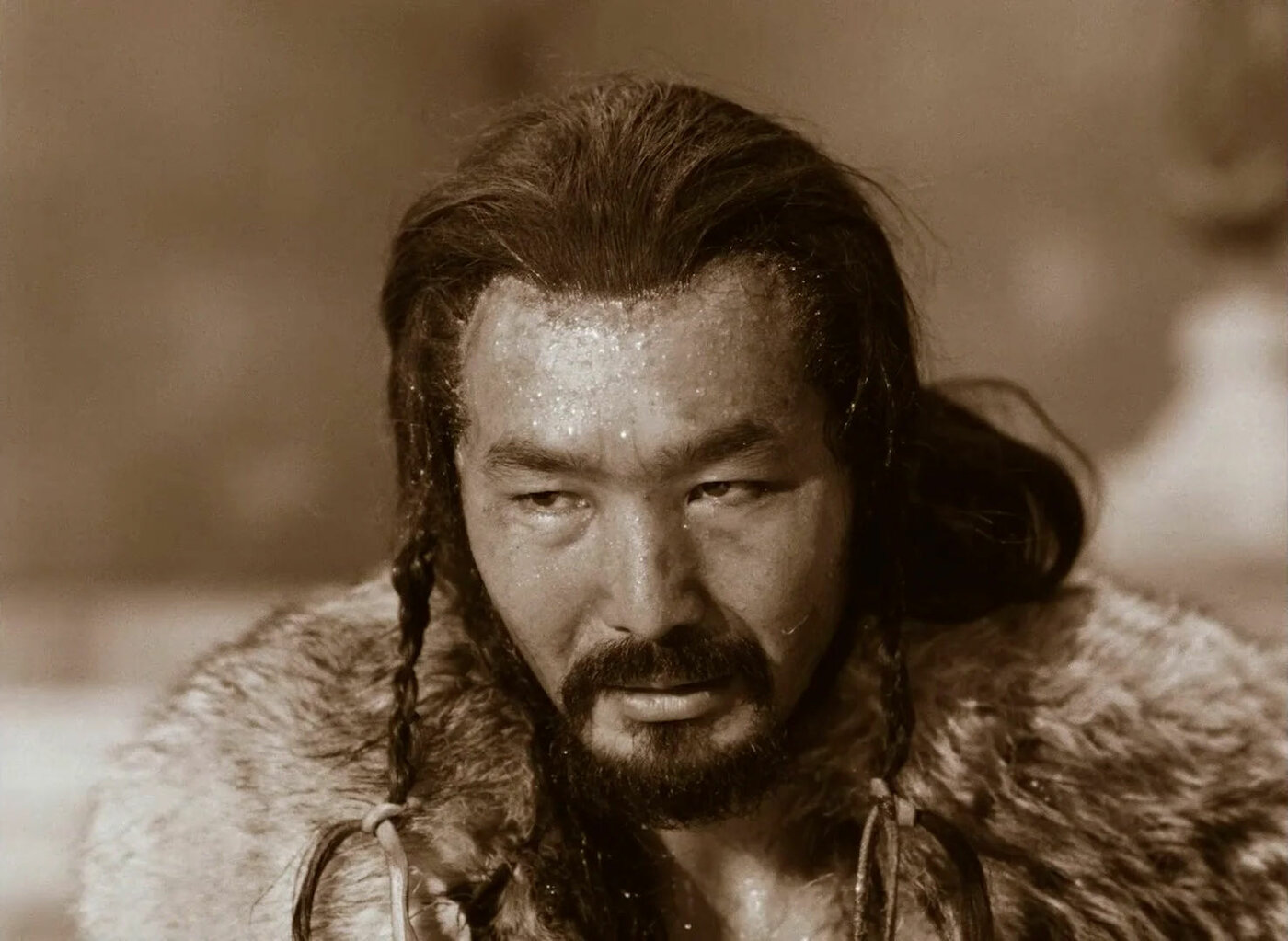
*The Fall of Otrar *(Adak Amirkulov, 1991).
Period pieces tend to associate the historical with wooden chairs, puffy outfits, spotty accents, and easy moral parables. Whether to celebrate or condemn, past conflicts become the stage on which contemporary dramas—of prejudice and principle, irrationality and reason—act themselves out. We turn our cameras on the past, and capture our own reflect…
Illustrations by Niklas Wesner.
This is the second in a series of short essays considering notable film restorations of the last year.
*The Fall of Otrar *(Adak Amirkulov, 1991).
Period pieces tend to associate the historical with wooden chairs, puffy outfits, spotty accents, and easy moral parables. Whether to celebrate or condemn, past conflicts become the stage on which contemporary dramas—of prejudice and principle, irrationality and reason—act themselves out. We turn our cameras on the past, and capture our own reflection.
But the past, as L. P. Hartley wrote, is a foreign country. Even in the fairly recent past, people’s lives were guided by other morals, other logics; they saw meaning where we find dull matter, and were indifferent to questions that seem to us existential. What we know of them comes from the recorded and physical matter that, against all odds, has survived time and its depredations, natural and human, representing only a sliver of life as it was lived. The vast majority of records, books, artworks, and deliberate marks have been lost, decayed, effaced, and what remains of any given time tells us very little about the people who made them, or why. We must bridge that void for ourselves.

*The Fall of Otrar *(Adak Amirkulov, 1991).
Adak Amirkulov’s *The Fall of Otrar *(1991), recently released in a new restoration by Martin Scorsese’s World Cinema Foundation, attempts to imagine one such break, and the world it annihilated. In the early thirteenth century, a scout named Unzhu (Dokhdurbek Kydyraliyev) arrives at the capital of the Khwarazmian Empire, in modern-day Uzbekistan. He has come from the Mongol Empire with a warning: Genghis Khan is coming, and they will not be able to stop him. For this, Unzhu is tortured, vilified, exiled; by the end of the film, his home and his people will be destroyed; yet he takes it all in stride. His fate is not his own, but Allah’s. Or as Unzhu puts it: He might be the arrow, but it is God who draws the bow.
Amirkulov’s film is a great many things: a Tarkovskian historical epic, a visionary work of late Soviet cinema, a feast of photochemical stock, a grimy physicalization of a seemingly distant time. But it is, above all, a story about what happens when two worldviews collide, and one world swallows another. The Persianate Khwarazmians believe themselves divine masters of Central Asia. They settled their Silk Road empire within geographic boundaries, its power grounded in palaces and mosques, fortresses to wall in their fantastic wealth. Their rule has swallowed up and subjugated the nomadic Kazakhs, making use of horsemen like Unzhu, but never trusting or fully empowering them. Their god, like their power, is sturdy, physical; he rules everyone, but resides within the limits of their empire.
The Mongols, meanwhile, move lightly, racing westward across the Hindu Kush, unencumbered by gold or stone. As the great Khan himself says: Their god is everywhere, all over the earth. From his throne, Genghis (Bolot Beyshenaliyev) speaks as a kind of missionary, preaching a gospel of scale and impermanence. He sees further than others, and acts according to that vision which rushes across the steppes, leveling walls and laying waste to empires, incorporating them into another world—his own.

*The Fall of Otrar *(Adak Amirkulov, 1991).
Morality must follow a logic of cause and effect: When certain things are done for certain reasons, certain outcomes must be expected. If that logic breaks down, an entire empire can shatter. Narrative works in much the same way, arranging words, images, ideas, and themes in relation to one another; how they relate expresses what they mean. These logics are not stable; they differ across cultures, and across time, and any artist who hopes to exhume the world of the past must take this into account. When Ulla Isaksson adapted a thirteenth-century Swedish ballad into the script for Ingmar Bergman’s *The Virgin Spring *(1960), she kept mostly intact a folktale which emerged at the crossroads of Christianity and paganism, telling a medieval story whose moral universe strikes the contemporary viewer as alien, as profoundly immoral. A young girl is raped and murdered; her father kills the killers; when her body is retrieved, a spring spills miraculously from the ground.
This is a familiar medieval story of suffering rewarded, and of the mystery of grace. Yet its moral logic disturbs. Her saintly death is awful, yet it leads to a miracle, a twinned moment of wonder and horror that her family struggles to comprehend. Why, as the critic Dwight MacDonald wondered, did God spend his miracle on a posthumous spring, rather than a living resurrection?1 Why did he let her die in the first place, when she might still have been protected? Isaksson’s script does not answer this or any other question. Its story just is, as so many folk narratives are. Its characters reside in a world of awful mystery where everything, from crop yields to the turning of the seasons to the death of a young girl, just happens. Meaning-making is God’s province; the rest of us merely live.
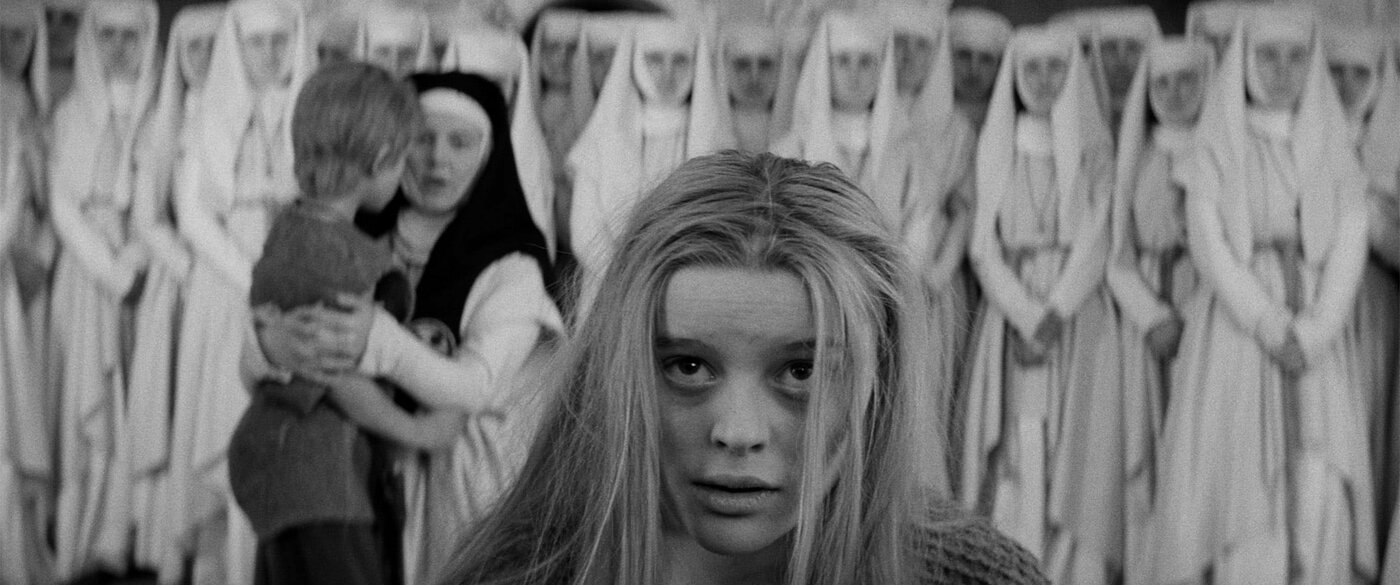
*Marketa Lazarová *(František Vláčil, 1967).
Violent and vile as they are, the events of František Vláčil’s *Marketa Lazarová *(1967) appear similarly inexorable. Guided by hunger, by greed, or by cruelty, the semi-noble, semi-feral residents of thirteenth-century Bohemia obey a rhythm and an order beyond the bounds of imperial and religious control. Their lives are muddy and bloody, yet touched by visions of natural and divine beauty that arise across the landscape. If *The Virgin Spring *directly invokes the conflict between a mystic pre-Christian religion and the usurping, universalist faith, Vláčil’s film incarnates it, setting an embodied, sensual, all-consuming credo against bright visions of a harsh, all-encompassing nature. One system is elemental; the other transcendent; and *Lazarová *is ultimately a film about the melding of the two, or rather the survival of one within the other in a process of cultural transmission, from their time to our own.
*Lazarová *treats the past as a place of mundane texture and sensation, a stinking mire of mystic visions and matted wool. Like *Andrei Rublev *(1967) and the work of Robert Eggers, it takes its cues from the physical world, deploying familiar objects—swords, crosses, chains—to naturalistically depict unfamiliar lives. Sergei Parajanov’s *The Color of Pomegranates *(1969) takes a more radical, metaphysical tack, restaging the life and the art of the eighteenth-century Armenian singer-poet Sayat-Nova as a series of symbol-rich tableaux, distilling a life and an era into 78 minutes of vivid imagery. Some of these images are fairly straightforward: A child peers through a window; a man courts a woman; a monk digs a grave. Yet Parajanov does not go in for straight depiction. His performers act repetitively, even awkwardly, and often stare straight into the camera. Occasionally, ecstatically, these tableaux approach a divine abstraction, an arrangement of colors and signifiers whose meaning derives from other times, deeper worldviews.
The effect is curious and totally unique, like a collection of illuminated manuscripts imbued with life. Such art does not represent reality, but takes the visible as a mere evocation of a metaphysical superstructure. As the film’s narrator intones, “The world is a window,” a physical form that allows us a glimpse of sublimity. Parajanov performs a similar feat, reassembling the historical record into a gorgeously alien object, an expression of cultural survival steeped in the history of art and Armenia, whose basic construction sets it apart from the history of narrative, of film, of art itself.

*The Color of Pomegranates *(Sergei Parajanov, 1969).
I’m sure that the past resembles *Pomegranates *no more and no less than it does The Virgin Spring. All these films make the past visible, through imagination, not resurrection. In depicting history, they reinvent it, adapting it to the time and the tools of (re)creation—and become themselves the subject of history. Otrar began filming in 1987, at the height of Perestroika. By the time it was completed and released, the nation that had commissioned, produced, and funded it was months from collapse. In recreating the passing of one era, Amirkulov’s film had become the relic of another.
The Khan knows that history annihilates, but also immortalizes: that records are lost, and recreated as legends. He executes the lord of Otrar by entombing his face in a mask of molten metal, a punishment that will ensure his place in myth. The city’s codices are buried and lost, preserving their knowledge for the future. Otrar was a small city, yet because it withstood the invasion longer than any other, we remember. And create again.

Continue reading Notebook’s 2025 Year in Review.
- Quoted in Tino Balio, The Foreign Film Renaissance on American Screens, 1946–1973 (University of Wisconsin Press, 2010), 140. ↩