Park Chan-wook’s No Other Choice, a MUBI Release, is in theaters this Friday in the UK and Ireland.
*No Other Choice *(Park Chan-wook, 2025).
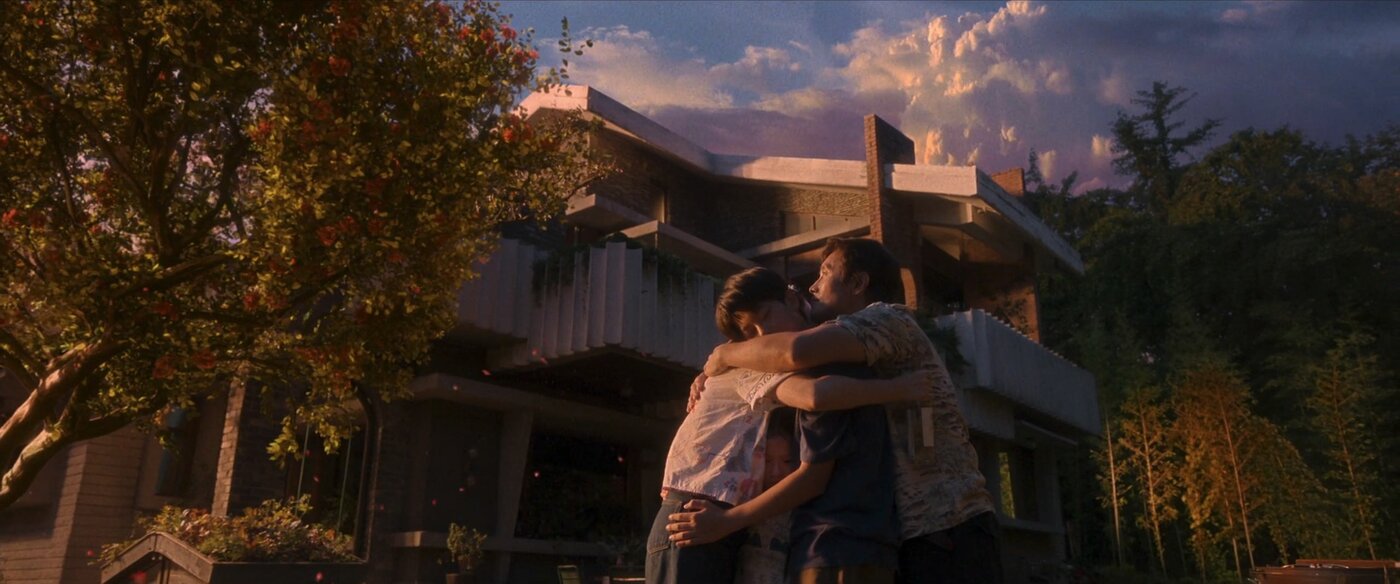
How does the working man’s garden grow? In Park Chan-wook’s* No Other Choice *(2025), the answer is: unnaturally. The film opens high in the boughs of a blooming crape myrtle tree, set against a hyper-saturated sky. As the tree’s too-bright blossoms swirl through a scene of seeming domestic bliss—Man-soo (Lee Byung-hun) grilling up a perishable Years of Service award for his family—they resemble nothing so much as pixels. The blossoms fall but rarely land, or land too cleanly to be wind-blown. Th…
Park Chan-wook’s No Other Choice, a MUBI Release, is in theaters this Friday in the UK and Ireland.
*No Other Choice *(Park Chan-wook, 2025).
How does the working man’s garden grow? In Park Chan-wook’s* No Other Choice *(2025), the answer is: unnaturally. The film opens high in the boughs of a blooming crape myrtle tree, set against a hyper-saturated sky. As the tree’s too-bright blossoms swirl through a scene of seeming domestic bliss—Man-soo (Lee Byung-hun) grilling up a perishable Years of Service award for his family—they resemble nothing so much as pixels. The blossoms fall but rarely land, or land too cleanly to be wind-blown. They brush past Man-soo’s wife (Son Ye-jin) without making contact; the myrtle appears almost flush with a digitally enhanced sky. While the family celebrates, the surreality of their setting sets a tone of foreboding, not peace. Their prosperity appears, like the natural world behind them, illusory.
It’s not out of character for Park to employ more or less obvious VFX (more obvious: the bug that “crawls” across a camera lens; less: the view out nearly every window) to enhance the “natural” world in accordance with his hyperbolic vision. But in No Other Choice, the presence of relatively obvious VFX compels the viewer to wonder whether other objects in the frame were subject to digital augmentation. Although the trunk of the crape myrtle tree is real, for example, we still wonder how many uncannily graceful blossoms were added in postproduction. This uncertainty is productive: Throughout the film, trees are vexed symbols, deeply rooted in the narrative’s broader thinking about work and sacrifice—evincing the film’s uneasy, ambivalent relationship to specialized labor in the age of automation.
*No Other Choice *(Park Chan-wook, 2025).
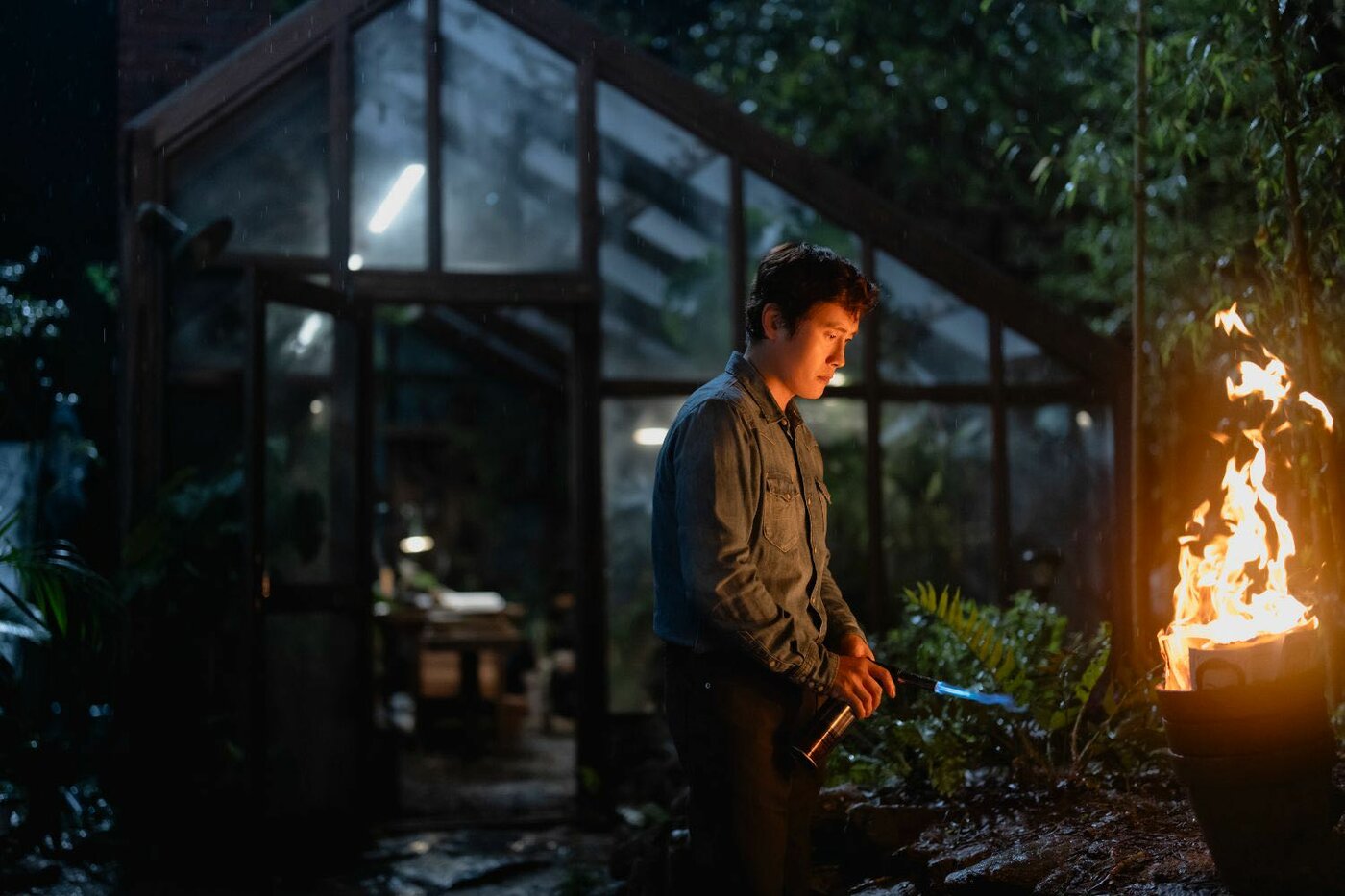
Updating Donald Westlake’s 1997 novel The Ax, No Other Choice is the story of a paper mill manager abruptly laid off, along with nearly everyone in his sector, as his industry embraces AI. Panicked and ashamed, Man-soo decides the only path forward is to—literally—kill the competition. But his brutal job hunt is ironized from the jump. Man-soo isn’t just a guy with a great, hyperreal crape myrtle in his yard. He’s a green thumb, the proud owner of both a greenhouse and a beloved family home that, built of in raw wood and decked out in dark greens, itself resembles a treehouse. To find work in an industry that, the film reminds us, “razes forests,” Man-soo will naturally have to jeopardize what he truly values.
The film is, at base, a screwy parable of late-capitalist delusion (also: a Looney Tunes–esque lens on masculinity in crisis, and a warped reflection on Korean-Japanese business relations). Its elementary lesson is complicated, however, by the presence of its VFX. The VFX sector has long been—like No Other Choice’s depiction of the paper industry—threatened by precarity, exploitation, and the encroachment of AI. Here, the visible VFX means that images of or “about” dehumanizing working conditions bear legible traces of those real-world conditions.
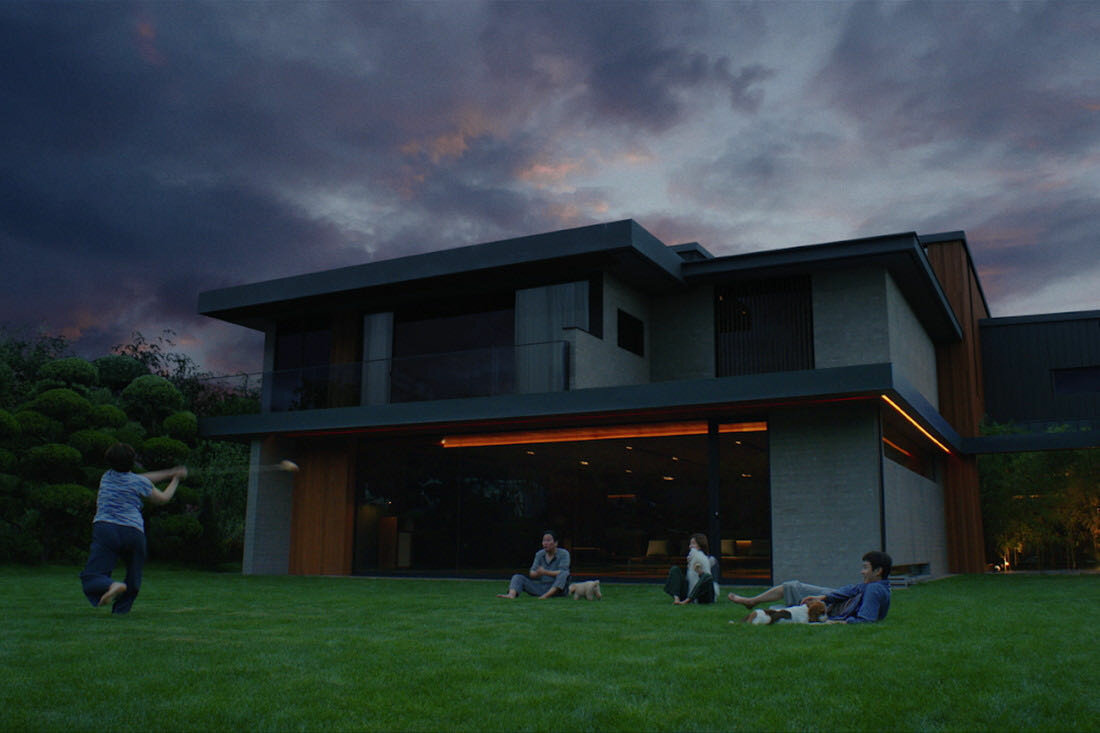
Above: *Parasite *(Bong Joon-ho, 2019). Below: *No Other Choice *(Park Chan-wook, 2025).
By “visible VFX,” I mean to distinguish No Other Choice’s video game–esque natural backdrops and wildlife—a startling CG snake, for one—from what industry workers call “invisible VFX,” forms of intervention that are largely imperceptible, no matter the scale. At least half of the bourgeois family home in Bong Joon-ho’s Parasite (2019), for instance, was CG; such undetectable production processes mimicked the clandestine lives of the working-class characters who lived within it in secret. If Parasite is in part a film about efforts to conceal the ugliness of material hardship, its “invisible VFX” performs some similar obfuscation. No one wonders, without sufficient prompting, which artists “did the house” in Parasite—or what effort, under what circumstances, it took to erase any detectable traces of their handiwork.
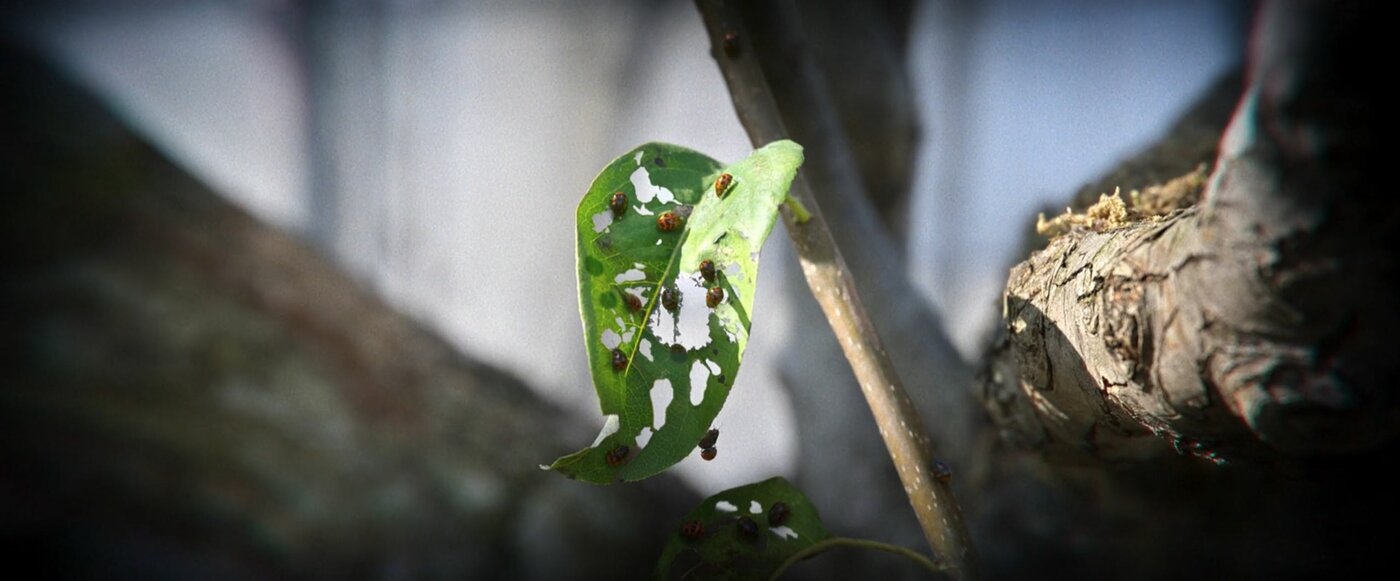
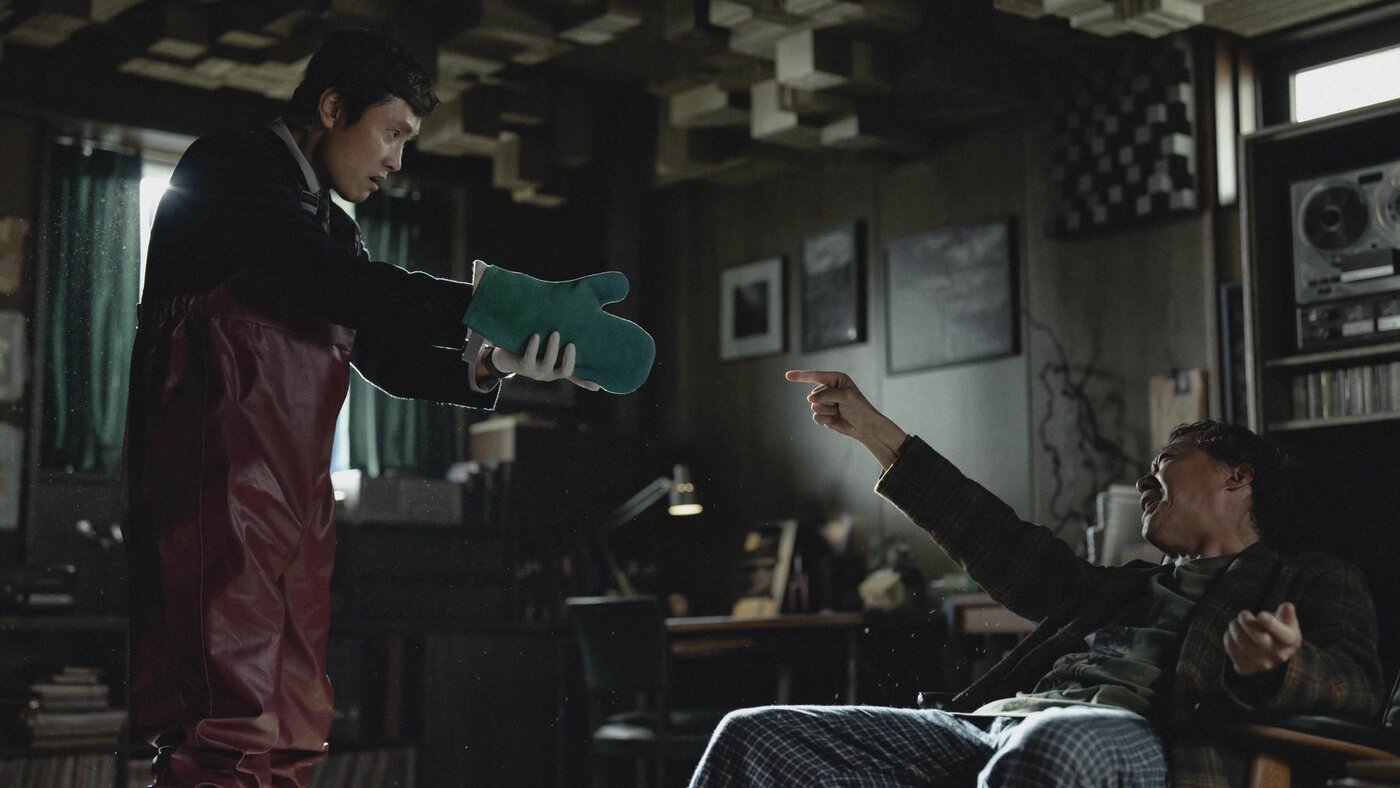
By contrast, the visibility of No Other Choice’s VFX components, and our constituent awareness of them as viewers, presents the opportunity for some recognition of the material conditions that produced them. Such reflexivity is visible, for instance, when Man-soo watches a slew of bugs chomp through pear tree leaves in a fellow job hunter’s yard. Peeped in close-up by Man-soo’s binoculars, the insects are at once too-detailed and textureless, drifting across the (likely digitally composited, based on a telltale sharpness) dying tree, leaving outsized holes behind. Here, obvious CGI does the small-scale work of “razing” a forest, bite by bite, rather than factory pallet by factory pallet. Read one way, we might say that, by evoking exploitative working conditions to render images of what we lose to those conditions, the film reaffirms the exhausted inevitability of its title. Following the logic of “no ethical consumption under capitalism,” this framework suggests that there is little to be mined from the fact that exploitation begets exploitation—even in diegetic and nondiegetic forms—other than the fact that all of it is real, and all of it is bad.
*No Other Choice *(Park Chan-wook, 2025).
But Man-soo’s fellow paper industry workers point to a more interesting way of reading visible VFX. Throughout the film, they defend their choice to stay in a dying field by expressing their commitment in vocational terms: “For those of us who make it, white paper is a kind of art.” Repeatedly, an out-of-work paper man will list all the things his paper has made: “that money,” “ice cream cone sleeves,” “bank notes,” “lotto tickets,” “menstrual pad paper.”
These moments, though played for laughs, express a melancholic resistance to the mechanics of commodity fetishism, which erase the labor power inured in a product by suggesting its value is inherent, even self-bestowed. The demonstrative VFX work in *No Other Choice *seems to counteract that: It offers us both the product and the production, all at once. We can intuit that the blossoms of the crape myrtle, or the snake, or some animated pear tree bugs were “made,” rather than magicked into life, because they are decidedly un-lifelike. Eventually, even seemingly natural elements, like the crape myrtle tree, may scan as artificial to audiences primed to expect digital intervention—an interpretation that still draws attention to the efforts of practical effects workers behind the scenes, tasked with readying nature for its close-up. That is to say: Even when the precise conditions or limits of VFX labor remain opaque, conspicuous CGI leaves the lingering sense that something has been worked into being.
*No Other Choice *(Park Chan-wook, 2025).
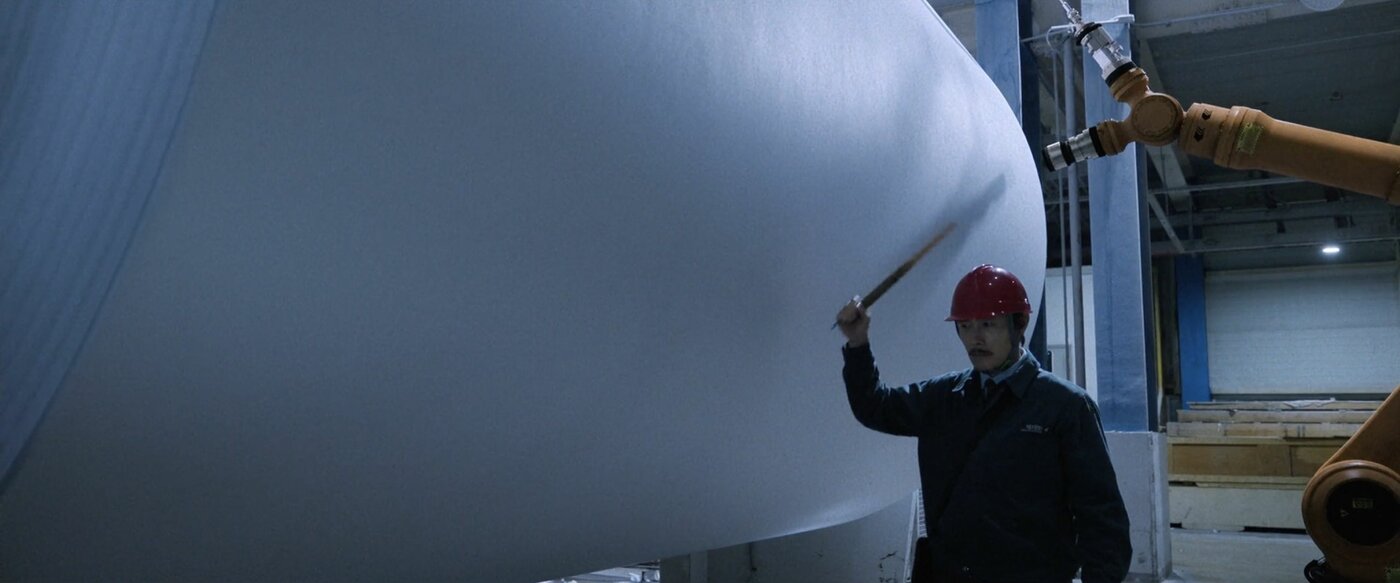
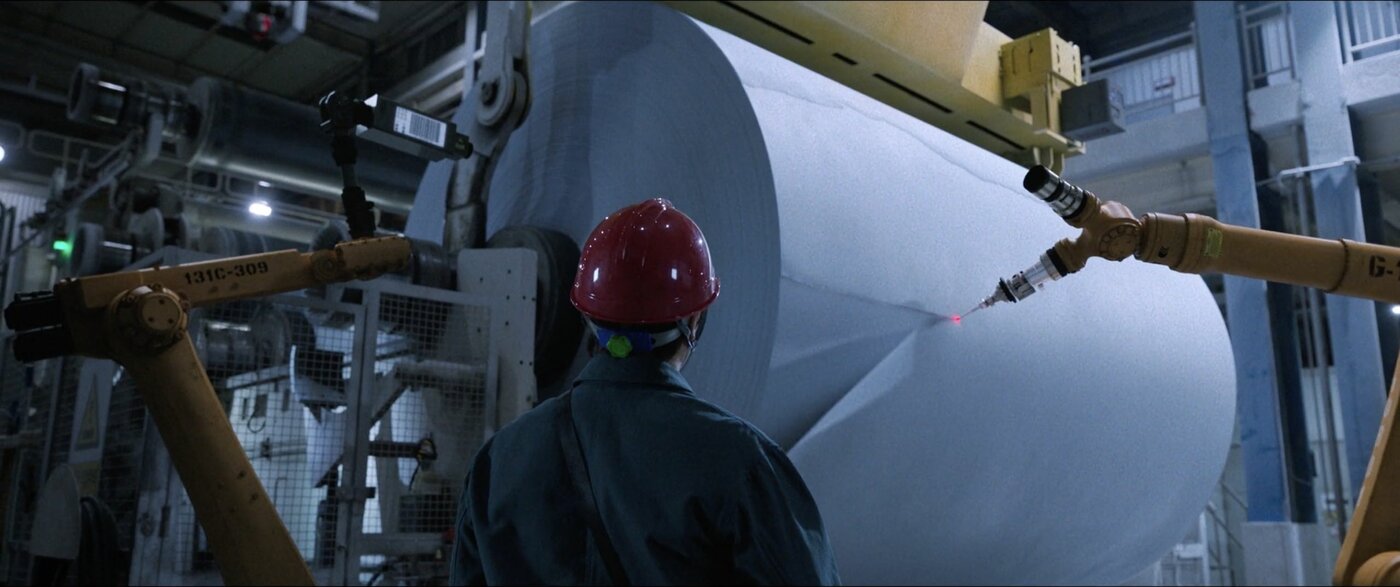
No Other Choice ends with Man-soo having effectively eliminated—in every sense of the word—the last of the human workers who could beat him out of a job. The last candidate standing, he finds himself the only human overseer of an entirely AI-run paper mill, a structure sure to extend the industry’s environmental devastation well beyond the forest. Gone, the higher-ups tell him, are the days of needing to tap a paper roll with a wooden stick to test its quality—the machines will handle that now. Man-soo is too pleased to have a job to care that the human touch—the very element that affirmed his colleagues’ faith in their profession as a creative act—has been drained from the process.
In the film’s final sequence, Man-soo tools around the empty, silver space of a worker-less paper mill, plugging his ears against the roar of the machine and, despite being told otherwise, tapping a roll of paper with a big wooden stick. The paper falls away from the roll, cascading more than folding. The movement is slick and off-putting; there’s something almost fleshy in the way the material slides. By this point, the viewer has become alert to Park’s artificial flourishes, and the paper immediately suggests the work of digital VFX. Up to this point, the film has repeatedly framed paper as a true “analog” medium, the manufacturing and use of which is compared, in one wry moment, to “listening to music on vinyl and watching movies on film.” It’s not clear whether we’re meant to take the analog versus digital debate seriously as a sign of our times—the desperate characters who voice the tension lend it a pitiful, elegiac pall. But nor does the film confront the epistemic chaos beget by GANs and LLMs. Park’s vision of AI sees big, silly robots tooling around the factory floor. If only it were always so obvious.
The other layer of analyzing “visible VFX,” then, is the fact that these graphics can or could easily be the work of generative AI. No longer is it sufficient to “show your work” when we can no longer take for granted that humans worked on these images. (Dexter, the Seoul-based VFX studio that worked on No Other Choice, often touts people-first values, but has also recently patented a slew of AI-driven tools and technologies.) In the face of this gray area between what has been created and what has been generated, No Other Choice prompts us to look closer. As the credits roll over a backdrop digitally rendered to look like “paper,” we catch glimpses of forest being chewed up by a pulping machine. It’s not clear if the trees are “real” in any meaningful sense—but the technology that’s killing them certainly is.