Lily Ray warns excessive optimization tactics now trigger Google penalties as AI content floods search results. Recovery requires sustained effort spanning years.
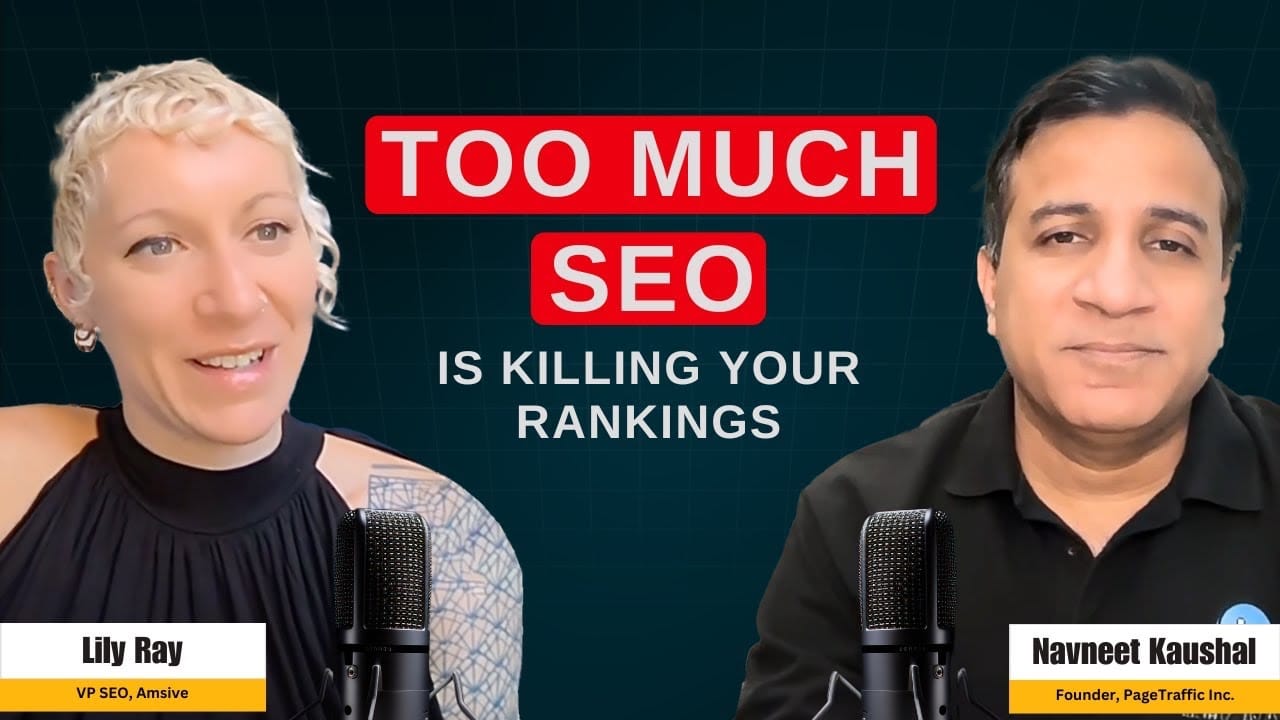 SEO expert Lily Ray discusses ranking penalties from excessive optimization with Navneet Kaushal on podcast.
In the last few years, websites have begun losing search rankings for an unexpected reason: they’re doing too much SEO. Lily Ray, senior director of SEO at AMS Digital, delivered this assessment during a December 26, 2025 interview on The Agency Insider Show with Navneet Kaushal.…
Lily Ray warns excessive optimization tactics now trigger Google penalties as AI content floods search results. Recovery requires sustained effort spanning years.
SEO expert Lily Ray discusses ranking penalties from excessive optimization with Navneet Kaushal on podcast.
In the last few years, websites have begun losing search rankings for an unexpected reason: they’re doing too much SEO. Lily Ray, senior director of SEO at AMS Digital, delivered this assessment during a December 26, 2025 interview on The Agency Insider Show with Navneet Kaushal.
Ray manages a team of 30 to 35 SEO professionals and has spent years analyzing algorithm updates and quality guidelines. Her experience working on 50 to 100 websites affected by penalties has revealed consistent patterns in what triggers Google’s enforcement systems. "The vast majority of what we help companies with when companies have been negatively impacted by algorithm updates or penalties is cleaning up a lot of the SEO work that they did a few years back," Ray said.
Subscribe PPC Land newsletter ✉️ for similar stories like this one
The tactics that generated strong results between 2018 and 2022 now actively harm rankings. Google began adjusting its systems in 2022 to target content created primarily for search engines rather than users. Companies that scaled content aggressively or purchased backlinks extensively now face the consequences of approaches that previously worked.
Ray first encountered major algorithm impacts during the 2012 Penguin update but found her specialty during the August 2018 core update. That adjustment, nicknamed the "medic update" by the SEO community, heavily affected health websites and established patterns Ray continues to observe. The update introduced Google’s emphasis on expertise, authoritativeness and trustworthiness signals.
"Google’s search quality guidelines is available online. It’s a PDF. It’s 160 plus pages. Most people don’t read it, you know, even though I think it contains a lot of the answers to how Google actually operates," Ray explained. The guidelines provide the foundation for understanding quality standards, yet few practitioners study them thoroughly.
Current ranking losses stem from both artificial intelligence content and traditional over-optimization. Ray identified programmatic SEO content strategies, aggressive backlink acquisition, and participation in specific ad networks as red flags Google can detect algorithmically. "If we go to an SEO conference and somebody’s sharing the secret weapon that they found and then tens of thousands of people are going to do the same thing on their sites or or better yet somebody builds a tool that automates a lot of those same techniques at scale which is what we saw with the helpful content update," Ray said. Google can identify these patterns as footprints and demote affected sites simultaneously.
Recovery from algorithm penalties presents significant challenges. Ray described the process as being put "in jail" by Google, requiring extensive work and extended timeframes to regain previous rankings. The process rarely involves immediate forgiveness. "It usually takes I’ve seen it take two years for some sites that have been doing really hard work which is why again like I think people get very tired of me like preaching you know follow the guidelines," Ray stated.
AI content currently ranks well despite Google’s guidelines against content created primarily for search purposes. Ray acknowledged multiple examples of pure AI content that rehashes existing articles performing strongly in search results. This temporary success creates tension for brands operating with longer time horizons. "I’m not going to deny that. I’m actually surprised by how well that content does rank, you know, given Google’s guidelines. I think the problem is it doesn’t work forever," Ray said.
The SEO expert predicted a major enforcement action in 2026 targeting AI spam similar to previous crackdowns. She compared the current situation to the March 2024 core update, helpful content update, Penguin update and Panda update. "I imagine Google is working very, very hard right now to figure out how to demote all of that content. I imagine in 2026, we’re going to see a huge crackdown," Ray predicted.
The SEO industry faces ongoing ranking volatility as Google implements multiple simultaneous ranking systems. Recent core updates in 2025 have created dramatic ranking changes, with the June update requiring 16 days to complete and the December update arriving just before Christmas. Ray identified several factors contributing to increased instability: multiple specialized ranking systems operating simultaneously, AI Overviews appearing on 20 to 30 percent of queries, and the deprecation of the num=100 parameter that changed reporting capabilities.
Google Ads placements further complicate organic search performance. "I can’t use Google. Like, I don’t understand how to use Google anymore because at the top we have 20 different ads and then we have popular products and then we have people also ask and it’s like how do I even know where to go to get what I’m looking for anymore," Ray said, describing feedback from users. The increased advertising presence affects how searchers interact with organic results.
Brand authority emerged as the strongest ranking factor in Ray’s analysis. Websites that appear as trusted entities in Google’s knowledge graph carry more algorithmic weight. Companies can assess their brand presence through simple searches for their own names, examining whether they control knowledge panels, social media properties, and top organic results. "The more that you can just do that work to like really establish yourself as an entity and as a business in Google, generally speaking, the more confident they’re going to be about your website and the content that comes from your website," Ray explained.
Content problems rather than technical SEO issues cause most traffic drops. While technical problems remain visible through Google Search Console performance reports and crawler alerts, content-related penalties have become more common. Ray emphasized the connection between content quality and expertise signals, particularly for your money your life topics like health, finance and insurance.
Buy ads on PPC Land. PPC Land has standard and native ad formats via major DSPs and ad platforms like Google Ads. Via an auction CPM, you can reach industry professionals.
Companies frequently underestimate the importance of avoiding deceptive practices. Ray cited examples of purely AI-generated articles on sensitive topics with human names attached as authors. "If you’re using a lot of AI to generate and automate your content, that should be labeled on the article. Most companies don’t want to do that. But if you’re not doing that, you are actually running the risk of being really deceptive with your customers," Ray said.
The March 2024 core update demonstrated Google’s capacity to reverse long-standing penalties. Sites began experiencing partial recoveries from the September 2023 helpful content update, suggesting algorithmic adjustments can restore visibility after extended suppression periods. However, recovery remains the exception rather than the rule.
External platforms including Reddit, Wikipedia, YouTube and LinkedIn dominate AI search citations. Ray identified user-generated content as the common thread connecting successful sites in large language model results. "What makes them valuable is that they have real human conversations. You know, even Facebook groups is really heavily cited in AI search. What do you get in Facebook groups? You get neighbors from the same neighborhood talking about, you know, issues that are specific to their neighborhood," Ray said.
Technical challenges affect all SEO platforms following Google’s elimination of the num=100 parameter in September 2025. Semrush confirmed the industry-wide disruption multiplies operational costs by a factor of 10, while Ahrefs gradually restored top 100 search result tracking functionality. The restriction forces tools to execute 10 separate requests instead of one to retrieve comprehensive search data.
AMS Digital treats AI search optimization as an extension of traditional SEO rather than a separate service. "We’re adding it, we’re offering it as an add-on, an extension to our SEO programs. It’s not much. It’s not that expensive compared to SEO programs," Ray explained. The approach reflects the reality that recommendations from auditing AI search performance involve traditional SEO fixes: website architecture improvements, internal linking adjustments and branding enhancements.
Team education remains central to AMS Digital’s operations. The agency implements daily 15 to 20 minute meetings covering different specializations: Monday meetings review the latest SEO developments, Tuesday sessions focus on technical SEO, and Wednesday gatherings address client workflows. "If you’re not getting that visibility into how more senior people are doing things and learning things and new tools. Sometimes we have new tools come on and do demos with us and things like that like if you’re working in a vacuum from home you you’re just going to lose out so quickly," Ray stated.
Hiring priorities have shifted toward candidates demonstrating enthusiasm for AI while understanding its limitations. Ray emphasized the importance of skepticism alongside technical proficiency. "It’s not just pure excitement for AI. It’s I understand the limitations of these tools so I figured out workarounds so I can get the most accurate data as possible," she said. Large language models frequently provide incorrect information when users lack knowledge to ask proper questions or validate responses.
Personal brand development supports agency positioning rather than complicating it. Ray’s global speaking engagements and media presence generate client opportunities while maintaining alignment with AMS Digital’s messaging. "I publish content on the AMS blog. I link to AMS when I get press mentions and things like that. So it’s from what we’ve seen over eight years of doing this together, it’s very mutually beneficial," Ray explained.
The SEO expert advised agencies to carefully vet potential clients before accepting projects. Red flags include companies that have worked with 10 agencies in six years, unrealistic growth expectations for startups selling products nobody searches for, and toxic client behavior that lowers team morale. "Sometimes you get clients and like as an agency, you want to take on lots of clients, right? So, like you might take on a client who has unrealistic expectations," Ray said.
Quality rater guidelines provide insights into Google’s evaluation criteria. The January 2025 update introduced formal definitions of generative AI and expanded spam tactic descriptions. The guidelines distinguish between content deserving "Low" ratings versus "Lowest" ratings, with the most severe designation reserved for copied or paraphrased content with no added value.
LLM.txt files remain a topic of debate within the SEO community. Ray noted disagreement among industry leaders about whether the files provide value. "I think listen um if you have the time and resources to build an LLM.txt txt um do that right what we don’t know is if it’s going to be used whether it’s actively being used like a lot of that’s unknown right now," Ray said. Google placed an LLM.txt file on Search Console for one day before removing it.
User behavior changes continue as AI search tools gain adoption. Ray predicted the trend favors large language models over traditional search engines for many query types. "If you count AI overviews as an LLM, obviously Google’s sharing. A lot of people love AI overviews. A lot of people complain that they don’t, but I think Google keeps sharing. It’s one of our most successful products," Ray stated. The shift toward zero-click experiences reduces traffic to source websites while providing convenient answers.
Professional SEO practitioners must balance multiple considerations simultaneously. Ray emphasized conducting both traditional SEO and AI search optimization rather than choosing between them. "I wouldn’t lose sight of doing the things that are important for SEO because you’re so focused on AI search. I would do them both simultaneously," she advised.
Subscribe PPC Land newsletter ✉️ for similar stories like this one
Timeline
- August 2018: Core update nicknamed "medic update" heavily impacts health websites
- 2018-2022: Aggressive SEO techniques deliver strong results before Google system changes
- September 2023: Helpful content update causes traffic losses up to 95% for independent publishers
- March 13-27, 2025: First core update of 2025 causes wild ranking swings over 14 days
- June 30-July 17, 2025: Second core update brings unexpected recoveries after 16-day rollout
- September 14, 2025: Google eliminates num=100 parameter affecting all rank tracking tools
- October 28, 2025: Major ranking volatility detected across monitoring platforms
- December 11, 2025: Third core update of 2025 begins before Christmas
- December 26, 2025: Lily Ray interview on The Agency Insider Show
Subscribe PPC Land newsletter ✉️ for similar stories like this one
Summary
Who: Lily Ray, senior director of SEO at AMS Digital managing 30 to 35 professionals, discussed search ranking challenges with Navneet Kaushal on The Agency Insider Show. The conversation addressed website owners, SEO practitioners and digital marketers facing algorithm penalties.
What: Websites lose rankings because excessive SEO optimization now triggers Google’s enforcement systems. Recovery from penalties requires years of sustained effort. AI content currently performs well despite violating guidelines but faces predicted crackdown in 2026. Brand authority emerged as the strongest ranking factor while technical challenges affect all monitoring platforms.
When: The interview occurred on December 26, 2025, examining patterns Ray observed from 2012 through current algorithm updates. Google began changing ranking systems in 2022 to target content created for search engines. The predicted AI content crackdown will likely arrive in 2026.
Where: The discussion covered global search ranking impacts affecting websites across all industries and geographic regions. Platform changes affect Google Search, AI Overviews appearing on 20 to 30 percent of queries, and large language models including ChatGPT and Gemini.
Why: Google implemented system changes to demote content created primarily for search engine optimization rather than user value. The adjustments target programmatic content scaling, aggressive backlink acquisition and participation in specific ad networks that create detectable patterns. Companies face penalties because previously successful tactics now conflict with Google’s human-first content policies.