Can media organisations use the work of independent artists without credit or payment? Does it not amount to a violation of an artist’s copyright?
In recent years, several independent photographers, filmmakers and writers have accused mainstream media organisations of using their photographs, videos and writings without proper attribution, and sometimes even presenting them as their own content.
The issue came into sharp focus in December when Emmy-nominated filmmaker and photographer Ronny Sen filed a civil suit against Zee News seeking Rs 18 crore in damages. He accused the channel of a deliberate act of copyright infringement, alleging it had used his exclus…
Can media organisations use the work of independent artists without credit or payment? Does it not amount to a violation of an artist’s copyright?
In recent years, several independent photographers, filmmakers and writers have accused mainstream media organisations of using their photographs, videos and writings without proper attribution, and sometimes even presenting them as their own content.
The issue came into sharp focus in December when Emmy-nominated filmmaker and photographer Ronny Sen filed a civil suit against Zee News seeking Rs 18 crore in damages. He accused the channel of a deliberate act of copyright infringement, alleging it had used his exclusive cinematographic work documenting the transport of cheetahs from Africa to India without authorisation.
A commercial court in Kolkata admitted the suit and will hear the matter.
Sen told Scroll that what had happened was “quite outrageous”. He alleged that Zee didn’t only “steal the work but have claimed it as exclusive and suggested that only they had access to it”.
Zee News did not respond to Scroll’s email seeking a response to the allegation.
Sen said that he hopes that “courts will do something so that the rights of photographers like me can be secured”.
For Sen, this was not an isolated incident involving Zee News. He has pointed out that,as far back as 2014, one of his photographs was used by Zee News’s Bengali channel during coverage of protests in Jadavpur University without his consent.
One of Sen’s main arguments in his suit is that Zee News cannot rely on “fair use” because the photograph was not used “incidentally or just for brief news reporting”. Instead, the channel used the entire photograph “repeatedly, without giving him credit, and even falsely claimed it as their own with exclusive access”.
At the heart of the debate lies a phrase that is frequently invoked but rarely understood, “fair use” – or as Indian law calls it, “fair dealing”.
What is fair dealing?
While the term “fair dealing” is widely used in India, the doctrine itself is distinct from the concept of “fair use” in the United States.
Fair use, a feature of American copyright law, is considered relatively “open-ended and flexible”, said Mumbai-based copyright law advocate Pankhuri Upadhyay. Under US law, courts apply a four-factor test that looks at the purpose and character of the use, the nature of the copyrighted work, the amount and substantiality of the portion used, and the effect of the use on the potential market for the original work.
In India, the governing framework is Section 52 of the Copyright Act, which lists specific situations where the use of copyrighted material “does not amount to infringement”.
These include limited use for “criticism or review” and for “reporting current events and current affairs”, including public lectures. However, the law does not define fair dealing in clear terms, instead provides circumstances where it may be used as a defence if an instance of use is challenged.
Explaining how courts approach this, Pankhuri said that “commercial use is not automatically disqualified in India, but it does warrant greater scrutiny” and often weighs against a fair dealing claim.
Another key factor, she noted, is the “amount and substantiality of the work used”, warning that even short excerpts can count against fair dealing if they capture the most significant part of a creative work.
These factors, she said, are applied together, “not as a rigid checklist”.
Section 52 also makes author attribution mandatory in news reporting, while Sections 51 and 57 protect copyright and moral rights.
Advocate Prashant T Reddy, who practises in Delhi, added that even permitted uses cannot cross into “misrepresentation or distortion” that harms an author’s reputation.
Pankhuri emphasised that fair use is “not a rule but a defence”, and can only be determined by courts on a case-by-case basis.
‘Photographers have no rights?’
Media organisations are increasingly exploiting the work of photographers, Sen argued, because of a key structural shift within newsrooms.
“Media publications that used to hire photographers in the past don’t really hire anymore because there is a sense that images can be produced by anyone,” he said. However, when a story becomes important, “there is tremendous pressure on publications to generate some kind of visual material, and then there is a tendency by large media groups to use other people’s work without any due process”, he added.
Sen pointed out that photographers remain a “largely unorganised community, which makes it difficult for them to enforce their rights”.
“The crisis we see today is because photographers have been completely sidelined, and under pressure, big media organisations run photographs without consent,” Sen said. “Photographers, like any other creative professionals, put in just as much work. How is it that photographers have no rights?”
Photographer Gauri Gill echoed similar concerns. She said she was “disheartened” last year to discover that her photographs had been used “without permission by media organisations”.
Brilliant Gauri Gill took these viral photos of @MiraPagliNair and @ZohranKMamdani. She’s being ripped off, they’re being circulated without credit. These have her name on, let’s share these and fix it. pic.twitter.com/hGsylPSKXY
— Karuna Nundy (@karunanundy) November 9, 2025
She recalled that in November 2025, major media organisations had taken her unpublished, older photographs of Zohran Mamdani, the New York mayor, with his mother Mira Nair, from her private Instagram account, without her permission. The images were subsequently made viral on social media.
Gill said she was upset that “major profit-making publications” had used her work without permission, credit, or payment, and chose to “let the matter go” instead of taking legal action.
“It has definitely given me pause to think and consider what to do in the future,” she added. “I was freely putting out original content on my Instagram account, just for the pleasure of sharing, and trusting people not to share without asking, but now, I don’t know.”
Gill said the problem has two sides – companies using images without permission or credit and individuals sharing photos online. “I wonder about the distinction in law as it applies to companies and individuals, print, TV and social media,” she said. “The internet has introduced a whole new dimension to the concern.”
Kolkata-based photographer Subhrajit Sen told* Scroll *that in May 2025, a major television network had “used his original photographs” while crediting itself as the source. The images were part of his work and had earlier been published with attribution by another publication.
Subhrajit raised the issue on Instagram, calling it “alarming and deeply irresponsible” to reuse his images without permission or credit, and said it violated his rights and reflected poorly on editorial ethics.
He said he took a stand publicly by posting about the issue on Instagram and tagging the news channel. It contacted him and “attempted to offer compensation”, which he declined. Subsequently, “they issued a public apology on LinkedIn”, he said.
Subhrajit said he chose not to approach the courts “as legal action is costly and time-consuming, especially against a large media house”. He also said the “lack of accessible contact details” left him with no option but to flag the issue on Instagram.
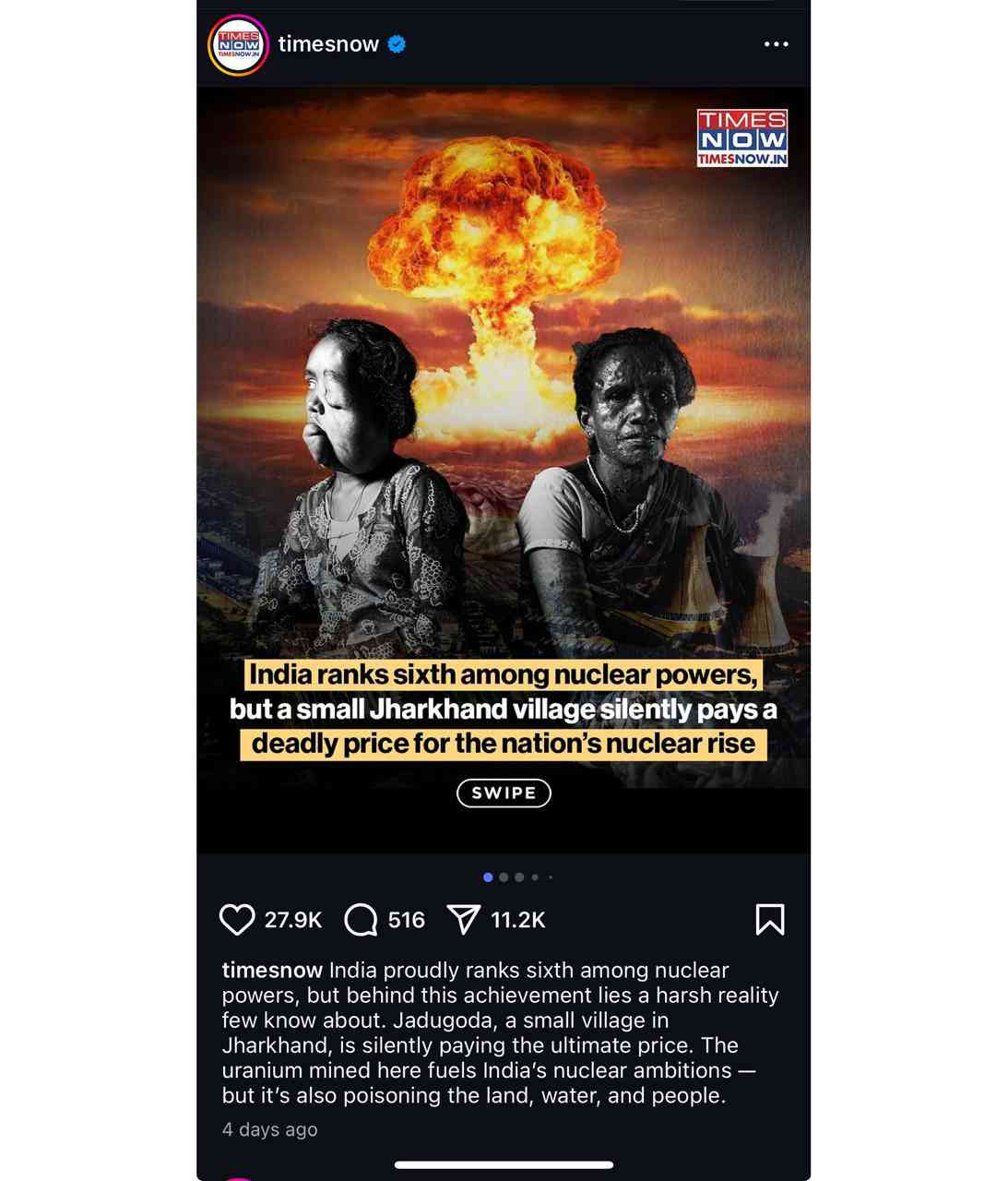 Subhrajit Sen says Times Now used his photographs in this Instagram post.
Another photographer, Ishan Banerjee, said he had a similar experience with* *the same television channel. After Subhrajit’s Instagram post, Banerjee said the channel used his photo and told him, “It’s just a photo. Why are you making a big issue?”
He said his credit request was refused, and the image was later quietly removed.
In its LinkedIn apology, the television channel said there was “absolutely no intention to misuse anyone’s work or to take credit for it”.
In April 2025, Delhi-based artist Anita Dube faced copyright allegations after using lines from poet Aamir Aziz’s poem Sab Yaad Rakha Jaayega in works shown and sold at Vadehra Art Gallery. Aziz accused her of theft, saying, “This is not conceptual borrowing. This is theft. This is erasure.”
Aziz told Scroll that while the gallery came to a settlement with him, Dube did not. Aziz said that Dube tried to convince him that the use amounted to “fair dealing, claiming it was promoting his work”.
On legal action, he said approaching the court would itself require around Rs 2 lakh in court fees. “How struggling artists could afford such costs,” he said.
Mumbai-based photographer Prarthna Singh summed up the wider problem, saying the theft of creative work is rampant in India. Even when images are publicly available, she said, “that is not the way it should be used; even if it’s out in public, you should still reach out to the artist for permission”.
Burden of implementation
Speaking to Scroll, Delhi-based intellectual property lawyer Anshumaan Sahni explained that individuals often lack the resources needed to enforce their own copyright.
“Large corporations typically have strong systems in place to track copyright infringement and actively pursue violators,” he said. “However, when it comes to independent artists, photographers and writers, this system is against them because it requires constant vigilance.”
Sahni noted that even among individuals, there is a clear hierarchy. Since damages claimed in court have to be based on potential earnings lost by an artist, new artists are at a disadvantage.
“Someone who has goodwill and is already famous, there is a clear value attached to their work,” he said. “But for someone who is just starting, how do you value their work?”
While an established artist may be able to claim damages based on prior sales, “to pursue such a claim, the artist would often have to spend a significant amount on legal costs”, which Sahni said “strongly discourages independent artists” from seeking legal remedies.
Another Delhi-based intellectual property lawyer, Nishchal Anand, said that in many cases, a legal or takedown notice is sufficient. “Big organisations are also very conscious about their image, so they try to settle the matter outside court,” he said.
Anand stressed the need for artists to have “collective management organisations” to enforce their rights.
Advocate Reddy emphasised that “collective societies are important” because they will help reduce the high costs of enforcing copyright.
Once infringement occurs, advocate Upadhyay said, “the burden shifts entirely onto the artist”, and “the costs involved are insane”.
“Big organisations have power and money, and in many ways, the battle is already lost before it begins,” she added.
- We welcome your comments at letters@scroll.in. *
 Get the app