Culture
Alberta
What happens when scientists and artists meet to confront humanity’s melting future? A letter from Banff.
Ian Gill TodayThe Tyee
Ian Gill is a journalist, author, conservationist and bookseller. He is co-creator of Salmon Nation, co-owner of the independent Vancouver literary arts studio Upstart & Crow and a contributing editor at The Tyee.
It began, did the Fire and Ice Symposium, with a chilling warning.
“So, here come the killing fields of three degrees Celsius or more of warming…. We have reached the point where there is now a direct link between…
Culture
Alberta
What happens when scientists and artists meet to confront humanity’s melting future? A letter from Banff.
Ian Gill TodayThe Tyee
Ian Gill is a journalist, author, conservationist and bookseller. He is co-creator of Salmon Nation, co-owner of the independent Vancouver literary arts studio Upstart & Crow and a contributing editor at The Tyee.
It began, did the Fire and Ice Symposium, with a chilling warning.
“So, here come the killing fields of three degrees Celsius or more of warming…. We have reached the point where there is now a direct link between fire and ice…. More and more, our glaciers are feeling the hot, black breath of wildfire upon them. Fallen ash darkens their surfaces accelerating already rapid melt…. In the absence of ice, the world will bake and burn.”
As cheerless as that might sound, Bob Sandford — a legendary author and academic known to many as “the water guy” for his long-term advocacy on behalf of fresh wet stuff — finished his opening plenary address to a theatre packed with ice people by galvanizing them with a different message: that we need new stories, “stories that drive us to take appropriate climate action. Right now, in our time, imagining those stories before it is too late may be our most urgent collective action.”
The very idea of a Fire and Ice Symposium to mark the 50th anniversary of the Banff Centre Mountain Film and Book Festival was itself recognition that our glaciers are no longer just sending a message about climate change — they are signalling that “no longer just tweaking the natural mechanisms of climate; we are dismantling them,” Sandford said.
The Banff symposium was staged in part to mark the United Nations International Year of Glaciers’ Preservation. “The UN Glacier Year brings us down to Earth,” Sandford said, “and this symposium brings art and thought to bear on bringing us back to reality.”
Reality? Where do we look for that, really? To the UN itself? Well the UN will tell you that we face the “end of eternal ice: Many glaciers will not survive this century if they keep melting at the current rate, potentially jeopardizing hundreds of millions of people living downstream.”
Art? At the festival, multiple proofs were offered from various scenes of the crime — by filmmakers, writers and scientists, first responders if you will — that gave compelling evidence to support Sandford’s dictum that fire and ice are now locked in a kind of pyro-glacial death grip from which they cannot easily be pulled apart.
WATCH: The trailer for Sasha Galitzki’s film Embers, which premiered last month at the Banff Centre’s Fire and Ice Symposium.
So how does an artist possibly confront coming home from a trip to find that her home in Jasper, Alberta burned to the ground? In Sasha Galitzki’s case, by exploring her grief through aerial art at both the scene of that devastating wildfire and by being suspended from the roof of an ice tunnel to perform an act whose breathtaking beauty is both a retort to the fire, and a moody, moving expression of loss and, what, hope?
At the conclusion of the premiere of her film, Embers, Galitzki “skied” onto the stage fully dressed, slowly shedding poles, skis, boots, a helmet and a ski outfit to step out in the same costume she wears in the film, treating the audience to a live aerial performance that drew roars of applause.
In another graphic response, Leanne Allison reprised her film Losing Blue, a meditation — written in partnership with the prolific and endlessly inventive J.B. MacKinnon — which posits that as glaciers retreat and the alpine lakes in the Rocky Mountains lose the source of the “flour,” or ground grains of rock that reflect light to give the waters their famous blue colour, they will surrender that blue for something the colour of tea.
Those lakes, those impossibly blue lakes, are one of the principal draws for about five million tourists who visit the Banff and Lake Louise area every year.
The trailer for Losing Blue, a requiem for the special colour of Rocky Mountain lakes that, like the glaciers that feed them, is in danger of fading away.
“What happens when we lose a colour?” Allison asks. “If you knew you were losing a loved one, wouldn’t you appreciate them more?” she said later in an interview. And would the world come to see murky brown lakes?
That’s a thought, and so is this. An idea advanced by Kate Neville, an associate professor cross-appointed between the department of political science and the school of the environment at the University of Toronto, who invited a panel audience to think not just about how to argue for social change, but to pay attention to how industries tell expert stories about not changing.
Acknowledging the work of authors of a Cambridge University paper “Discourse of climate delay” among others, Neville convincingly listed off six Ds, each of them a story in themselves: denial (i.e. it’s a hoax); doubt (isn’t it just weather?); delay (technology will save us); downshifting (make consumers change their behaviour); despair (nothing can really be done); and finally, danger (criminalizing activism, painting resistance as the work of radicals).
“The organized power of it continues to shock me,” Neville told The Tyee. There’s no competing with industry’s lobbying and story spinning budgets, Neville said, other than to pursue “a plethora” of approaches that link climate action to social justice and to find or create more and more places to have conversations that cut through polarization and the contamination of misinformation.
Another thought was surfaced, this at a town hall one evening down the hill in the town of Banff itself, which was to demonstrate just how significant is the “recreation economy” to a country that sells itself to ourselves, and the world, as a vast repository of natural wonders — letting slip the fact that we are recklessly putting at risk, and in many cases degrading or destroying, what makes Canada Canada.
At the town hall, POW (Protect Our Winters) Canada released a new report that claims that outdoor recreation supports one million jobs in our country and, at more than $101 billion in economic activity, that the recreation economy is second only to oil and gas ($139 billion), and exceeds the value of forestry, or agriculture or fisheries nationwide.
“Outdoor recreation is helping many small, rural and Indigenous communities transition away from resource-based industries to build our future economy,” the report says. Tell that to your MP, your MLA, your MPP, your town councillor, your premier. Tell that to Mark Carney.
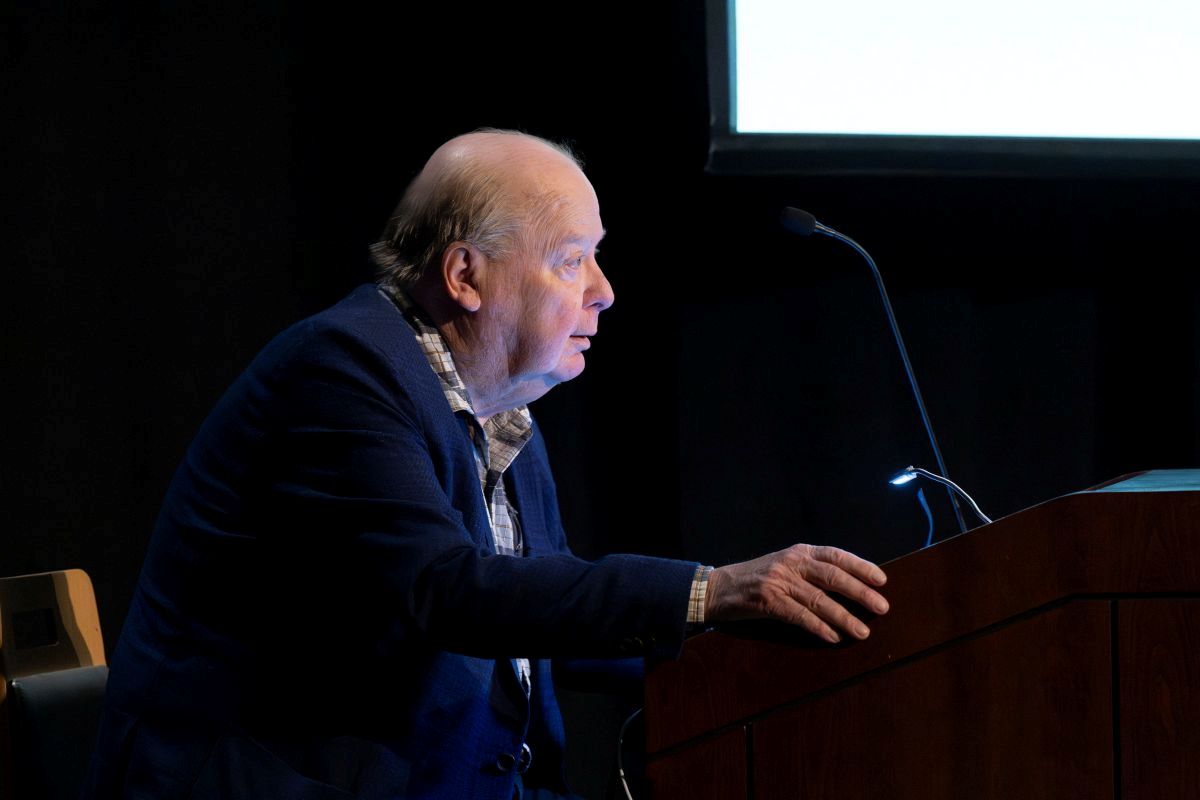 ‘In the absence of ice, the world will bake and burn.’ Renowned freshwater expert Robert Sandford giving a keynote at the Banff Fire and Ice Symposium on Nov. 4. Photo by Abigaile Edwards, Banff Centre.
But back to reality for a moment.
The Fire and Ice Symposium at the beginning of November was taking place just as Carney was releasing his first federal budget. You know, the one designed to pour taxpayers’ money into projects that interpret Canada’s “national interest” as including more pipelines, more fracked “natural” gas, more mines, more fossil fuel subsidies and less environmental oversight. The same budget that also relieved industry of the onus not to greenwash their operations or products. Stories? Why let annoying facts get in the way?
Meantime, a reminder that in Alberta, oil money — even, or perhaps especially at a stunning facility like the Banff Centre — is always in play. Next to the (oilman) Max Bell building, where many of the festival events took place, there was the TransCanada Pipeline Pavilion, home to the Banff International Research Station for Mathematical Innovation and Discovery. It was shuttered throughout the festival, maybe because TransCanada has already done the math? Up in the food hall nearby, tables were set for an Enbridge leaders’ party.
Coincidentally, as the Fire and Ice Symposium was coming to an end, another party was about to start, in Belém, Brazil. The story that emerged from that conference of the parties, sadly, the reality is that no amount of photos or films or podcasts or articles about glaciers melting or lonely polar bears drifting on floes or whole towns burned to the ground — no amount of showing and telling is going to radically alter the script, the trajectory we are on.
“One day,” Bob Sandford said, “when it’s likely too late to hold anyone alive accountable, we will maintain that everyone has always been against what we are doing now…. In the meantime, there will be no avoiding the penetrating question our vanishing glaciers are dying to ask and to which, if you have had the privilege of setting foot on the down-wasting surface of a glacier, the ice is justified in demanding an answer.
“It is a question upon which our collective future may depend.
“What did you do when you knew?
“What did you do when you knew?”
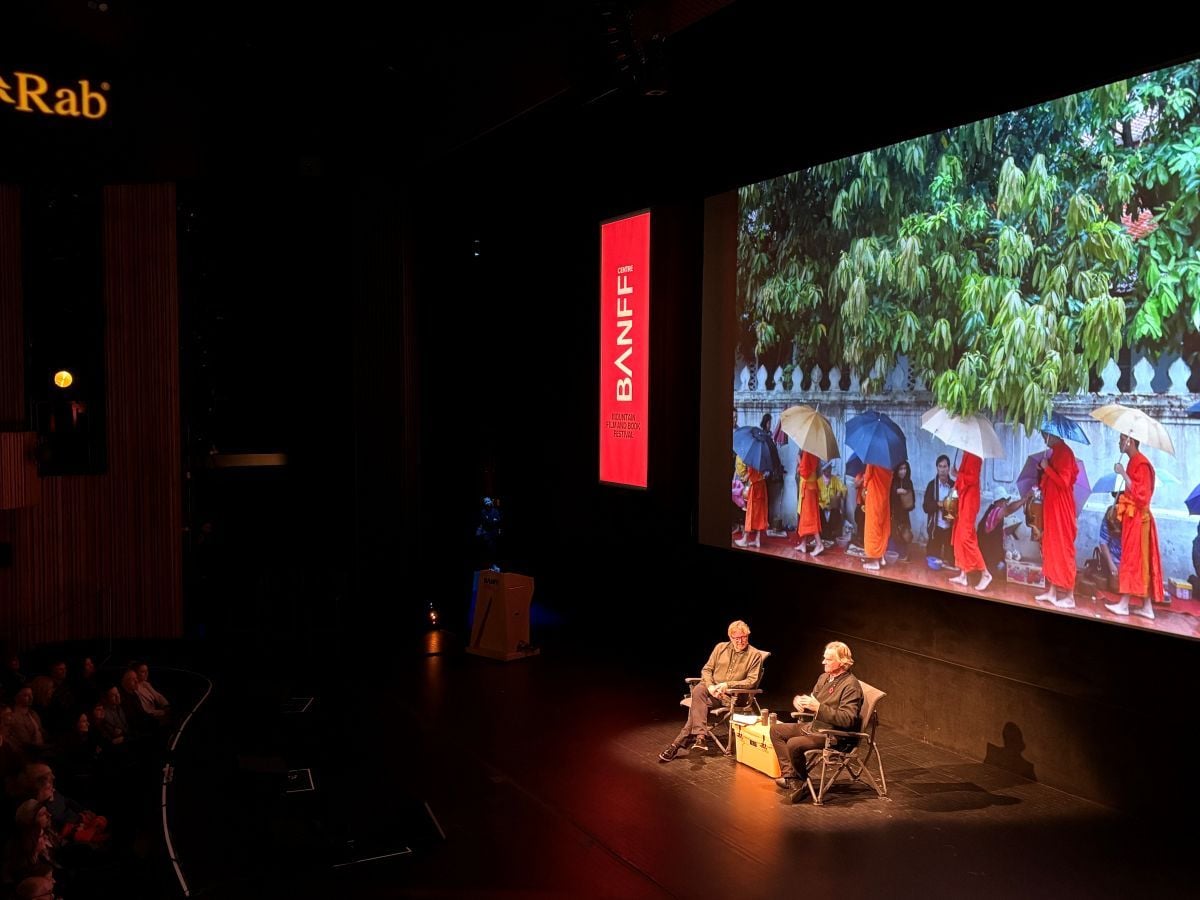 Ian Gill, left, interviews celebrated author Wade Davis at the Fire and Ice Symposium, exploring the importance of fending off despair when everything hangs in the balance for people and the planet. Photo by Zoe Grams.
Days later, master storyteller Wade Davis gave a keynote tribute towards the end of the festival, a conversation that I was honoured to host. Davis, author of 25 books, countless films and essays and articles — an enormous body of work in celebration of the dizzying diversity and complexity of nature and cultures the world over — reflected on a glittering career as a field botanist, anthropologist, traveller and explorer.
He, too, reflected on the state of the planet and the tarnished inheritance we are leaving our children. He said he was old enough now (72) to feel qualified, if not obliged, to give advice to young people who are struggling to find their way in a world besieged.
First, don’t despair. Despair is an indulgence.
“Change never comes through fear, only through hope.”
Don’t be anxious if it takes time to find your way. Be patient. “Give your destiny time to find you.”
Don’t be afraid to fail. “Say yes to everything.”
And a piece of advice that he remembers his father giving him, which is to not assume you are always going to win. Know that there is good and evil in the world. “Light and dark walk hand in hand, they always have.”
The one thing you can do is to pick a side.
What do you do when you know?
You pick light. ![[Tyee]](https://thetyee.ca/design-article.thetyee.ca/ui/img/yellowblob.png)
- Share:
- **
Get The Tyee’s Daily Catch, our free daily newsletter.
** The Barometer
What Do You Think of PM Carney’s First Months?
-
I’m still excited about PM Carney.
-
His shine has worn off for me.
-
I never liked the guy.
-
I don’t know.
-
Tell us more…