 Image via Mead Art Museum / Bridgeman Images
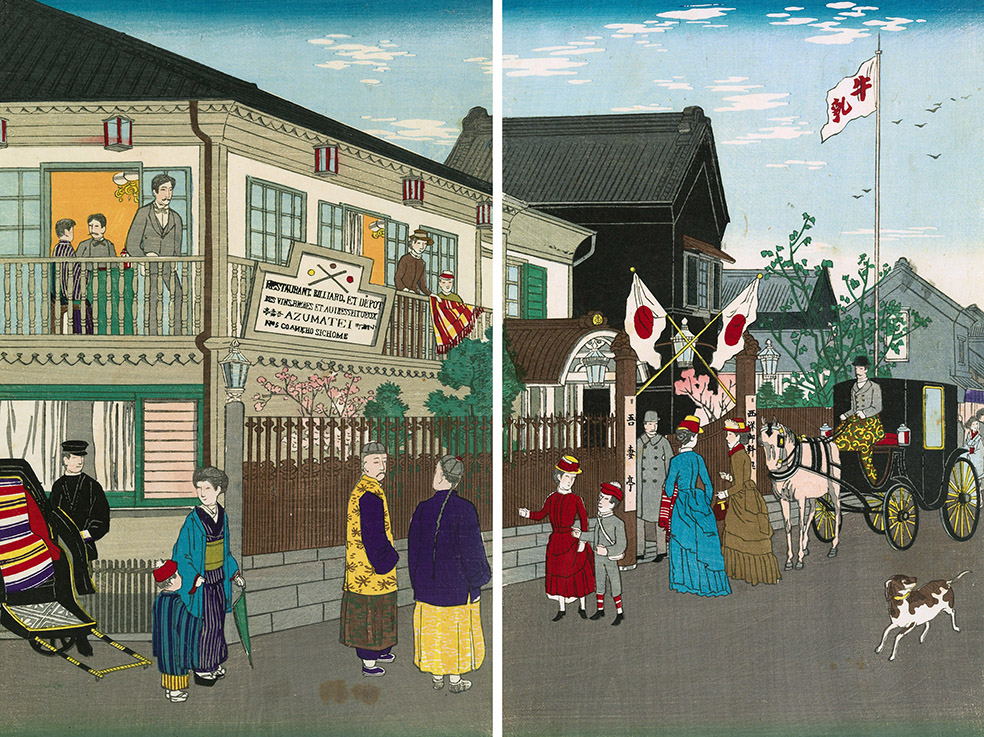
Beware Westerners whose only values are “fact-gathering and technique”. This warning, issued by the Japanese emperor to his subjects in 1879, had its roots in the shock arrival off Japanese shores in 1853 of heavily armed US gunships. Their commander, Commodore Matthew C Perry, demanded that the Japanese exchange isolation for friendship – threatening war if they declined.
A reckoning followed. Why, critics in Japan wanted to know, did their country not have this technology? Some blamed dusty Confucian scholars – “rice-consuming dictionaries”, as one critic called them: purveyors of useless knowledge. Others pointed the finger at Japan’s Buddhists, accusing them of hoove…
Image via Mead Art Museum / Bridgeman Images
Beware Westerners whose only values are “fact-gathering and technique”. This warning, issued by the Japanese emperor to his subjects in 1879, had its roots in the shock arrival off Japanese shores in 1853 of heavily armed US gunships. Their commander, Commodore Matthew C Perry, demanded that the Japanese exchange isolation for friendship – threatening war if they declined.
A reckoning followed. Why, critics in Japan wanted to know, did their country not have this technology? Some blamed dusty Confucian scholars – “rice-consuming dictionaries”, as one critic called them: purveyors of useless knowledge. Others pointed the finger at Japan’s Buddhists, accusing them of hoovering up people’s taxes while peddling cosmological lies. In some temples in Japan today you will find decapitated stone statues: a legacy of that post-Perry reckoning.
The crisis set in train by the US eventually led to civil war in Japan, the fall of the shogunate and the coming to power of a new generation of young, suit-wearing modernisers. In 1871, they set off on a round-the-world trip to find out which Western countries could provide the best models for new institutions in Japan: courts, banks, post offices, laboratories, universities, a police force, an army – the list went on and on. Enthusiasm for the West briefly reached such a pitch that some advocated binning the Japanese language in favour of English, converting en masseto Christianity and importing brides to help inject a little Western vim into Japanese bloodlines.
The emperor’s warning in 1879 was part of a backlash against all this. Did Japan want to end up a mere Asian facsimile of Great Britain? Was there really nothing in Japanese tradition that might serve as a foundation for the future and even out the cultural balance of trade?
New year, new read. Save 40% off an annual subscription this January.
By this time, an export version of Japanese culture was taking shape, forged by a coalition of Western Japanophiles and Japanese cultural nationalists. If you love Japanese art, you owe something to early adopters like Vincent van Gogh and Claude Monet, alongside an array of less prominent Western and Japanese curators and collectors. If you’re a samurai or matcha fan, the romance of Nitobe Inazō’s *Bushidō: The Soul of Japan *(1899) and Okakura Kakuzō’s *The Book of Tea *(1906) – both published in English, for foreign audiences – may well have played a role, whether or not you’ve actually heard of these books. And if you trust wordless spirituality over doctrinaire Christianity then you likely owe something to Shaku Sōen’s *Zen for Americans *(1906) and the many books that followed in its wake.
A central theme in this cultural movement has been the claim that modern Westerners relate to nature by bullying and overthinking it. Science probes her secrets. Technology perverts her potential. Scholars seek to entomb her beauty and freedom in stone-cold concepts. Japanese culture, by contrast, springs from people participating in and accommodating themselves to nature. Haiku takes us to the edge of words, then shows us great vistas beyond. Tea houses were originally designed so that guests had to leave their swords and egos at the door, approaching the sacred on their knees.
Walk into a Waterstones, and you see how enduring these ideas have been. From books about tidying up and ikigai – finding your purpose in life – to whimsical stories about cats (The Travelling Cat Chronicles, The Cat Who Saved Books, We’ll Prescribe You a Cat), a big part of the promise of Japan is a more wholesome way of living in the world. It’s a high-status promise, from Hillary Clinton trying out forest-bathing to the air of exclusivity that has long wafted around Japanese food, film and performing arts.
These trends can feel faddish and tiresome. But set aside the clichés and the sometimes overrated fiction and elements of that old East-West dichotomy ring true. A welcome new voice here is Hiroko Yoda: a Japanese author with extensive experience of American life, whose new book offers a series of personal and highly practical insights into Japanese life and spirituality.
Moved by the decline and death of her parents to revisit some of the traditions she grew up with, Yoda travelled Japan in search of solace and wisdom while studying for a set of official Shinto cultural examinations. Much of what makes Japanese culture attractive is implicit, baked into everyday life. And Yoda makes for an excellent guide, recalling what it was like to grow up with these traditions – practised without much reflection – and then to seek to understand them more deeply in middle age.
At the heart of her story are the kami, Japan’s indigenous deities – all eight million of them: a number which, as in other religious traditions, really just means “lots”. For Yoda, these kami are “the avatars of every aspect of the natural world, and Shinto is a method of interacting with them… grappling with the never-ending cycles of life, birth and death”. The kami, she writes, are “shorthand for the unknowable and the unpredictable”.
Anyone tempted to channel their inner Richard Dawkins at this point may conclude that it’s all just poetry, then: secularisation in Japan has, as in the West, resulted in a journey from literal belief in the gods – well-attested across Japanese history – to colourful metaphor. Yoda anticipates such objections and discusses a useful third way, common in Japan: hanshin hangi, or “half belief, half doubt”.
This is not agnosticism, or laziness, but rather respect for the enormity of all that we don’t know about the world. It is, writes Yoda, a “quantum state of mind”, promoting flexibility and opening the way for unexpected insights. Her argument reminds me of a lovely definition of religious faith offered by the psychiatrist Iain McGilchrist: “A disposition to the world as if God exists, in order to open the possibility of an encounter with whatever the word ‘God’ designates.”
Yoda shares a number of bruising encounters with American evangelicals in her book, the effect of which occasionally threatens to draw her into an old and over-egged East-West dichotomy of rigid Western religious mentalities vs open and free-flowing Japanese ones. It would be truer to say that within western Christianity there has long been a tension between relying on cognitive propositions – often as a way of keeping religious communities together – and emotional, moral and intuitive dispositions: the stuff of everyday religious life.
Japan has a strong tradition of training people’s dispositions. As any self-respecting Japanophile knows, art forms such as calligraphy and archery are about more than having nice handwriting or hitting a target. They’re about self-cultivation, about who you steadily become while practising them.
That is true in other areas of Japanese life, too. Marie Kondo, the former Shinto shrine attendant and tidy-up guru, keeps a kamidana in her home: a simple altar to the kami on which she places salt, rice and evergreen fronds. “This is not a religious thing,” Yoda quotes Kondo as saying, “it’s just for me to take this time every morning to feel gratitude.”
For all that the currency of “feeling gratitude” has been devalued from overuse by celebrities and influencers, whose sincerity the cynical might be inclined to question, it is one of three important themes that emerge in this book. A prime example, for Yoda, is people sitting down to eat but not touching the food until everyone has put their hands together and said itadakimasu: “Humbly receiving with gratitude.”
You could say that this resembles the saying of grace in Christian households, but without the religious implications. And yet that wouldn’t be entirely true. Itadakimasu is also religious, in the sense that it’s about dependence. “It reminds us,” writes Yoda, “of the invisible web of relationships upon which we rely to live.” For some, those will be purely human relationships: the chain of agriculturalists, packers, drivers, shop assistants and family members who made possible the meal that is about to be enjoyed. For others, imbued with the Buddhist ideas that pervade Japanese life, the web of dependence is cosmic in scale and implication.
A second valuable theme in this book is the approaching of spiritual questions with what Yoda calls “a playful mindset”. For Westerners brought up to think about religion and spirituality in grim, worthy and even persecutory terms, it is refreshing to see them linked, in Japan, with singing, dancing, practical jokes – and lots and lots of shopping, at places like Sensō-ji: Tokyo’s most famous temple complex. This goes back to one of Japan’s earliest myths, when the sun goddess hid herself away in a cave – plunging the world into darkness – and was eventually lured out after hearing other gods laughing and playing.
There are occasional echoes in this book of the soft cultural nationalism that has informed the East-West genre over the years. Talk of “my country” and “my people”, while perhaps intended as warm and communitarian, risks coming across as chauvinistic. These are minor gripes, however, and I suspect that many of Yoda’s core insights will prove timely, as the creed of self-discovery becomes ever more tainted by its potential to shade into self-involvement and entitlement.
This is where Yoda’s third and final theme comes in: respect. A refrain I hear time and again, when speaking with recent returnees from trips to Japan, is that compared with the people they met on holiday many of us here in the West seem to have raised self-centred obliviousness to an art form. Theatre-goers taking phone calls and tapping out emails. The creeping normalisation of watching videos or playing music out loud in public. Rudeness and violence suffered by shop assistants and healthcare workers. The US transport secretary recently called for greater civility from airline passengers, only to be met with a howl of self-righteous indignation about aeroplane seats being a bit cramped.
A generation ago, Westerners used to make jokes about Japanese conformism. Now that we understand the place a bit better, not least because of the tourist boom, we’ve become aware that there is something more going on: an ethic, bred into children from a young age at home and at school, of taking account of the people around you, being aware of their feelings, and acting accordingly.
There is a danger, here, of feeding into an emerging brand of nationalism in Japan which demonises migrants for tarnishing a utopian society. Still, should our hunger continue to grow for a less self-absorbed way of living in the world, and should the mooted revival of Christianity come to nothing, then Japan might really have something to teach us.
Christopher Harding is senior lecturer in Asian history at the University of Edinburgh. His books include “The Japanese: A History in Twenty Lives” (Allen Lane)
Eight Million Ways to Happiness: Wisdom From the Heart of Japan Hiroko Yoda Bloomsbury Tonic, 368pp, £14
Purchasing a book may earn the NS a commission from Bookshop.org, who support independent bookshops
[Further reading: Ali Smith’s infectious hope]
Related