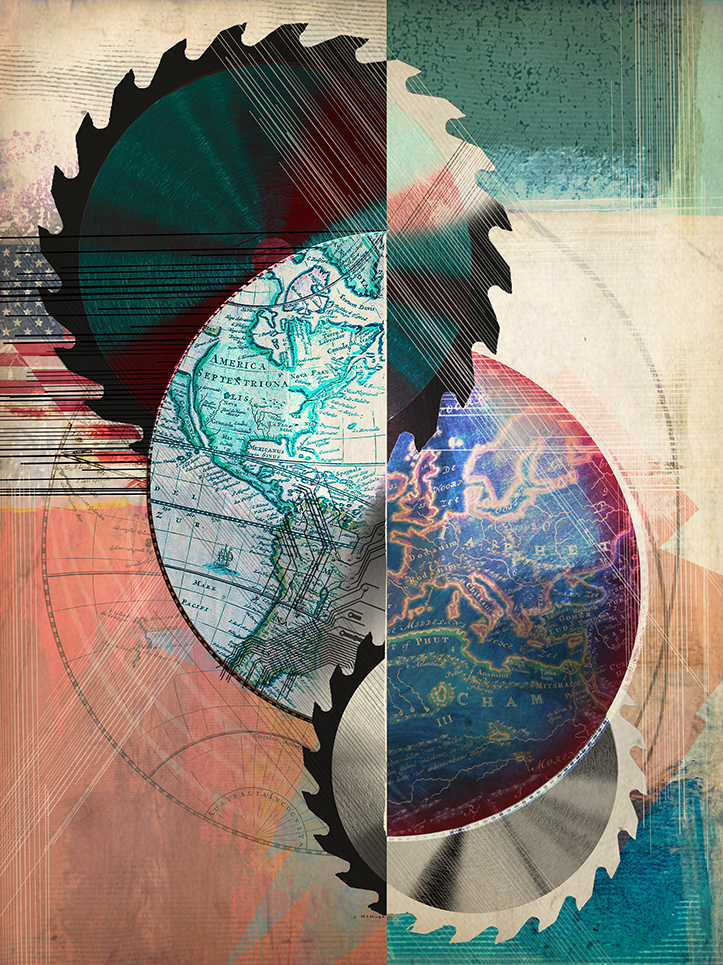
 Illustration by Jonathan Mchugh for New Statesman
Writing in 1930 in the texts that came to be known as Prison Notebooks, Antonio Gramsci coined a dictum that has sustained progressive activists through generations of recurrent defeat: “The crisis consists in the fact that the old is dying and the new cannot be born; in this interregnum, a variety of morbid symptoms appear.” A year earlier, the 20th century’s most original Marxist thinker and co-founder of the Italian Communist Party wrote to his brother Carlo explaining how this analysis applied in his own case: “I’m a pessimist because of intelligence, an optimist because of will.” After his health was destroyed by more than a decade in Mussolini’s jails – he co…
Illustration by Jonathan Mchugh for New Statesman
Writing in 1930 in the texts that came to be known as Prison Notebooks, Antonio Gramsci coined a dictum that has sustained progressive activists through generations of recurrent defeat: “The crisis consists in the fact that the old is dying and the new cannot be born; in this interregnum, a variety of morbid symptoms appear.” A year earlier, the 20th century’s most original Marxist thinker and co-founder of the Italian Communist Party wrote to his brother Carlo explaining how this analysis applied in his own case: “I’m a pessimist because of intelligence, an optimist because of will.” After his health was destroyed by more than a decade in Mussolini’s jails – he could not eat solid food and suffered convulsions – Gramsci died of a cerebral haemorrhage at the age of 46, days after his sentence expired in 1937.
Gramsci formulated a thesis that still frames thinking on the left: the West is stuck in a pathological state of disorder between two regimes. Because this condition is morbid, it can be remedied by resolute political will. So, at any rate, progressives would like to believe. The alternative, for them, is despair.
Reality, however, is unyielding. There will be no global regime akin to those that existed, or were imagined. Liberalism and socialism were formulated in an era of Western supremacy, a historical accident lasting a few centuries, now plainly ending. Progressive thinkers envision the future through the lens of their lost pasts. Life in the aftermath is unthinkable.
The American-led order, in its final incarnation, was a neoliberal construction. Proclaimed immortal in a forgotten “Washington consensus”, it has been killed off by regime change in the American capital. The system that was supposed to spread across the globe has disappeared in its country of origin. Trump has not only shattered free trade. By taking equity stakes in strategic industries, he has made American capitalism into a dirigiste enterprise ruled by himself and his friends. By authorising a criminal investigation into the chairman of the Federal Reserve, Jerome Powell, he is undermining a central pillar of the neoliberal order and the primacy of the American dollar. As a functioning system neoliberalism remains semi-intact only in the European Union, a crumbling continental free market wedged helplessly between predatory mercantilist powers. If it retaliates against Trump’s tariff threats, the last bastion will fall.
New year, new read. Save 40% off an annual subscription this January.
Rather than being stuck in an uneasy hiatus, we are reverting to historical normalcy, with different regimes – empires and nation states, tyrannies and republics – competing in shifting alliances. Despite joining the World Trade Organisation in 2001, China has never accepted free-market globalisation and plans to instal its own state-led model. But it can no more corral all of humankind into a single economic system than America could. India will not submit to Chinese domination, nor will Japan surrender to become a Chinese tributary state. Vietnam and the Philippines will resist incorporation into Sinocentric structures. The globe’s axis is tilting from West to East; but there will be no new unipolar moment under Chinese auspices.
The international system built after the Second World War, along with that supposedly installed after the Cold War, is being demolished. In the December 2025 National Security Strategy (NSS), the US renounced any role as guarantor of international security, while claiming suzerainty over the Western Hemisphere – the “Trump corollary” of the Monroe Doctrine, renamed the “Donroe doctrine”. The document gives an official American stamp to multipolarity – the theory, for some time substantially fact, in which no power possesses the authority to impose its political economy throughout the world.
Trump’s Venezuela gambit followed the NSS playbook. The coup the US Army’s Delta Force and the CIA executed in Caracas was not an exercise in regime change. Aside from replacing Nicolás Maduro by his long-standing vice-president, Delcy Rodríguez, the repressive apparatus of government lies untouched.
The gambit is a reversion to the Great Game, with a crucial caveat. For all the babble about the rise of an economy based on the infinite expansion of knowledge, a struggle for control of finite natural resources is driving rivalry between great powers as it did between European empires. AI is reinventing the limits to growth. If China is pulling ahead in the technological arms race, one reason is that it has plenty of coal to feed energy-hungry data centres. Fossil fuels and scarce water resources are powering the digital revolution.
Yet Venezuela’s huge petroleum reserves will be of little use in a resource war. With infrastructure wrecked by mismanagement, extracting the oil would be a lengthy and costly enterprise undertaken in a relentlessly hostile environment. The country hosts a plethora of anti-government militias, Maduro loyalist gangs and criminal cartels, including networks infiltrated by Hezbollah. The oil executives Trump summoned to the White House on 9 January seemed unenthusiastic at the prospect of operating in such an anarchical environment, with the Exxon CEO describing the country as “uninvestable”.
Targeting Greenland reveals the same distance from reality. It is not the first time the US has considered absorbing the island. The American secretary of state William H Seward, who purchased Alaska from Russia in 1867, later considered acquiring Greenland, as did Harry Truman in 1946. Nothing came of the idea, but its position at the edge of the Western Hemisphere makes sovereignty over the island problematic. Geography is one reason history cannot end. Russia is steadily militarising the Arctic, and China has begun referring to itself as a “near-Arctic state”.
The rationale for annexation is nonetheless tenuous. Under a defence treaty with the Danish government, Greenland hosts ballistic missile early-warning systems that help protect the US from missile attack. Reinforcing the American presence can be done within existing agreements. Annexing the territory against the will of other Nato members would be a catastrophe for European security. Not only would the Atlantic alliance disintegrate overnight, lacking American satellite intelligence, Europe would be defenceless.
The impact of this prospect on European elites is a study in cognitive dissonance. Even as Trump threatens European countries (including the UK) with tariffs if they resist his seizure of Greenland, they are relying on him for security guarantees in Ukraine. In Europe, psychopathology eclipses geopolitics.
Keir Starmer, in a speech on 19 January, held fast to the order that is passing away. It is an understandable reaction: American regime change leaves Britain in an almost impossible bind. The Prime Minister predicted the US president would not resort to military action. Starmer is ignoring Trump’s own words, as he wrote in his letter to the Norwegian prime minister on the same day: “I no longer feel the obligation to think purely of peace.”
Trump is too solipsistic a personality to be guided by any world-view. But one was spelled out for him by the US deputy chief of staff, Stephen Miller, in a CNN interview: “We live in a world in which you can talk all you want about international niceties and everything else…But we live in a world, the real world, that is governed by force, that is governed by power… These are iron laws of the world.”
Miller was part of a black comedy. Trumpian “realism” is performative posturing, staged for immediate effect in the evanescent glare of phone screens, not strategy. American companies are no more likely to rush in to exploit Greenland’s resources than in Venezuela. Buried beneath the frozen ground, there is no obvious profit in extracting them. China, meanwhile, controls the rare earths of Africa, Myanmar and others. This is the caveat: whereas the tyrants are accumulating material assets, the power-worshippers in the White House are chasing phantoms.
The actual interregnum was the American-led order. Destined to be transient, it shortened its lifespan by overreaching. Fanciful projects of nation-building disappeared beneath the rubble strewn by economic shock therapy in Russia and the sands of Afghanistan, Iraq and Libya. Today, what remains of the liberal West is being dismantled by its former hegemon.
Regimes come and go. Today’s shifts are happening at a time of accelerating technological advance. From the late-18th century onwards, progressive visionaries have seen technology as a unifying force. Whether it terminated with the hierarchical technocracy of Henri de Saint-Simon, Marx’s egalitarian communism, Hayek’s “spontaneous” market or Fukuyama’s “democratic capitalism”, the logic of history was a planetary civilisation modelled on a Western template.
History reveals no such logic. If anything, the opposite is the case. The diffusion of new technologies leads, for one, to the democratisation of warfare. A fundamentalist tribe continues to disrupt vital supply chains in the Red Sea. A Houthi drone costs thousands of dollars, a Western surface-to-air missile launched to intercept it millions. Nor does technological progress require liberal individualism. Meiji Japan industrialised in a generation without importing liberal values, becoming the first Asian country to defeat a European empire in the naval battle with Russia at Tsushima in 1905.
In any likely future the US will be prodigiously innovative, its divisions energising its inexhaustible vitality, but no longer the anchor of a global regime. Much is made, in certain Maga circles, of the US acting as the guardian of Western civilisation. In truth, the Trump regime is giving the hyper-progressive left what it has so long desired – the deconstruction of the West. That is the true meaning of America First.
Summarising his analysis of the idea of regime change in the London Review of Books last year, Perry Anderson writes:
“The conflict between neoliberalism and populism, the adversaries that have confronted one another across the West since the turn of the century, has become steadily more explosive, even if, for all its apparent compromises or setbacks, neoliberalism retains the upper hand. The first has survived only by reproducing what it threatens to bring down, while the second has grown in magnitude without advancing in meaningful strategy. The political deadlock between the two is not over; how long it will last is anyone’s guess.”
The echoes of Gramsci are unmistakable. The West is stranded between two “modes of production”. No grand theory comparable to “the Keynesian and Hayekian paradigms of old” is available, but none may be needed – Brazil under Getúlio Vargas in the Thirties and post-Mao China moved ahead without any “systematic doctrine”. A big shock – the Great Depression and the Cultural Revolution – supplied the trigger. “If disbelief that any alternative is possible were ever to lapse in the West, the probability is that something comparable will be the occasion for it.”
Like Gramsci, Anderson assumes that any regime change must eventually result in a similarly hegemonic order. Rightly, he thinks of neoliberalism as an international system rather than a set of national policies. But it began to break down in specific countries before it collapsed as a whole.
The neoliberal debacle began in Russia at the end of the Cold War. A brief period of market anarchy produced oligarchical capitalism, which has in turn mutated into a radical variant of military Keynesianism. The Russian economy has performed better than many predicted, but it is questionable whether it could survive peace. In some of the poorer regions, Russia has been revitalised by war. Large bonuses awarded to the families of soldiers who perished in the meat grinder have bought new cars and opened restaurants. Civilianising the economy would be a colossal enterprise, risking the fragmentation of a hollowed-out state. Vladimir Putin’s Russia cannot function other than as a war machine. If it prevails in Ukraine, it can only expand.
In its ideological dimension, the Cold War was a contest between twin Enlightenment projects. When it concluded Russia reverted to being a Eurasian empire, with its ruling ideology a corrupt version of Eastern Orthodoxy. If Putin does fall, the empire could break up as it did after the Romanovs. Then, it was the Bolsheviks who picked up the pieces. This time it could be China drawn by the resource wealth of Siberia. If the Russian state lives on, it will be in China’s shadow.
Iran’s theocracy also shows signs of mortality. Desperate economic conditions – a plummeting currency and spiralling food inflation – have made daily life intolerable. When the shah was deposed and Ayatollah Ruhollah Khomeini returned from exile in February 1979, Iran’s Islamic Revolution was greeted as a modernising movement. Michel Foucault, a bellwether of the Western intelligentsia, welcomed the breach with the shah’s “archaism”. Sunnis thought they might be witnessing the birth of a new type of Islamic democracy. Modernity is amorphous, changing with events.
Nearly half a century later it is the shah’s son, Reza Pahlavi, who embodies a democratic future for the country. Not a very likely future, however. The popular illegitimacy of the clerical regime is clearer than ever; its capacity for ferocious repression is not in doubt. A spontaneous protest originating in Teheran bazaars has spread to become more like an attempted revolution. An American bombing campaign cannot dictate the course of asymmetric urban warfare or determine its political outcome. Other futures include the persistence of the theocracy or a long civil war.
The cardinal illusion of the left is to think of the aftermath of neoliberalism as a temporary condition. Viewing populism as an eruption of irrationality illustrates this error. Anderson sees “xenophobia” as “the trump card” of populist movements. He recognises that mass immigration lacks legitimacy among voters: it has “virtually always happened behind their backs, becoming a political issue not ex ante but ex post facto”. The issue was in fact excluded from public discourse. Neoliberalism was, in large part, the project of depoliticising politics. It has been continued in maximalist human rights law, which places immigration beyond democratic control.
Asserting that populist movements are driven by xenophobia pathologises the voters who support them. Why should they accept the legitimacy of a state that places them, their values and their economic interests in second place when they conflict with an inflated interpretation of human rights? Populist insurgency is the political flipside of liberal legalism. In the UK, it is the alternative to populism – a process-obsessed technocratic regime in which nothing ever works – that increasing numbers of voters reject as illegitimate.
Strangely, Marxist theorists seem not to have grasped the dialectical relationship between regime change and legitimation crisis. Margaret Thatcher’s free-market experiment began in almost Gaullist mode as a project of national renewal. Keith Joseph began with the breakdown of the postwar British settlement, evident in 1976 when Labour was forced to seek an IMF bailout and renounce Keynesian economics. By the time Thatcher was ousted in November 1990, a British-centric political adjustment had become a universalist project, resembling vulgar Marxism in its narrowly economic focus and contempt for the casualties of progress. Continued by Tony Blair and David Cameron, it was derailed by Brexit.
Far from being a vote for “global Britain”, the referendum result in June 2016 was the first major eruption of opposition to globalisation in a first-world country. Donald Trump’s electoral victory that year expressed a similar impulse. Beginning with Hillary Clinton’s dismissal of a near-majority of American voters as “deplorables”, the liberal ruling class wasted its legitimacy through its contempt for these voters. Trump’s America is payback for globalisation’s losers.
Another dialectical interaction is playing out on a much larger stage. Trump aims to reverse America’s decline through the unapologetic assertion of its economic and military power. His much-touted “transactional” foreign policy, however, is self-defeating. A discontinuous series of one-way coercive deals, punctuated by intermittent kinetic explosions, has left America alone. (As he approaches a dire midterm reckoning, Trump’s foreign adventures may be designed to distract attention from his domestic situation – a worsening cost-of-living crisis and the shade of Jeffrey Epstein, a haunting from which he cannot escape.) Long-term allies have been estranged, while America’s enemies look on with bemused schadenfreude.
During his prison years Gramsci was preoccupied with Niccolò Machiavelli, using his writings to reimagine communist strategy. He and his followers on the left remain resistant to the clear-eyed Florentine historian and diplomat’s fundamental insight. Regimes rise and fall in unending cycles, which human action cannot end or much control. Optimism of the will is a wilful refusal to understand the present. History is on the move, and disintegration is the logic of events. The art of strategy – if it still exists in the states once known as the West – is knowing how to live in a permanently fractured world.
[Further reading: Europe’s reckoning over Greenland has arrived]
Related