Editor’s note: A version of the following article originally appeared on Seattle Bike Blog and is republished with permission.
Panic is the appropriate response to the passage and signing of a new law in New Jersey that requires all e-bike riders 17 and older to have driver’s licenses, registration and insurance (which may not even be available and proof of which they must carry with them while riding) and wear a state-approved motorcycle helmet. Riders 15 or 16 years old will need to acquire a “motorized bicycle license.”
The New Jersey law comes as Washington State’s legislature considers its own set o…
Editor’s note: A version of the following article originally appeared on Seattle Bike Blog and is republished with permission.
Panic is the appropriate response to the passage and signing of a new law in New Jersey that requires all e-bike riders 17 and older to have driver’s licenses, registration and insurance (which may not even be available and proof of which they must carry with them while riding) and wear a state-approved motorcycle helmet. Riders 15 or 16 years old will need to acquire a “motorized bicycle license.”
The New Jersey law comes as Washington State’s legislature considers its own set of law changes to further separate e-bikes from electric mopeds and motorcycles, though the first draft of HB 2374 – 2025-26 is written to protect the status of e-bikes in Washington State that have 20 mph limits while also cracking down on devices with trivial bypasses to unlock moped and motorcycle speeds.
Meanwhile, conversations nationally about what to do about the New Jersey law have been all over the place, including a call to jettison all bikes with throttles from the definition of an e-bike.
The New Jersey law is the most serious legislative attack on bicycling in many years, and the fear is that other states will follow suit. For those who remember the tedious annual fights over bicycle licenses, this could be worse than that.
The New Jersey bill does not change any laws related to pedal-only bikes, but it will almost certainly blow a hole in the already strained bottom lines of any local bicycle business that relies on the sales and maintenance of e-bikes.
It also threatens to create a patchwork of vastly different state laws surrounding e-bike use, which is an existential threat to the larger industry that worked all last decade to get the 3-class standard codified in as many states as possible. Six months from now, a person in New York or Pennsylvania will no longer be able to legally ride their e-bike across the state line into New Jersey, which is ridiculous.
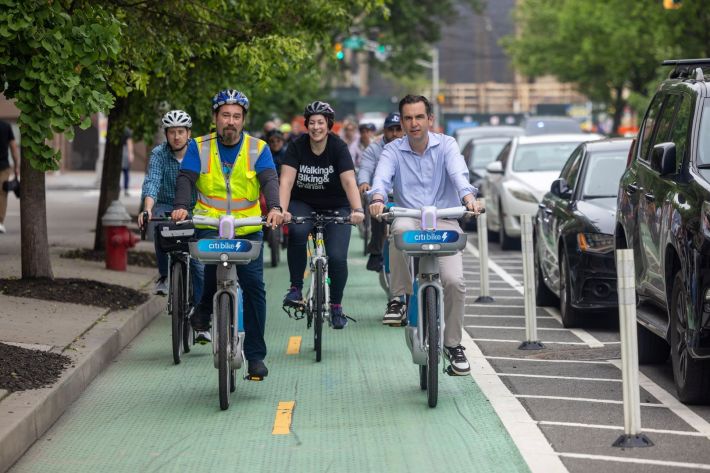 Jersey City’s then-Mayor Steven Fulop on Ride to Work Day in 2025.
Photo: Jersey City via Facebook
Jersey City’s then-Mayor Steven Fulop on Ride to Work Day in 2025.
Photo: Jersey City via Facebook
The law also creates serious barriers to accessibility.
As Anna Zivarts has written, e-bikes can be a tool of freedom for many people with disabilities including low-vision riders like herself who are not able to get a driver’s license. Insuring any vehicle without a driver’s license is also often difficult or impossible. A law like New Jersey’s will discriminate against people who can’t get a driver’s license, further reducing their options for mobility compared to their licensed peers. (New Jersey does require a vision test to receive a motorized bicycle license.)
The technical change in the law deletes the e-bike classes and then moves all e-bikes into the existing category of “motorized bicycle,” which is the term New Jersey uses for a moped. If I am reading the law correctly (see point 5), the new law also means e-bikes may no longer be allowed to be parked at sidewalk bike racks, and local governments cannot choose to allow them.
I sure hope I am wrong about this, because this parking change alone essentially makes it impossible to legally use an e-bike even if you get licensed (I can’t find a regulation stating where motorized bicycles in NJ can be parked). New Jersey law seems to allow mopeds to use bike lanes and paths, which Washington does not, so at least e-bike riders won’t be forced onto busy streets next to calm bike paths.
Both of these bills are coming from a place of concern around the rising number of high-powered electric two-wheelers hitting the streets, especially when operated by kids. I am sure there is wide agreement that children should not be riding motorcycles, and the Washington bill seeks to eliminate loopholes and confusing marketing around high-powered devices masquerading as class 1, 2 or 3 e-bikes (especially class 2, which includes bikes with throttles).
But the New Jersey bill wildly overreaches, putting absurd restrictions on the use of bikes that are leading the way in increasing low-emission, healthier and safer transportation in our communities. Passing this bill was a mistake that will do lasting damage to the rising use of e-bikes, a source of happiness and mode of zero-emission transportation for so many people.
I cannot believe that with all the horrible things happening in our country right now, New Jersey chose to crack down on a source of joy like low-speed e-bikes. The same day the outgoing governor signed this law, he also signed a law mandating that schools teach three years of cursive writing. Together, these new laws raise some serious questions about the standard of research and legislative analysis within the New Jersey legislature.
The entire point of the e-bike class system was to draw a line between devices that are compatible with regular bicycle use and devices that should instead be used (and regulated) as mopeds and motorcycles. It’s odd that New Jersey allows gas-burning mopeds on bike trails since they are not very compatible with other path users in terms of speed, power, vehicle weight, sound or pollution emissions. None of this makes sense.
20 mph limits are a sweet spot that put use within the speed range of a reasonably fit bike rider while also allowing e-bikes to be extremely efficient and reliable vehicles for getting life done. They are replacing car trips for many people, which is a good thing.
Tonight, for example, I am going to use my class 1 electric family cargo bike to haul my hockey gear 12.5 miles up to the rink in Mountlake Terrace for a late night game, then I will ride it 12.5 miles back home. This trip is not feasible without the motor (my legs are so tired after playing hockey), and I will likely get passed by at least one person out for nighttime training ride on their road bike. This is a functional and safe system working as it should.
Meanwhile, cars and trucks remain by far the biggest hazards to public health on our streets. That’s not an excuse to ignore an emerging issue (like kids riding motorcycles!), but it’s extremely frustrating to see such an overreaching law take a sledge hammer to the e-bike sector while we can barely get our governments to raise a finger to protect people walking, rolling and biking on public streets from being injured or killed in collisions with cars and trucks.
As we wrote in our previous story, there is clearly a demand for riding electric mopeds and motorcycles, and people are not currently registering them for reasons that are worth understanding. Maybe our moped and motorcycle laws need updating in this world of smaller and lower-weight electric motos.
In addition to trying to discourage use of illegal or unregistered electric mopeds and motorcycles, the state could also try to figure out how to make it easier and more appealing to bring these riders into the state’s licensing system. This would be an opportunity for education about moped and motorcycle use as well as a chance to update outdated materials or rules, such as those assuming the use of a gas motor.
One of the more interesting takes in the aftermath of this New Jersey law has come from Seth Alvo, the face of the Berm Peak YouTube channel. Berm Peak mostly covers mountain biking, but he posted a talking head video the other day arguing that bike folks should essentially jettison class 2 throttle e-bikes as way to protect pedal-assist bikes:
I’m not ready to go this far since there are plenty of legitimate use cases for throttles on e-bikes. But it is true that jettisoning throttles from the definition of an e-bike (most likely by grouping them with mopeds) would more easily clarify the difference between e-bikes and e-motos. Under this definition, if you aren’t pedaling, then you’re not biking.
However, we need to be careful about who we cut loose as a movement by abandoning their bikes. There are many different accessibility reasons to have a throttle, folks we shouldn’t leave behind. But also, why should it matter how much someone else is pedaling their bike? If they are going a compatible speed with other bicycles while using a vehicle of compatible weight, size and power, it’s none of my business how often they move their legs in a circle. They aren’t racing, so they aren’t cheating anyone out of anything by not pedaling or pedaling less often, and they don’t owe anyone an explanation for why they aren’t pedaling more.
The bicycle movement has a long and troubled history with people gatekeeping how other people should ride their bicycles, and that gatekeeping is not helpful. Turning our noses up at the many thousands of people with throttles on their e-bikes seems potentially disastrous for the bicycling movement at a moment when we really need allies.
The point still stands, though, that we, the bicycle movement at large, need to figure out how to win these fights over awful New Jersey-style e-bike laws. If we cannot come up with an effective way to clearly differentiate a class 2 e-bike from an electric motorcycle, then the bike movement and bike industry is going to be in a tough spot. It seems the public may no longer be willing to look the other way when it comes to loopholes and easy “derestriction” mods.
I am hopeful that Washington State’s legislature can do just that. Maybe our state can provide the positive e-bike legislative model for the nation, the answer to turn to in response to efforts pushing New Jersey-style regulations.
Stay in touch
Sign up for our free newsletter
More from Streetsblog USA
‘Gateway’ Drug: Trump Is Holding the Second Avenue Subway Hostage
The president blocked funds for the Second Avenue Subway during the government shutdown in October — and the MTA has still not received the money, sources said.
January 28, 2026
‘Kavanaugh Stops’ Are Making Streets More Dangerous
In Minneapolis, ICE agents have killed more people than violent drivers so far in 2026, according to Minnesota’s crash database.
January 28, 2026
A Few Legal Tweaks Could Unlock A Mother Lode of Housing Near Transit
It’s time to help communities use federal financing to build housing near transit, a new bill argues.
January 28, 2026
Do Wednesday’s Headlines Dream of Electric Sheep?
It’s OK if the computer writing federal transportation safety rules hallucinates a bit, right?
January 28, 2026
What’s A Transportation Reformer’s Role In the Fight Against ICE Violence?
Migrants and protestors are being killed in the streets by ICE agents. What should transportation reform advocates do?
January 27, 2026
Tuesday’s Headlines Become More Affordable
Cities can help residents cut their average $13,000 annual transportation costs.
January 27, 2026