Kioxia AiSAQ software enables fast AI recognition of new product images without retraining a foundation model for every new product.
Japanese steel chain maker Tsubakimoto Chain and AI-focused tech startup EAGLYS have developed AI-driven image recognition in collaboration with Kioxia that recognizes products moving through a logistics system. New items such as images, labels, and feature lists are stored in SSDs and indexed for quick identification based on retrieval-augmented generation (RAG). This means that the foundation model behind the image recognition does not need time-consuming parameter tuning and retraining whenever new or seasonal products are introd…
Kioxia AiSAQ software enables fast AI recognition of new product images without retraining a foundation model for every new product.
Japanese steel chain maker Tsubakimoto Chain and AI-focused tech startup EAGLYS have developed AI-driven image recognition in collaboration with Kioxia that recognizes products moving through a logistics system. New items such as images, labels, and feature lists are stored in SSDs and indexed for quick identification based on retrieval-augmented generation (RAG). This means that the foundation model behind the image recognition does not need time-consuming parameter tuning and retraining whenever new or seasonal products are introduced into production logistics systems.
AiSAQ, meaning “all-in-storage ANNS with product quantization,” is a graph-based ANNS (approximate nearest neighbor search) algorithm using SSDs. Normal ANNS operations run in DRAM. They pre-load product-quantized (PQ) compressed vector indices into DRAM for fast access, which takes time, and are used in RAG semantic searches that look for vector sets closest to an input vector set.
When DRAM is limited, RAG ANNS performance slows as fresh vector set indices have to be fetched from storage. AiSAQ stores the vector set indices in an SSD and has the search execute on them there. This avoids storage data transfer to DRAM, lowering latency and enabling near-instant query starts without pre-loading.
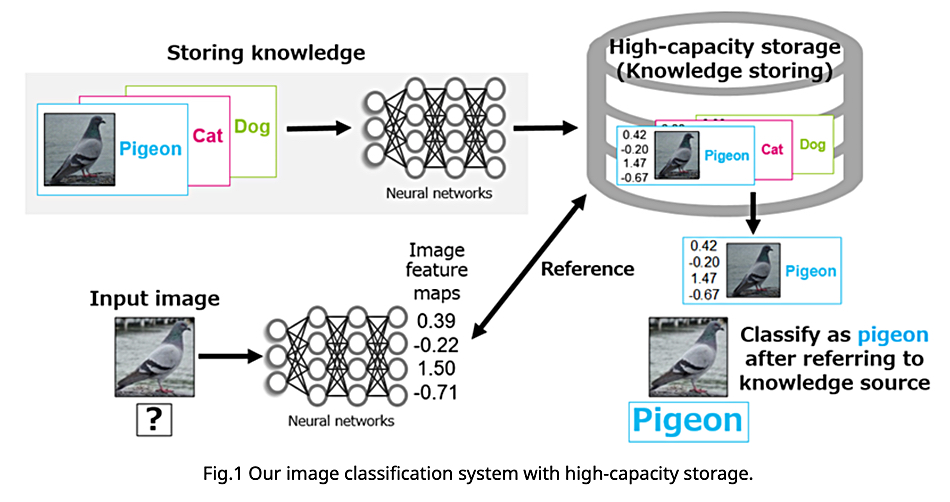 Diagram from source AiSAQ paper
We understand that AiSAQ organizes the index so that PQ vectors and graph nodes reside in the same SSD storage blocks. The search operation can thus fetch the data it needs, using NAND’s high sequential read rates, in fewer I/O accesses than otherwise. Overall, AiSAQ can handle billion-scale vector datasets with low DRAM occupancy. This enables extended RAG scaling across multiple servers.
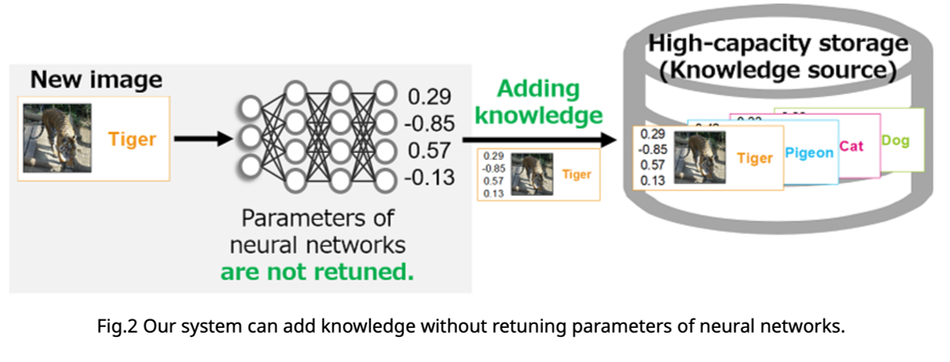 Diagram from source AiSAQ paper
The jointly developed AI image recognition technology will be demonstrated during the 2025 International Robot Exhibition. Find a background document on the technology here. Kioxia’s AiSAQ software was released as open source in January. It’s available on GitHub as a DiskANN fork.
Comment
This looks like a real and practical use of AI with no outlandish claims. In principle, it could apply to all production and logistics systems involving product or packages moving past an inspection point with subsequent routing depending on the item’s identity.
Bootnote
Product quantization is a lossy compression technique designed for high-dimensional vectors (e.g. embeddings from neural networks) that enables compact storage and fast approximate distance computation. It was introduced in the 2011 paper “Product Quantization for Nearest Neighbor Search” by Hervé Jégou, Matthijs Douze, and Cordelia Schmid (INRIA).
The abstract reads: “This paper introduces a product quantization based approach for approximate nearest neighbor search. The idea is to decompose the space into a Cartesian product of low dimensional subspaces and to quantize each subspace separately. A vector is represented by a short code composed of its subspace quantization indices. The Euclidean distance between two vectors can be efficiently estimated from their codes. An asymmetric version increases precision, as it computes the approximate distance between a vector and a code.”