A Microsoft review of Project Silica’s technology, progress and prospects suggests that “it represents the most promising solution for bridging the gap between current storage limitations and future archival requirements.”
Project Silica is Microsoft’s development of a robotic archive library system using high-capacity glass tablets with laser-written, multi-layer, multi-level, data encoding schemes. We have reviewed it here and, most recently, here.
 Mahabir Bisht
Mahabir Bisht, a Senior Technical Advisor at Microsoft, wrote in September: “Microsoft’s Project Silica represents a paradigm shift in archival storage technology, utilizing femtosecond laser-inscribed quartz glass to potentially store data for millennia while offering superior density and environmental sustainability compared to existing magnetic and optical storage solutions.
Alternatives for archival data storage are disk drives, tape, trad optical drives, and holographic and advanced optical tech.
Bisht dismisses disk, claiming: “Modern HDDs face fundamental physical limitations that constrain their archival utility.” He also criticizes tape: “While tape storage has evolved significantly, it faces several fundamental challenges.” These include slow sequential access speed, append-only architecture, media degradation, and tape libraries with sophisticated robotic systems with maintenance overhead.
Optical disks in the DVD – Blu-ray line “face several inherent limitations for long-term archiving.” He lists chemical degradation, format obsolescence and capacity limitations. So goodbye to them.
The holographic and advanced optical technologies “face practical challenges” and these are material science limitations, system complexity, and slow read/write speeds for their high potential capacity.
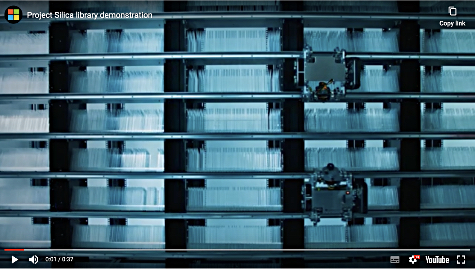 Project Silica’s independent robots.
Which brings us to Project Silica, a sophisticated library using advanced robotics and high-capacity advanced optical technology glass tablets.
A problematic area is cost, with the main one being the femtosecond laser, which “operates at pulse durations of approximately 100 femtoseconds (10^-13 seconds), delivering peak powers exceeding terawatts per square centimeter. This extreme intensity enables nonlinear optical interactions that create localized plasma formation within the glass matrix without affecting surrounding material.”
Bisht says: ”Current femtosecond laser systems cost hundreds of thousands of dollars,” and “require sophisticated maintenance and calibration.”
The recording method involves three-dimensional voxel structures in multiple layers and multi-dimensional encoding, providing very high capacity: “a two-millimeter thick piece of glass the size of a DVD would be able to store more than seven terabytes of data. … This translates to approximately 1.75 TB per square inch when considering the full thickness utilization, representing a significant advancement over traditional optical media.”
Reading data also needs advanced technology: ”The reading process for Project Silica involves sophisticated optical microscopy combined with machine learning algorithms.”
Write performance is slow: “The current writing process is inherently slower than traditional storage due to the precision required for femtosecond laser positioning and pulse delivery. Write speeds are measured in megabits per second, making the technology suitable for write-once, read-many (WORM) applications.”
Bisht notes: “The slow write speeds make Project Silica unsuitable for applications requiring frequent data updates or high-throughput writing.”
Reading performance is not that great either: “Reading involves optical microscopy scanning, which provides predictable but limited throughput. The parallel nature of optical reading and AI processing offers potential for performance optimization.”
But, unlike tape, Project Silica does offer random instead of sequential access, which is inherently faster.
The glass media “can potentially last thousands of years without degradation” and doesn’t need a controlled environment, unlike tape.
A comparison table sums up Bisht’s views:

Project Silica has “high initial costs … primarily driven by femtosecond laser systems and precision optical equipment.” These should reduce over time through manufacturing scale and technological maturity. It has reduced ongoing power needs, unlike traditional archive systems, needs no periodic media migration, and so its costs should be lower than trad archive systems over time.
He thinks Project Silica has a good fit with requirements for cultural heritage preservation, scientific data archives, regulatory compliance with extended legal data retention, and disaster recovery.
Overall Bisht reckons: “As an emerging technology, Project Silica requires further development for commercial deployment, standardization, and ecosystem development.” Also: “High capital requirements may limit adoption to applications where ultra-long-term storage justifies the investment.”
Future development will feature laser system cost reduction, faster reading systems, integration with existing archive management software, comprehensive metadata systems, industry standardization with reference system implementation certification, and supply chain development.
Bisht foresees:
- Near-term developments (2025-2027) to increase capacity and speed,
- Mid-term innovations (2027-2030) to improve encoding (holography?) and have more integrated systems, such as cloud-based glass storage offerings,
- Long-term vision (2030+) to scale capacity to multiple PBs per glass unit, ultra-fast data access and self-organizing storage.
Potential Project Silica adoption timeline:
- 2025-2027: Pilot deployments in specialized applications – government national archives and intelligence agencies, large-scale scientific research data preservation, entertainment industry master copy storage,
- 2027-2030: Commercial availability for enterprise archiving
- 2030-2035: Widespread adoption in data center environments
- 2035+: Consumer applications and ubiquitous deployment
Bisht concludes: “The environmental benefits of passive storage, combined with the ultra-long lifespan and high density, provide compelling total cost of ownership advantages for applications requiring extended data retention. As we will generate a massive 175 zettabytes of data annually, the need for sustainable, long-term storage solutions becomes increasingly critical.”
But: ”While current limitations in write performance and initial cost present near-term challenges, the technology’s trajectory suggests significant potential for addressing the growing global demand for archival storage.”
And: “As the technology continues to develop and costs decrease, it represents the most promising solution for bridging the gap between current storage limitations and future archival requirements.”
Comment
Project Silica has been a scientific, optical engineering and robotic technology research initiative lasting 8 years, and funded by Microsoft. Any commercial return would not happen until the 2027 – 2030 period, with Microsoft being a potential consumer of the technology by offering an Azure cloud data archive service using it. The necessary cost-reduction for femtosecond lasers is not in Microsoft’s control. The necessary increases in reading speed can be helped with parallelization, but writing speed acceleration seems more difficult.
Ecosystem and supply chain development could be assisted with a partnership between Microsoft and an existing robotic tape library systems vendor, such as Quantum or Spectralogic.
Overall Project Silica appears to be at the end of its basic research and development phase and posed to enter post-prototype, initial pilot production. It will likely be facing competition from Cerabyte and others and this will surely influence Microsoft’s decision to proceed to commercisalization – or not.