Sometime next year, NASA is hoping to send the crew of Artemis II around the moon and return them to Earth; if the mission goes as planned, the four astronauts will travel farther from Earth than any humans previously. Meanwhile, our robotic probes have travelled much farther; the Voyager 1 spacecraft, for example, is now in interstellar space, some 25 billion kilometers (almost 16 billion miles) from our planet.
That we have hurled ourselves, and our machines, so far from home is unquestionably an astonishing feat. But in “The Giant Leap: Why Space Is the Next Frontier in the Evolution of Life,” astrobiologist Caleb Scharf goes further.…
Sometime next year, NASA is hoping to send the crew of Artemis II around the moon and return them to Earth; if the mission goes as planned, the four astronauts will travel farther from Earth than any humans previously. Meanwhile, our robotic probes have travelled much farther; the Voyager 1 spacecraft, for example, is now in interstellar space, some 25 billion kilometers (almost 16 billion miles) from our planet.
That we have hurled ourselves, and our machines, so far from home is unquestionably an astonishing feat. But in “The Giant Leap: Why Space Is the Next Frontier in the Evolution of Life,” astrobiologist Caleb Scharf goes further. “I call this trajectory into the future ‘Dispersal,’” Scharf writes. “It describes a scenario that is the synthesis of everything that we’ve learned about the physical principles behind space exploration, the history of that exploration, and the history of how our ideas have changed the nature of our own evolution.”
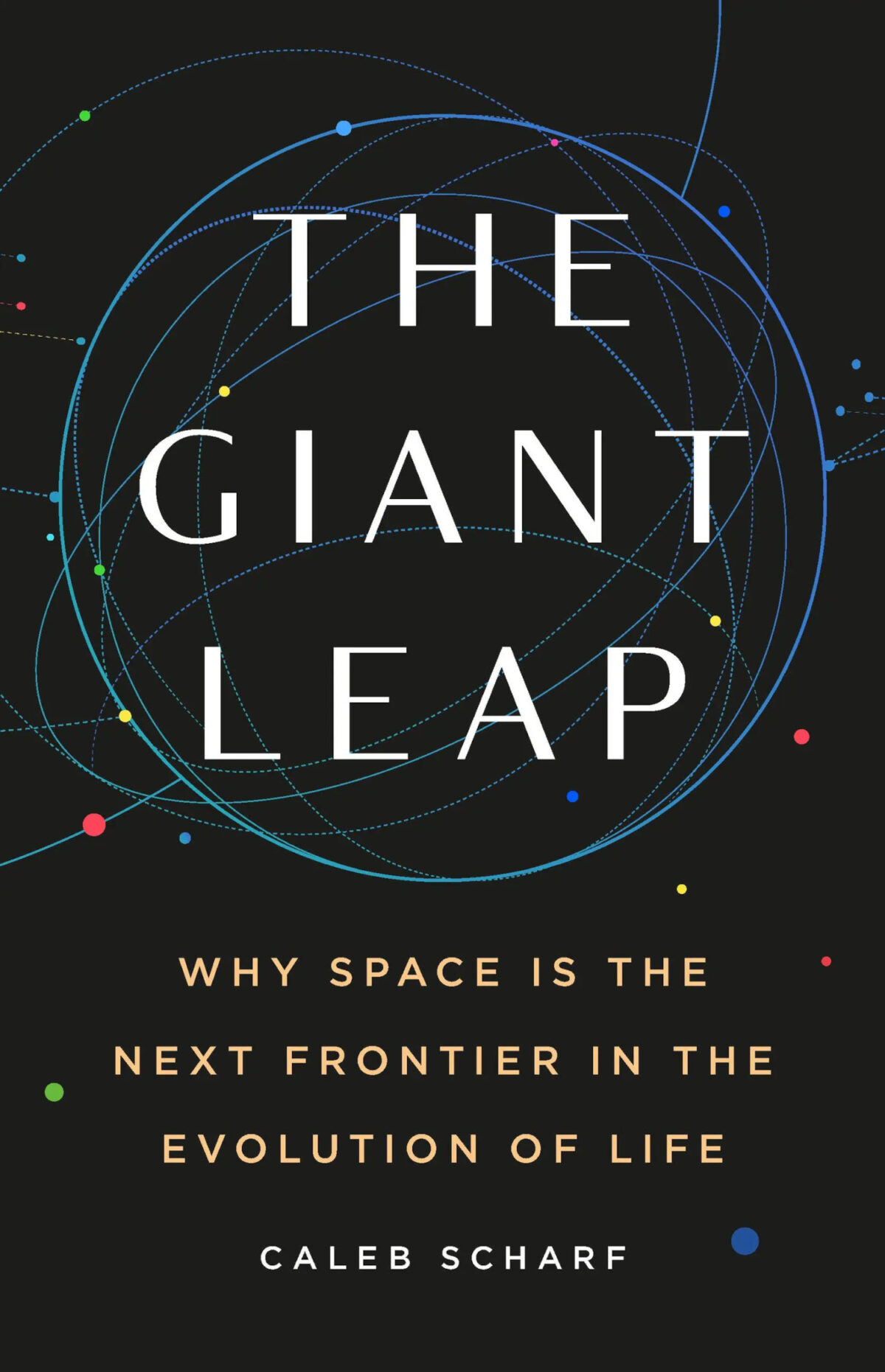
BOOK REVIEW** — ** “The Giant Leap: Why Space Is the Next Frontier in the Evolution of Life,” by Caleb Scharf (Basic Books, 368 pages).
In recounting the steps that have made up the initial stages of this dispersal, Scharf presents an overview of humankind’s journeys into space, both crewed and robotic, through the decades. Though this is well-trod ground, the author finds historical details that will delight even the most well-read space enthusiasts. For example, we learn that the Soviet spacecraft Luna 3, launched in 1959, took photos using film that it processed with an on-board developing system. A primitive digital camera then scanned the negatives and sent the digitized information back to Earth.
While the immediate neighborhood of the Earth and the moon present challenges, they’re nothing compared to what we’ll have to get used to if, one day, we venture to Mars. The data gleaned from a multitude of robotic missions have painted a detailed picture of this distant world. Scharf believes the first thing an astronaut who sets foot on its surface would notice would be the silence. “The most barren wildernesses on the Earth, whether they’re arid and scorching deserts or arctic snowfields, can have moments so quiet that human ears and nerve endings find themselves stunned and in search of something, anything to register,” he writes. “But replace Earth’s atmosphere with one that is a hundred times thinner and made mostly of cold carbon dioxide, and the silence is even more profound. Low-pitched sounds are muffled, and high-pitched sounds are heavily muted for human aural sensitivities.”
Mars, of course, is virtually next door compared to some of the places our robotic craft have ventured. As Scharf reminds us, we now have actual photographs of the surprisingly Earth-like terrain of Saturn’s moon, Titan, thanks to the Cassini mission, including the Huygens probe which descended to the moon’s surface. That’s right: We have detailed photographs of a world that is, on average, some 1.4 billion kilometers (890 million miles) from Earth.
Yet as Scharf details, this stunning achievement almost never happened. Due to a design flaw that went unnoticed, Cassini wasn’t going to be able to decode the radio signals it received from Huygens, which would be Doppler-shifted due to the probe’s acceleration. But scientists found a clever, if low-tech, solution: They delayed the probe’s deployment for a month, thus changing its trajectory and eliminating the Doppler-shift problem.
“Through tens of thousands of rocket launches and clever, complicated machines, the evolutionary path of life on Earth has reached an inflection point and a new trajectory.”
Scharf’s tone is generally upbeat, even on subjects where a cautionary note might seem warranted. Consider the problem of space junk. He describes Kessler Syndrome — the name given to the potentially dangerous repercussions of low-Earth orbit becoming ever more crowded with debris, as satellites and used rocket stages and other detritus collide with one another, creating even more debris. As the amount of orbital junk increases, the danger of further collisions grows by leaps and bounds.
Scharf is well aware of this danger, but he does not see it as insurmountable: Roughly put, the crowding is a close-to-home problem; if we can push the next generation of orbiting objects beyond our local environs, we may be in the clear. He writes: “Outrunning your own filth isn’t always a failure; it’s often the natural way of things. Maybe the Kessler Syndrome will actually encourage us to think bigger.”
And what of the future? Scharf cites the researcher Michael Mautner, who calculated that the resources available in the solar system could support some 6,000 biospheres comparable to that of Earth — in other words, a potential population of around 50 trillion.
That such a plethora of humans will ever materialize is purely speculative, but Scharf is confident that our blue-green planet will one day be remembered as where we came from, rather than where we all live. “Through tens of thousands of rocket launches and clever, complicated machines, the evolutionary path of life on Earth has reached an inflection point and a new trajectory,” he writes. “One possible if not probable form of this trajectory is Dispersal, the true nature of which finally comes into view: a synthesis of space exploration’s history, the architecture of the solar system, and the malleable nature of evolution itself, all projected into the future.”
Support Undark Magazine
Undark is a non-profit, editorially independent magazine covering the complicated and often fractious intersection of science and society. If you would like to help support our journalism, please consider making a donation. All proceeds go directly to Undark’s editorial fund.
This broadly pro-space perspective stands in stark contrast to Adam Becker’s “More Everything Forever,” published earlier this year, which casts humankind’s beyond-Earth ambitions in a skeptical light. Becker, arguing that our one real home is the one we already inhabit, wrote: “Nobody’s going to boldly go anywhere, not to live out their lives and build families and communities — not now, not soon, and maybe not ever.”
In Scharf’s optimism for all things space, some readers may hear echoes of writers of previous generations, like Carl Sagan and Isaac Asimov.
A major theme running through “The Giant Leap” is an analogy between today’s push for the exploration of space and Charles Darwin’s nearly five-year voyage on the HMS Beagle. Each chapter opens with a quotation from Darwin’s “The Voyage of the Beagle” — and some of these are truly wonderful, as when we hear Darwin reflecting on the beauty of the night sky, for example, or pondering what we might observe on the surface of another planet.
Unfortunately, quotations aside, the many references to Darwin and evolution often feel a bit forced. (Does it matter, for example, that the French astronomer Édouard Roche published his work on the tidal effects that planets exert on their moons 11 years before Darwin published “On the Origin of Species?”)
A major theme running through “The Giant Leap” is an analogy between today’s push for the exploration of space and Charles Darwin’s nearly five-year voyage on the HMS Beagle.
And some of the analogies, like this one, feel a bit ponderous: “Just as Darwin and his contemporaries brought about one evolution in thought, the peeling apart of the workings of motion, gravity and energy to find the cosmic in the colloquial was intertwined with great changes in how we thought. The history of space exploration, with its roots in these shifting cognitive frames, was never just a thread of mechanical how to do it; it was a long-germinating agent in the human psyche.”
But there is one way in which the analogy rings true: Darwin’s ideas hinged on the findings of geologists, who showed just how ancient our planet was; this allowed for the unimaginably slow rate at which evolution unfolded, with untold millions of years (in fact billions, as it turned out) passing between the dawn of life and the present day. Scharf, conscious of this vast span of time, very clearly understands that the steps that we and our machines have taken — to orbit, then to the moon, then (via our robots) to Mars and beyond — are mere baby steps.
“It took over two billion years for complex multicellular life to really erupt on the Earth,” he writes. “That’s a long wait time, yet we wouldn’t call life on Earth a failed experiment. Similarly, if it takes four billion years for life to overcome the energetic barrier of gravity in order to begin to insinuate itself beyond one planet, that’s entirely on point.”